The fear that patients will message you nonstop through the portal is not irrational. It’s based on what’s actually happening to a lot of attendings right now.
You’re not being dramatic. You’re seeing the same horror stories everyone whispers about: the inbox that never ends, the unpaid “mini-visits,” the 11 p.m. messages about mild ankle pain, the 14-messages-in-a-row “just one more question” patient. And you’re trying to picture your actual life as an attending in that reality.
Let’s walk straight into the worst-case scenario you’re imagining—and then I’ll tell you honestly where the reality usually lands, what you can control, and what’s actually a sign you should run from a job.
The Nightmare Scenario You’re Afraid Of
You know the story:
You sign your first attending contract. You’re already nervous about RVUs, documentation, productivity metrics, “panel size,” whatever. Then you log in on day one and see the EMR sidebar of doom:
“In Basket: 63 unread patient messages.”
By lunch, it’s 97.
You’re getting:
- “Hey Doc, quick question…” that’s actually 8 screenshots and a full symptom novel
- Refill requests that should have been handled 10 days ago
- Messages at 10:58 p.m. while you’re finally trying to sleep before clinic
And then the real anxiety thought hits: What if this never ends?
What if I leave clinic at 5, and then grind on the portal till 8?
What if every evening, every weekend, every “day off” becomes inbox catch-up?
You picture yourself:
- On your couch, laptop open, partner annoyed you’re “still working”
- On vacation, secretly checking portal “just in case”
- Waking up at 3 a.m. thinking “Did I answer that chest pain message? Did I document that advice?”
You’re not just worried about time. You’re worried about liability too. Like:
- If they message “shortness of breath” and you don’t see it for 24 hours—are you screwed?
- If you answer a complex question in two lines—will that look negligent later?
- If they interpret “monitor at home” as “I was cleared by my doctor,” and something goes wrong, is that on you?
And let’s just say it plainly: you’re scared your life will be hijacked by a bottomless inbox that nobody pays you for and nobody protects you from.
That fear is…reasonable.
But it’s also not the whole story.
How Bad Is It Really? What I’ve Actually Seen
Portal overload is very real—but it’s not uniform. The environment you choose matters more than anyone likes to admit.
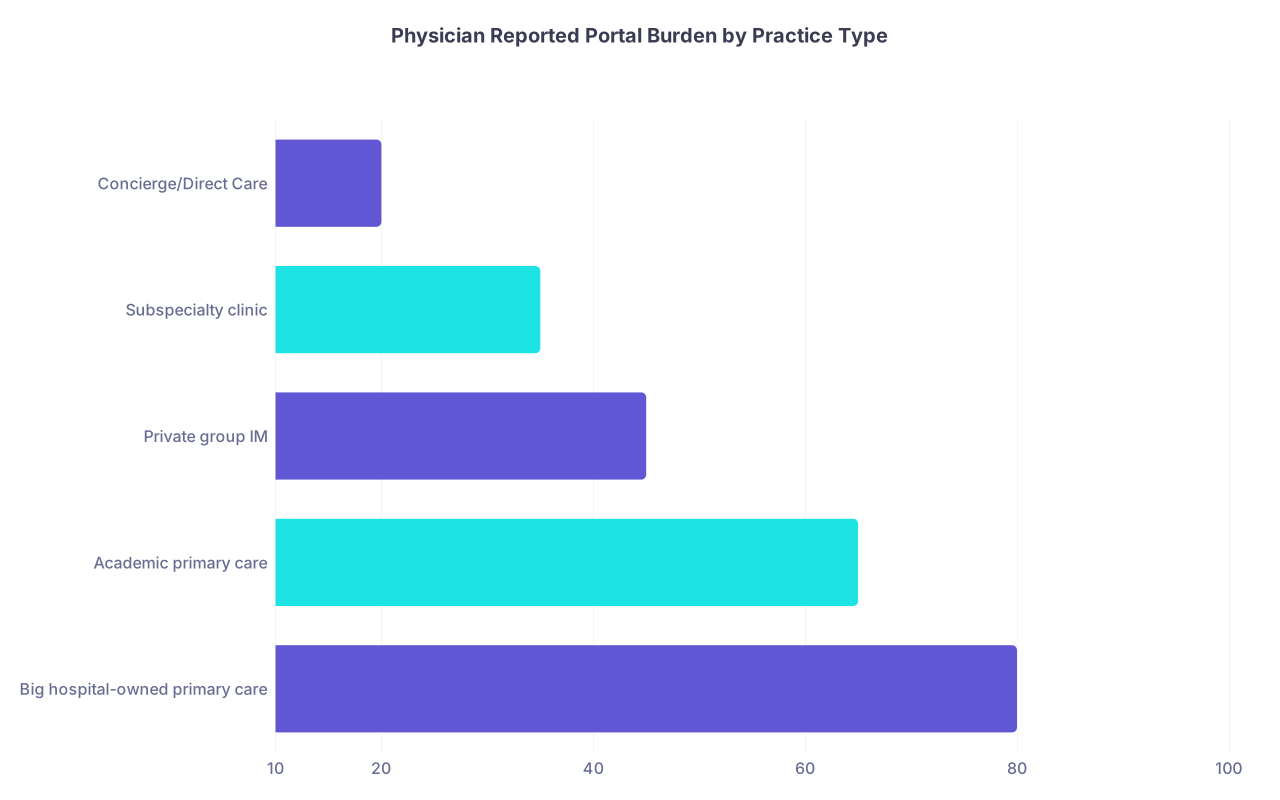
Here’s the unpretty breakdown I’ve seen across friends in primary care, IM, pediatrics, and some specialties:
| Category | Value |
|---|---|
| Big hospital-owned primary care | 80 |
| Academic primary care | 65 |
| Private group IM | 45 |
| Subspecialty clinic | 35 |
| Concierge/Direct Care | 20 |
Think of those numbers as a rough “% of physicians who say their portal is out of control.”
Big hospital-owned primary care is where you hear the true war stories. Large panel sizes, someone turned on “open notes,” administration slapped on a metric like “respond within 24 hours,” the system keeps telling patients “Message your doctor anytime!” with cute buttons and no filters.
Those are the people logging 1–2 extra unpaid hours a day just on portal stuff. Some of them are drowning.
Academic primary care: often better staffing, but “academic” doesn’t mean sane. Sometimes they dump all the pre-visit work and post-visit clean-up into the portal and tell you it’s “innovative care coordination.”
Private groups and subspecialty clinics are all over the place. Some are old-school and barely use the portal. Others weaponize it to push everything onto you. Concierge/direct care? They intentionally cap panel size and build this into the financial structure, so yes, patients message a lot—but you’re paid to handle it and usually have actual breathing room.
So no, the universal “your life will be destroyed by portal messages” narrative isn’t automatically true.
But if you walk blindly into the wrong system? It can be very close.
The key question isn’t “Will patients message me nonstop?”
It’s: “What guardrails exist between me and nonstop messaging?”
Because those are what actually decide your day-to-day reality.
What You Can (And Can’t) Control About Portal Chaos
You can’t control whether a patient messages. You can control:
- The culture you sign into
- Your personal boundaries
- How messages get triaged before they even hit you
- What your contract and clinic policies say
And this is where most new attendings get burned—they assume “everyone’s miserable, that’s just medicine now,” and they stop asking questions before they sign.
Let’s make this concrete.
1. Ask directly about portal expectations before you sign
I’m talking blunt questions, not polite hints. Things like:
- “How many portal messages do your physicians handle per clinic day, on average?”
- “Is there dedicated time blocked in the schedule for inbox management?”
- “Who handles: normal labs, refills, prior auths, forms, simple symptom questions?”
- “Is portal work RVU-generating or otherwise compensated?”
- “Are there expectations about response time? Is that officially written anywhere?”
Watch for red flags in how they answer:
- Vague hand-waving: “Oh, it just kind of works out.” Translation: it doesn’t.
- “We expect you to respond within the same business day” with no protected time.
- “Our MAs can help, but physicians are ultimately responsible for all responses” (and they mean everything gets routed back to you).
If someone says calmly, “We build 1–2 hours of inbox time into the daily schedule, and nurses handle first-pass triage for all non-urgent concerns,” that’s galaxy-brain level green flag.
2. Look at their actual workflow, not the sales pitch
If you get to shadow or do a site visit, pay attention to what people are actually doing between patients.
Are they:
- Clicking into the in-basket every time they leave a room?
- Sighing and saying “I’ll just finish this tonight” at 4:30 p.m.?
- Vaguely laughing about “living in the portal”?
Or do they:
- Have carved-out time on the schedule literally labeled “inbox”
- Offload simple questions to RNs or MAs
- Use structured templates like: “This question is too complex for messaging. Let’s schedule a visit.”
You’re not just interviewing them about salary and RVUs. You’re investigating: What does your portal do to your life?
If you don’t ask, they won’t volunteer it.
Concrete Strategies So the Portal Doesn’t Eat Your Life
You can’t control patient anxiety, or Google, or the “send message” button. But you can set up a system that makes you less of a portal victim.
Here’s what actually works in real clinics.
1. Build ironclad triage rules
If your clinic doesn’t have them, you push for them.
| Message Type | Routed To |
|---|---|
| Refill (stable med) | MA/RN |
| Normal lab result question | MA/RN template |
| New symptom > 1 week | Front desk – visit |
| Complex chronic issue | Front desk – visit |
| Urgent/red-flag symptom | Nurse phone triage |
| Administrative forms | MA – queue system |
This isn’t hypothetical. This is how some sane clinics actually operate.
The MA or RN does the first pass. You only see what requires your brain.
If instead, everything goes straight to “Dr. You” by default, you will be buried. No superhuman time management hack fixes that.
2. Use clear, repeated patient expectations
This part feels annoying, but it works.
You say it in clinic. You put it in your after-visit summary. Your staff reinforces it. Variations of:
- “Portal is great for quick, simple questions. For anything new or complex, we’re going to schedule a visit so I can give it the attention it deserves.”
- “Messages are reviewed during business hours, not 24/7. For anything urgent, please call or go to the ER.”
- “If a question takes more than a few minutes to handle, we’ll usually convert it into a visit, either in-person or virtual.”
Patients don’t magically know that you’re not paid to write them an 8-paragraph consult at 10 p.m. They just see a chat window and think “customer service, but for my body.”
You’re not being mean by redirecting them. You’re practicing actual medicine, not free text-based telepathy.
3. Protect your off-hours like your sanity depends on it (because it does)
The dangerous pattern I keep seeing:
- “I’ll just quickly clear messages after dinner to stay ahead.”
- Suddenly that “quickly” is 90 minutes every night, totally normalized.
If your system has nighttime coverage (some large groups do), use it. If they don’t, then you:
- Do portal during protected blocks in your workday
- Finish the urgent stuff before you leave
- Let non-urgent messages wait until the next business day
And yes, that means tolerating the discomfort of an inbox that’s not at zero. I know. That’s the part that keeps you up at night. “But what if I miss something?”
You build safety into the triage rules and phone system—not into your insomnia.
4. Don’t be afraid to bill for complex portal work (where allowed)
Some systems now allow billing for certain time-based or complexity-based portal encounters. The details depend on location and payer, but the big idea is:
- If it’s equivalent to a visit in time and brainpower, it should be treated as a visit.
That might look like:
- “This is an issue that requires more than I can safely answer by message. I’d like us to schedule a video or in-person visit so we can go through it properly.”
It’s not about nickel-and-diming patients; it’s about not secretly adding a second unpaid job to your evenings.
The main point: if every complex message turns into a full free evaluation, your portal will own you. If complex turns into scheduled, bounded encounters, you have a chance.
How to Use Portal Policies to Judge a Job Offer
Here’s where your anxiety is actually a superpower: it’ll make you notice the stuff other people ignore.
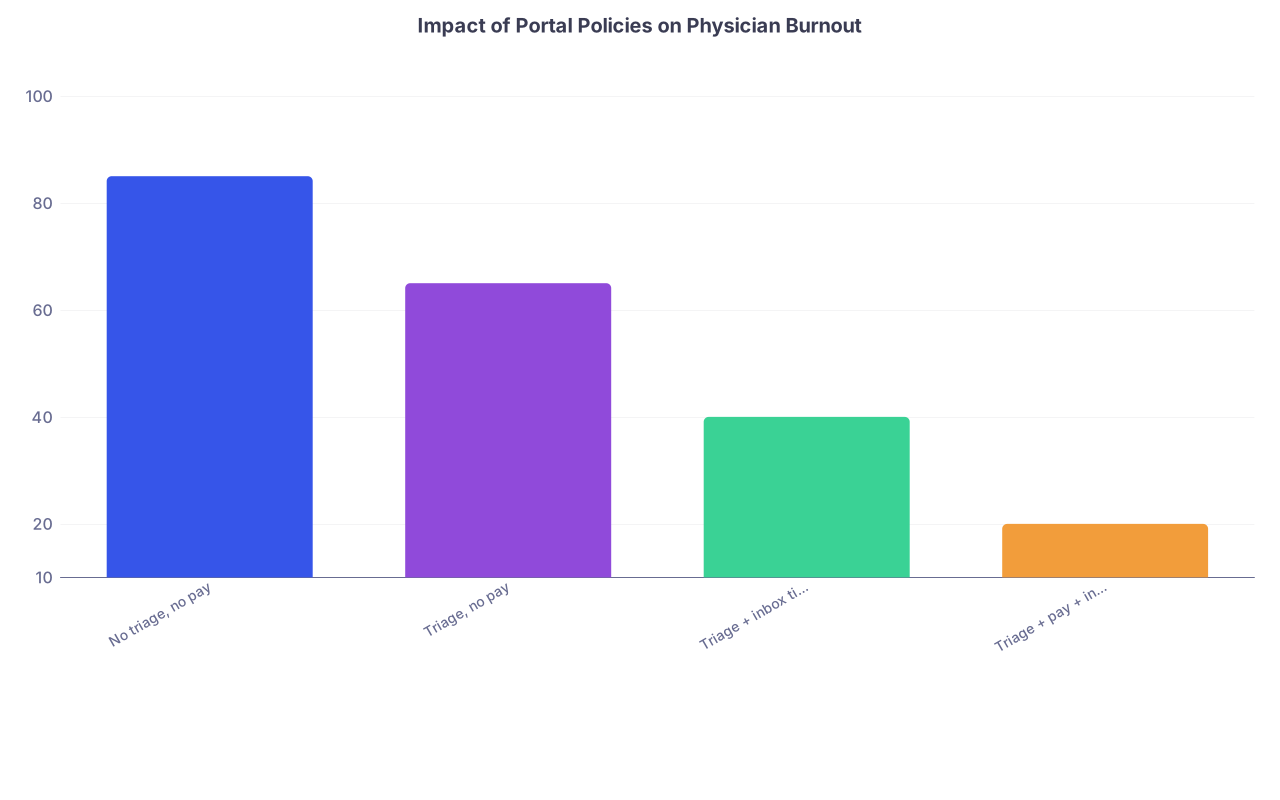
When you’re comparing offers, stop just looking at salary, signing bonus, and location. Ask how they’ve structured the digital side of practice.
| Category | Value |
|---|---|
| No triage, no pay | 85 |
| Triage, no pay | 65 |
| Triage + inbox time | 40 |
| Triage + pay + inbox time | 20 |
That “burnout” number is exactly what it looks like: proportion of docs who say their job feels unsustainable.
If a group has:
- No triage
- No protected time
- No billing or credit for portal work
you are signing up to be the default 24/7 advice machine. Even if they say “most doctors answer within 24 hours,” what that really means is “we’ve normalized everyone working after hours so the metrics look good.”
On the other hand, if a group:
- Has RN triage and strict rules for what reaches you
- Blocks out real inbox time
- Supports turning complex messages into visits
you’re still going to be busy, yes, but you’re far less likely to be sitting on your couch at 10:30 p.m. typing into the void.
The Liability Fear You’re Secretly Carrying
There’s one more quiet fear here: “If it’s this easy to message me, am I legally on the hook for everything I didn’t answer fast enough?”
This one is tricky, because risk is never zero. But the things that protect you are boring and unsexy:
- Clear auto-messages: “Messages are not monitored 24/7. For urgent issues, call 911 or go to the ER.”
- Documentation showing you gave proper instructions and risk warnings.
- Consistent triage protocols (e.g., anything with chest pain routed by nurse protocol, not handled as casual chat).
What increases your risk is trying to play superhero in the portal with vague, informal reassurance at weird hours. The more you turn complex, high-risk issues into quick back-and-forth text, the more exposure you create.
You lower your risk when you’re okay saying:
“This is too serious or unclear for messaging. You need to be seen.”
That sentence feels cold when you’re anxious and want to “help.” But it’s actually safer—for you and them.
You’re Not Wrong To Be Worried
This isn’t one of those times where your anxiety is just catastrophizing nothing. The portal really can mutate into an endless treadmill that eats evenings, weekends, and your brain.
But it is not purely random.
Three core things decide whether you get crushed:
- The system you choose: triage rules, staff support, protected time, payment structure.
- The boundaries you enforce: what you answer, what you convert to visits, what you allow to bleed into your nights.
- The expectations you set: for patients, staff, and yourself.
If you treat portal overload like some unavoidable curse of modern medicine, you’ll walk right into a bad setup and call it “normal.”
If you treat it like a negotiable part of your job—something you can question, measure, and say no to—you actually give yourself a shot at a sustainable career.
You don’t have to love patient portals. You just have to stop pretending they’re a minor detail.
They’re not. They’re a second job. So make damn sure you’re not signing up to do that job alone, unpaid, and around the clock.