
It’s 8:47 p.m. You left clinic at 5:30. You’ve eaten something vaguely resembling dinner, your scrubs are in a pile on the chair, and you’re hunched over your laptop doing “just a few more charts.” Your non‑med friends think you work 8–5. You know the truth: your real work starts when the door to clinic closes.
And now you’re staring down your first attending job thinking:
If I can’t keep up as a resident, what’s going to happen when I’m the attending and all the liability is mine?
Let’s talk about that. Honestly. Not the brochure version.
How Bad Is After‑Hours Charting Really After Residency?
There’s a lie people tell you in training: “It gets better after residency.”
Sometimes that’s true. Sometimes it just…changes shape.
The honest version is more like: it can get better, the same, or worse depending on:
- Your specialty
- The practice model (hospital‑employed, private, academic, FQHC, etc.)
- How aggressively your employer schedules you
- How firm your personal boundaries are (or aren’t)
So what are you realistically looking at as a new attending?
| Job Type | Typical Extra Charting Time/Day |
|---|---|
| Outpatient Primary Care | 1–3 hours |
| Outpatient Specialty | 0.5–2 hours |
| Hospitalist | 0.5–1.5 hours |
| ED | 0–1 hour |
| Surgical Subspecialty | 0.5–2 hours |
Yes, there are unicorns who do zero after‑hours charting. They either:
- Have super efficient workflows + aggressive boundary setting
- Have genuinely well‑designed schedules and support
- Or they’re lying and “don’t count” the hour they always stay after
For most new attendings, the default is: you’ll still chart at home, at least at first. The question isn’t “Will I?” — it’s “How much, and for how long?”
Why Residency Trains You to Be Terrified of Charting
You’re not crazy for being scared. Residency basically hard‑wires you to associate documentation with:
- Shame (“Why isn’t your note done yet?”)
- Fear (“If it’s not documented, it didn’t happen — malpractice!”)
- Unending backlog (the list never hits zero, and if it does, it’s for 11 minutes)
- Tech frustration (three clicks to open the chart, two to sign your own name)
The part nobody says out loud: you build your identity in residency around surviving overwhelm, not around working at a sustainable pace. So when you imagine being an attending, your brain just scales up the same chaos and adds “I’m now fully liable.”
So you picture:
- Dozens of unsigned notes
- 50+ unchecked inbox messages each morning
- Angry admin emails about quality metrics
- Patients sending MyChart novels at 10 p.m.
- You, at 11:30 p.m., still clicking “smart phrases” that somehow aren’t smart
You’re not picturing a manageable day with a few leftover notes. Your brain is picturing drowning.
The truth sits somewhere in the middle. It can be soul‑sucking. It also can be brought under control faster than residency ever allowed.
What Changes After Residency (For Better and Worse)
Some things really do improve. Others…not so much.
The good news
You finally have:
More control over how you work.
No senior yelling if you step out to finish notes between patients. You can restructure your own flow.Fewer random fires.
No codes at 3 a.m. during your “charting hour.” Fewer people pulling you away every five seconds.Stable systems.
Same clinic, same nurses, same workflows. That alone boosts efficiency like crazy over 6–12 months.Money to buy back time.
You can pay for help. Scribes. Extra childcare. Better laptop. Faster internet. All things you couldn’t as a resident.
And you slowly stop doing that resident thing where you type a novel in every note “just in case.” You realize nobody reads 75% of that, and you get more comfortable with focused documentation.
The bad news
The flip side:
You’re the final sign‑off.
No attending above you to close charts. It’s your name. Your responsibility. Your guilt when you’re behind.The EMR inbox is now a hydra.
Refill requests, patient messages, result notifications, quality reminders, pharmacy clarifications. It never. Stops.Productivity pressure gets real.
RVUs. wRVUs. Quality bonuses. “Your panel could handle 3 more patients per session…” Sure it could.No one protects your time for you.
In training, at least theoretically, someone is supposed to safeguard education. As an attending, the system assumes you’ll just…figure it out. Translation: if you don’t set boundaries, no one will.
So if your main fear is: “Will after‑hours charting completely own my life as an attending?”
The boring, true answer: it will if you let things just happen to you, the way they have in residency.
Where Technology Actually Helps (And Where It’s Overhyped)
You’ve probably heard someone from admin say something like:
“Don’t worry, we’re rolling out new EMR tools / AI documentation / templates. It’ll save you HOURS!”
Sure. Sometimes. But there’s a gap between the sales pitch and what it feels like at 8 p.m. when your eyes burn.
Let me break it down without the marketing gloss.
Things that genuinely help
Scribes (human or virtual)
When done right, this is the single biggest charting time‑saver.
You walk in, talk to the patient like a human, and someone else types 80–90% of the note. You review, tweak, sign. Done.Caveats:
- You still have to make sure it’s accurate.
- They’re only as good as your instructions. Most new attendings under‑direct at first.
- If you don’t get dedicated scribes (or you’re forced to share in a chaotic way), the benefit drops fast.
Smart phrases / templates that YOU actually designed
The canned ones? Usually bloated garbage.
The ones you build around how you actually practice? Those are gold.Example: a focused “normal” exam template where you only edit the 2–3 abnormal things, plus a handful of diagnosis‑specific snippets you use constantly (DM2 f/u, HTN visit, depression check).
AI‑assisted note drafting from visit audio
This is newer, but when it’s implemented properly, it really can cut down your typing. You talk; it drafts; you edit.
It won’t magically erase charting, but it does turn “blank page terror” into “quick edit mode.”Inbox triage rules + team workflows
Having MAs or RNs filter, answer simple messages, process refills based on clear protocols—this is quietly life‑saving.
You shouldn’t be answering “Can I take Tylenol with this?” at 9:30 p.m.
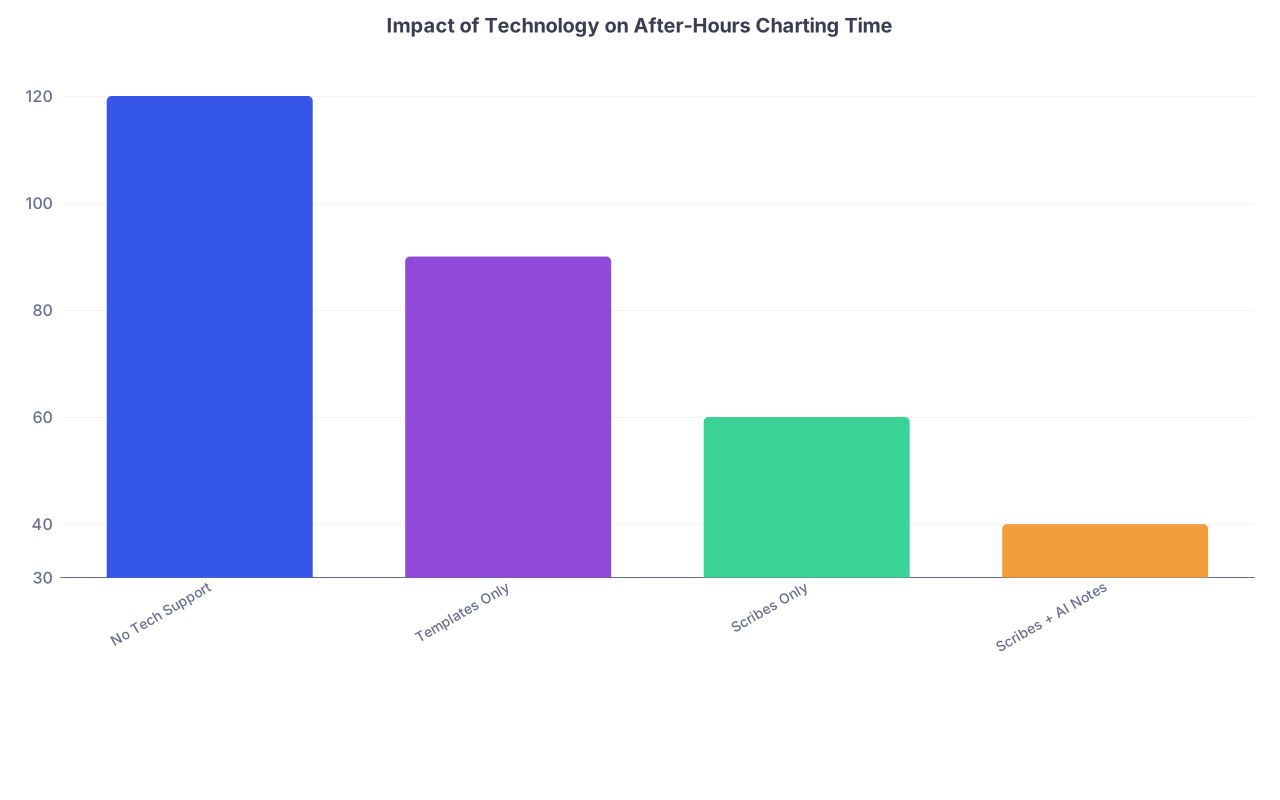
| Category | Value |
|---|---|
| No Tech Support | 120 |
| Templates Only | 90 |
| Scribes Only | 60 |
| Scribes + AI Notes | 40 |
(Values approximate minutes per day of after‑hours charting for a busy outpatient doc.)
Things that are mostly hype (at least initially)
“Our EMR is very intuitive.”
No it’s not. It’s slightly less awful than the other one.“This new feature will reduce clicks.”
Sometimes it just moves the clicks around.“Just use more macros!”
If they aren’t well‑designed, you’ll spend more time fixing them than you saved.
Your goal isn’t to chase every shiny tech solution. Your goal is to ruthlessly adopt the few things that actually get you out of your chair sooner.
What a Realistic Day Looks Like If You’re…Not a Unicorn
Let’s do a concrete example. Outpatient internal med, first year out, hospital‑employed clinic, 20–22 patients/day.
Here’s a realistic (not ideal) timeline for many new attendings once they’ve been in the job ~6 months and somewhat found their footing:

| Step | Description |
|---|---|
| Step 1 | 7 30 Arrive |
| Step 2 | 8 00 First patient |
| Step 3 | 8 00-12 00 See patients |
| Step 4 | 12 00-12 30 Quick lunch and chart |
| Step 5 | 12 30-5 00 Afternoon patients |
| Step 6 | 5 00-6 00 Finish in-office charts |
| Step 7 | 6 00 Leave clinic |
| Step 8 | 8 00-9 00 Home charting inbox |
So you’re looking at maybe 1–3 hours/day of documentation/inbox outside “face‑to‑face” time, split between staying late and working at home.
That can shrink over time as you:
- Get faster with your templates
- Stop over‑documenting
- Automate or delegate more inbox tasks
- Learn what admin actually cares about and ignore the noise
But it rarely drops to zero in a standard high‑volume clinic. If a recruiter tells you “Our doctors don’t do any work from home,” hear: “We either massively undercount it or we schedule 10 patients/day.”
How to Avoid Getting Trapped in a Nightmare Job
This is where your fear is actually useful. Because once you’re terrified of after‑hours charting, you start asking the right questions before signing a contract.
When you interview, you don’t just ask vague stuff like “How’s work‑life balance?” You ask questions that force them to show their hand. For example:
- “On average, how long do your new attendings spend charting after they leave clinic, in their first year?”
- “How many patients per half‑day? Are there blocked admin sessions?”
- “Who handles inbox messages? What’s delegated to RNs/MAs?”
- “Do physicians get scribes or AI note tools? Is that guaranteed or ‘maybe in the future’?”
- “What’s the average time to close a note in this group? Are people struggling?”
Watch their faces when you ask this. If they dance around or give slippery non‑answers, that’s a sign.

You’re not being “difficult.” You’re doing the thing everyone wishes they’d done before they woke up three months into a job with 150 open encounters.
The Mental Side: Guilt, Perfectionism, And That Constant “I’m Behind” Feeling
Here’s the part that doesn’t get fixed by tech or scheduling alone: your brain.
Residency trains you to feel like:
- If your note isn’t detailed enough, you’re unsafe
- If inbox messages sit longer than 30 minutes, you’re “neglecting” care
- If you go home with open charts, you’re failing
So you overcompensate. You write everything. You respond immediately. You can’t let stuff wait.
As an attending, that mindset is gasoline on the after‑hours fire.
Some hard truths:
- You will have some open notes at the end of the day.
- Some messages can absolutely wait 24–48 hours without harming anyone.
- A tight, focused note is safer and more defensible than a bloated wall of text nobody can parse.
You’ll need to unlearn a lot of residency panic. And yeah, that takes time. You’ll have nights where you do extra charting not because you technically have to, but because your anxiety can’t tolerate leaving it.
That slowly improves as you:
- See that nothing explodes if a non‑urgent thing waits till morning
- Get more malpractice‑savvy and realize “document everything” doesn’t mean “type every thought”
- Watch more senior attendings model “good enough and done”
What “Better” Actually Looks Like 1–3 Years Out
I’ve watched this pattern over and over:
Year 1: You’re slow, overly detailed, terrified of missing something. After‑hours charting is rough.
Year 2: You’ve refined templates, trimmed your notes, pushed for help (scribes, RN protocols). Still busy, but more predictable.
Year 3: You know what matters. You batch things. You say “no” to stupid add‑ons. After‑hours charting exists but doesn’t own your life.
Here’s how that can look for, say, outpatient primary care:
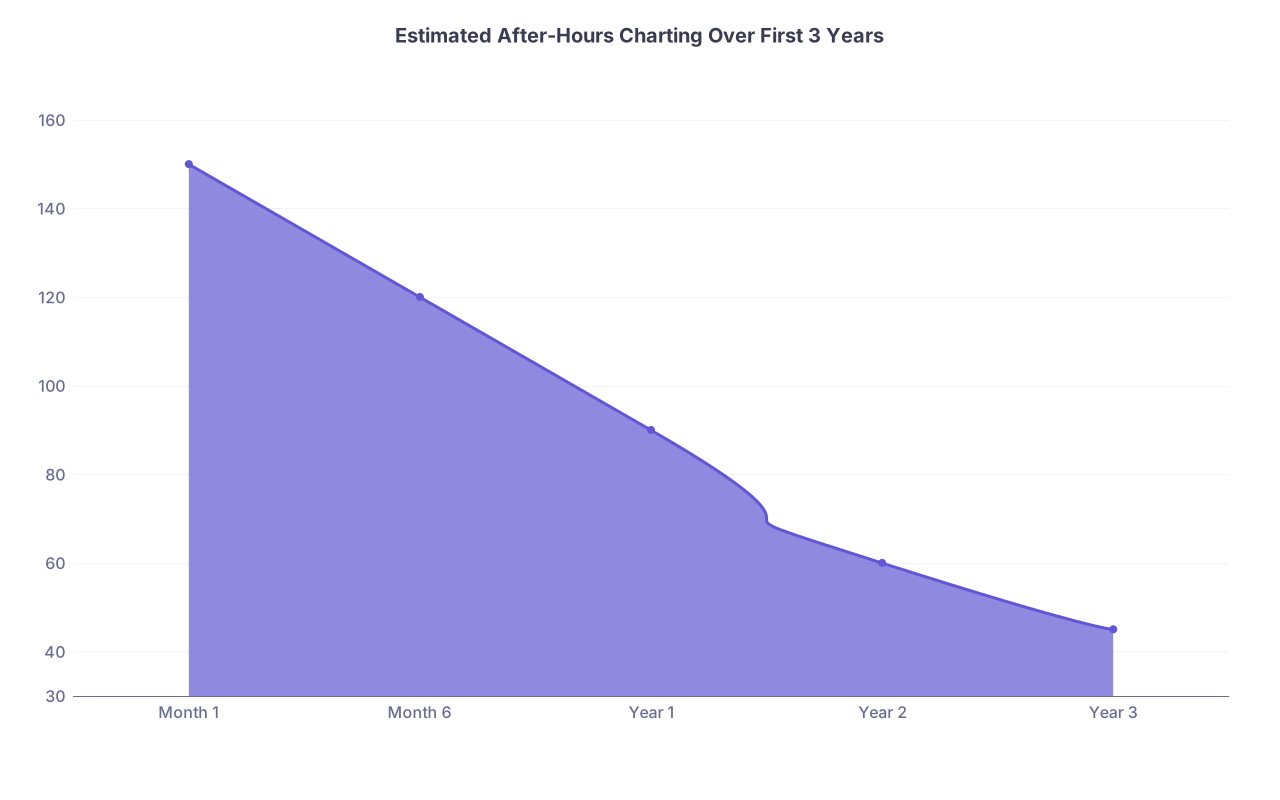
| Category | Value |
|---|---|
| Month 1 | 150 |
| Month 6 | 120 |
| Year 1 | 90 |
| Year 2 | 60 |
| Year 3 | 45 |
Those are minutes per day. Not fantasy numbers. I’ve seen busy docs actually get there once they stop acting like residents in disguise.
The key is that it doesn’t magically trend down on its own. The ones who “grow out of it” are the ones who:
- Aggressively tweak their workflow
- Push back when admin tries to cram more in without support
- Use technology strategically instead of drowning in every new feature
- Let go of the guilt‑driven perfectionism
Quick Reality Check: You’re Not Broken For Struggling With This
If you’re reading this already exhausted and you haven’t even started your first job, that doesn’t mean you’re not cut out for medicine. It means the system you trained in is absurd and your reaction is normal.
You’re allowed to care about:
- Being home for dinner
- Not carrying a laptop on every vacation “just in case”
- Having evenings that don’t end in EMR eye‑burn
You’re not lazy for wanting that. You’re sane.

You’ll probably have months (especially early on) where it feels like charting is still swallowing you. But that doesn’t mean it will always be that way. You’re not locked into “resident mode” forever.
FAQ (Exactly 5 Questions)
1. Is it realistic to expect no after‑hours charting as a new attending?
For almost all high‑volume outpatient jobs? No. That’s fantasy. You can absolutely aim to keep it under an hour most days and chip away at it with better workflows and tech, but going from resident chaos to zero home work right away is rare. If a job promises that with 20+ patients per day and no scribes, be suspicious.
2. Should I avoid outpatient medicine if I hate charting?
Not automatically. Outpatient does have some of the worst inbox + note burden, but it also has some of the best opportunities for tech solutions (scribes, AI notes, templates) and workflow redesign. What you should avoid is any outpatient job that refuses to talk concretely about volume, support, and documentation expectations. The specialty matters less than the specific practice setup.
3. Are AI documentation tools actually safe to rely on?
They’re tools, not magic. They can massively cut your typing and help structure notes, but you’re still responsible for making sure the content matches what actually happened. Think of them like a very fast, slightly clueless intern: helpful, but you can’t sign without reading. Used that way, they’re safe and can be a real lifeline for charting time.
4. How long does it usually take new attendings to feel “in control” of their charting?
Most people I’ve seen start to feel less panicked and more in control somewhere between 6–12 months in their first stable job. You’ll recognize it when you realize your backlog isn’t haunting you on your day off and you’re not automatically opening the EMR every night. Total mastery takes longer, but the shift from “drowning” to “treading water confidently” happens within that first year for many.
5. If I’m already burned out by charting as a resident, should I delay starting an attending job?
Delaying just pushes the problem down the road. What actually helps is being picky about your first job, asking brutal questions about workflow, and planning from day one to use the tech and support available to you. If you’re severely burned out, you might need a short reset (vacation, lighter locums) before a permanent job, but you don’t need to “fix” yourself before you can handle attending‑level charting. You need a sane environment and permission to practice differently than you did as a resident.
Key points:
- After‑hours charting doesn’t magically disappear after residency, but it can become manageable with the right job, tech tools, and boundaries.
- Your residency‑trained guilt and perfectionism are half the battle; you’ll have to unlearn some of that to get your evenings back.
- The fear you feel right now is actually useful if it pushes you to ask hard questions, choose your first job carefully, and refuse to treat “constant charting” as just the price of being a doctor.