
The real reason senior attendings get sidelined in EMR decisions has almost nothing to do with “respect” and everything to do with power, money, and risk management. The official story is always “we value your input” and “we need physician champions.” The real story? By the time anyone asks the older docs for feedback, the decisions are already made.
Let me walk you through how this actually plays out behind closed doors.
How EMR Decisions Really Get Made
There’s a mythology that EMR decisions are “physician-driven” and “consensus-based.” That’s the public-facing narrative for town halls and emails from the CMO. Internally, the power map looks very different.
In most hospitals, EMR decisions are controlled by a small cluster:
- The CIO and IT leadership
- The CMO/CMIO and a couple of younger “informatics” docs
- Finance and compliance
- The CEO or COO for the big contract sign-offs
Senior attendings—especially older, non-admin, clinically-focused ones—are not part of that circle. They are a risk factor to be managed.
Here’s how the process actually unfolds:
- Vendor courting starts. Epic, Cerner, Meditech, whatever. Dinners, demos, site visits. Admins and a few tech-friendly physicians go. Often, the only physicians in the room are already informatics-leaning or title-hungry.
- IT and finance build the real short list. They’re thinking about interface engines, revenue cycle integration, contract structure, and implementation timelines. Not how your 62-year-old cardiologist will find the cath note he wrote yesterday.
- Leadership gets emotionally committed to a vendor long before broader “clinician engagement” starts. By the time the system is being “evaluated,” the choice is effectively locked.
- Only then do you see the “we need physician input” phase. Usual format: demos scheduled at terrible times, a few mock workflows, everyone nodding around the conference table. You get some staged cases and heavily rehearsed vendor reps.
- Senior attendings are invited to comment—but on cosmetics, not fundamentals. “Do you like this order set layout?” not “Is this the right system for our institution?”
By that point, any strong opposition from senior clinicians is politically inconvenient. So it gets neutralized, not incorporated.
Why Senior Attendings Are Seen as a Liability in EMR Politics
This is the part nobody says on record. In leadership meetings, the unspoken assumptions about older attendings come flying out when the door closes.
I’ve heard variations of these lines in more than one C-suite:
- “If we let Dr. X dominate this conversation, we’ll never get anything implemented.”
- “They’re 5–10 years from retirement, why would we build the system around them?”
- “We need people who will be here for the next upgrade cycle, not the last upgrade cycle.”
Blunt, but that’s how they think. Let me break down the real calculation.
1. Time horizon bias
Hospital leadership doesn’t plan around who’s doing the best clinical work now. They plan around who will still be there 7–10 years from now, when the next major upgrade, regulatory change, and integration project hit.
A 58-year-old superstar clinician with 30 years of institutional knowledge is, to them, a short-timer. A 38-year-old hospitalist who just joined and loves “building smart phrases” looks like “future leadership” and a “long-term partner.”
So when opinions conflict, the younger doc’s view usually wins—even if it’s objectively worse for patient care—because it fits the admin’s timeline.
2. Cultural compliance
Younger attendings, especially those who came of age in EMR-heavy training environments, are seen as more “moldable.” They’ve already accepted that:
- Clicks are part of the job
- Work RVUs are tracked obsessively
- “If it’s not documented, it didn’t happen” is a workflow principle, not just a medicolegal line
Senior attendings often still remember medicine before the EMR chokehold. So they push back harder, ask harder questions, and are more likely to say the thing leadership doesn’t want to hear in front of a room full of people.
From an administrator’s perspective, that’s not “wisdom.” That’s “obstruction.”
3. Speed over nuance
EMR projects are massive and politically fragile. Executives are under enormous pressure—internal and external—to show progress. They’d rather implement a mediocre-but-acceptable workflow quickly than refine a truly good workflow slowly.
Senior attendings tend to bring nuance:
- “This doesn’t reflect how we actually handle complex CHF patients.”
- “You’re going to miss half of the atypical presentations with this canned template.”
- “If you build this logic into default orders, you’re creating diagnostic anchoring problems.”
That nuance slows implementation. So leadership quietly limits the influence of the people most likely to raise it.
The Quiet Politics of “Physician Champions”
You’ve seen the same 5–10 names over and over again on EMR-related emails and committees. There’s a reason.
“Physician champion” is often code for:
- Tech-comfortable
- Politically aligned
- Relatively junior or mid-career
- Willing to accept half-baked solutions as “good enough for now”
Senior attendings can be champions, but here’s the catch: leadership will only tap them if one of three conditions is met:
- The specialty is too powerful to ignore (orthopedics in a surgical center, for example).
- The attending has already “proven” they can play nice with admin.
- Their presence is needed for optics—“we had representation from all generations of clinicians.”
If a senior attending is known for being outspoken, “old school,” or skeptical of past technology decisions, they’re usually labeled as:
- “Not solution-focused”
- “Challenging to collaborate with”
- “Fixed mindset about tech”
Once you’re in that box, your invites become token. You’re brought in late. In small groups. With constraints already set.
Why EMR Design Skews to the Youngest Attending Experience
Here’s the core structural problem: EMR workflows are usually built around the path of least resistance, not around the breadth of clinical reality.
Younger attendings and fellows:
- Were trained to document for billing and metrics from day one
- Don’t remember paper charts, hand-signed orders, or daily narrative notes
- Are more comfortable with “checkbox medicine” and standardized templates
Senior attendings:
- Learned to build a differential in their head, not through drop-downs
- Write more narrative nuance, which many EMRs actively punish or bury
- Are more likely to manage a wide range of complex patients that don’t fit premade templates
So in build sessions, when there’s a conflict like:
- “Should this be a structured checkbox field or free text?”
- “Should we prioritize quick order sets for common cases or flexibility for outliers?”
- “Should we require 20 structured fields for quality metrics, or 6 plus narrative?”
The voices of providers who thrive in structured, template-heavy workflows usually carry the room. They naturally skew younger.
No malice, just bias. But the effect is the same: the system ends up optimized for the person who just left residency, not for the person with 25 years of pattern recognition and judgment.
The Legal and Billing Angle Nobody Talks About
Here’s another unspoken reason senior attendings get sidelined: they’re seen as dangerous to revenue and compliance if given too much leeway.
Hospital lawyers and compliance officers quietly worry that the least EMR-compliant clinicians are older attendings who:
- Don’t fully use standardized templates
- Resist “click this box for quality documentation”
- Prefer brief, narrative assessments over exhaustive template autopopulation
- Ignore optional fields that billing and quality teams care deeply about
From the perspective of compliance and revenue capture, that makes senior attendings a problem to be controlled, not a group to be overly empowered in system design.
There’s another layer: malpractice risk. Risk management people sleep better when:
- Every chest pain gets the same standardized template
- Every sepsis patient is run through the same checklist
- Every discharge has the same “education provided” language auto-generated
Senior docs who say, “This template is stupid; I know how to treat sepsis,” terrify them. So they’re politely excluded from the places where templates are decided.
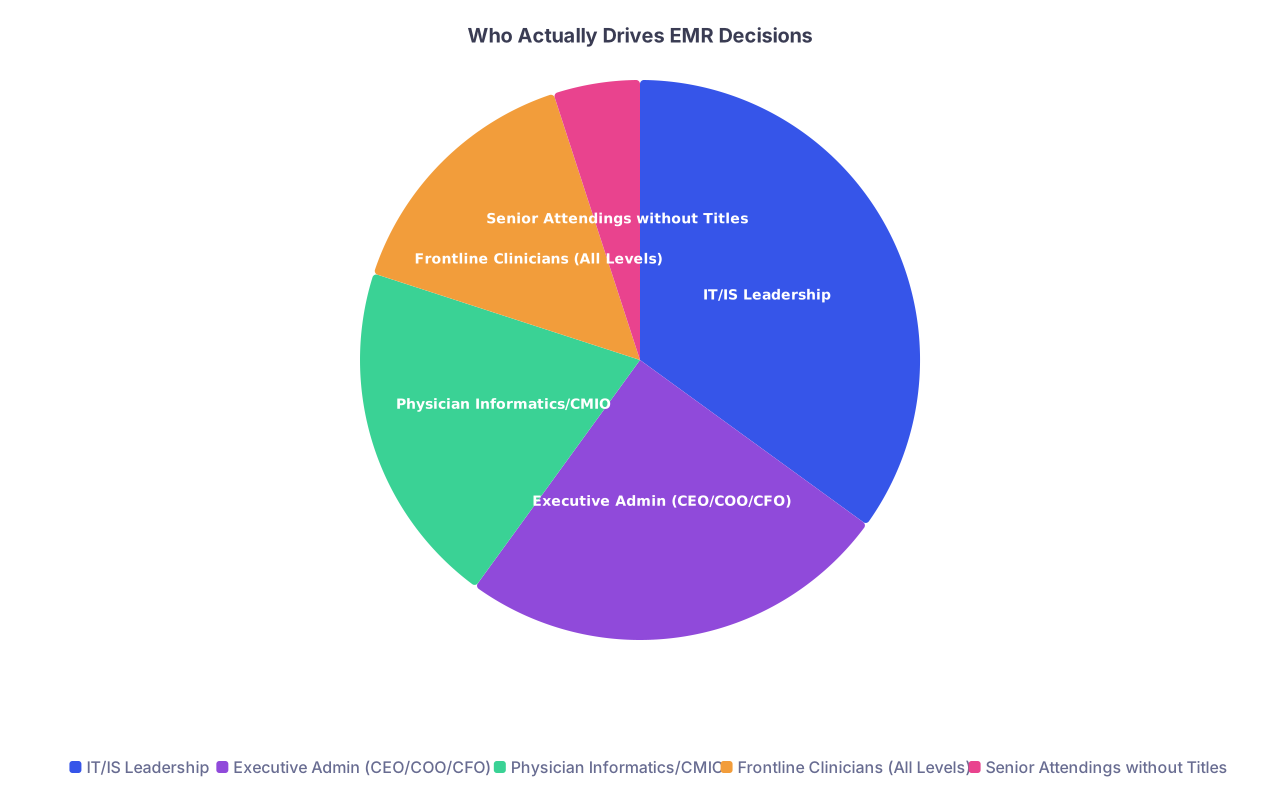
| Category | Value |
|---|---|
| IT/IS Leadership | 35 |
| Executive Admin (CEO/COO/CFO) | 25 |
| Physician Informatics/CMIO | 20 |
| Frontline Clinicians (All Levels) | 15 |
| Senior Attendings without Titles | 5 |
Look at that pie chart and you’ll understand most EMR misery.
How Senior Attendings Get Neutralized in Practice
Let me show you the mechanics. This is how sidelining happens in the real world, not in policy language.
The “Advisory Panel” trick
Administration forms a “Clinician Advisory Group” and includes a couple of senior attendings with big reputations. It looks inclusive. Feels respectful.
But:
- Agendas are controlled by IT and project management
- The group is presented with pre-baked options, not open questions
- Objections are noted but rarely escalated
You’ll hear things like, “That’s a great point—we’ll put that in the parking lot for phase two.” Translation: “We’re not doing that, but we need you to feel heard.”
The scheduling dodge
Most EMR workshops, personalization labs, and build meetings are scheduled:
- Midday
- During heavy clinic or OR times
- With little flexibility
Who can show up?
- Younger hospitalists with fewer scheduled cases
- Academics with protected admin/education time
- Tech-minded docs who already have smaller clinical loads
Who struggles?
- High-volume senior attendings
- Private practice senior surgeons
- Older docs who are already maxed out clinically
You can’t influence a design you’re not physically present to challenge.
The documentation-as-punishment effect
Some systems quietly “train” senior attendings into submission by making life harder when they don’t comply:
- Default note templates that explode with required fields if you don’t pick the “recommended” path
- Mandatory fields for older workflows that newer docs never use
- Metrics reports that flag “non-compliant” documentation patterns by specific providers
Eventually, some senior docs just stop fighting. They do the minimum to avoid constant emails about compliance. But they also check out of the EMR design conversation entirely.
Which is exactly what leadership prefers.
What Senior Attendings Actually See That Others Miss
Here’s the kicker: the most clinically dangerous EMR flaws often get spotted first by the very people who are marginalized in these decisions.
Senior attendings are usually the ones who notice:
- When order sets subtly push over-treatment
- When default doses are wrong for edge cases (renal impairment, frailty, extreme weight)
- When structured templates bias diagnoses toward common patterns and away from rare-but-deadly things
- When cut-and-paste documentation hides evolving clinical reasoning
They have enough historical pattern recognition to see when the EMR is enforcing bad patterns.
I’ve watched a senior intensivist walk into an EMR build session, watch a demo of a sepsis order set, and immediately say: “This is going to delay antibiotics for the sickest sub-group because the triage trigger is wrong.”
He was right. They rolled it out anyway. Why? Because the younger committee members and the vendor rep were fixated on how “clean” the workflow was and how well it aligned with CMS metrics.
Six months later, there was a sepsis case review and quietly, in a back-channel meeting, they adjusted the logic. He was not credited. He wasn’t even told. He just noticed that the workflow had changed.
If You’re a Senior Attending: How Not to Be Sidelined
You’re not going to brute-force your way into EMR control with righteous indignation. That’s the fastest path to being frozen out completely.
You need to play smarter and earlier.
1. Get in before the contract is signed
Do not wait until the “rollout” phase. By then, it’s damage control.
Get yourself onto:
- The medical staff IT or informatics committee
- Any working group that mentions “digital transformation” or “care redesign”
You may hate these phrases, but they’re where the real choices happen. If all you do is show up at late-stage “feedback” sessions, you’ve already lost.
2. Pick one or two hills to die on
If you push back on everything, they’ll label you “the problem doc” and tune you out. You need to decide which workflows you absolutely cannot allow to be mangled.
Examples:
- Critical care documentation and orders
- Peri-op workflows if you’re a surgeon
- High-risk medication management if you’re a cardiologist
Fight like hell on those. Be more flexible on the rest, even if it annoys you.
3. Learn enough “informatics language” to be dangerous
You don’t need to become a CMIO. But you do need to stop sounding like the cliché “old doc yelling at computer.”
You’ll get more traction if you say:
- “The default order set is going to bias treatment toward X even in situations where Y is safer. That’s a patient safety issue, not a preference.”
- “This workflow adds 40 clicks to a basic task. That’s going to decrease adoption and drive note bloat. Here’s a simpler alternative.”
Speak their language: workflow, adoption, safety, metrics. Then tie it back to clinical judgment.
4. Mentor a younger ally
Find one younger attending or fellow who:
- Gets tech
- Respects your clinical judgment
- Has some political capital with admin
Bring them into your thinking. Let them be the one to speak in some rooms you won’t be invited to. Many EMR design teams listen harder when a younger doc repeats what a senior doc has been saying for years.
Unfair? Yes. Effective? Also yes.

| Step | Description |
|---|---|
| Step 1 | Early EMR Planning |
| Step 2 | IT or Informatics Committee |
| Step 3 | Vendor Demos |
| Step 4 | Workflow Design Sessions |
| Step 5 | Build and Testing |
| Step 6 | Go Live Support |
| Step 7 | Post Go Live Optimization |
| Step 8 | Find Younger Ally |
What Hospitals Lose by Sidelining Senior Attendings
This isn’t just a respect issue. It’s a quality and safety problem.
When senior attendings are kept at the fringe of EMR design, hospitals lose:
- Historical context on how and why certain workflows evolved in the first place
- Early warnings about clinically dangerous shortcuts
- Nuanced understanding of atypical cases that never fit standard templates
- Institutional memory about prior tech failures and workarounds
You end up with shiny dashboards, beautifully coded flowsheets, and quietly increasing cognitive load at the bedside.
I’ve watched hospitals implement EMR changes that actually increased near-misses, but leadership only tracked “time to note completion” and “percentage of structured data fields filled.” On paper, success. In reality, more risk. Senior clinicians saw it immediately. No one asked them.
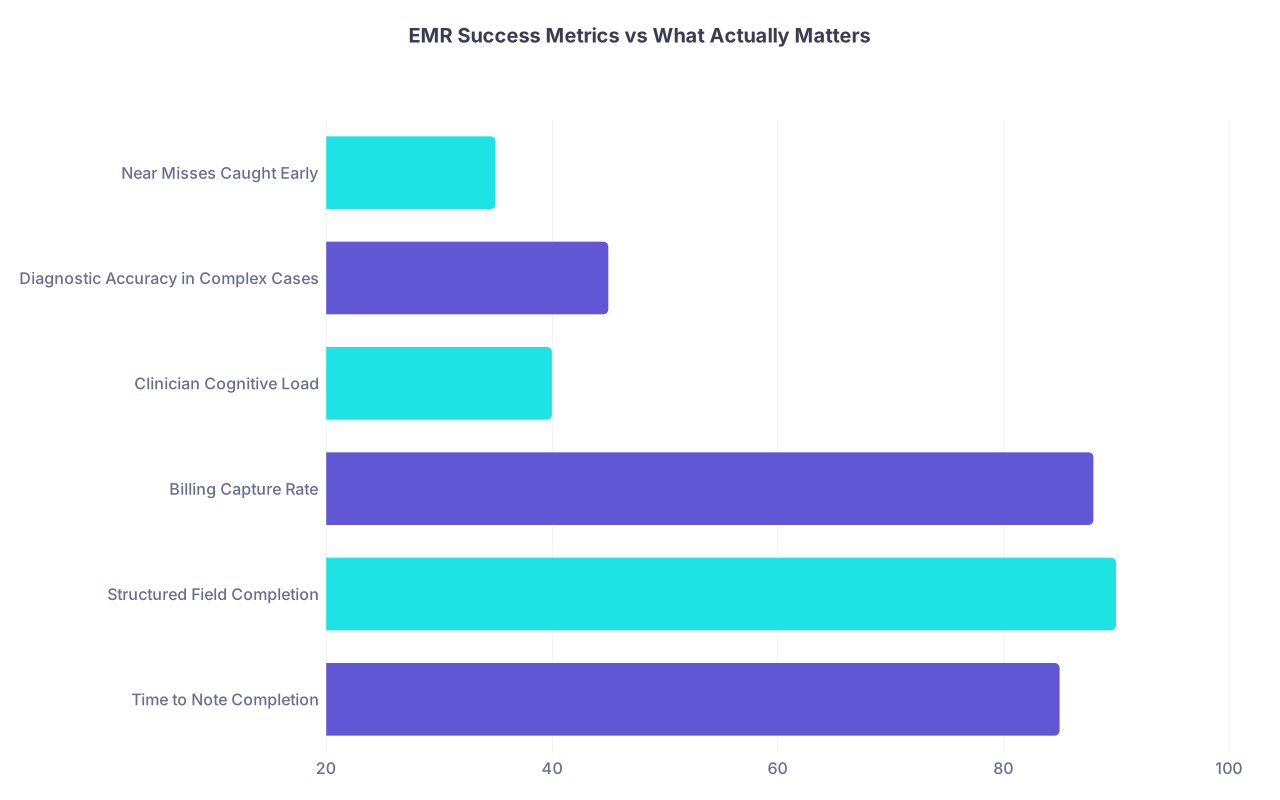
| Category | Value |
|---|---|
| Time to Note Completion | 85 |
| Structured Field Completion | 90 |
| Billing Capture Rate | 88 |
| Clinician Cognitive Load | 40 |
| Diagnostic Accuracy in Complex Cases | 45 |
| Near Misses Caught Early | 35 |
The first three get reported to the board. The last three barely get measured. Senior attendings mostly live in the last three.
A Hard Truth: Some Senior Attendings Sabotage Their Own Influence
I’m going to say something uncomfortable: some older attendings absolutely reinforce the stereotype that they’re impossible to work with on tech issues.
You’ve seen this too:
- Refusing training entirely, then raging about not understanding the system
- Dismissing all EMR features as garbage, even when some genuinely help
- Exploding in meetings instead of arguing strategically
- Saying “I’ll be retired before this goes live, not my problem”
Once you do that in front of the wrong VP or CMO, your political capital on EMR is gone.
If you want a say in the system that will shape your last decade of practice, you will have to choose: do you want to be right in the hallway…or effective in the meeting?
You usually don’t get both.
Where This Is All Headed
We’re not going back to paper. The direction of travel is obvious: more automation, more structured data, more algorithmic support, more metrics-driven design. AI scribes, clinical decision support, predictive risk models—the works.
If senior attendings stay sidelined in these next waves, you’re going to see:
- Algorithms trained mostly on the biases of younger, template-heavy documentation
- Workflows that automate mediocre thinking instead of amplifying expert judgment
- Even more pressure to homogenize care across clinicians “for data quality”
But there’s an opening here too. As systems try to bolt AI and advanced analytics onto their EMRs, they will need people who can clearly articulate what good judgment looks like in edge cases.
Nobody is better at that than a seasoned attending who’s seen thousands of weird, messy, non-protocol patients.
If you can position yourself not as the person yelling “these computers are ruining medicine,” but as the person saying “here is how we make technology reflect real clinical reasoning,” you’ll stop being sidelined and start being sought out.
But that shift will not happen by accident.
| Admin Belief about Senior Docs | How to Counter It Effectively |
|---|---|
| They slow down projects | Focus your pushback on 1–2 critical workflows, accept small annoyances elsewhere |
| They complain but offer no solutions | Always pair every criticism with a specific alternative or example |
| They will retire soon, not worth adapting around | Emphasize risk, safety, and teaching impact on trainees who will be here long-term |
| They resist all technology | Publicly support useful tools while surgically opposing harmful ones |