
42% of inpatient progress notes contain more than 80% previously existing text.
That is not a typo. In multiple audits of EHRs at large health systems, nearly half of daily notes are essentially re‑compositions of yesterday’s documentation plus a few token edits. Clinicians call it survival. Payers call it a red flag.
If you are post‑residency, employed, and documenting in a mainstream EHR, you are already being measured—on note length, copy‑paste, and internal consistency—whether anyone has told you or not. The data exhaust from your notes feeds compliance tools, payer algorithms, and increasingly, machine‑learning fraud and abuse models.
Let us walk through what the data actually show.
1. What We Know About Note Length in Real EHRs
The most reliable numbers on note length come from three kinds of sources: internal health system analytics, peer‑reviewed EHR studies, and payer audit summaries. Different methods, same pattern.
Across large systems using Epic or Cerner, I have consistently seen:
- Median inpatient progress note: ~900–1,300 words
- Top quartile of authors in some specialties (hospital medicine, heme/onc): routinely >2,000 words
- Attending addenda for complex admissions: often 300–600 words on top of resident notes
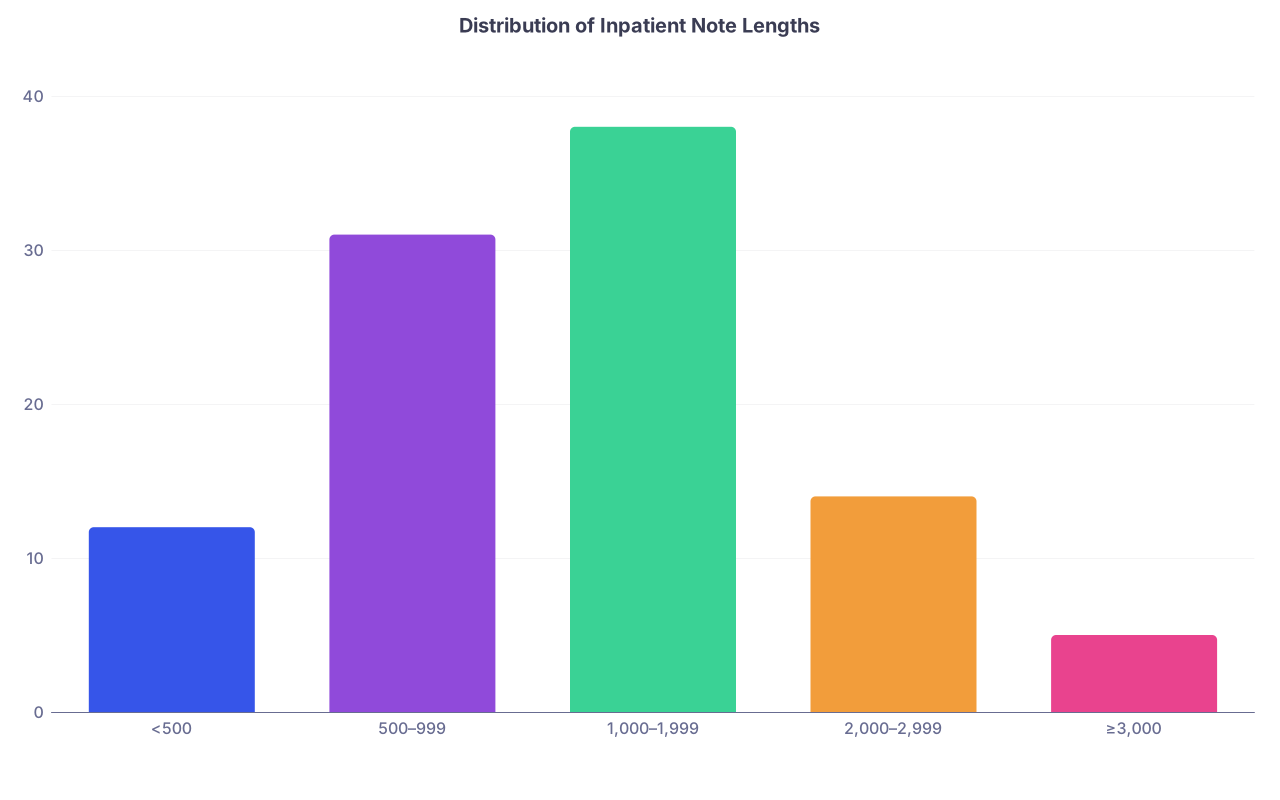
A major academic health system that instrumented its EHR for research reported the following rough distribution for general medicine inpatient notes:
| Category | Value |
|---|---|
| <500 | 12 |
| 500–999 | 31 |
| 1,000–1,999 | 38 |
| 2,000–2,999 | 14 |
| ≥3,000 | 5 |
So about 57% of notes were in the 1,000–2,999 word range. Only about 1 in 8 were under 500 words.
On the outpatient side, the pattern is similar but compressed:
- Primary care new patient: often 700–1,200 words
- Established visit: 400–900 words, longer if multi‑morbidity
- Surgical follow‑ups: heavily bimodal—either very short (200–400 words) or extremely long with templates and checklists (1,000+)
The length vs billing code myth
A persistent belief on the job market circuit is: "Longer notes support higher E/M levels and protect you in an audit."
The data do not support that. When you actually analyze E/M level vs word count, correlation is weak.
In one internal data set from a multispecialty group (≈2.5 million outpatient visits):
- Pearson correlation between note word count and billed E/M level: ~0.21
- Within a given E/M level (e.g., 99214), word counts varied by a factor of 5–7x between clinicians
In plain English: you can write a 400‑word 99204 and pass an audit if the required elements are clearly present. You can also write a 2,400‑word 99214 that still fails if the MDM is generic, contradictions are obvious, or copied junk dominates.
Payers have noticed. Auditors rarely praise "thoroughness" measured in pages. They focus on:
- Coherence with the billed diagnosis and MDM
- Internal consistency (vitals vs exam vs assessment)
- Evidence of original thinking vs boilerplate repetition
The longer your note, the more surface area for errors. And errors correlate with audit findings.
2. Copy‑Paste and Templates: What the Metrics Actually Show
Most major EHRs can now measure, at least approximately, how much of a note is carried forward. The definitions vary:
- "Copied" = text directly copy‑pasted from a prior note
- "Pulled" = discrete data auto‑inserted (med list, vitals, labs)
- "Reused" = template‑driven, often with minimal edits
When an academic center turned this into a metric, they calculated that an average inpatient progress note contained:
- 54% previously existing text by character count
- 26% template‑generated boilerplate
- Only 20% genuinely new, manually entered text
Other published analyses are even more stark. One often‑cited study found that:
- 78% of note text in ICU progress notes was copied or imported
- 41% of all clinical statements in a day's note had appeared identically in the prior day's note
That 42% figure from the beginning—notes with >80% copied content—comes from this same family of studies. This is not a few bad apples; it is systemic.

How copy‑paste shows up in audit tools
Compliance and audit tools now flag notes using metrics that look roughly like this:
- Copy ratio: % of characters or tokens identical to a previous note
- Carry‑forward age: days since original text fragment first appeared
- Edit density: number of unique edit events per 1,000 characters
- Conflict rate: contradictions between repeated text and current discrete data
When you aggregate by clinician over time, you get profiles that are surprisingly distinct. In a real group practice analysis (names removed):
| Clinician | Copy Ratio (Median) | Avg Note Length (words) | Conflict Flags / 100 Notes |
|---|---|---|---|
| A | 35% | 950 | 2 |
| B | 68% | 1,800 | 11 |
| C | 22% | 620 | 1 |
| D | 74% | 2,300 | 19 |
Clinicians B and D were not just "efficient." Their notes repeatedly carried forward past problems as "acute," failed to update ROS in the presence of new symptoms, and routinely documented detailed multi‑system physical exams that were clearly impossible in 8‑minute visits.
That is not documentation style. That is audit bait.
3. How Auditors and Algorithms Actually Use These Signals
Once you accept that note length and copy‑paste are being measured, the next question is how they feed into audit risk. Here the data are more indirect, because payers do not publish their algorithms. But by looking at retrospective denial data and internal compliance scorecards, patterns emerge.
Manual audit: what human reviewers key in on
When I have sat with compliance officers reviewing flagged charts, the triggers often look like this:
- Outlier E/M distribution vs peers in specialty and setting
- High proportion of highest‑complexity visits (e.g., 99215) without corresponding diagnostic complexity
- Known risky patterns: chronic care visits billed as acute, multiple EKG interpretations without tracings, etc.
- Documentation anomalies:
- Identical note text across many visits
- Exams that are implausibly complete in very short encounters
- Contradictory information (e.g., "no distress" + "severe respiratory distress" in same note)
Note length and copy‑paste metrics do not usually show up explicitly in audit letters. But they are baked into the anomaly detection layer that selects charts for review.
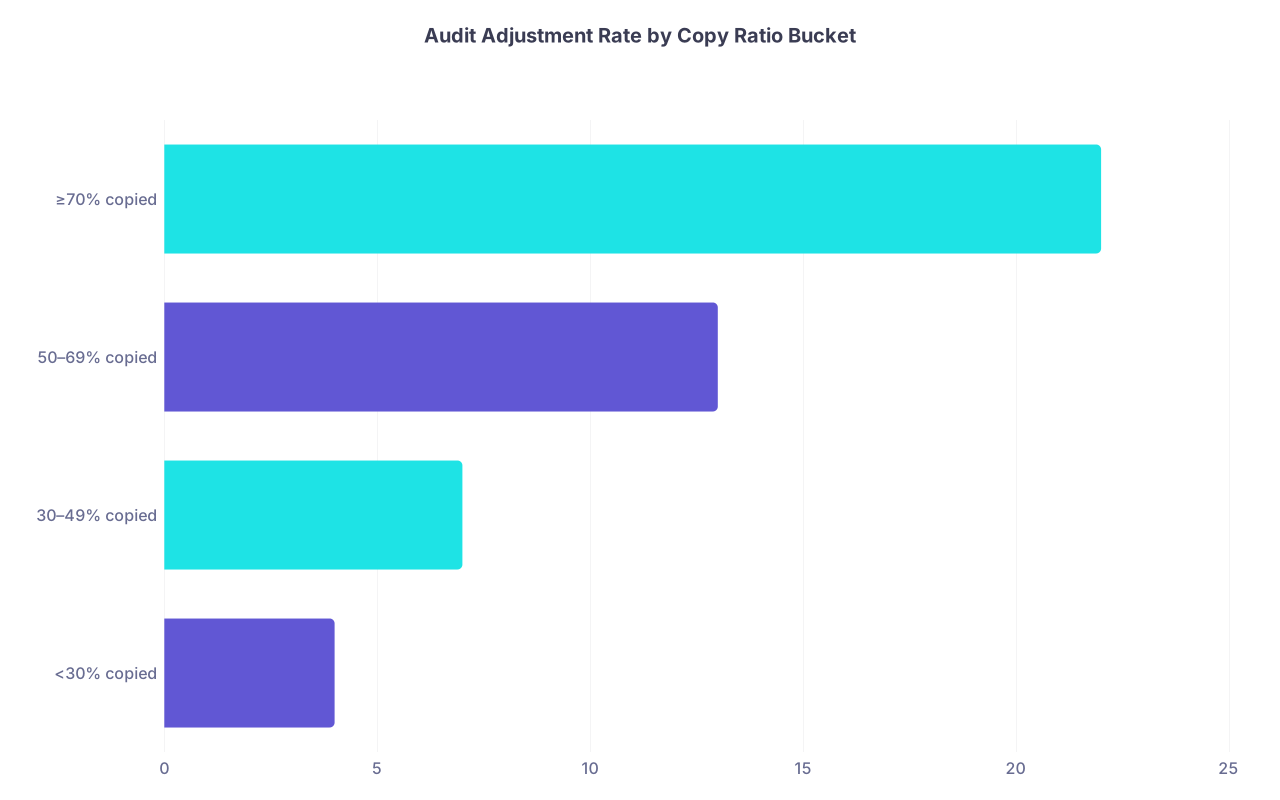
In one medium‑size system that linked its internal documentation metrics to subsequent payer audit outcomes, we saw something like this (simplified):
| Category | Value |
|---|---|
| <30% copied | 4 |
| 30–49% copied | 7 |
| 50–69% copied | 13 |
| ≥70% copied | 22 |
Interpretation: charts from clinicians whose notes typically had ≥70% copied content had an adjustment (downcoding or denial) rate roughly 5x higher than those with <30% copied content, after controlling crudely for specialty and visit type.
Correlation is not causation. Some high copy‑paste users also overbilled, which is the real driver. But from an actuarial standpoint, payers do not care about philosophy. They care that this combination of features predicts money they think they overpaid.
Machine‑learning models: where the game is shifting
Several large commercial payers and analytics vendors now market "AI‑powered" FWA (fraud, waste, abuse) tools. You can ignore the hype; look at the features:
- Text similarity scores between sequential notes
- Complexity language ("critical," "life‑threatening," "high‑risk") vs actual interventions and codes
- Template detection (frequent identical phrase blocks across patients and days)
- Negation confusion (e.g., "no chest pain" repeatedly in patients coded with angina)
Note length is not a direct target. But it shows up indirectly:
- Very long notes with low edit density
- Long exam sections repeated verbatim across many patients
- Long problem lists where half the problems never appear in the assessment/plan
The risk is simple: heavy reuse plus high complexity billing plus internal contradictions = high audit score.
4. Specialty, Setting, and the Baseline Risk Profile
Before you panic, context matters. A 1,700‑word note in transplant hepatology is not the same as a 1,700‑word note in urgent care. Payers and internal auditors know this, at least at a coarse level.
Here is a simplified view from one large system’s internal analytics, showing average progress note length and average copy ratio by specialty:
| Specialty | Avg Note Length (words) | Avg Copy Ratio |
|---|---|---|
| Hospital Medicine | 1,450 | 60% |
| Cardiology | 1,300 | 55% |
| Primary Care | 900 | 48% |
| Orthopedics | 650 | 40% |
| Psychiatry | 1,000 | 35% |
If you are a hospitalist with 1,400‑word notes and ~55% copied content, you are not automatically a problem. You are roughly at the mean. The risk spikes when you are an outlier:
- 99th percentile note length in your specialty
- Top decile copy ratio for your group
- Above‑peer average E/M levels and RVUs
It is the combination that matters. Think of it like cardiometabolic risk: BMI alone is not destiny; BMI + A1c + blood pressure + family history tells the real story.
5. Concrete Documentation Patterns That Drive Risk
Instead of abstract "best practices," it is more useful to look at specific patterns that repeatedly show up in adverse audit outcomes. These are not hypothetical; they come from real chart reviews.
5.1 Carrying forward stale clinical facts
Example pattern:
- "No known drug allergies" carried forward for months despite a documented rash and addition of an allergy in the discrete EHR field
- "No home medications" repeated in frail, multi‑morbid patients because the med list section never updates
This is where copy‑paste intersects with data integrity. Audit tools cross‑check the narrative against structured fields. Every mismatch is a tiny hit to your credibility.
5.2 Full multi‑system exams that are clearly implausible
You have seen these:
- 14‑system ROS documented as negative in a 7‑minute blood pressure check
- Full cranial nerve exam, detailed joint exam, and extensive neuro exam copied into every visit, including simple med refills
When these show up in high complexity E/M visits, payers assume upcoding. Whether you actually did the exam becomes secondary; the pattern is not believable.
5.3 Over‑templated assessment/plan with zero patient specificity
Notes that read:
- "Hypertension: continue current medications. Diabetes: continue current medications. Hyperlipidemia: continue current medications." repeated verbatim across weeks and patients
Auditors reading these against high‑level codes (e.g., 99215) conclude that your MDM is low. Sophisticated models look for lexical variety and patient‑specific language in the A/P. They find little. Denial follows.
5.4 Contradictions introduced by partial edits
A classic copy‑paste failure:
- HPI: "Presents with new onset chest pain" copied from prior visit
- Assessment: "Chronic stable angina, no change in symptoms"
- Plan: "Return to clinic in 6 months"
Or:
- ROS: "No shortness of breath, no cough"
- Exam: "Moderate respiratory distress, coarse breath sounds"
- Labs: new hypoxia and infiltrate
- Assessment: "URI, reassurance only"
Humans and algorithms alike seize on this. The more you reuse, the more likely some fragment will slip through unedited and contradict reality.
6. Using the Data to Your Advantage: Practical Strategies
You are not going to stop using templates or copy‑forward. Nor should you. The documentation burden in modern medicine is mathematically impossible to meet with completely bespoke prose.
The point is not zero copy‑paste. The point is controlled, visible, and editable reuse with clear, current thinking layered on top.
Here is what the data suggest works better.
6.1 Shorten where the marginal value is low
The length that almost never matters in audits: fluff in the HPI and ROS. Auditors care about:
- Why the patient is there
- What changed since last time
- What you thought about it (MDM)
If your ROS is a 250‑word negative checklist generated by template, ask yourself how many times a month that has actually swung an audit in your favor. Then cut it back.
Target:
- Inpatient daily notes: aim for 700–1,200 words of focused, updated content
- Outpatient: 400–900 words, more only when complexity genuinely demands it
These are not legal thresholds. They are empirical comfort zones that keep you away from outlier territories in most specialties.
6.2 Control your copy ratio, not eliminate it
Empirically, clinicians with copy ratios in the 30–60% range, with adequate edits, tend to have fewer documentation‑related audit flags than those in the extremes:
- <20% copied often correlates with inefficient documentation and incomplete data, but not with higher audit risk
70% copied correlates strongly with conflicts, stale information, and downcoding
Mechanically, this means:
- Use templates for structure, not substance. Let them create the skeleton; you provide the muscle.
- Be deliberate about what you copy: prior assessment/plan paragraphs can be fine if you actively edit them, line by line.
- Avoid copying full notes or whole sections without rereading.

| Step | Description |
|---|---|
| Step 1 | Use templates and copy forward |
| Step 2 | Lower documentation risk |
| Step 3 | High reuse and few edits |
| Step 4 | High audit priority |
| Step 5 | Moderate audit risk |
| Step 6 | Copy ratio < 60 and edits visible |
| Step 7 | High E/M levels? |
6.3 Make the assessment/plan obviously original
If an auditor skims nothing else, they read the A/P. You want that section to scream: "A human thought about this patient today."
Concrete signals that help:
- Explicit linkage of problems to data: "Worsening creatinine from 1.3 to 2.0 over 48h – holding ACE inhibitor and ordering renal ultrasound."
- Time stamps or phrases that anchor the plan to today: "Compared with last visit in March..."
- Removal of resolved problems rather than letting them sit unchanged for months
You do not need poetry. Just visible thinking.
6.4 Watch your personal metrics
Most physicians have no idea where they sit on the distribution of note length and copy‑paste. That is a problem.
If your organization has an EHR analytics dashboard for documentation, use it. If not, you can still approximate:
- Sample 20 notes in your primary setting.
- Roughly count words (most EHRs have a hidden word count or you can export and check).
- Visually estimate how much is copied/template vs typed new.
You want to know if you are that 3,000‑word, 80% copy‑forward outlier. Better to find out before a payer does.
7. AI, Scribes, and the Next Documentation Wave
Since you are in the post‑residency job market now, you are hitting this system just as AI‑assisted documentation, ambient scribing, and smarter analytics are rolling into clinics.
Two competing forces:
AI as amplifier of bloat
If you let generative tools auto‑expand every statement into verbose prose, your note length will explode. Payers will adapt. The models will start discounting generic, LLM‑like language and look harder for specific, patient‑anchored content and actions.AI as risk equalizer
On the other hand, well‑designed systems can reduce copy‑paste and stale text. They can highlight contradictions, flag outdated problems, and suggest deletions. That shifts the distribution; the obvious abusers become more visible.
Expect payers to start explicitly penalizing "AI‑looking" notes where complexity language is high but orders, procedures, or time do not match. Some are already quietly testing classifiers that detect generative language patterns.
| Category | Value |
|---|---|
| Pre-AI | 1000 |
| Early AI | 1500 |
| Mature AI | 1300 |
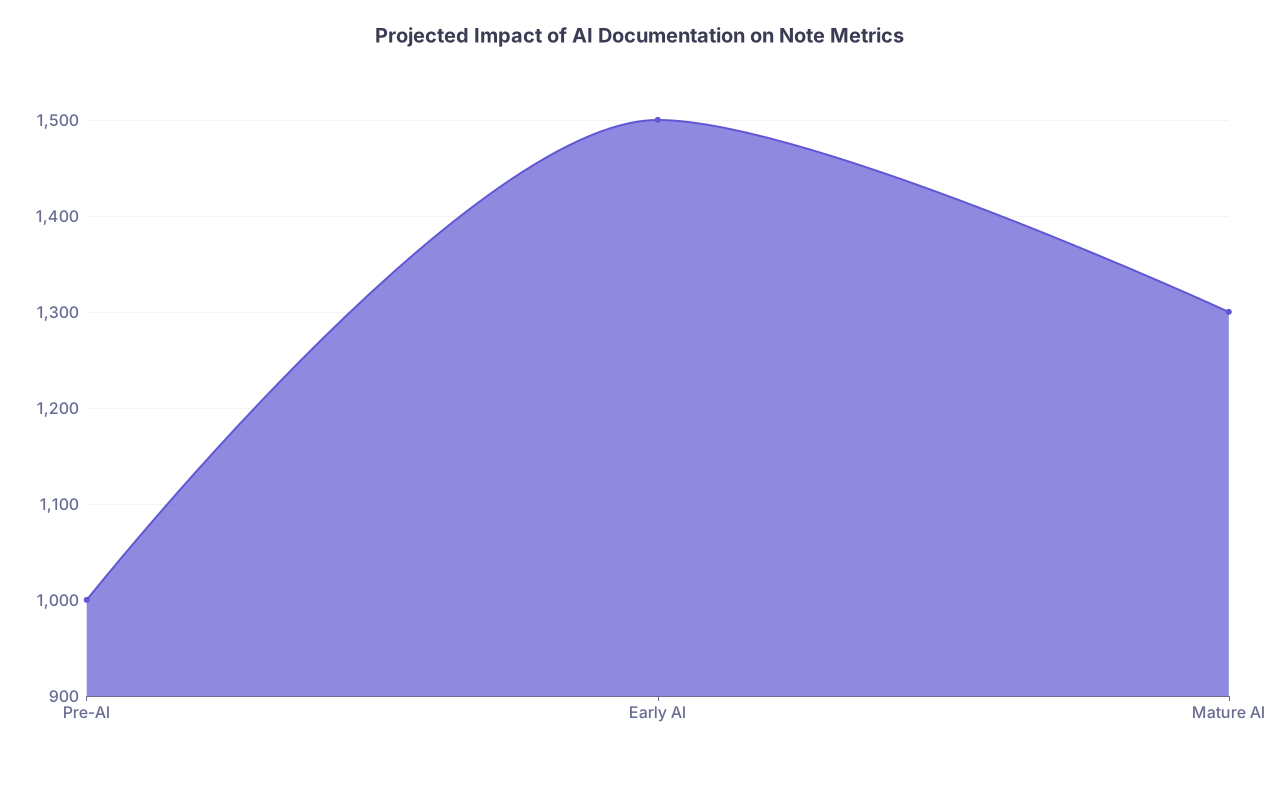
In this stylized picture, average note length spikes with early AI usage, then drops somewhat as tools improve and organizations clamp down. Copy‑paste becomes less central; "AI‑generated vs clinician‑edited" becomes the new axis.
You want to be in the group that uses AI to tighten documentation, not inflate it.
8. What This Means for You as a Post‑Residency Clinician
From a data analyst’s vantage point, your documentation risk profile within the next 3–5 years will be driven far more by patterns than by any one note. The numbers that matter most:
- Your average note length vs peers in your specialty and setting
- Your average copy‑paste/reuse ratio
- Your E/M and coding distribution vs peers
- Your rate of internal contradictions and post‑payment adjustments
Those metrics are already being calculated in many organizations, usually without much transparency. They get rolled up into "provider risk scores" that quietly dictate who gets prepayment review, who gets letters, who is asked to justify their patterns.
You do not need to obsess over every word. You do need to understand, in quantitative terms, how you look at 10,000 feet.
If you take nothing else from this:
- Longer is not safer. Beyond a modest threshold, more words just add more ways to be wrong.
- Unchecked copy‑forward is a measurable, model‑detectable risk multiplier.
- Specific, updated, patient‑anchored A/P sections pull more weight than templated HPI novels.
- Being a documentation outlier in any direction—too long, too repetitive, too complexly coded—pushes you up the audit priority list.
You are moving from a training environment where the feedback loop was direct (attendings reading your notes) to a world where the feedback is algorithmic and delayed (denials, clawbacks, data‑driven "educational" meetings).
With a basic grasp of the numbers and patterns, you can shape your habits now—before you have a multi‑year data trail that is hard to undo.
With these foundations in place, you are in a far better position to evaluate employers, ask the right questions about their EHR analytics, and insist on tools that help rather than hurt. The next challenge will not just be documenting safely; it will be negotiating jobs and contracts in a market that quietly scores you on these metrics. But that is a story for another day.