
It’s 7:42 p.m. You’re still in the hospital, finishing notes after a full day of clinic and a consult or two that “just had to be seen.” You finally close the EMR, stand up, and as you walk past the nurse’s station you notice your name is still on the “Active in System” board. A charge nurse half-jokes: “You’re our productivity king today.”
You laugh it off.
Meanwhile, three floors up, in a windowless “command center,” a data analyst just exported a spreadsheet. It has your name, your RVUs, your average documentation lag, your “time in chart after hours,” the exact windows you were in exam rooms, and how many minutes you spent on each patient. It’s getting packaged into a deck for next month’s “Physician Performance Dashboard” meeting.
You think you’re just doing your job. They think you’re a data stream.
Let me walk you through what’s actually happening, what the IT folks and administration are not going to tell you directly, and how you can protect yourself without becoming paranoid.
The Quiet Explosion of Physician Tracking
Most attending physicians underestimate how deep this goes. You’re post‑residency, focused on RVUs, call schedules, and trying to hold onto some version of a life. Meanwhile, the hospital’s IT and analytics teams have quietly built an industrial‑grade surveillance apparatus around your work.
They don’t call it surveillance, of course.
They call it “clinical analytics,” “performance optimization,” “throughput monitoring,” “provider efficiency.” Safe, clean words. But look at what’s actually tracked:
- EMR login/logoff timestamps
- Location pings from badge readers and Wi‑Fi access points
- Order entry timestamps, note timestamps, signature times
- RVUs by hour, by day, by clinic session
- “Encounter duration” — literally how many minutes you’re in each room
- Inbox message handling times and after-hours logins
- CPT codes per encounter, “coding velocity,” and chart completion time
None of this is hard to collect. The EMR already logs it. The Wi‑Fi system logs it. Your badge system logs it. All IT has to do is connect the dots.
And they have.
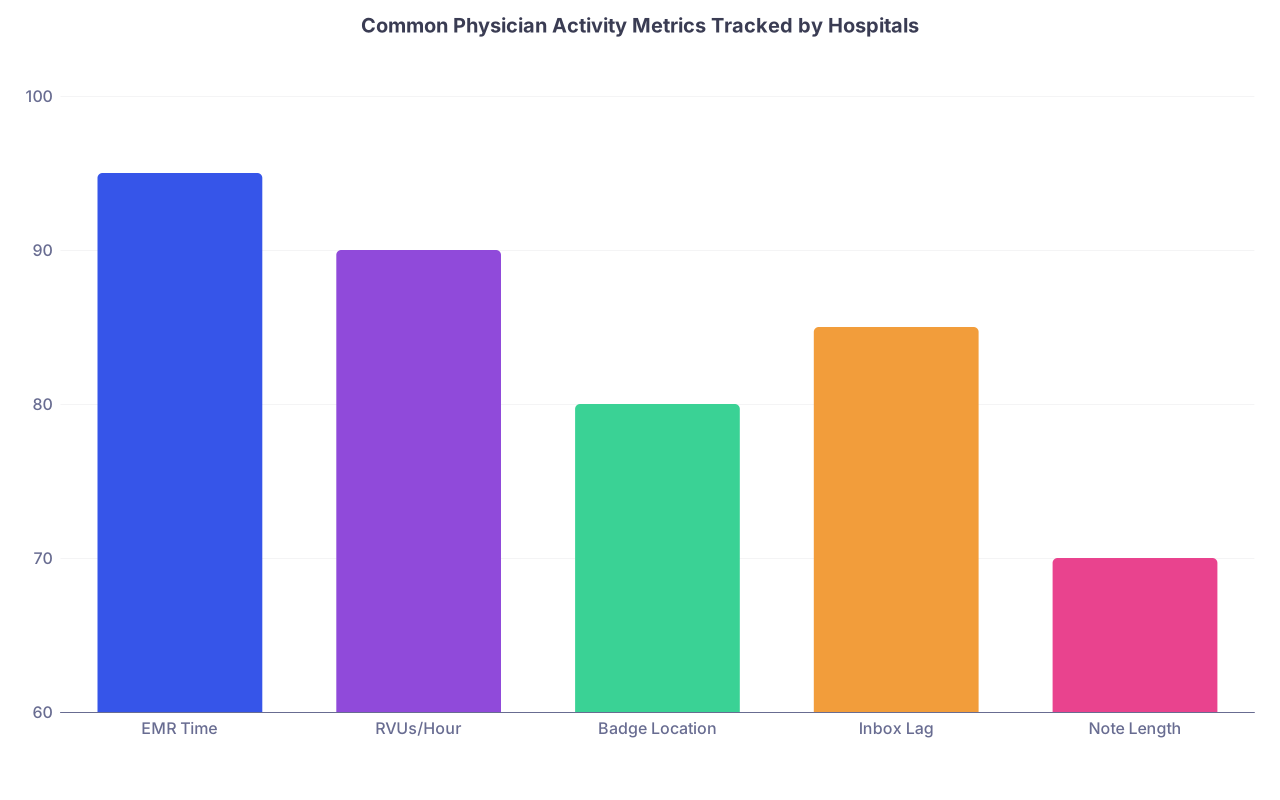
| Category | Value |
|---|---|
| EMR Time | 95 |
| RVUs/Hour | 90 |
| Badge Location | 80 |
| Inbox Lag | 85 |
| Note Length | 70 |
Those percentages are not hypothetical. I’ve seen analytics teams brag at conferences that they have over 90% of “provider journey touchpoints” instrumented. They speak about physicians the way Amazon talks about warehouse workers.
You’re not supposed to realize that.
How the Surveillance Actually Works (Behind the Curtain)
Let’s strip away the euphemisms.
Every big EMR — Epic, Cerner, whatever variant your system uses — logs every interaction. Every click, every order, every opened chart, every message. That’s the backbone. Layered on top, the hospital ties in:
- Badge readers at unit doors and ORs
- Wi‑Fi access points that triangulate device location
- Scheduling systems (block time, clinic templates)
- Billing/RVU systems
- Call schedules and staffing rosters
Then they dump everything into a data warehouse.
Behind closed doors, in those “Performance” or “Optimization” committees, they run dashboards that look like something out of a logistics company. Color-coded heat maps of “provider idle time.” Labeled lines showing “avg time per encounter by provider.” Tables of “top performers” ranked by RVUs/hour and “panel access.”
You don’t see those dashboards. At least not in their real form.
What you get is the sanitized downstream: “You’re at 0.87 of benchmark productivity.” Or a generic email saying, “We’ve identified opportunities to improve encounter efficiency.”
Let me decode that for you: they’ve been watching your every move for months. They already know who they think is “slow,” who is “too generous” with time, who is “overcoding,” and who is “ripe for leadership.”
What IT and Admin Actually Use This Data For
This is the part they will absolutely not put in writing.
Officially, physician analytics is for:
- Quality improvement
- Reducing burnout
- Enhancing patient throughput
- Optimizing resource utilization
Unofficially? It’s about money, control, and leverage. In roughly this order:
Productivity Pressure and RVU Justification
Your “productivity” graphs back every conversation about compensation. “The benchmark for your specialty is X RVUs per clinic session, you’re at 0.9X.” That sentence didn’t fall from the sky. It came from months of tracking exactly how you work.Staffing Cuts and “Optimization”
Some executive in a meeting: “Our data show Dr. Smith sees 22 patients per half-day with the same support staff that Dr. Jones uses to see 14. We don’t need more MAs, we need Dr. Jones to work more like Dr. Smith.” Translation: staffing requests denied, because the data says you should be faster.Targeting “Outliers” for Behavior Change
There’s always a red list. People whose charts close too slowly. Who spend “too much” time in patient rooms. Who have “excess inpatient LOS” or “too many low-acuity admissions.” Those folks get quiet visits: “We’re just here to support you in working more efficiently.” It’s not support. It’s pressure.Negotiation Leverage
When you ask for more clinic time, different block schedules, or a pay bump, they’re already sitting on 12 reports. “Our analytics indicate your utilization of current slots is below departmental median.” That’s not a conversation. That’s a premeditated no.Firing Safely
When administration finally wants someone gone, their favorite shield is data. “We’ve tracked your performance over 18 months and there’s a sustained pattern of lower productivity compared to peers.” Meanwhile, that pattern might be entirely explainable — but the tide of numbers is against you.
I’ve sat in those performance meetings. I’ve heard the phrases:
- “If we bring this to MEC, we’re covered.”
- “Let’s trend them one more quarter before we act.”
- “We can show they’re an outlier; that gives us room.”
This is not paranoia. It’s standard operating procedure.
The Creepy Part: How Deep the Behavior Profiling Goes
Here’s where it gets darker.
It’s not just “how many patients you see.” It’s how you practice medicine, reduced to metrics that never fully tell the story, but get used like they do.
Some examples I’ve seen:
“Excessive diagnostic testing” flags
They cross-reference your ordering patterns with your peers. Order too many CTs, MRIs, or specialty labs relative to the cluster, and a “stewardship opportunity” gets created. They might be right. Or maybe you see a sicker, more complex subgroup. The data rarely accounts for nuance.Documentation “efficiency” rankings
Some EMRs now show relative rankings of “time in notes,” “time in orders” by physician. Internally, admins look for “excessive time spent in notes per encounter.” The thinking: if you’re spending 5 minutes documenting and a peer spends 90 seconds (with macros and copy-paste), you’re “inefficient.”After‑hours and pajama time profiling
They track how much “work outside scheduled hours” you do. That data is sold to you as “we care about burnout.” Reality: if your charts are habitually unfinished and spill into evenings, you get flagged as a “cycle time problem.” Some executives genuinely worry about burnout. Many just want it to be “off the clock.”Referral and downstream revenue monitoring
Your referral patterns are tracked and correlated with downstream imaging, procedures, and admissions. Admin discussion example: “Dr. X sends 30% more to our own cardiology group than peers — very aligned.” Or the opposite. Do not think they’re not correlating your behavior with revenue flows.“Alignment” scoring
I’ve seen internal notes literally categorize docs as “aligned,” “neutral,” or “resistant” to system goals. How do they decide? Meeting attendance. Timeliness with new protocols. How fast you adopt new order sets. Participation in quality projects. Much of that is logged digitally.
| Data Type | What They Call It | How It’s Really Used |
|---|---|---|
| EMR time per note | Documentation efficiency | Pressure to chart faster |
| Patients per session | Access/throughput | RVU and staffing leverage |
| Order patterns | Stewardship metrics | Cost containment and denial ammo |
| After-hours logins | Burnout monitoring | Flag “inefficient” cycle times |
| Referral patterns | Network integrity | Revenue alignment and loyalty |
You’re getting profiled. Not just as a worker. As a type of physician.
The Lie of “Anonymized” and “Aggregate” Data
IT loves to reassure you: “We only look at aggregate data. Individual physician data is de‑identified in analytics reporting.”
That’s a half‑truth, and they know it.
Here’s what actually happens:
For public dashboards they show at department meetings, yes, they might aggregate or anonymize. You’ll see yourself as “Provider 17” on a scatter plot.
But behind the scenes, there are always toggles that switch the same views to named mode. Every analytics tool used in large health systems — Tableau, Power BI, Qlik, Epic’s Radar — supports drill‑through to the row level. Which means down to you.
I’ve watched the move in real time. In a committee meeting, the slide is anonymized. After the meeting, a small subset stays, somebody says, “Can we see who this outlier is?” One click. Names.
And then the follow‑up emails start.
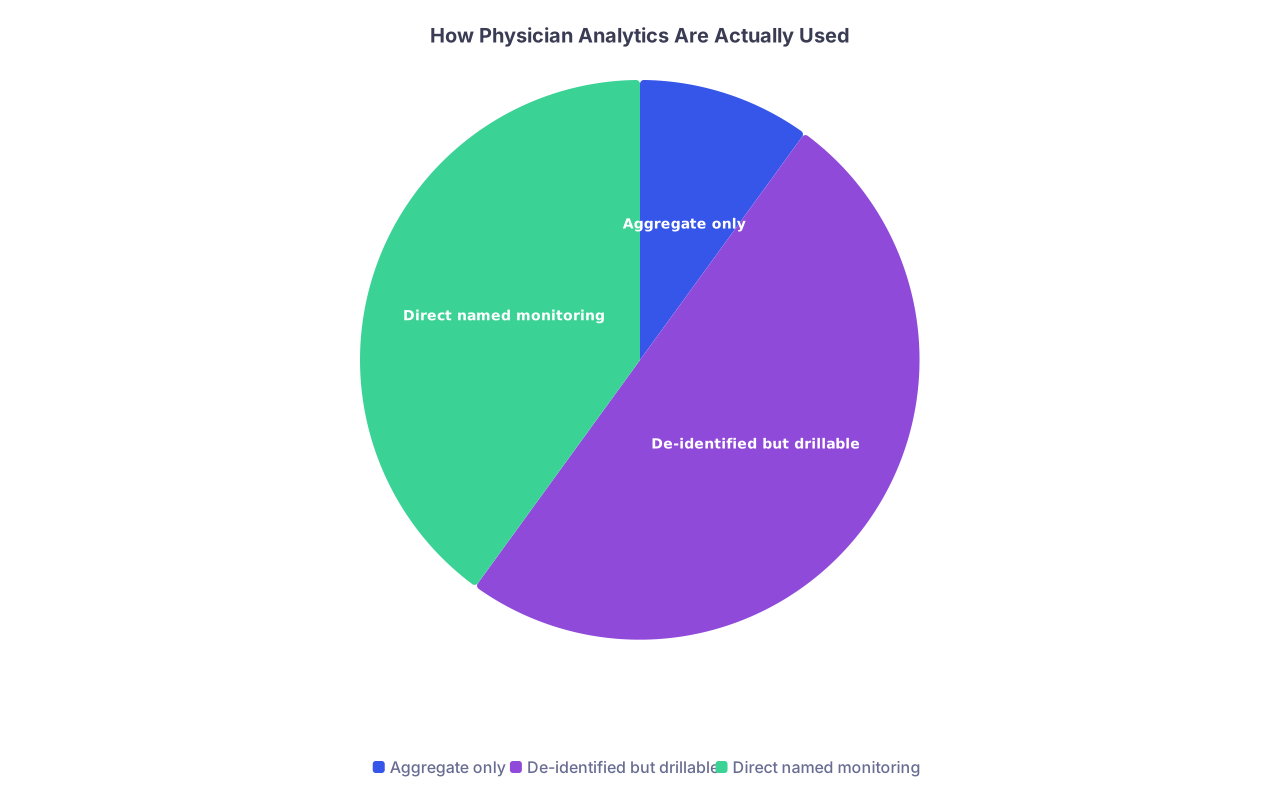
| Category | Value |
|---|---|
| Aggregate only | 10 |
| De-identified but drillable | 50 |
| Direct named monitoring | 40 |
This is why words like “de‑identified” are almost meaningless internally. It’s de‑identified until they want it re‑identified. And they usually do when there’s money or liability on the line.
The Subtle Ways It Changes How You Practice
Here’s the part many of you already feel in your gut but haven’t articulated.
Once you know you’re being tracked — or even vaguely sense it — your behavior shifts. You start:
- Rushing encounters because you know someone’s watching your “patients per hour”
- Clicking through note templates faster, maybe cutting corners on nuance
- Avoiding complex or time‑sink patients late in the day because your average time per encounter is already high
- Becoming more conservative with ordering, not always in a good way, because you’re worried about being a “high cost” outlier
You end up with perverse incentives:
- More patients, shorter visits
- More standard templates, less individualized documentation
- Less patience for complex social cases or vague complaints
- Defensive practice driven by what the dashboard wants, not what the patient needs
No executive will say, “We want you to see more patients in less time, even if that harms depth of care.” But functionally? That’s the signal the system sends when metrics are all volume, throughput, and cost.

This is why you feel less like a professional and more like a cog in a factory. Because the system is literally measuring you like one.
Why IT Won’t Say Any of This Out Loud
You might think, “Why not just be transparent?” Because transparency would blow up the story they’re selling.
IT and admin depend on three myths:
Myth of Neutral Technology
They frame analytics as just “data,” as if collection and interpretation are value‑free. They’re not. Every metric they choose to show — or hide — pushes behavior in a specific direction.Myth of Physician Partnership
You’ll hear, “We want to partner with you around data.” Partnership implies shared power. But who builds the dashboards? Who chooses the benchmarks? Who controls access? Not you.Myth of Benign Intent
It’s always couched in “quality” and “burnout mitigation.” If they admitted the data is used to deny resources, push RVU targets, and justify discipline, you’d push back. Hard.
Behind closed doors, IT people complain about “provider resistance.” They call you “non‑technical” or “data‑phobic” when you question their metrics. But your instincts are correct: you’re not afraid of data; you’re wary of how they’re using it against you.
How to Protect Yourself Without Burning Bridges
You’re not going to shut this down. The analytics train left the station years ago. But you can stop being an easy target, and you absolutely can force more balance in how this stuff gets used.
This is the part most attendings never get coached on.
1. Know Exactly What They Track — Ask Directly
Stop accepting vague answers.
In your next department meeting or one‑on‑one with leadership, ask explicit questions like:
- “What specific physician activity metrics does our system track?”
- “Who has access to named physician performance data?”
- “What are the top five metrics used in compensation and performance reviews?”
Make them say it out loud. Some will dodge. Persist. The more concrete the conversation, the less invisible the surveillance stays.
2. Get Your Own Data Copies
If they’re measuring you, you should see what they see.
Ask for:
- Your RVU reports, broken down by clinic session or month
- Your “EMR efficiency” metrics (Epic has provider‑level dashboards)
- Your chart closure latency statistics
- Any “stewardship” or “cost” outlier reports where your name appears
You are absolutely allowed to see data used to evaluate your performance. I’ve watched physicians go into remediation meetings blind and get buried under metrics they’d never seen. Do not make that mistake.
3. Force Context into Every Conversation
Any time you’re confronted with a metric, do three things:
- Ask for the denominator and peer range. “What’s the spread? Who’s at the low and high ends?”
- Demand case mix and complexity adjustments. “Is this adjusted for my panel’s comorbidities, or are we comparing apples to oranges?”
- Add qualitative context. “The reason these encounters run longer: I’m the one seeing complex post‑transplant kids, not 21‑year‑olds with strep.”
Never argue “the data is wrong” in a vacuum. Argue the interpretation is wrong without proper context. That’s where you win.
4. Make Burnout Their Problem, Not Just Yours
If your after‑hours EMR time is through the roof, use their own data to push back.
“Your analytics show I’m logging X hours a week of pajama time. If we’re serious about burnout, I need either decreased panel size, additional MA/scribe support, or adjusted RVU expectations to match the actual documentation load.”
Now their beloved metrics corner them. Either they admit they don’t care about burnout, or they have to move something.
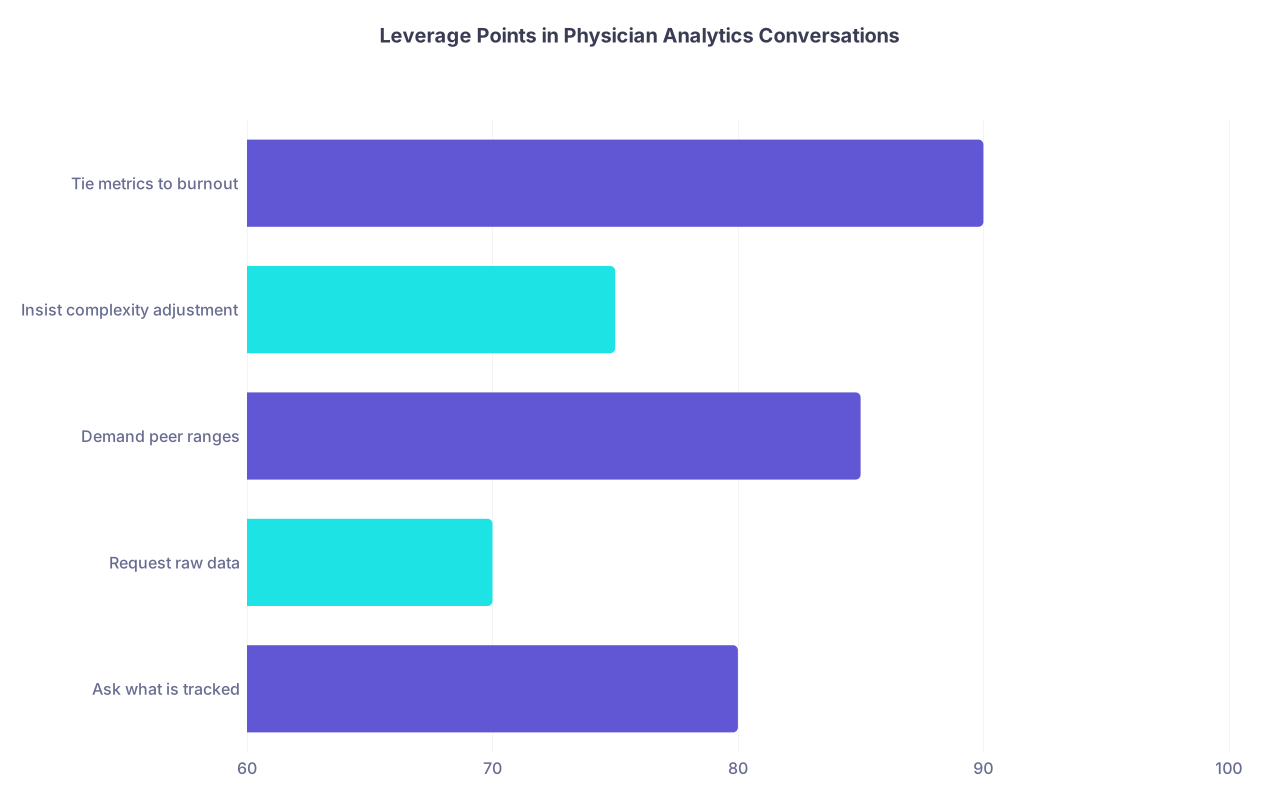
| Category | Value |
|---|---|
| Ask what is tracked | 80 |
| Request raw data | 70 |
| Demand peer ranges | 85 |
| Insist complexity adjustment | 75 |
| Tie metrics to burnout | 90 |
5. Form Alliances — Do Not Fight Alone
The biggest mistake is going one‑on‑one versus a department chair armed with a binder of metrics and an IT liaison.
Talk to trusted colleagues:
- Compare your dashboards and reports
- Identify which metrics are clearly unfair or misleading
- Approach leadership as a small group with specific asks: “These three metrics, as currently defined, are harmful. We want them adjusted or de‑emphasized.”
When five or six high‑revenue clinicians say that in unison, the tone changes. Now it’s a political problem, not a stray complainer.

6. Be Strategic About Your Own Patterns
This is the part a lot of physicians don’t want to hear, but I’m going to say it anyway.
You have to decide where you’re willing to play the game.
Some metrics are so entrenched — chart closure within X days, basic RVU thresholds — that fighting them head‑on just bruises you. So you hit the baseline. Not for pride. For cover.
Get:
- Your chart closure time to whatever threshold stops your name from being highlighted in red.
- Your basic RVU numbers to the point where you’re at least in the middle third.
- Your “time in chart after hours” trending downward if at all possible, or at least not worsening.
This isn’t about selling out. It’s about staying out of the crosshairs so you can preserve energy to fight the battles that actually matter — like staffing, panel size, and clinical autonomy.
The Next Phase: Predictive Analytics and “Risk Scores” On You
If you think what I’ve described is the end point, you’re behind. The next wave is already being piloted in several large systems.
They’re not just tracking what you do now. They’re predicting what you’re likely to do.
I’ve seen prototypes of:
- “Physician efficiency risk scores” that predict who will fall below RVU targets based on historical patterns, PTO use, and schedule adherence.
- “Turnover risk” models that flag which doctors are more likely to leave based on survey responses, external offers, or sudden drops in productivity.
- “Over‑utilization risk” models that correlate ordering patterns with payer denials and flag you as a financial liability.
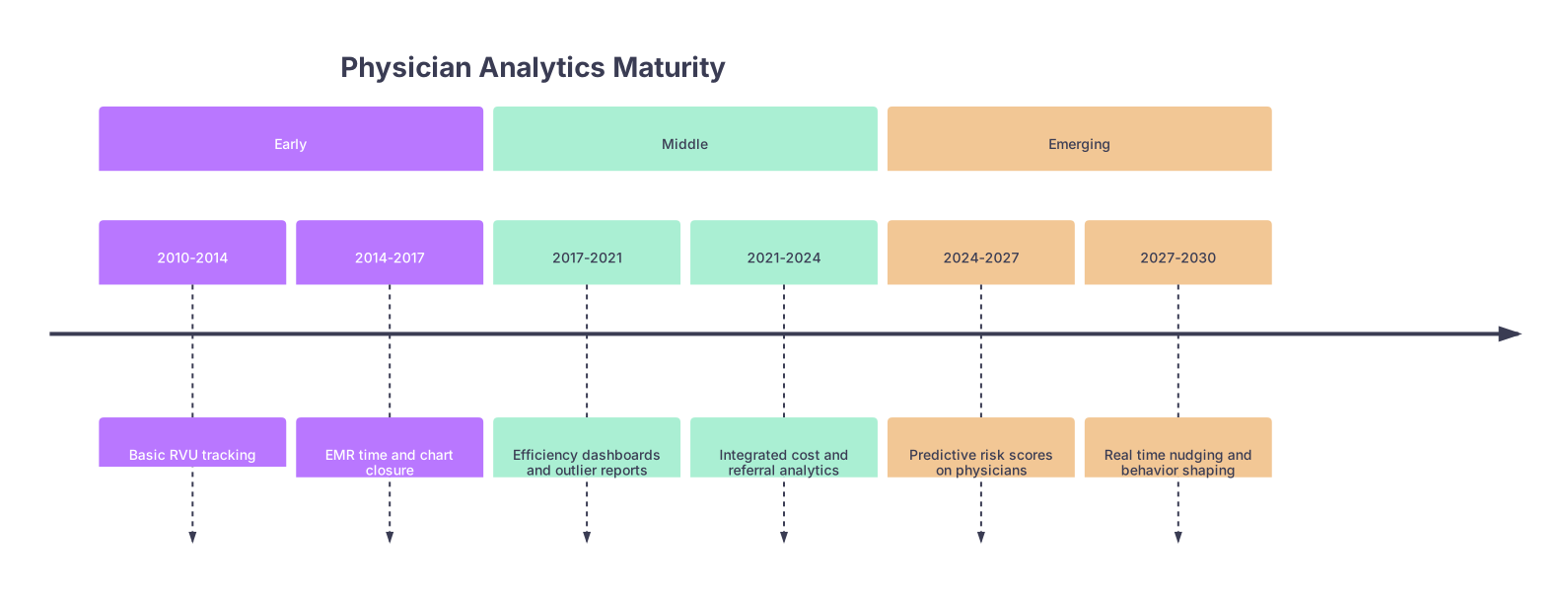
| Period | Event |
|---|---|
| Early - 2010-2014 | Basic RVU tracking |
| Early - 2014-2017 | EMR time and chart closure |
| Middle - 2017-2021 | Efficiency dashboards and outlier reports |
| Middle - 2021-2024 | Integrated cost and referral analytics |
| Emerging - 2024-2027 | Predictive risk scores on physicians |
| Emerging - 2027-2030 | Real time nudging and behavior shaping |
Nobody will ever say “we’ve assigned you a risk score.” But your experience will change:
- Leadership suddenly “checks in” more often.
- You’re nudged more aggressively to adopt protocols.
- Your compensation plan gets quietly rewritten with more downside risk.
The logic is simple: from the hospital’s vantage point, physicians are just another asset class to model and manage.
You’re not going to stop them from building these models. But knowing they exist lets you read the room correctly when behavior around you shifts.
Where This Leaves You Now
You’re past residency. You’re in the job market or already in attending life. You’re negotiating contracts, trying to stabilize your income, maybe planning a family or paying off debt.
Meanwhile, an entire parallel system is grading you, forecasting you, and nudging you in directions you didn’t consent to.
So here’s what you do with all this:
- Stop pretending the tracking is minimal or benign. It’s not. Treat it as a permanent reality.
- Demand access to your own data. Not summaries. Actual reports. Learn to read them.
- When analytics are weaponized against you, attack the assumptions and context, not the idea of measurement itself. You’ll get farther.
- Build small coalitions. Lone wolves get chewed up. Groups force recalibration.
- Hit baseline metrics so you can’t be casually dismissed as “underperforming” when you push back.
Most physicians are walking into this blind. You don’t have to be one of them.
You’re going to see more of this, not less. More dashboards. More “suggested efficiencies.” More “alignment” talks with “just a few numbers we’d like you to look at.”
But once you know what’s really behind those numbers, you stop being an easy mark.
With that foundation, the next steps in your career — choosing employers carefully, negotiating contracts that acknowledge the analytics reality, and deciding how much you’re willing to let a dashboard shape your day — become strategic choices, not surprises. And that’s where you start to reclaim a bit of the control this system is quietly trying to take.