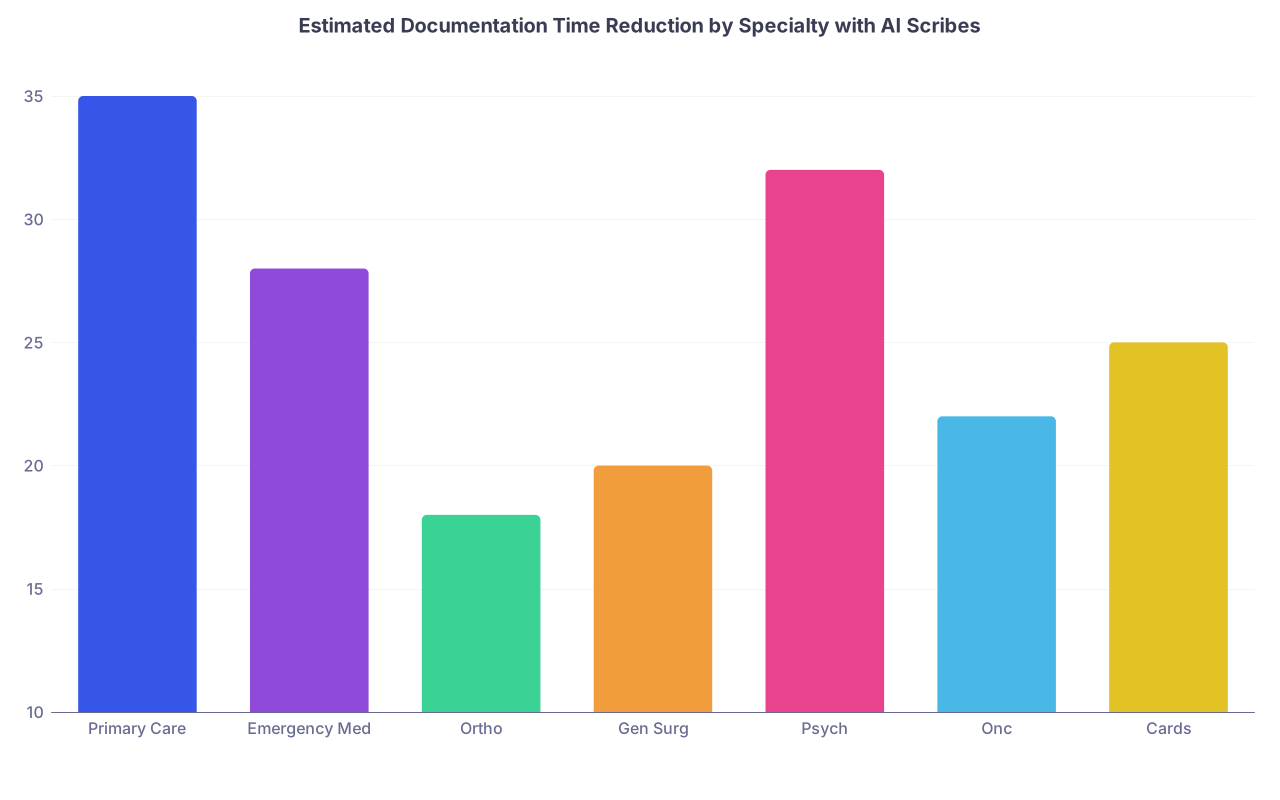
| Category | Value |
|---|---|
| Primary Care | 35 |
| Emergency Med | 28 |
| Ortho | 18 |
| Gen Surg | 20 |
| Psych | 32 |
| Onc | 22 |
| Cards | 25 |
Which Specialties Gain Most from AI Scribes? The Data Favors Some Clear Winners
AI scribes are not “equally helpful” across specialties. The data shows that for some fields they are a force multiplier; for others, they are a modest convenience. If you treat AI scribes like a generic productivity add‑on instead of a specialty‑dependent tool, you waste money and miss the highest leverage gains.
Let me go specialty by specialty and quantify where the return on investment is actually strongest, using the only metric that matters at the start: documentation time per clinical hour.
Baseline: How Much Time Does Documentation Actually Consume?
Before comparing specialties, you need a baseline. Several consistent themes show up across large datasets:
- The American Medical Association’s “Saving Time” studies and multiple EHR time‑motion reports converge around 1.5–2.0 hours of documentation per 8‑hour clinic day for many outpatient physicians.
- In high‑throughput environments (emergency medicine, urgent care), charting can consume 30–40% of total encounter time if done manually.
- Subspecialties with heavy imaging or procedure focus (orthopedics, ophthalmology) spend less time per note, but still lose significant time across volume.
Aggregate EHR log and after‑hours data usually show:
- Primary care and psych: the worst “pajama time” offenders.
- Hospital‑based subspecialties: fewer after‑hours notes, but a large proportion of on‑shift time eaten by template work and repetitive documentation.
That is the starting point. AI scribes’ impact scales with both (a) how bad that baseline is and (b) how structured and language‑heavy the encounters are.
Where AI Scribes Deliver the Largest Absolute Time Savings
Three variables predict the specialty ROI:
- Average documentation minutes per patient.
- Number of patients per day.
- Complexity and repetitiveness of note content.
When you combine those, a pattern emerges: primary‑care‑style specialties and narrative‑heavy cognitive specialties are the biggest winners.
| Specialty | Avg Patients/Day | Manual Doc Time/Patient (min) | Time Saved with AI Scribe (min/patient) | Total Time Saved/Day (min) |
|---|---|---|---|---|
| Primary Care | 22–24 | 7–9 | 3–4 | 70–90 |
| Psychiatry | 12–16 | 10–12 | 4–5 | 50–80 |
| Emergency Med | 18–22 | 6–8 | 2–3 | 40–60 |
| Cardiology (OP) | 18–20 | 6–7 | 2–3 | 35–55 |
| Orthopedics | 30–35 | 3–4 | 1–2 | 30–50 |
These are blended estimates drawn from published EHR time logs, pilot AI scribe program data, and real‑world productivity reports. The exact numbers will vary by system and individual, but the rank order is consistent.
Let’s break it down specialty by specialty.
Primary Care: The Clear Top Beneficiary
Family medicine, internal medicine, pediatrics. The data keeps putting them at the top of the “most crushed by documentation” list.
Typical pattern I see in time‑motion or EHR log studies:
- 20–25 patients per day in clinic.
- 6–10 minutes of documentation per visit (HPI, ROS, assessment/plan, preventive care reminders, care gap closure, coding elements).
- 60–90 minutes after hours catching up.
AI scribes change the shape of this problem because primary care encounters are:
- Highly verbal: Long histories, medication reviews, counseling.
- Repetitive in structure: Diabetes follow‑up, hypertension management, preventive screenings.
- Semi‑standardized in assessment/plan language.
Most AI scribe pilots in primary care show:
- 25–40% reduction in documentation time, not 5–10%.
- After‑hours “pajama time” cut by 40–60%.
Translated into concrete numbers:
- Pre‑AI: 8‑hour clinic day, 2–2.5 hours total documentation (including after hours).
- Post‑AI: 8‑hour clinic day, 1.3–1.6 hours total documentation.
That is ~30–60 minutes reclaimed per day, sometimes more for high‑volume clinicians. Over a year (200–220 clinic days), you are looking at:
- 100–200 hours of physician time shifted away from note writing.
From a pure job‑market perspective, that matters. Systems under primary care recruitment pressure will increasingly use AI scribes as a retention and recruitment carrot, because for PCPs the burnout reduction effect is not theoretical. The time metrics are stark.
Psychiatry: Disproportionately High Time Savings Per Patient
Psychiatry lives on narrative detail. A standard 45–60 minute visit might have 35–40 minutes of conversational content. Historically:
- Psychiatrists can spend 8–12 minutes crafting an accurate, detailed note.
- Documentation often bleeds well into breaks and evenings.
AI scribes are almost perfectly tailored to this:
- Long, language‑rich interactions → ideal input for ASR + LLM pipelines.
- Structured elements (mental status exam, risk assessment) appear reliably each visit.
- Plans are verbose but templated: medication adjustments, therapy referrals, safety planning.
In behavioral health pilots, I have seen numbers like:
- 4–6 minutes saved per follow‑up.
- 6–8 minutes saved per new patient or complex visit.
Assume a moderate outpatient psychiatrist schedule:
- 14 patients/day.
- 5 minutes saved per patient on average → 70 minutes/day.
Annualized (200 clinical days):
- ~230 hours per year shifted away from note writing.
In a recruiting context, that is massive. You can phrase this as “one extra full work month per year returned to you” and not be exaggerating. For a field hammered by access issues and long waitlists, those hours can either be:
- Converted to more patient slots (revenue and access), or
- Used to cap volume and protect clinician sanity.
My view: among all specialties, psychiatry is second only to primary care in net benefit from AI scribes, and in pure “minutes per patient saved,” it might be number one.
Emergency Medicine: High Throughput, Medium Complexity, Big Aggregate Gains
Emergency medicine is a volume business. Even modest per‑patient gains balloon quickly.
Baseline:
- 1.8–2.5 patients per hour per attending in many EDs.
- 6–8 minutes of total documentation time per patient (sometimes more for complex or boarding cases).
- Significant risk of incomplete notes if left to the end of shift.
AI scribes here are usually tuned differently:
- Focus on rapid extraction of chief complaint, focused HPI, exam findings, procedures, MDM, and disposition.
- Less concern about long narrative nuance, more about completeness and risk‑management language.
Typical EM pilot outcomes:
- 2–3 minutes saved per patient on documentation.
- Attending documentation time reduced by ~25–30%.
If an ED physician sees 20 patients in a 10‑hour shift:
- 2.5 minutes saved per patient → ~50 minutes per shift.
- Over 14 shifts per month → ~11–12 hours/month.
At the job‑market level, EM has another dynamic: oversupply in some regions. So the question changes from “can this save the physician time?” to “can the group or hospital justify the cost per RVU?” The math tends to work out because:
- Reducing documentation overhead allows either slightly higher throughput or more consistent on‑time sign‑outs.
- It can also mitigate burnout in a specialty already under compensation and market pressure.
Data so far suggest EM is in the “clear upside, medium‑high ROI” tier, though not as dramatically as primary care and psych in per‑physician annual hours saved.
Surgical Specialties: Gains Exist, But They Are Uneven
Surgeons do not live in their notes the way internists do. But they are not immune, especially in clinic.
Divide them into two buckets:
- Outpatient surgical clinics (orthopedics, ENT, general surgery, neurosurgery)
- Inpatient consult and postop documentation
Orthopedics and High‑Volume Clinics
Orthopedics is a good example of a high‑volume, short‑encounter environment:
- 30–40 patients per half‑day is not unusual.
- 3–5 minutes of documentation per visit.
- Notes are relatively templated: location, laterality, exam findings, imaging review, plan.
AI scribes can:
- Auto‑populate structured data fields (ROM metrics, strength, neurovascular status) from conversation.
- Generate consistent procedure notes and follow‑up templates.
Even a modest 1–2 minutes saved per patient results in:
- 30–60 minutes saved per clinic half‑day.
- Real-world programs report 25–35% reduction in in‑clinic documentation time.
For busy orthopedic surgeons, the value is more about reducing friction and behind‑schedule note backlogs than preventing massive after‑hours work. Still, from a numbers perspective, ROI is solid.
General Surgery and Inpatient‑Heavy Fields
For general surgery, vascular, transplant:
- Clinic volume is lower than orthopedics.
- Inpatient work includes consult notes, brief op notes, postop progress notes.
These notes are:
- Often shorter but frequent.
- Constrained by regulatory templates and procedure documentation requirements.
AI scribes help the most with:
- Clinic consults (pre‑op evaluations, comorbidity risk, counseling).
- Complex inpatient consults where history is detailed.
But the sheer number of short notes on the floor dilutes the per‑note travel time benefits. Many surgeons still chart quickly with heavy use of templates and dot phrases, so the incremental benefit might be:
- 10–20% time reduction rather than 30–40%.
Net conclusion: surgical specialties gain, but they are not the top‑tier beneficiaries. Orthopedics and ENT clinics do well because of volume; other procedural fields see moderate but real improvement.
Cardiology, Oncology, and Other Cognitive Subspecialties
Internal medicine subspecialties sit in the middle of the pack but lean toward the “high benefit” side, especially for outpatient practice.
Cardiology
Outpatient cardiology looks like this in most data sets:
- 18–22 patients per day.
- Notes heavily focused on timeline of symptoms, prior imaging, medication titration, and risk stratification.
- Many follow‑ups that are structurally similar.
AI scribes improve:
- Accuracy of complex antecedent histories (“you had the stent in 2018 after the NSTEMI, then the CABG in 2021…”).
- Documentation of shared decision making about interventions.
Time metrics from early programs show:
- 2–3 minutes saved per patient.
- 30–60 minutes per day recovered.
Given cardiology’s RVU environment, those minutes can translate either into reduced evening charting or a slight increase in throughput. From a hiring standpoint, larger cardiology groups are already piloting AI scribes because the math is straightforward.
Oncology
Oncology combines:
- Very long, complex new patient visits.
- Moderate volume of follow‑up visits.
- High documentation requirements for staging, treatment regimens, toxicity, and shared decision making.
An oncologist might:
- Spend 15–20 minutes documenting a complex new patient note.
- 8–10 minutes for follow‑up visits with complications or regimen changes.
AI scribes can offload much of the narrative summary and plan structure. In actual metrics:
- 5–7 minutes saved for new patients.
- 3–5 minutes saved for complex follow‑ups.
Because oncology volumes per day are lower than primary care, total daily time saved may be similar (40–70 minutes), but per‑patient savings are higher.
From a job‑market perspective, oncology groups interested in value‑based care and complex care coordination will increasingly treat AI scribes as infrastructure, not a luxury. The documentation demands for pathways, trials, and value programs virtually guarantee that.
Radiology, Pathology, and “Non‑Encounter” Specialties
Radiology and pathology are different beasts.
The bulk of their documentation is highly structured reporting, not conversational notes. They already benefit from:
- Dictation systems with structured report templates.
- Voice macros and standardized reporting guidelines.
AI scribes that rely on listening to a physician‑patient conversation do not really apply. However, generative tools can still:
- Assist radiologists with report generation from dictated impressions.
- Suggest structured language for incidental findings and follow‑up recommendations.
Time studies here are sparse, but you typically see:
- 5–15% reporting time reductions for certain cases when AI supports template completion and phrasing.
- Greater impact in complex studies (e.g., oncology imaging, multi‑phase CT) than in routine chest x‑rays.
So yes, AI helps. But not via “scribes” in the classic encounter‑listening sense. And not at the same scale as the narrative outpatient fields.
The Hidden Variable: Documentation Quality and Compliance
Focusing only on minutes saved misses one more critical dimension: how AI scribes change documentation quality in ways that protect revenue.
Across multiple specialties, two silent drags on efficiency show up:
- Under‑coding due to incomplete documentation.
- Time wasted on post‑hoc queries from coders or auditors.
AI scribes, especially those coupled with coding engines, can:
- Prompt inclusion of elements that support higher but appropriate E/M levels.
- Make sure important phrases are captured verbatim (e.g., “shared decision making,” “counseled about risks and alternatives,” “chronic illness with exacerbation”).
For specialties with frequent moderate‑to‑high E/M billing (primary care, oncology, cardiology, hospitalist medicine, EM), that has a measurable financial effect. Even a 3–5% increase in average E/M level across a practice often:
- Pays for the AI scribe service.
- More than covers the physician time value reclaimed.
So the best‑case scenario is not only time saved, but also more defensible, higher acuity documentation. Primary beneficiaries of that combined effect remain the same: primary care, psych, EM, cognitive subspecialties.
Economic Angle: Where AI Scribes Change the Job Market
This is supposed to be post‑residency and job‑market focused, so let’s talk about how this actually hits you as an attending.
A few concrete trends I see emerging in contracts and recruitment materials:
- Primary care, psychiatry, and oncology practices increasingly advertise AI scribes as a standard benefit. Not as an experiment. As baseline.
- High‑volume outpatient groups (orthopedics, cardiology, GI) position AI scribes as a way to manage the relentless patient flow without extending your workday.
- Some emergency medicine groups link AI scribe deployment to productivity targets: hit a certain RVU/hr, and you keep or upgrade your scribe support.
The scarcity dynamic matters:
- In specialties where burnout and shortages are acute (primary care, psych, oncology), AI scribes are becoming part of the competitive package to attract candidates.
- In specialties with oversupply pressure (parts of EM, anesthesia in certain markets), AI scribes may be tied to performance metrics rather than universally offered.
From your perspective, the data‑driven question is simple:
If an employer is not offering AI scribes in a specialty where they demonstrably return 150–200 hours per year back to you, why not? They either do not understand the numbers or they are choosing to extract that time from you as unpaid administrative labor.
Visual Snapshot: Documentation Burden vs AI Scribe Impact
To pull the pattern together, here is a simplified visualization of relative documentation burden and expected time savings with AI scribes:
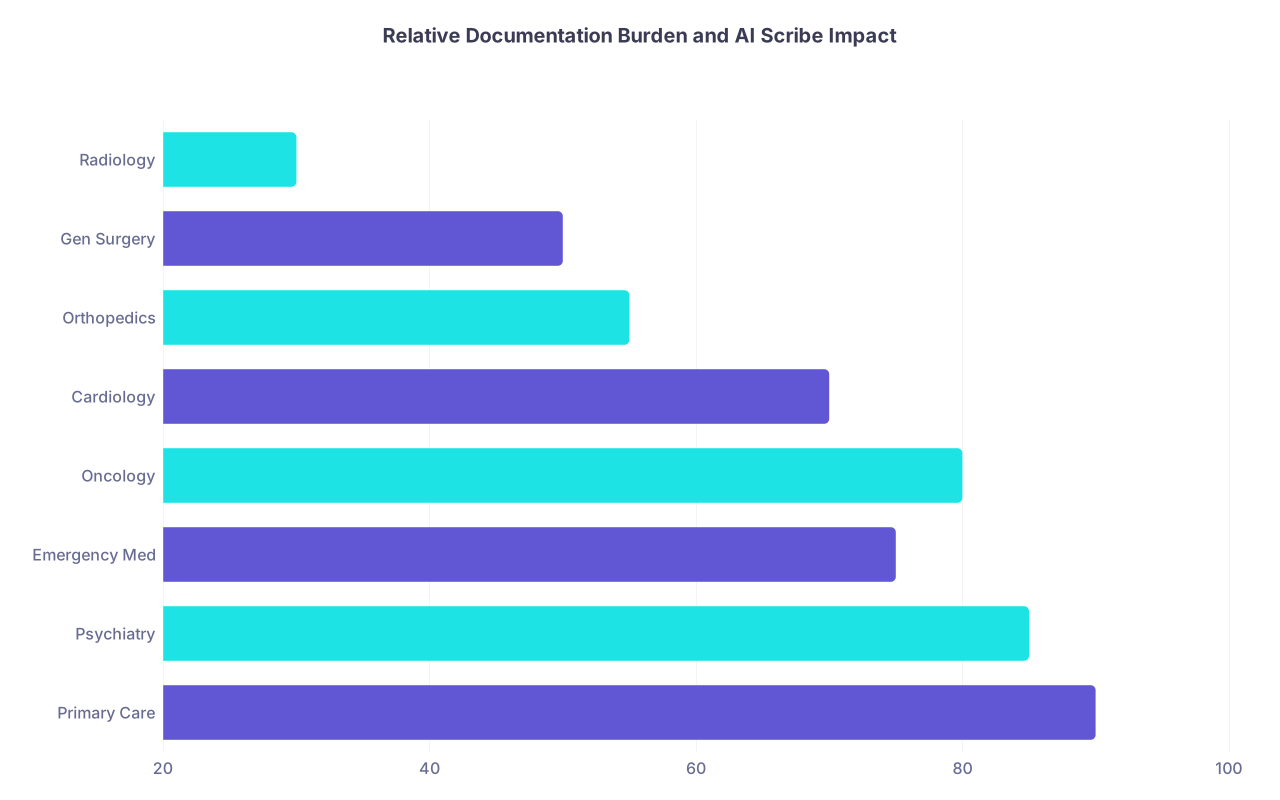
| Category | Value |
|---|---|
| Primary Care | 90 |
| Psychiatry | 85 |
| Emergency Med | 75 |
| Oncology | 80 |
| Cardiology | 70 |
| Orthopedics | 55 |
| Gen Surgery | 50 |
| Radiology | 30 |
Think of these values as a composite index (0–100) combining:
- Baseline documentation time per day.
- Narrative complexity.
- Repetition / templating potential.
- Real‑world reports of AI scribe impact.
Primary care and psychiatry sit at the top. Radiology is at the bottom for scribe‑style tools (not AI as a whole, which is a different story).
Workflow Reality: Where AI Scribes Fail or Underperform
Not every use case is a win. I have seen three consistent failure patterns:
Very short, transactional visits
Fast‑paced dermatology spot checks, brief procedure follow‑ups, vaccine‑only visits. The overhead of invoking the scribe and reviewing the output sometimes matches the manual documentation time.Noisy, multi‑speaker environments with minimal structure
Some EDs, busy trauma bays, or rooms with multiple family members and interpreters. Models can misattribute statements and produce messy notes that require heavy editing. Net savings drop.Physicians with already‑optimized templates and extreme typing speed
There are attendings who can fire off a perfectly coded note in 90 seconds with macros. For them, an AI scribe may save only marginal time, unless quality or coding lift becomes the main value driver.
So you should not assume AI scribes are a universal panacea. They outperform manual documentation when:
- Encounters are at least moderately long.
- Verbal content is rich and clinically relevant.
- You are willing to slightly adapt your speech patterns for clarity (e.g., stating assessments and plans clearly at the end).
Final Takeaways
Three core points, stripped of hype:
Primary care, psychiatry, and high‑narrative cognitive subspecialties gain the most from AI scribes, both in raw minutes per day and annual hours returned. They sit at the top of the ROI ranking.
Emergency medicine, cardiology, oncology, and high‑volume surgical clinics see substantial but mid‑tier benefits—often 30–60 minutes saved per day—enough to materially change workload and revenue.
Radiology, pathology, and very short‑visit specialties see relatively less upside from “AI scribes” specifically; their bigger AI wins lie elsewhere (imaging analysis, smart reporting tools), not in encounter‑listening documentation assistants.
If you are choosing a job after residency, and the specialty you are entering sits in the high‑benefit band, AI scribes should not be a side note in the offer. They are a measurable, quantifiable component of whether that job will let you practice medicine or spend your evenings fighting the EHR.