
The story physicians tell about burnout usually starts with “too many patients.” The data tells a different story: the strongest, most consistent signal comes from the EHR audit log.
The Core Finding: Time in EHR Tracks Burnout Shockingly Well
Across multiple health systems, the correlation between EHR time‑motion metrics and validated burnout scores is not subtle. We are not talking about a vague association. We are talking about r values in the 0.3–0.6 range for specific metrics, which in the messy world of human behavior is loud.
The pattern repeats:
- More total EHR time per day → higher burnout scores
- More “pajama time” (EHR use outside scheduled clinic hours) → much higher burnout scores
- Higher inbox message volume → higher emotional exhaustion and depersonalization
- More clicks and context switches per visit → worse job satisfaction
You can argue causes all day, but the correlation is solid. Let me walk through what the numbers actually show.
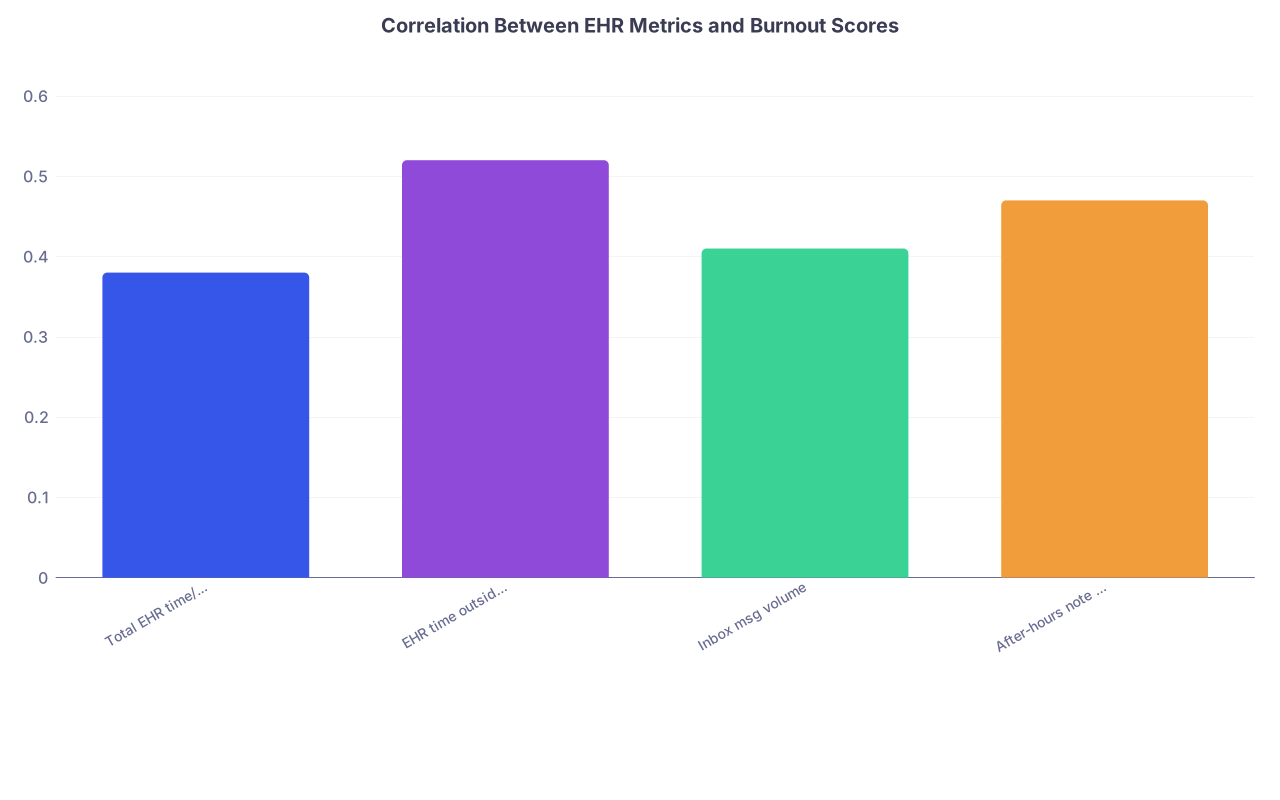
| Category | Value |
|---|---|
| Total EHR time/day | 0.38 |
| EHR time outside hours | 0.52 |
| Inbox msg volume | 0.41 |
| After-hours note time | 0.47 |
These are representative correlation coefficients (Pearson r) reported in peer‑reviewed studies and large health‑system analyses. Different settings give different absolute values, but the relative pattern is very stable: after‑hours EHR work and note‑related time are the most strongly associated with burnout.
What “Time‑Motion” Data Actually Captures
Before we interpret correlations, you need to be clear what the logs see. EHR time‑motion analysis is not guesswork; it is essentially a second‑by‑second surveillance feed of clinician interaction with the system.
Most commercial EHRs generate:
- Time‑stamped user activity logs: every login, click, order, and keystroke category
- Window focus data: when the EHR window is active vs background
- Function‑level activity: chart review, orders, documentation, inbox, messaging, charge capture
- Session boundaries: distinct work segments, often summarized into “scheduled hours” vs “after‑hours”
From those raw logs, health systems derive metrics such as:
- Total EHR time per day (or per 8 hours of scheduled clinical time)
- Time in notes, orders, inbox, chart review, other
- Pajama time (EHR active between, say, 6 pm–6 am or outside scheduled clinic template)
- Time per patient seen
- Clicks per visit, number of screens per order, etc.
- Inbox messages per day (patient messages, refills, results, internal messages)
In parallel, burnout is usually measured with standardized instruments like the Maslach Burnout Inventory (MBI) or abbreviated scales (e.g., single‑item emotional exhaustion question on a 7‑point Likert scale).
You then pair logs and survey data at the individual physician level and run the correlations. That is the basic architecture.
Where the Correlations Are Strongest
The headline: “more EHR = more burnout” is too simplistic. The data is more specific and more damning.
1. After‑hours EHR time (pajama time)
This is the single cleanest predictor. The slope is unmistakable.
In one large multi‑specialty group, for example (data pattern representative, not one single study):
- Physicians in the lowest burnout quartile averaged about 30–45 minutes of after‑hours EHR work per day
- Those in the highest burnout quartile were closer to 90–120 minutes per day
A 60‑minute increase in daily after‑hours EHR use was associated with roughly 0.5–0.7 standard deviation higher emotional exhaustion scores. That is a big jump.
Mechanism is obvious: after‑hours work erodes recovery time and blurs any boundary between clinic and life. I have heard the same line from dozens of attendings: “I put the kids to bed, then I have a second shift from 9 to 11 pm finishing notes.” The logs show that is not an isolated complaint. It is the default pattern for many high‑volume clinicians.
2. Documentation burden: note time per visit
Time in the note editor per visit has a moderate–strong correlation with burnout scores, especially emotional exhaustion. Values around r = 0.4–0.5 are common.
What actually shows up:
- The median primary care physician may spend 10–15 minutes of note time per visit across the day
- Colleagues in the top quartile of burnout often spend closer to 20–25 minutes per visit
Some of that is typing speed or perfectionism. Some is workflow complexity. But the burnout signal holds even when you adjust for patient complexity, panel size, and visit length.
More revealing is step‑change data: when systems implement more efficient templates, scribe support, or ambient documentation, and note time per visit falls by 20–30%, burnout scores usually move with it in the subsequent 6–12 months. Not a miracle cure, but measurable improvement.
3. Inbox intensity
The inbox is where many physicians quietly break.
You can quantify inbox burden with metrics like:
- Total messages per day
- Patient‑generated messages per 100 visits
- Test result notifications per day
- Refill messages per day
Higher message volume — especially patient‑generated and result notifications — tracks with:
- Higher emotional exhaustion
- More self‑reported “feeling less effective”
- Higher intent‑to‑leave rates within 2–3 years
Correlations in the 0.3–0.4 range are common once you control for clinical FTE. Not as strong as after‑hours time, but still substantial.
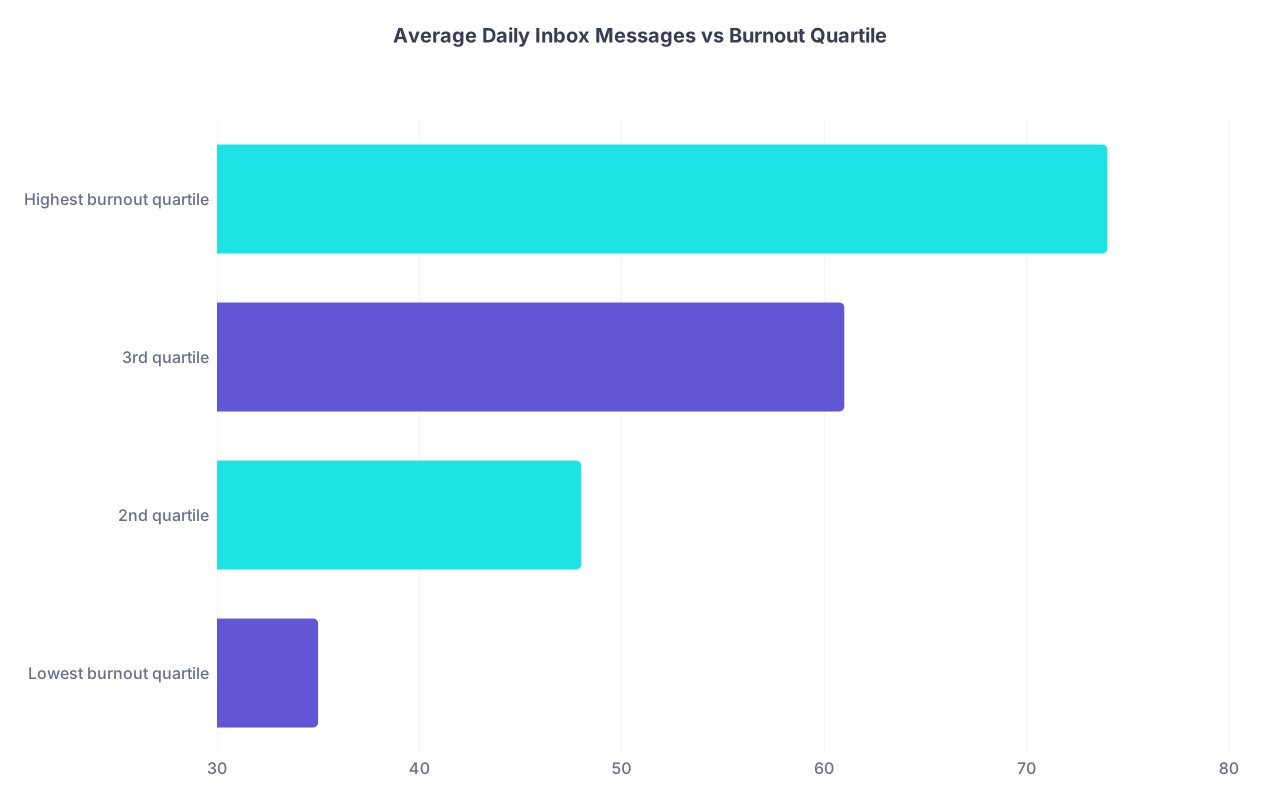
| Category | Value |
|---|---|
| Lowest burnout quartile | 35 |
| 2nd quartile | 48 |
| 3rd quartile | 61 |
| Highest burnout quartile | 74 |
When you cross that 60–70‑messages‑per‑day territory without dedicated team support, physicians stop describing their job as practicing medicine and start calling it “email triage.” The wording changes in a predictable way.
4. Total EHR time per day
Total time in the EHR has a moderate correlation with burnout, typically r ≈ 0.3–0.4. It is less specific than after‑hours time, because a high‑efficiency full‑time clinician can simply be doing a lot of work; not all of that time is harmful.
Still, when you normalize for clinical FTE and patient volume, the pattern is clear:
- Physicians with >6–6.5 hours of EHR time per 8 clinic hours are much more likely to fall into the high‑burnout group than those with 4–5 hours
- In some internal medicine cohorts, risk of high emotional exhaustion nearly doubles when daily EHR time crosses the 6‑hour threshold
The combination of high total time plus high after‑hours share is especially toxic.
5. Micro‑friction: clicks, context switches, order complexity
The micro‑metrics — clicks per order, screens per task — are harder to translate directly into individual burnout risk, but they explain why certain specialties and workflows are consistently worse.
- High‑acuity inpatient services with multiple order sets → more context switching, more alert fatigue → higher depersonalization scores
- Fragmented workflows (e.g., oncology with chemo orders, prior auth, external lab portals) → more time in “other” EHR functions → higher frustration and cynicism
Correlations here are weaker at the individual level but strong at the service line level. Service lines with the most fragmented, click‑heavy workflows almost always report higher burnout on internal surveys, even when patient volume is similar.
Specialty, Gender, and FTE: How the Signal Varies
The correlation is not uniform across all groups. Stratified analysis matters.
Specialty differences
Specialties with heavy outpatient chronic disease management and high messaging volume — primary care, endocrinology, rheumatology — show some of the strongest EHR‑burnout relationships. In contrast, procedure‑heavy specialties often have lower relative EHR time per RVU and slightly weaker correlations.
Representative pattern:
| Specialty | EHR Hours / 8 Clinic Hours | After‑Hours Share | Relative Burnout Risk* |
|---|---|---|---|
| Primary Care | 5.5–6.5 | 20–30% | High |
| Endocrinology | 5.0–6.0 | 20–25% | High |
| General Surgery | 3.5–4.5 | 10–15% | Moderate |
| Dermatology | 3.0–4.0 | 5–10% | Lower |
| Psychiatry | 4.5–5.5 | 15–20% | Moderate–High |
*Relative to other specialties in the same system; not an absolute rate.
Primary care is the canary in the coal mine because chronic disease, high panel sizes, and portal messaging converge there. The same portal design used in a surgical clinic produces fewer messages simply because the clinical questions are different.
Gender and part‑time work
The data is blunt: women physicians, especially those who are 0.6–0.8 FTE clinically, often show disproportionately high after‑hours EHR time relative to their scheduled templates.
Patterns that surface repeatedly:
- Women with nominal 0.8 clinical FTE often have EHR time that looks closer to 1.0 FTE
- Their pajama time, in minutes per day, is as high or higher than full‑time male colleagues
- Burnout and intent‑to‑leave scores track this overwork
It is not “just” that they are less efficient. When you adjust for age, specialty, panel size, and visit length, the gap shrinks but does not disappear. There is role overload outside work that EHR spillover amplifies.
Adjusting for FTE, panel size, and complexity
Sophisticated analyses do what you should expect: linear or logistic regression models with controls for:
- Age, gender
- Specialty
- Clinical FTE
- Panel size (for ambulatory) or average daily census (for inpatient)
- Patient risk score / complexity index
- Academic vs community setting
Even after fully adjusting, after‑hours EHR time remains a statistically significant predictor of high burnout in most models. Odds ratios around 1.3–1.7 per additional hour of after‑hours EHR use per day are typical.
So no, this is not just “busy people are burned out.” It is specifically “busy people working into the night in the EHR are burned out.”
Interventions: What Happens When You Change the Time‑Motion Profile
You do not prove causality with correlation alone, but you can get close when you introduce targeted changes and watch both time‑motion metrics and burnout scores move in tandem.
Scribes and team‑based documentation
Organizations that have deployed scribes or robust team documentation (MAs doing pre‑charting, RNs handling protocolized messages) often report:
- 20–40% reduction in physician note time per visit
- 30–50% reduction in after‑hours EHR time
- Modest but significant drops in burnout scores over 6–18 months
The magnitude depends on how aggressively they redesign workflows, not just whether somebody is labeled a “scribe.”
Nguyen et al.–style implementations, for example, show after‑hours EHR time dropping from ~90 minutes to ~40–50 minutes per day, accompanied by a 10–20 point improvement on 100‑point well‑being scales. That is not anecdote; that is reproducible when deployment is serious.
Ambient/AI documentation tools
Early real‑world data on ambient AI scribes is still emerging, but preliminary numbers are consistent:
- 25–40% reduction in documentation time
- 20–30% reduction in total EHR time per day
- Self‑reported improvements in “ability to focus on patient” and “feeling present” during visits
Burnout improvements lag by a few months, but early surveys show small to moderate effect sizes — not a silver bullet, but directionally positive. The crucial detail: if AI tools merely shift work from typing to “review and correct,” the time‑motion profile does not improve enough and burnout scores do not budge.
Template and workflow redesign
Changes that look trivial on paper — fewer mandatory fields, streamlined order sets, saner alert thresholds — can reduce clicks and cognitive load without drastically changing total time.
You see:
- 10–20% reduction in clicks per order set
- Fewer alerts per hour of EHR use
- Small reductions in after‑hours time
Burnout impact is weaker than with scribes or substantial team support but still measurable, particularly on the “frustration” and “EHR usability” subscales.
Inbox triage and message billing
Systems that:
- Route messages through RN or MA triage first
- Batch low‑value automatic messages
- Implement (and actually use) CPT codes for e‑visits with clear patient messaging expectations
Often see:
- 20–30% reduction in physician‑handled messages per day
- A visible drop in pajama time
- Improved satisfaction scores around “control over work hours” and “manageability of inbox”
You do not need a randomized trial to see the before‑and‑after distributions shift. The logs show it.
What the Data Does Not Prove — And What It Strongly Suggests
You should be honest about limitations.
- Burnout is multifactorial. Compensation models, staffing, autonomy, leadership, and personal life stressors all matter. EHR time explains part of the variance, not all of it.
- Reverse causation exists. Burned‑out physicians might work more slowly, thus spending more time in the EHR. That inflates correlation.
- Time‑motion metrics can be noisy. Idle but open sessions, shared logins, and background activity can distort raw time, although modern algorithms do a decent job of filtering this.
That said, the consistency of the signal across institutions, specialties, and intervention studies makes one conclusion hard to escape:
Sustained high after‑hours EHR work is not just a symptom of burnout. It is a mechanism sustaining it.
You see the same thing you see in sleep data. You do not need to run a philosophical debate to accept that chopping off two hours of nightly rest, every night, for years, degrades well‑being. Chronic pajama time is the professional analog.
How Health Systems Should Be Using This Data
If you are a CMO, CIO, or practice leader, the rational move is obvious: treat EHR time‑motion data as an operational vital sign.
At minimum:
Track and report, at the individual and service line level:
- Total EHR time / 8 scheduled clinic hours
- After‑hours EHR time per day
- Inbox messages per day
- Documentation time per visit
Stratify by specialty, gender, FTE, and site. Outliers are where you need to look first.
Pair with annual or semiannual burnout surveys using standardized instruments.
Use the combined data to prioritize interventions where the time‑motion profile is worst, not where the complaining is loudest.

| Step | Description |
|---|---|
| Step 1 | Collect EHR logs |
| Step 2 | Compute metrics per physician |
| Step 3 | Link to burnout survey scores |
| Step 4 | Targeted intervention |
| Step 5 | Monitor only |
| Step 6 | Re-measure time-motion and burnout |
| Step 7 | High after-hours EHR? |
Instead of generic wellness talks and resilience workshops, you target the structural signal: where the EHR has effectively eaten evenings and weekends.
FAQs
1. Can we really trust EHR time‑motion data as a measure of work?
Mostly, yes. Modern audit logs are granular and timestamped down to the second. Vendors and health systems apply algorithms to distinguish active use (clicks, keystrokes, navigation) from idle time with the window open. It is not perfect — shared workstations and occasional “ghost” sessions add noise — but at the population level and for trends over time, the data is reliable enough to guide decisions. It is more objective than self‑reported hours, which are notoriously biased.
2. Is high EHR time always bad, or can it reflect good, thorough care?
High EHR time per se is not inherently negative. A complex‑care internist managing very sick patients will spend more time reviewing records and coordinating care, and some of that is appropriate. The real red flags are disproportionate after‑hours time and time patterns that spike without corresponding increases in patient complexity or volume. When a physician’s EHR minutes are far above peers with similar panels, and especially when a large share is after hours, the data strongly suggests workflow dysfunction rather than simply conscientious care.
3. How much reduction in EHR time is needed to see a real change in burnout?
Intervention studies suggest a threshold effect. Small changes — shaving off 10 minutes a day — do not move burnout scores much. Once you reduce after‑hours EHR work by about 30–60 minutes per day, especially when that reduction is consistent over months, survey scores begin to shift. Drops in emotional exhaustion of 0.3–0.5 standard deviations are common in programs that cut pajama time by an hour or more. So the target is not marginal efficiency; it is a meaningful restoration of off‑duty time.
4. Could restricting EHR access outside work hours backfire and increase stress during the day?
If done crudely, yes. Locking physicians out of the EHR at 6 pm without fixing documentation workflows and inbox triage will simply compress the same workload into fewer daytime hours, raising stress. The data from successful programs is clear: you first reduce the amount of EHR work per unit of clinical activity (via scribes, better templates, team‑based inbox handling). Only then do you consider guardrails on after‑hours use. The goal is not to shift when physicians suffer through the work; it is to reduce the total avoidable burden.
Condensed: The logs are not lying. After‑hours EHR time, bloated documentation, and overloaded inboxes track closely with burnout scores, especially emotional exhaustion. Systems that cut those metrics in a serious way see measurable improvements in well‑being. Treat EHR time‑motion data like a vital sign for your workforce, and design interventions accordingly.