
The uncomfortable truth about machine learning risk scores in medicine is simple: most of them look impressive in the paper and quietly fall apart in the real world.
Not because the models are inherently bad. Because calibration is ignored, drift is inevitable, and deployment is treated like publishing a ROC curve instead of managing a living system that interacts with messy clinical workflows.
Let’s walk through this the way a data analyst actually thinks: distributions, baselines, error decomposition, and where you are statistically most likely to get burned once you leave the residency bubble and step into a health system that expects you to “own” these models.
1. What a Risk Score Actually Is (and Why Calibration Matters More Than AUC)
A risk score is not magic. It is just an estimated probability:
P(event | features) = some number between 0 and 1
For a 30‑day readmission model, that might be “this patient has a 23% chance of readmission.” For a sepsis model, “this patient has a 6% probability of developing sepsis in the next 12 hours.”
Two distinct concepts matter:
Discrimination – how well the model ranks patients from low to high risk
- Measured by AUC/ROC, c‑statistic, precision‑recall AUC
- AUC = probability that a randomly selected case gets a higher score than a randomly selected control
Calibration – how well predicted risks match observed event rates
- If 100 patients have predicted risk 0.20, about 20 should experience the event
- Measured by calibration plots, Brier score, calibration slope and intercept, E/O ratios
The problem: academic papers and vendor decks worship discrimination. Real‑world patient management lives and dies on calibration.
Because you act on numeric thresholds.
If you set an alert at 10% sepsis risk, you are implicitly believing: “patients above this threshold are roughly, actually, around 10%+ likely to crash.” If your model systematically overestimates risk in certain subgroups (e.g., younger women, non‑English speakers), you build inequity and alarm fatigue into the system.
Quick numeric example
Assume:
- Model outputs risk scores between 0 and 1
- Two risk bins:
- Bin A: predicted risk ≈ 0.10 (n = 1000)
- Bin B: predicted risk ≈ 0.30 (n = 500)
Observed data over 30 days:
- Bin A: 60 events (6% observed)
- Bin B: 210 events (42% observed)
Discrimination might still be decent (high‑risk bin has higher event rate).
Calibration is terrible:
- Bin A: predicted 10%, observed 6% → overprediction
- Bin B: predicted 30%, observed 42% → underprediction
If you are allocating limited resources (e.g., a sepsis rapid response team that can see only 10 patients per day), this miscalibration is operationally lethal. You will under‑serve the truly sick, over‑serve the wrong people, and convince clinicians the tool “does not match reality.” They will be right.
2. Measuring Calibration: The Boring Step That Saves You
From a data analyst’s viewpoint, the calibration story is pretty mechanical. You have a few core tools.
2.1 Calibration plots and bins
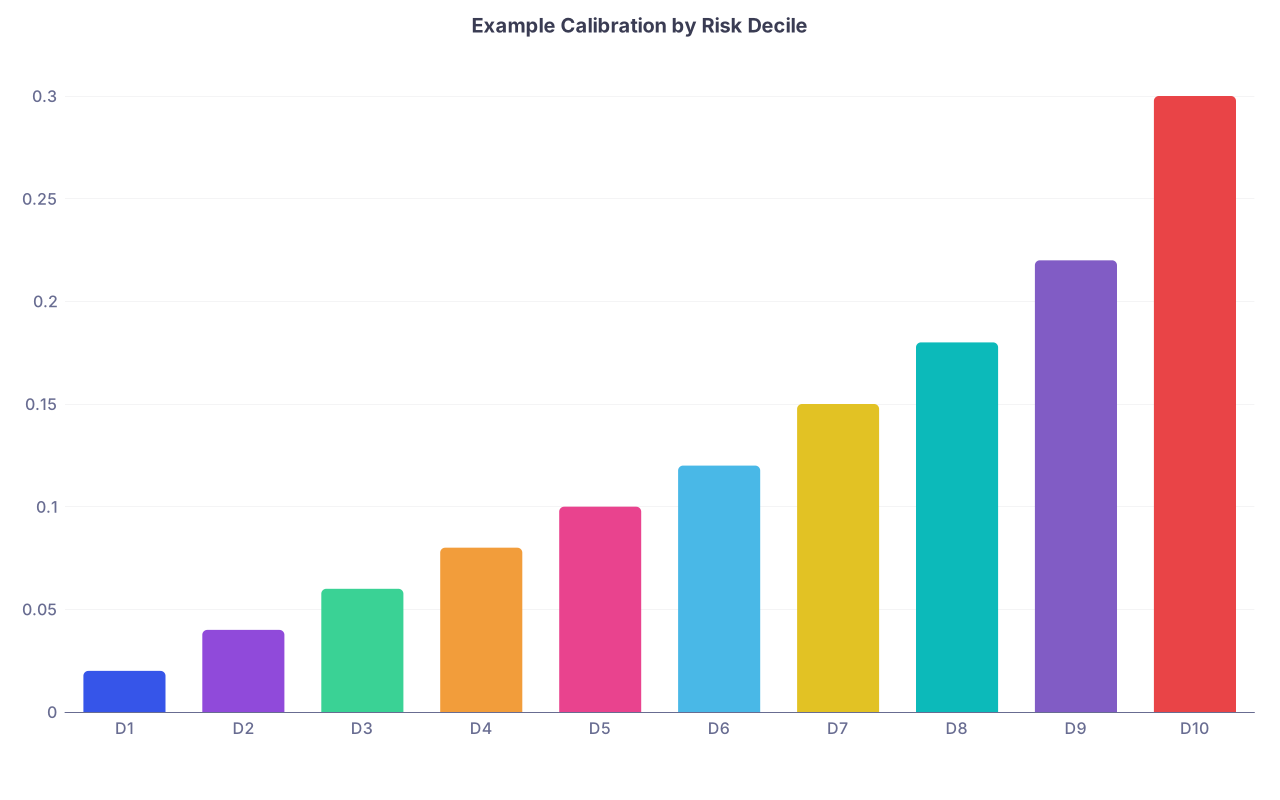
Take all predictions, group them into K bins by predicted risk (often deciles, K=10). For each bin:
- Compute average predicted risk
- Compute observed event rate
Then plot predicted vs observed. Perfect calibration lies on the 45° line.
You can also summarize each bin by an Expected/Observed (E/O) ratio:
- E/O = (mean predicted risk) / (observed event rate)
If E/O = 1 → perfect calibration.
If E/O > 1 → systematically overpredicting risk.
If E/O < 1 → underpredicting.
| Category | Value |
|---|---|
| D1 | 0.02 |
| D2 | 0.04 |
| D3 | 0.06 |
| D4 | 0.08 |
| D5 | 0.1 |
| D6 | 0.12 |
| D7 | 0.15 |
| D8 | 0.18 |
| D9 | 0.22 |
| D10 | 0.3 |
Suppose the observed event rates are:
- [0.01, 0.03, 0.05, 0.07, 0.09, 0.11, 0.13, 0.17, 0.24, 0.35]
That means at the top decile you are predicting 30% but observing 35%. This gap matters when clinicians are deciding who is “very high risk” and which patient gets the last ICU bed.
2.2 Brier score – overall calibration plus discrimination
The Brier score is just mean squared error for probabilistic classifiers:
Brier = (1/N) * Σ (pᵢ − yᵢ)²
where pᵢ = predicted probability, yᵢ ∈ {0,1}
Lower is better. A perfectly calibrated, perfectly discriminating model has Brier = 0.
Random guessing at event rate r has Brier = r(1−r).
You usually compare:
- Uninformative baseline (e.g., always predict base rate 0.10)
- Your model
If the baseline Brier is 0.09 and your model is 0.085, the incremental gain is trivial. Any “wow” factor in ROC curves is fake comfort; this model barely improves expected squared error.
2.3 Calibration intercept and slope
Fit a logistic regression:
logit(y) = α + β * logit(p_model)
- α (intercept) tests global miscalibration (systematically too high or low)
- β (slope) tests whether predictions are too extreme (β < 1) or too conservative (β > 1)
Ideal: α = 0, β = 1.
Values far from that indicate you need recalibration. Which almost no one does after deployment. They should.
3. Drift: Why Models Degrade after You Go Home for the Weekend
Model drift is not esoteric. It is two basic phenomena:
- Data (covariate) drift – input feature distributions change
- Concept drift – the relationship between features and outcome changes
Both are guaranteed in healthcare.
3.1 Covariate drift: the population you trained on no longer exists
Signs you will see in raw data:
- Age distribution shifts (e.g., new catchment area, new service lines)
- New EHR version that changes coding patterns (ICD‑10 updates, new lab codes)
- A pandemic. Or a new oncology program. Or a hospital merger.
From a numeric perspective, think:
- P_train(X) ≠ P_deploy(X)
Basic drift detection can be done with population statistics:
- Kolmogorov‑Smirnov test on continuous variables
- Population stability index (PSI) across time windows
- Chi‑square tests for categorical shifts
If your PSI for a key feature (e.g., comorbidity index, baseline creatinine) exceeds common thresholds (e.g., PSI > 0.25 = large shift), you should assume performance has changed and re‑check calibration and discrimination.
3.2 Concept drift: medicine itself changed
This one is subtler and more dangerous.
P(Y|X) changes while P(X) may look stable.
Concrete cases:
- Sepsis bundle adoption increases early antibiotic use. The relationship between early vitals and later sepsis changes.
- New anticoagulant protocol shifts bleeding vs thrombosis risk for similar patients.
- COVID waves change mortality patterns for the “same” comorbidity profile.
Your model was tuned on:
f_old(X) → Y
But the true data‑generating process becomes:
f_new(X) → Y
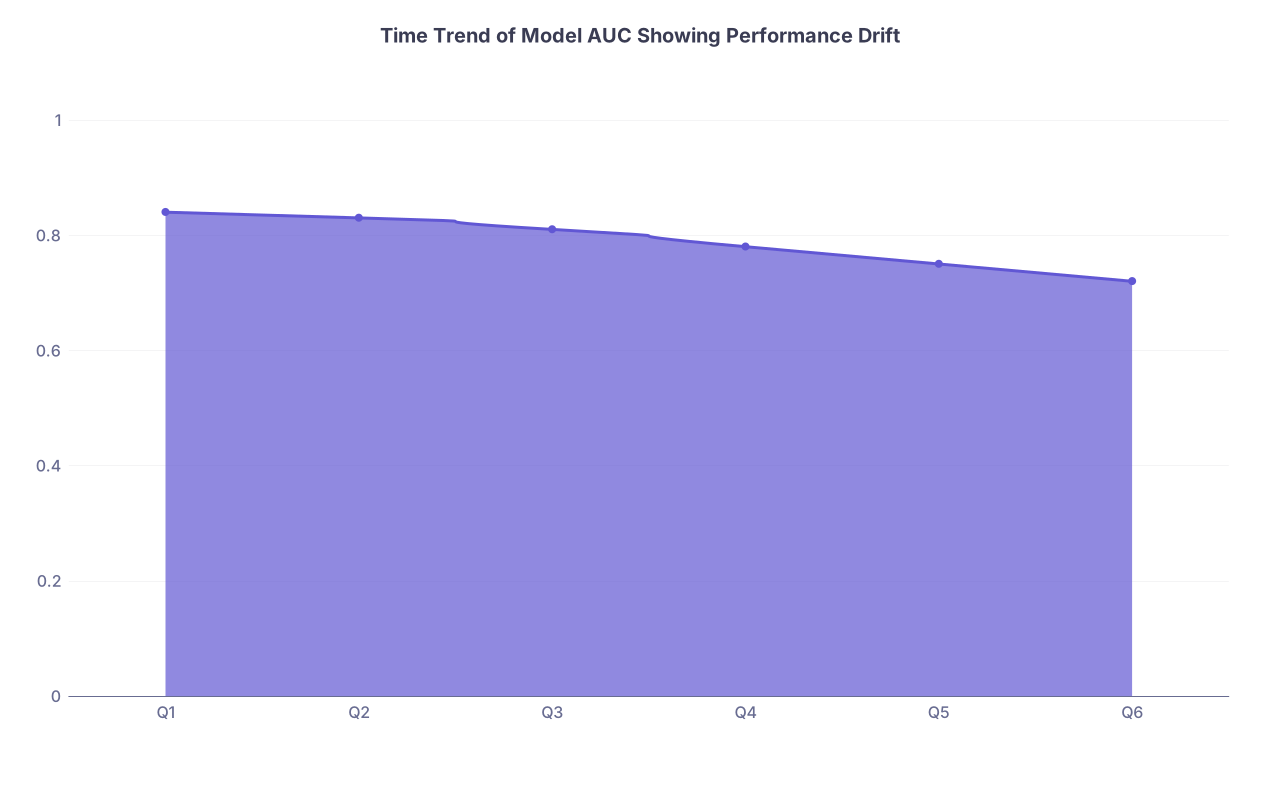
Your nice calibrated score is now systematically wrong. You will see this if you track:
- Time‑segmented AUC: declining c‑statistic over months / quarters
- Calibration plots over time: slope moves away from 1, intercept shifts
- E/O ratio drifts from ~1 to 1.3, 1.5, 2.0…
The data is screaming at you: “this is not the same world anymore.”
| Category | Value |
|---|---|
| Q1 | 0.84 |
| Q2 | 0.83 |
| Q3 | 0.81 |
| Q4 | 0.78 |
| Q5 | 0.75 |
| Q6 | 0.72 |
Once you see a pattern like that, you have three options:
- Recalibrate only (if discrimination remains acceptable)
- Retrain with new data
- Retire the model
Most hospitals pick option 4: ignore it and keep marketing the system in internal newsletters.
4. Real‑World Failure Modes: How Risk Scores Go Off the Rails
Let me be blunt: I have seen more failure than success when hospitals roll out production risk scores. The pattern repeats.
4.1 “Strong” ROC performance, weak clinical value
You will see the paper: AUC = 0.85. Looks great.
But you never see:
- Positive predictive value at chosen alert threshold
- Number needed to evaluate (NNE = 1/PPV)
- Workload metrics (alerts per 100 admissions per day)
- Impact on outcome after accounting for secular trends
AUC is averaged across every possible threshold. Clinicians use exactly one threshold (or a small set). That local performance matters.
Example:
- Prevalence of event = 5%
- Model AUC = 0.85
- At sensitivity 0.80, specificity may be 0.75
- PPV at that threshold = (0.05 * 0.80) / [0.050.80 + 0.950.25] ≈ 0.145
So about 14.5% of alerts are true events. 85.5% are noise.
Now assume:
- 200 admissions per day
- 5% event rate → 10 true events daily
- Sensitivity 0.80 → 8 events detected
- False positives = 0.25 * 190 ≈ 47.5
Daily alert volume ≈ 8 true + 48 false = 56 alerts/day.
One in seven matters.
Clinicians will ignore most. Over a month, your “state‑of‑the‑art” system becomes background noise.
4.2 Calibration bias by subgroup
No one trusts a system that persistently mislabels their patients. Racial, socioeconomic, and language‑based bias typically does not show up in global AUC. It shows up in subgroup calibration.
Example pattern I have seen:
- Model trained predominantly on insured, English‑speaking, white patients
- Deployed in a safety‑net hospital with high uninsured and non‑English‑speaking population
Global performance:
- AUC overall: 0.82
- Brier overall: 0.07
Subgroup‑stratified calibration, event = ICU transfer:
- White, insured: predicted risk 0.20, observed 0.21 → good
- Black, uninsured: predicted 0.10, observed 0.18 → underprediction
- Hispanic, limited English: predicted 0.12, observed 0.22 → underprediction
On paper: “Model generalizes reasonably well.”
In reality: you are systematically under‑escalating care for exactly the patients who already face access barriers.
You do not fix this with PR or an ethics statement. You fix it with data:
- Reweight training data
- Incorporate social risk variables carefully
- Recalibrate per subgroup or use group‑aware calibration strategies
- Monitor subgroup calibration quarterly, not as a one‑time audit
4.3 Gaming and feedback loops
Once risk scores drive real decisions (e.g., bundled payments, staffing), people adapt.
Two recurrent patterns:
- Code inflation – Document more comorbidities to increase predicted risk, which can justify more resources or better apparent model performance. This breaks P(X) and thus your calibration.
- Treatment leakage – The model’s recommendations change care, which changes outcomes, which changes the apparent accuracy of the model.
Example: a deterioration model flags patients for early ICU transfer.
- High‑risk patients are moved quicker
- Their mortality drops
- Now the model “overpredicts” mortality for similar‑risk patients, because your intervention changed the outcome process
Your evaluation data is no longer independent of your model. If you ignore this, you will be misled by apparent “degradation” or “improvement” that is in fact just the effect of your own actions.
5. Deployment Reality: Monitoring Like an ICU, Not a Poster
You would never start a vasoactive drip and then just “check back in a year.” Yet many health systems do this with risk scores.
At post‑residency stage, if you are involved in quality, informatics, or clinical leadership, you will eventually be asked something like, “Can you help us understand if this model is still working?” You should know what a basic monitoring stack looks like.
5.1 Minimum monitoring set
You want this per quarter at least, monthly for critical models:
- Input data quality
- Missingness rates by feature
- Distribution shifts (PSI, KS tests)
- Discrimination
- AUC overall
- AUC by key subgroups (age, sex, race/ethnicity, insurance)
- Calibration
- Global calibration plot
- Calibration slopes and intercepts
- E/O ratios by decile and by subgroup
- Operational metrics
- Alert volume per day / per 100 admissions
- PPV, NPV, sensitivity, specificity at deployed threshold
- Clinician response rates to alerts (acknowledged, acted upon)
| Metric | Target | Alert Threshold |
|---|---|---|
| AUC overall | ≥ 0.80 | < 0.75 |
| Brier score | ≤ 0.08 | > 0.10 |
| Calibration slope | 0.9–1.1 | < 0.8 or > 1.2 |
| E/O ratio (overall) | 0.9–1.1 | < 0.8 or > 1.25 |
| Alert PPV at threshold | ≥ 0.20 | < 0.15 |
When a metric breaches its threshold, that should trigger a real event: review, recalibration, possibly model suspension.
5.2 Recalibration strategies that actually work
If discrimination remains acceptable but calibration has drifted, you rarely need a full rebuild. You can often recalibrate on a rolling window of, say, the last 6–12 months.
Common approaches:
- Platt scaling – Fit a logistic regression on the model’s log‑odds to refine probabilities
- Isotonic regression – Non‑parametric mapping from predicted scores to calibrated probabilities
- Bayesian updating – Adjust baseline risk and slope using new data priors
The key is that you treat the original model’s score as a feature, not as a sacred final probability. Once you see calibration slope deviate meaningfully from 1, you re‑estimate that mapping.
This is cheap. It is statistically routine. Yet many vendors treat “frozen model parameters” as a selling point. That might be commercially convenient. It is not clinically defensible.
6. Where Clinicians Get Burned (and How to Protect Yourself)
You may not be the data scientist, but you will be the one whose name ends up in the committee minutes if bad AI hurts people. So you need a small, sharp toolkit for self‑defense.
Here is what you ask for before trusting or promoting a risk score:
Show me the calibration plot on our data, not just the published cohort.
- If they cannot, they do not have a serious deployment process.
Break it down by subgroup.
- Age groups (e.g., <50, 50‑69, ≥70)
- Sex
- Race/ethnicity
- Insurance / socioeconomic proxy
If you see repeated underprediction in marginalized groups, you stop.
Show the confusion matrix at the deployed threshold.
- True positives, false positives, true negatives, false negatives
- Then report PPV and NPV, not just AUC
Quantify workload.
- “How many alerts per 24 hours on an average nursing unit?”
- “How many of those ended in the event within the prediction horizon?”
Ask about drift monitoring.
- “What will be checked monthly?”
- “What thresholds will trigger recalibration or shutdown?”
This is not being difficult. This is the minimum level of statistical hygiene when patient care is at stake.

| Step | Description |
|---|---|
| Step 1 | Model development |
| Step 2 | Internal validation |
| Step 3 | External validation |
| Step 4 | Local calibration |
| Step 5 | Production deployment |
| Step 6 | Ongoing monitoring |
| Step 7 | Recalibrate or retrain |
| Step 8 | Suspend model |
Notice that in that flow, “publication” does not appear. Because journals do not keep patients safe. Your monitoring and governance do.
7. Post‑Residency Reality: Jobs, Liability, and Who Owns the Model
After residency, especially if you drift toward informatics, quality, or leadership roles, you will see job descriptions full of phrases like “oversight of predictive analytics,” “AI governance,” and “clinical decision support optimization.” This is where the abstract statistics hit your day‑to‑day reality.
Three blunt facts:
Liability will land closer to clinicians than vendors.
If a risk score nudges a team away from appropriate escalation and a patient dies, families and lawyers rarely sue the algorithm directly. They sue the health system and the clinicians. From a risk‑management standpoint, you must insist on transparent performance data.Calibrated mediocrity beats uncalibrated excellence.
A model with AUC 0.78 and rock‑solid calibration in your population will deliver more real‑world value than a “cutting‑edge” 0.90 AUC model trained elsewhere with no local recalibration. The data shows that local context and monitoring dominate theoretical algorithmic superiority.Governance is a job, not a formality.
An AI oversight committee that meets quarterly, reviews calibration reports, and actually pauses tools when they drift is a competitive advantage. It saves lives and reduces regulatory exposure. You want to be the person in that room who can read the charts and call nonsense when you see it.