No, AI is not coming for your job. It is coming for your bad habits, your mediocre workflows, and the parts of your day you secretly hate but learned to tolerate.
Let’s cut through the noise. Hospital administrators are whispering about “automation efficiencies.” Conference speakers are waving around ChatGPT screenshots like they’ve discovered fire. Some attendings half-joke on rounds: “Radiology is dead. Pathology is next.” Residents grimly laugh and then Google “non-clinical careers.”
Most of this is nonsense.
AI will absolutely transform how physicians work. But replacement? For the vast majority of clinicians in the next 20–30 years, that is fantasy or fear-mongering. The data simply does not support the “doctors obsolete” narrative.
Here is what’s actually changing—and what is not.
The Myth of the Fully Automated Doctor
The claim: “AI will diagnose better than doctors, so why keep the doctors?”
This line gets thrown around a lot, usually by people who have never managed a crashing patient at 3 a.m., broken bad news to a family, or argued with insurance for a necessary drug.
You’ll hear references to studies where AI “beats doctors” at narrow tasks: reading retinal images, spotting lung nodules, classifying skin lesions. And yes, those papers exist. But they’re not telling you the whole story.
Look at what these systems are actually doing: constrained, single-task pattern recognition under ideal conditions with carefully curated datasets. Great for benchmarking. Dangerous to extrapolate.
Even in radiology—the favorite punching bag in these debates—the reality is stubbornly boring.
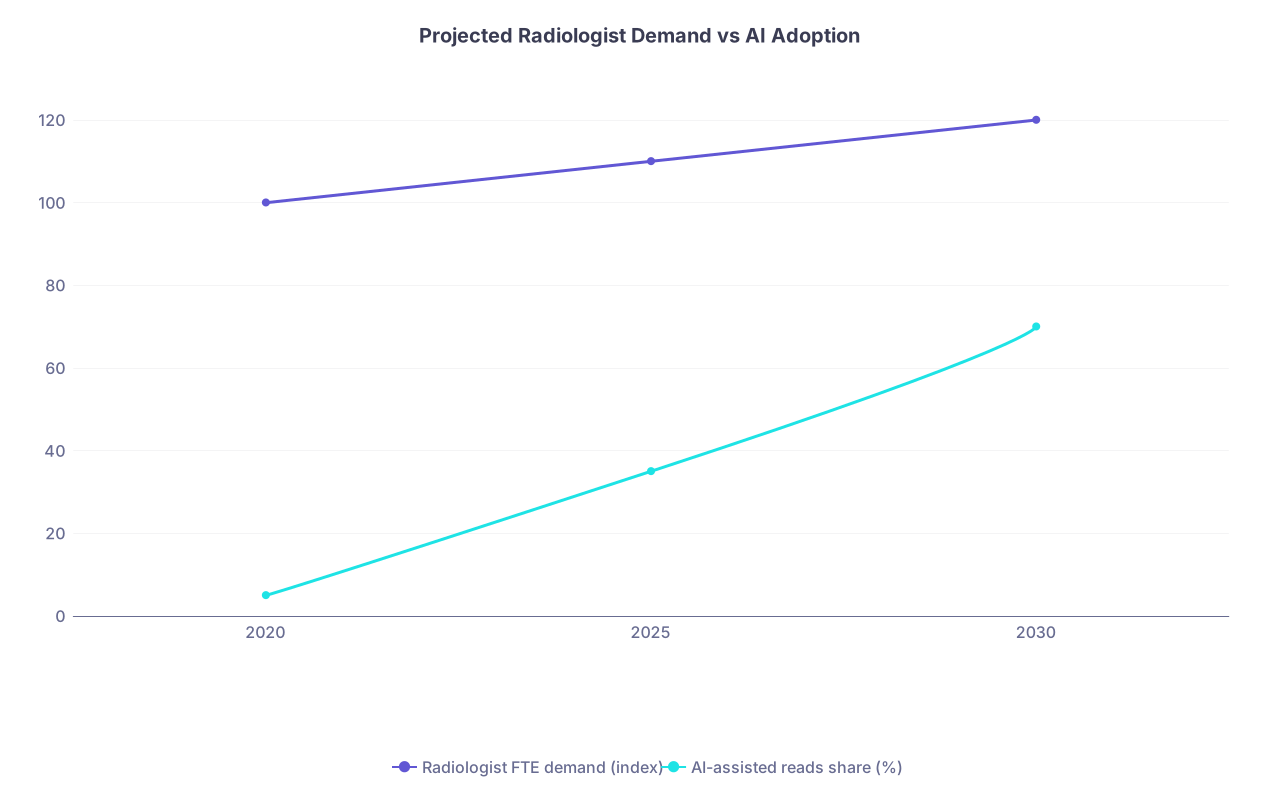
| Category | Radiologist FTE demand (index) | AI-assisted reads share (%) |
|---|---|---|
| 2020 | 100 | 5 |
| 2025 | 110 | 35 |
| 2030 | 120 | 70 |
We are seeing two simultaneous trends in high‑income countries:
- Demand for imaging and complexity of studies keep rising.
- AI tools are increasingly embedded in workflows.
If AI were replacing radiologists, vacancy rates would shrink and training spots would be cut aggressively. In reality, many systems still struggle to fill radiology positions, and national societies (e.g., in the US, UK, Canada) are projecting continued workforce need, not collapse. The promise is not “one AI instead of five radiologists.” It is “the same or more radiologists doing more with less pain.”
The “AI replaces doctors” myth also ignores the real bottlenecks in care: system-level dysfunction, staffing shortages, regulation, and human behavior. The thing stopping your discharge today is not a missing convolutional neural network. It is social work, placement, prior authorization, pharmacy delays, and plain old decision paralysis.
AI will touch some of that. But it cannot sign orders, take legal responsibility, or testify in court. You still can.
What Automation Actually Targets in Your Work
Here’s the uncomfortable truth: AI is not aimed at your medical judgment first. It is aimed at your time.
Specifically, the garbage parts.
Every physician I know complains about documentation. Prior auth. Inbox overload. Repetitive messages. Manual data entry. Reconciling meds across three incompatible systems. Clicking the same order set 200 times a week.
That’s where serious investment is going.

Look at where big players are actually deploying AI and automation post‑2020:
- Ambient scribing and automated note generation (Epic ambient, Nuance DAX, Abridge).
- Triage tools for inbox and messaging (filtering low-value messages, drafting replies).
- Clinical summarization of prior records for new consults.
- Drafting appeal letters and prior auth requests.
- Order set suggestions and decision support inside the EHR.
This is not theoretical. It’s live in outpatient clinics and hospital systems right now.
These tools don’t substitute for your medical license. They substitute for your keyboard.
They will compress the time you spend on what is essentially admin disguised as medicine. And that leads to an important shift: your value will be less about being the only one who can push certain buttons, and more about being the one who can decide which buttons should be pushed at all.
An AI can pre-draft a note. It cannot decide whether that patient actually should be admitted, or whether “observe at home and call me tomorrow” is the right call given their social situation, risk tolerance, and your gut from three similar cases that went sideways.
What the Evidence Really Shows About AI Performance
Let’s deal with performance claims head on.
Yes, large language models and medical foundation models can now:
- Pass licensing exams.
- Generate decent differential diagnoses.
- Draft discharge summaries.
- Propose management plans that are… not terrible.
The hype cycles on these results are exhausting. What gets less attention are the constraints and the failure modes.
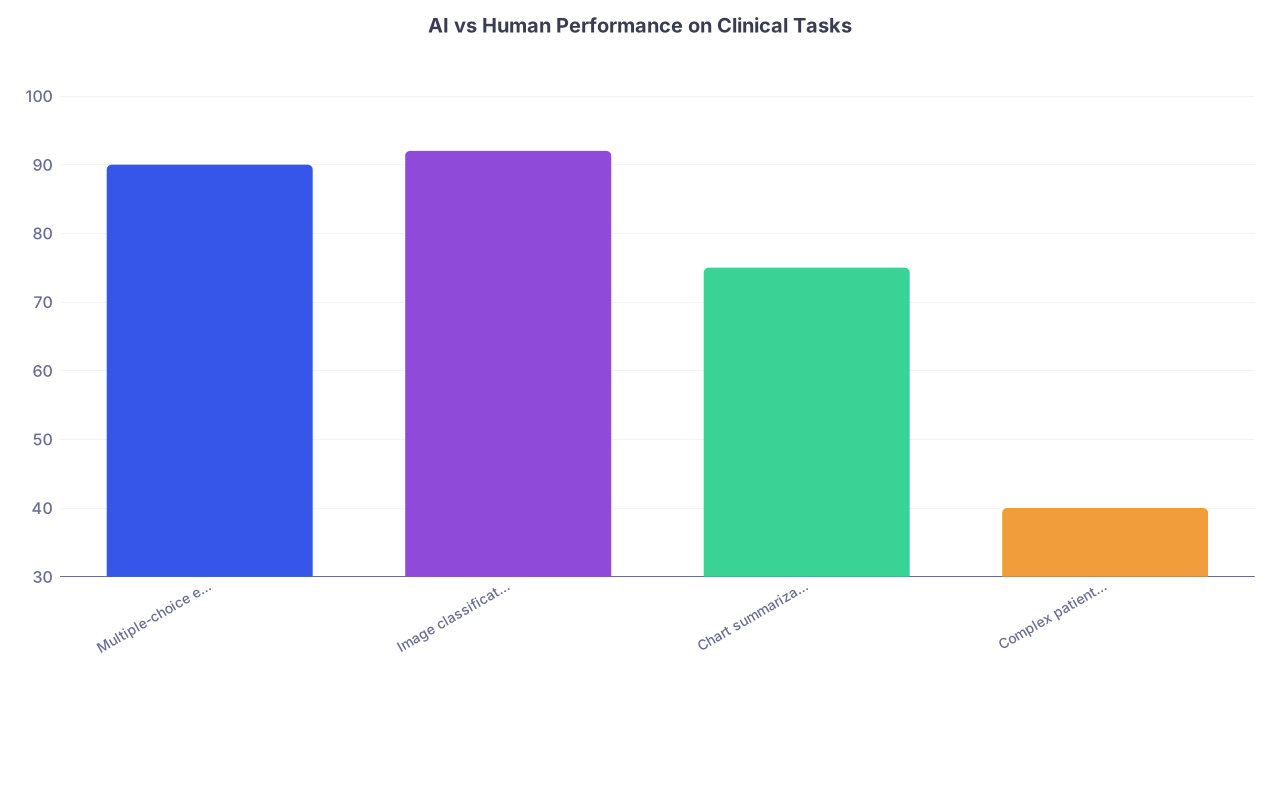
| Category | Value |
|---|---|
| Multiple-choice exams | 90 |
| Image classification | 92 |
| Chart summarization | 75 |
| Complex patient management | 40 |
Roughly speaking (numbers here represent approximate relative performance vs expert clinicians, not strict percentages):
- Multiple-choice exams: AI can match or exceed average test takers. So what? Exams are stylized, constrained, and heavily pattern-based.
- Image classification: Very strong at narrow tasks. But error patterns are weird—confidence does not equal safety, and domain shift (different scanners, populations, artifacts) breaks performance quickly.
- Chart summarization: Good enough to help you, not good enough to trust unsupervised.
- Complex patient management: Still bad at context, competing priorities, and real-world tradeoffs. It will hallucinate, double-book, ignore the family constraint that “I cannot get here daily,” and blithely suggest options you know your system cannot deliver.
The key pattern: AI does best where the problem is tightly defined and information complete. Your work is rarely like that. The intern on their first month may have the same textbook knowledge as you on paper. You would still not let them run an ICU alone.
AI is like that intern—on steroids, always awake, but still an intern. It needs supervision, guardrails, and someone who knows when to ignore it.
So no, it is not “better than doctors.” It is better than nothing in specific narrow jobs. That is very different.
Where Your Role Actually Grows, Not Shrinks
Here’s the part almost no administrator presentation will admit: as systems get more complex and more automated, the value of real clinical judgment goes up, not down.
Because two things happen simultaneously:
- The easy, low‑risk, protocolized decisions get increasingly automated.
- The cases that reach you become more complex, ambiguous, and politically fraught.
You will see fewer straightforward UTIs, more “I’ve been to three clinics and two ERs, nobody can figure this out.” Fewer “check the box” refills, more “this 82‑year‑old with CKD, CAD, and dementia is on 18 meds; what actually matters for her?”

| Step | Description |
|---|---|
| Step 1 | Current State |
| Step 2 | High volume simple cases |
| Step 3 | Moderate number complex cases |
| Step 4 | AI Automation |
| Step 5 | Simple cases handled by protocols |
| Step 6 | More complex cases reach physician |
Automation pushes you up the complexity ladder. That is not replacement. That is triage.
Your value shifts away from:
- Memorizing every guideline detail.
- Being a living order set.
- Acting as a human fax machine between patient, pharmacy, and insurer.
and toward:
- Weighing risks under uncertainty.
- Managing conflict between patient preference, system constraints, and medical best practice.
- Coordinating among AI outputs, other clinicians, and the patient’s reality.
- Taking legal and moral responsibility for decisions.
Here’s the part you already know but rarely say out loud: patients do not trust institutions. They trust people. They may tolerate a chatbot, but when they are scared, they still want a human saying, “I’ve got you. Here’s what we’re going to do.”
That role does not vanish. It becomes more central—and more contested. Because a future where AI is everywhere is not a future with less need for trusted humans. It is a future where attention is scarce and trust is the premium currency.
Where You Actually Are at Risk: Not Learning to Work With the Tools
Let me be blunt. Your job isn’t going away. But your current way of working might.
The risk is not that AI makes physicians irrelevant. The risk is that:
- Physicians who refuse to adopt efficient tools become slower, more error‑prone, and more expensive to employ.
- Physicians who learn to orchestrate AI tools become the new standard of “minimum expected productivity.”

Think of EHRs 15 years ago. The doctors who fought them tooth and nail didn’t lose their licenses, but many ended up marginalized, forced into niches, or retiring early because they could not keep up with the documentation load compared to colleagues who adapted. The Frankenstein EHRs were the problem—but so was total refusal to engage.
AI will be similar, but faster.
You do not need to become a programmer. You do need to:
- Learn how to check AI outputs quickly and systematically.
- Understand which use cases are safe for delegation (drafting notes, summarizing charts, patient education handouts) and which are not (autonomous ordering, independent diagnosis).
- Get comfortable saying “the AI is wrong here” and documenting why.
There will be a real performance gap between the physician who:
- Lets ambient AI generate the bulk of the note, edits for nuance, and moves to the next patient,
and the physician who:
- Types every line manually, re-writes the same education text, and spends half their evening in the inbox.
Guess which one administrators will quietly prefer to hire.
That does not mean you must become a compliance puppet chasing meaningless metrics. It does mean that if you want leverage—time for thinking, time for complex patients, time for your own life—you should be the one controlling these tools, not pretending they do not exist.
The Economic Reality: Why Replacing You Isn’t Actually Attractive
The other side of the story is financial. Replacing physicians outright with AI is not just technically hard. It is economically and legally unattractive in most systems.
Look at incentives:
- Malpractice and liability: Who gets sued if an AI misdiagnoses? Right now, the safest answer for hospitals is “make sure there is a physician in the loop.”
- Regulation: Fully autonomous medical AI that actually replaces clinical judgment would face a brutal approval landscape. The FDA, EMA, and other regulators are barely keeping up with static tools, never mind continuously learning systems.
- Public trust: Hospital boards are not eager to be the first headline case of “Hospital’s AI Kills Patient.” They will move conservatively whether you like it or not.
What’s attractive instead? Using AI to:
- Shift lower-value tasks away from highly paid physicians to cheaper staff, or to software directly.
- Increase patient throughput per physician without hiring more.
- Reduce burnout (at least on paper) by making documentation less miserable.
| Target Task/Role | AI Likely Effect |
|---|---|
| Manual documentation | Largely automated |
| Simple triage / reminders | Partially automated |
| Protocolized chronic care | Team-based + AI supported |
| Complex diagnosis | Enhanced, not replaced |
| Therapeutic decision-making | Enhanced, not replaced |
This is not a robot‑replaces‑doctor scenario. This is a “squeeze every drop of efficiency out of existing clinicians” scenario. Ethically dubious at times. But very different from “You’re redundant, go home.”
How to Make Yourself “AI-Resilient” as a Physician
If you’re post‑residency or entering the job market, here’s the mindset you actually need:
You are not defending against AI. You are competing against other physicians who also have AI.
So the useful question is: what makes you valuable in that environment?
Three practical moves that actually matter:
First, lean into the parts of medicine that are hardest to formalize. Complex multi-morbidity. Geriatrics. Palliative care. Transitions of care. Psychosocially messy situations with conflicting priorities. AI will assist here, but these are structurally resistant to full automation because the objective function—“what is best”—is not stable or easily encoded.
Second, get fluent in AI‑augmented workflows. That means you actually try the ambient scribe, the LLM summarizer, the decision support. You don’t just roll your eyes at grand rounds. You stress‑test the tools on known cases, see where they fail, and build intuition. The physician who can say “I used it, here’s what it’s good for, here’s where it’s dangerous” will own the conversation; the one who only says “this is stupid” from the sidelines will get sidelined.
Third, guard the human parts of care like they are your competitive edge—because they are. Communication, conflict resolution, shared decision-making, building trust with patients who hate the system. None of that is fluff. It is the one thing both patients and systems will still pay real money for when everything else is commoditized.
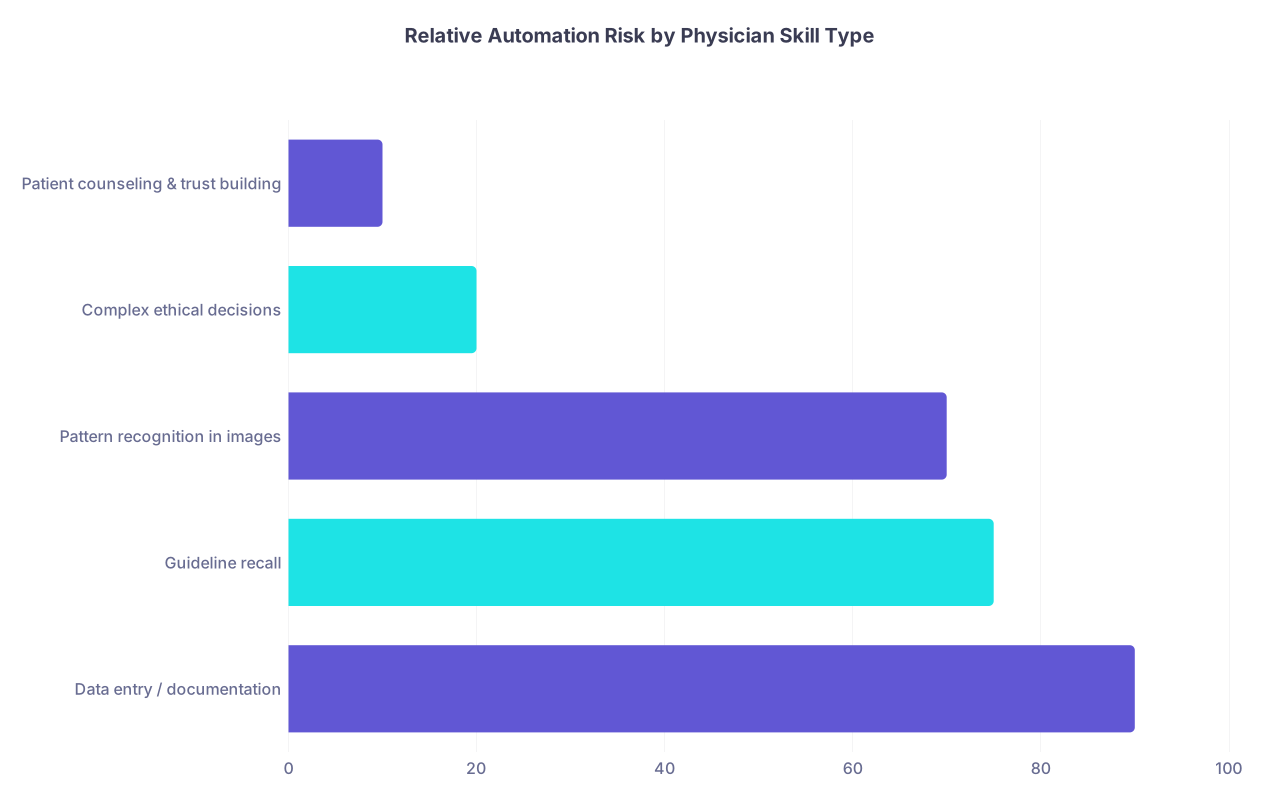
| Category | Value |
|---|---|
| Data entry / documentation | 90 |
| Guideline recall | 75 |
| Pattern recognition in images | 70 |
| Complex ethical decisions | 20 |
| Patient counseling & trust building | 10 |
Notice where the true low‑risk zones are: ethics, judgment, trust. That’s your moat.
The Real Threat Isn’t AI. It’s Passive Physicians.
Let me end where most conversations about AI and medicine refuse to go.
The real hazard to your career is not the algorithm. It is complacency.
If you sit back, let vendors, administrators, and regulators design everything without clinician input, you will absolutely get stuck in a system where AI is used against you: to track your clicks, measure your RVUs to the decimal, and nudge you to see “just two more patients per day” because “the tools make it easier now, right?”
If you engage early—test tools, push back on unsafe use, advocate for guardrails, insist documentation gains translate into actual schedule relief—you are in a different universe. You become the person they come to when they want to roll out the next system. That is leverage.
Summary, stripped down:
- AI is not replacing physicians anytime soon; it is attacking the administrative sludge and low‑complexity edge of your work, not your core clinical judgment.
- Your risk is not obsolescence; it is falling behind colleagues who learn to harness AI to be faster, safer, and less burned out.
- The safest place in an automated health system is not outside it, shaking your fist. It is inside, as the human who knows when to say “yes, use it here” and when to say “no, I’ll take it from here.”