
The popular story that “more clicks = worse care” is lazy, half-true, and often wrong in the ways that matter.
You’ve heard the rant in every physician lounge. “I spent 3 hours charting last night.” “The EHR is killing medicine.” “I click more than I doctor.” The villain is always the same: clicks, keystrokes, screen time. And the moral is always: more EHR = worse care.
Let’s be blunt. The burden is real. Burnout is real. But the idea that click counts alone are destroying care is a myth built on vibes, not data.
The actual EHR data paints a messier picture: some “click-heavy” patterns are strongly linked to worse outcomes and higher burnout. Other high-use patterns are associated with better quality, safer care, and fewer malpractice events. The difference is not “how much” you click. It is why you’re in the system and how the system is designed.
You cannot fix this by just counting clicks like steps on a Fitbit.
What the Data Actually Says About EHR Time, Clicks, and Outcomes
Let me start with the uncomfortable truth: yes, physicians spend a staggering amount of time in the EHR. That part of the story is not exaggerated.
Several large studies using vendor log data (Epic, Cerner, etc.) have shown that physicians routinely spend 1–2 hours in the EHR after scheduled clinic, and often 4–6 hours per day total, depending on specialty. Primary care is usually at the top of the misery list.
But when you dig into outcomes—mortality, readmissions, diagnostic error, patient experience—the relationship is not what the coffee-room folklore claims.
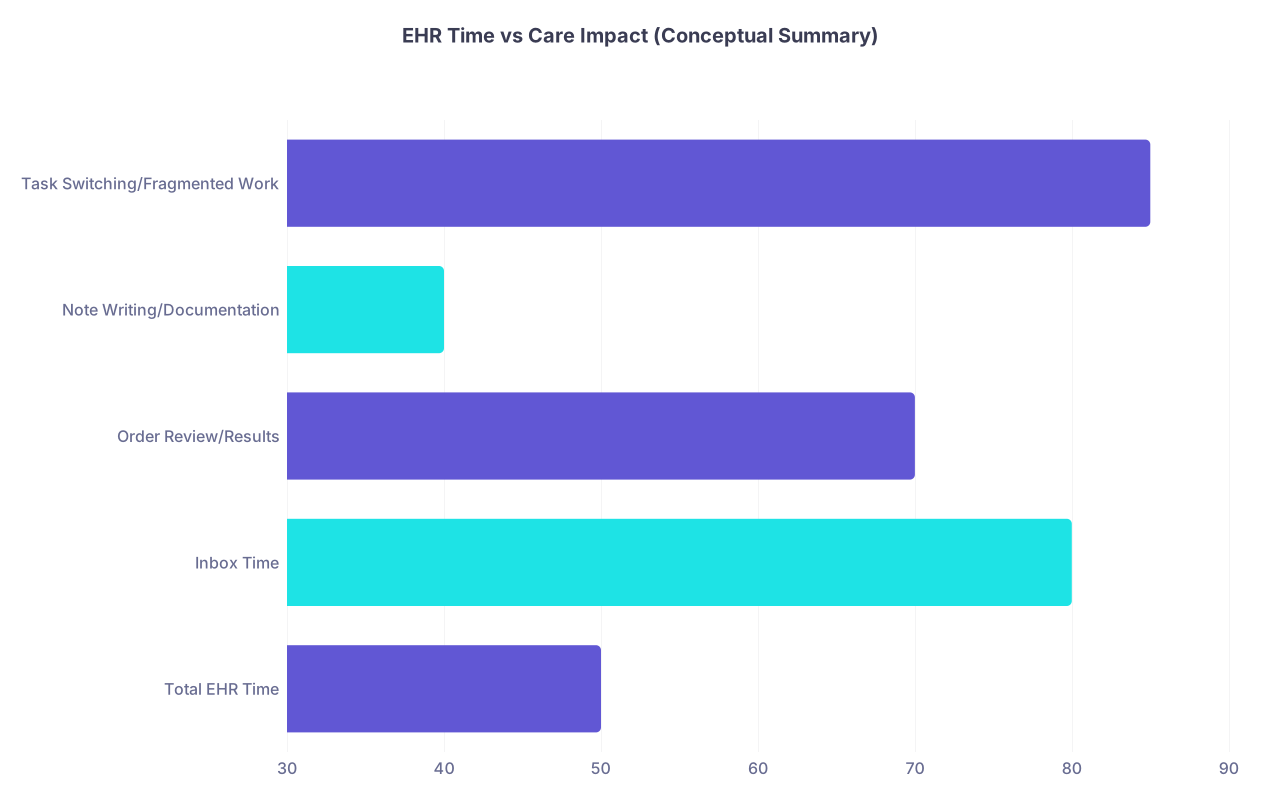
| Category | Value |
|---|---|
| Total EHR Time | 50 |
| Inbox Time | 80 |
| Order Review/Results | 70 |
| Note Writing/Documentation | 40 |
| Task Switching/Fragmented Work | 85 |
Think of those numbers as “how consistently linked this domain is to problems or benefits” (not literal percentages). The real story from the literature looks like this:
- Total EHR time: correlated with burnout, but only weakly and inconsistently tied to objective patient outcomes.
- Inbox/message load: strong link to burnout, emotional exhaustion, and reduced visit capacity. It drains the tank.
- Results review and order management: more time here often equals better test follow-up, medication safety, and fewer missed abnormalities.
- Note bloat and documentation time: mixed; some of it is clearly waste (billing fluff), but some is just the necessary cost of practicing in a complex system.
- Task switching and fragmented work: strongly associated with stress, error risk, and feeling out of control.
Notice what’s missing? Raw click counts.
The systems log everything: mouse clicks, keystrokes, which screen you touched, what order you placed. If “more clicks” directly caused bad care, we’d see a clean dose–response curve. We do not.
What we do see is that certain patterns of use correlate with bad outcomes: chaotic workflows, excessive inbox interruptions, clunky routing of tasks, and interfaces that force you to jump between five screens to answer one basic question about a patient.
The myth is that the quantity of interaction is the villain. The reality is the quality and structure of that interaction.
The Myth of the “Good Old Days” vs What We Can Actually Measure Now
A lot of the nostalgia for pre-EHR medicine is just that: nostalgia. Paper charts were not magical conduits of humanism. They were often illegible, lost, incomplete, and impossible to search.
You could miss a creatinine trend because there were three partial labs in three different sections. You could never see another service’s note unless someone remembered to physically put that sheet in the chart. And tumor boards were run off stacks of photocopies and guesswork.
Today, for better or worse, we can see what clinicians actually do. This is new. And uncomfortable.
We can measure:
- How quickly abnormal test results get reviewed.
- How often discharge meds conflict with home meds.
- How long it takes to sign critical imaging reports.
- Which alerts are always ignored.
- When a clinician spends 30 seconds vs 15 minutes in a chart.
We also know this: clinicians who never check their inbox after 5 p.m. will miss things in a system that is dumping patient messages, lab results, refill requests, and consultant notes on them 24/7. Minimal EHR use is not a virtue if the system around you requires electronic work.
That’s the ugly structural truth: EHRs did not just digitize charts. They became the central nervous system for everything: scheduling, billing, messaging, decision support, quality reporting, regulatory nonsense. The clicks are not just “documentation.” They’re the tax you pay to operate in a massively complicated, under-staffed, liability-heavy environment.
The “good old days” also had errors that were invisible. Today, EHR data drags those errors into the light. That’s painful, but it’s also progress.
Where More EHR Use is Actually Associated with Better Care
Let’s get more concrete. Across multiple health systems, patterns like these show up repeatedly:
Better lab and imaging follow-up.
Clinicians who spend more time in results and order review sections (not just note writing) are less likely to have unacknowledged critical results, missed abnormal labs, or delayed follow-up. This is not subtle; several malpractice insurers now look at this strongly.Safer medication management.
More time in med reconciliation, allergy review, and order verification is tied to fewer adverse drug events. Of course it’s tedious. That doesn’t mean it’s optional if you care about safety.Chronic disease control.
In some population health programs, primary care doctors with higher engagement in EHR-based registries, care gaps lists, and protocol-driven ordering (vaccines, screenings) have better performance on objective metrics like A1c control or blood pressure targets. Yes, metrics can be gamed. But the basic signal—more organized use of EHR tools can improve coverage—is real.
Here’s where a lot of angry EHR rants go off the rails. They conflate “extra clicking” with “meaningless clicking.” That’s not always true.
Some of that “extra” is the cost of doing things that used to be done poorly or not at all: structured medication lists, legible orders, in-system tracking of follow-ups.
Would I love those tasks to be far smoother, faster, and more intelligently automated? Of course. But calling every click “waste” is like complaining that hand-washing takes time.
Where Clicks and EHR Design Clearly Make Care Worse
Now the other side. There are places where the data is damning, and it isn’t subtle.
Fragmented workflows and constant context switching.
When the interface forces you to jump between dozens of screens—chart review, messages, orders, outside records—with poor search, no clear prioritization, and constant interruptions, error rates go up. People miss abnormal results. Orders get half-completed. Notes get copy-pasted incorrectly. The log data shows it: high task-switching density correlates with both burnout and safety issues.Alert fatigue.
When 90–99% of alerts are overridden or ignored, they stop functioning as safety tools and become background noise. There are studies showing that reducing low-value alerts improves compliance with the few that actually matter. Yet many hospitals keep layering in more pop-ups for regulatory or legal reasons.Note bloat and compliance-driven documentation.
Notes have turned into bloated legal/compliance artifacts instead of concise clinical tools. Auto-populated text, templated nonsense, fifteen pages of normal findings. That’s not just annoying; it actively hides useful information. EHR data shows that clinicians often scroll through enormous notes without really reading them. Information density goes down as note length explodes.Inboxes as unfiltered catch-all.
Patient messages, refill requests, clinical alerts, FYI notes from other services, system notices—all pouring into the same place, with weak triage. Inbox load has been clearly associated with emotional exhaustion and lower satisfaction. And unlike some clinical tasks, message content is wildly variable in importance. You can spend 10 minutes on a portal message about vitamin supplements while a critical lab sits two screens away.After-hours encroachment (“pajama time”).
The more work spills into evenings and days off, the more likely burnout follows. EHR logs and well-being surveys align here. It’s not just the raw minutes; it’s the loss of control. You are never really off.
So yes, the system can absolutely make care worse. But again, the culprit isn't just “clicks.” It’s poor design, bad policy, and misaligned incentives pushing the wrong work onto clinicians through the EHR.
The Real Enemy: Misaligned Incentives, Not Just Bad Software
If you’re in practice now, especially post-residency, you already know this: the EHR is being asked to solve problems it was never designed to fix. Or it’s being weaponized by people who never touch patients.
Administrators want the EHR to:
- Capture every billable element.
- Satisfy every quality metric and regulatory checkbox.
- Produce “data” for dashboards, reports, and pay-for-performance schemes.
- Reduce support staff by shifting work to physicians via “self-service” in the software.
All of that lands on your screen.
| EHR Activity Type | Typical Impact on Care Quality |
|---|---|
| Results review | Often positive |
| Inbox/message processing | Mixed, high burnout risk |
| Med reconciliation | Positive if done well |
| Compliance/billing clicks | Neutral to negative |
| Excess alerts/pop-ups | Negative via fatigue |
If you treat all of these clicks as equivalent—if you just say “I had 3,000 clicks today, the system is bad”—you miss the point.
Some of those clicks are doing actual clinical work: adjusting insulin, reconciling meds, checking a CT result before discharge. Others are nonsense tasks policymakers offloaded onto you because “the EHR can do it.”
The data is clear: when systems aggressively push non-clinical, low-value work into the EHR workflow (extra attestations, redundant signatures, excessive documentation requirements), burnout rises without any corresponding benefit in safety or outcomes.
The software is the visible villain. But the puppeteer is policy.
What Can a Practicing Physician Actually Do About This?
You’re not going to rewrite Epic or change CMS rules single-handedly. But pretending you’re powerless is also wrong. A few things that actually move the needle, based on what we know from EHR data and practice transformation projects:
Aggressively separate high-value from low-value EHR work.
You want more of the former, less of the latter. That means pushing hard for:- Team-based inbox management with clear protocols: MAs and RNs handling routine messages, normal results with standard replies, refill protocols for stable meds.
- Delegation of documentation: scribes, template support, smart phrases owned by the team, not just you hand-typing history for every visit.
- Clear routing rules: who gets what alert, what really needs a physician click, what can be batched.
Use the tools that actually reduce chaos.
The same EHR that annoys you also has features most people underuse:- Custom views that surface labs, meds, and imaging trends in one place.
- Order sets that actually match how you practice (once you or your team build them).
- Smart filters for inbox items, separating urgent from non-urgent.
I’ve seen practices cut after-hours charting by 30–40% just by redesigning how they use these features. Not because they clicked less overall, but because they clicked more intentionally during scheduled time.
Push for data-driven optimization, not whining.
Administrators and IT can ignore “the EHR sucks.” They have a harder time ignoring, “Here’s the log data showing we’re spending 20% of our time on a step that does not change care. Remove it.”Vendor logs can show exactly:
- How many clicks a task takes.
- How many different screens are involved.
- How long common workflows take compared to benchmarks.
Use that. Ask for that. Argue from data, not from vibes.
Fight the expansion of junk requirements.
Many of the worst EHR burdens come from local decisions: extra fields, extra checkboxes, extra “hard stops” added because someone wants a report or is afraid of liability. Push back at the source.“Show me the evidence this extra attestation improves care or safety.”
If they cannot, it should not live in your workflow.
The Bottom Line: More Clicks Do Not Automatically Mean Worse Care
So where does that leave us?
The myth is that the EHR is a pure evil that simply converts physician time into garbage clicks and worse care. The data refuses to support that simple story.
- Some high-intensity EHR use—especially results review, med management, population health tools—is tied to better safety and quality.
- Some of the worst burdens—messy inboxes, meaningless documentation demands, bad alert design—are clearly harmful and fixable, but they’re symptoms of policy choices and organizational cowardice, not just software.
If you want sane, sustainable practice in the post-residency world, stop asking “How do I reduce clicks?” and start asking “Which clicks are actually worth my time, and who can handle the rest?”
That’s the difference between being a victim of the system and forcing the system to serve the care you’re actually trying to deliver.
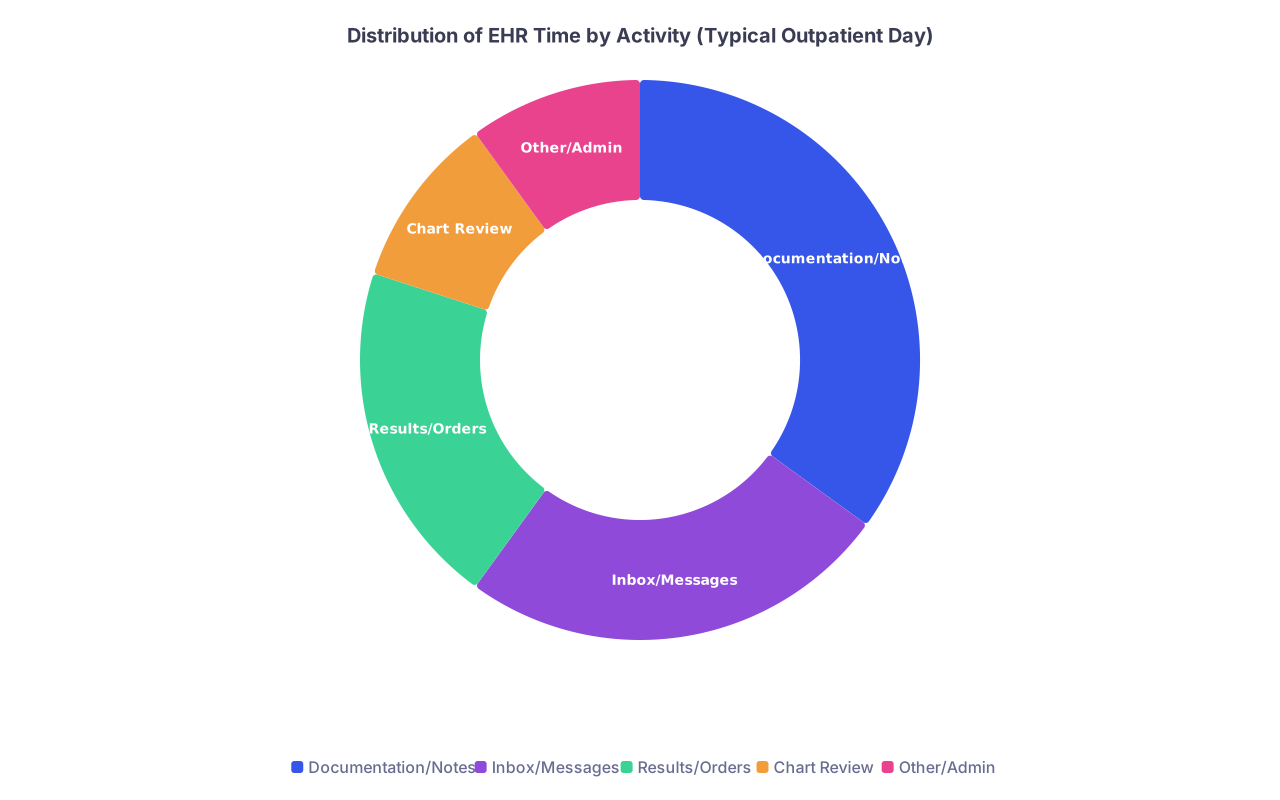
| Category | Value |
|---|---|
| Documentation/Notes | 35 |
| Inbox/Messages | 25 |
| Results/Orders | 20 |
| Chart Review | 10 |
| Other/Admin | 10 |

| Step | Description |
|---|---|
| Step 1 | Start Clinic Day |
| Step 2 | Review Schedule |
| Step 3 | Chart Review |
| Step 4 | See Patient |
| Step 5 | Document Visit |
| Step 6 | Orders and Med Changes |
| Step 7 | Results Follow Up |
| Step 8 | Inbox Messages |
| Step 9 | After Hours Work |
| Step 10 | Compliance Billing Steps |
| Step 11 | RN MA Manage Routine |
| Step 12 | Triaged by Team? |