
The EHR is not ruining your productivity. It’s mostly shining a very harsh light on habits that were already slow, fragmented, and undocumented.
That’s the uncomfortable truth buried under all the “EHR burnout” talk. Yes, some systems are objectively terrible. Yes, bad UI costs real time. But the data—and what I’ve seen in clinics and hospitals across multiple systems—points to something more inconvenient: the fastest, safest clinicians are not magically using a different EHR. They’re using the same clunky software with brutally efficient workflows and disciplined habits.
Let’s separate what the EHR is actually doing to you… from what it’s simply revealing.
The Myth: “The EHR Made My Job Slower”
You hear the same lines in every physician lounge:
- “I used to finish notes by 5. Now I’m charting at 10 pm.”
- “This EHR doubled my documentation time.”
- “I’m spending more time clicking than with patients.”
Some of that is true. But you have to untangle three very different forces that all get lazily dumped into “EHR is bad”:
- Regulatory and compliance creep – what has to be documented now didn’t exist 10–15 years ago.
- Billing and coding escalation – level 4/5 visits with complex templates and required elements.
- Actual software usability – clicks, load times, UI layout, alerts.
Most physicians blame (3). The data says (1) and (2) are doing far more damage.
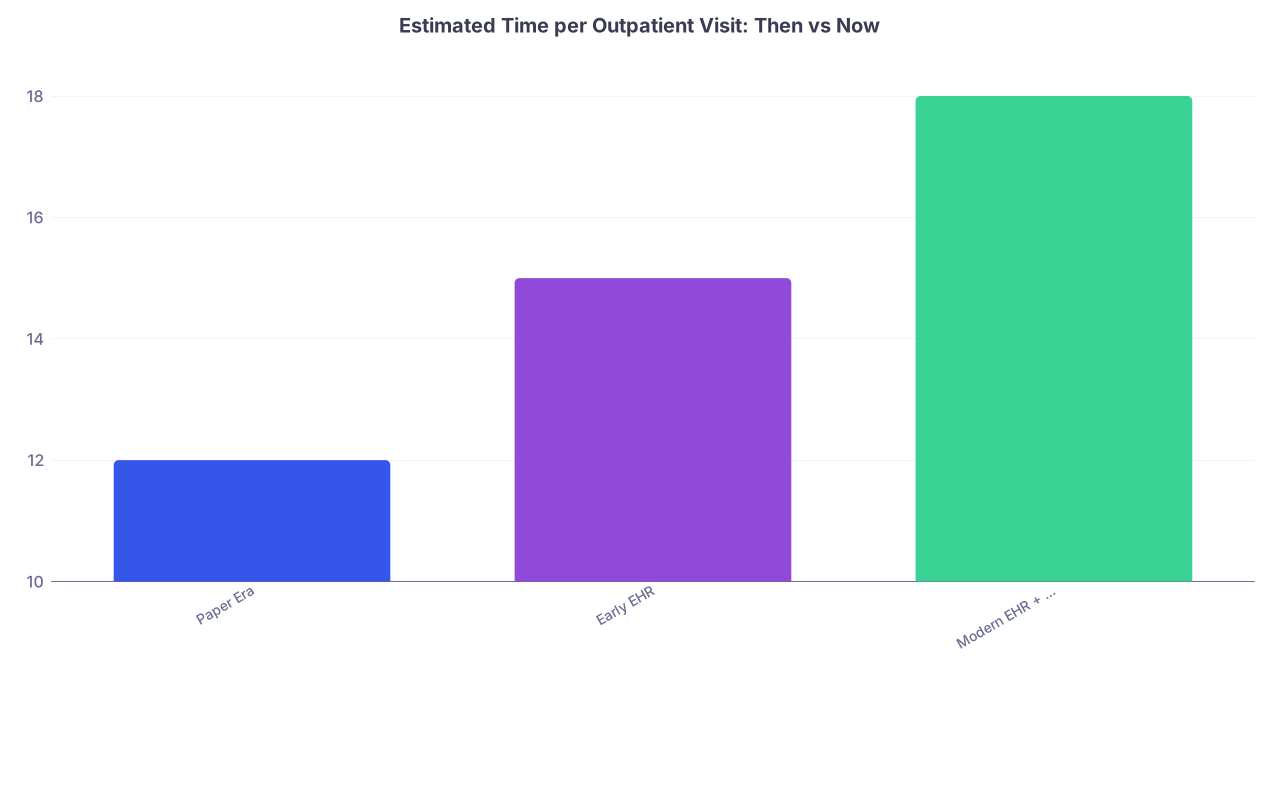
Look at time-motion studies pre- and post-EHR. When hospitals went from paper to EHR, documentation time did increase. But so did documentation requirements. People conveniently forget that part.
| Category | Value |
|---|---|
| Paper Era | 12 |
| Early EHR | 15 |
| Modern EHR + Current Rules | 18 |
A lot of the “EHR made me slow” sentiment is really “the modern practice environment requires more than my 2005 workflow can support.”
The EHR didn’t invent:
- LOOOOONG problem lists
- Medication reconciliation expectations
- Social determinants, screening tools, quality metrics
- Defensive documentation norms in litigious markets
It just made the demands visible, trackable, auditable—and very hard to ignore.
What the Data Actually Shows About Time in the EHR
Let’s get specific instead of hand-wavy.
Several large systems, especially Epic sites, have pulled structured use data on physicians: after-hours time, clicks per order, time per note, inbox volume, etc. The patterns are consistent:
- There’s a huge spread between the fastest and slowest clinicians using the same EHR, same clinic, same templates.
- High-volume, efficient physicians often spend less total time in the EHR per RVU than some lower-volume peers.
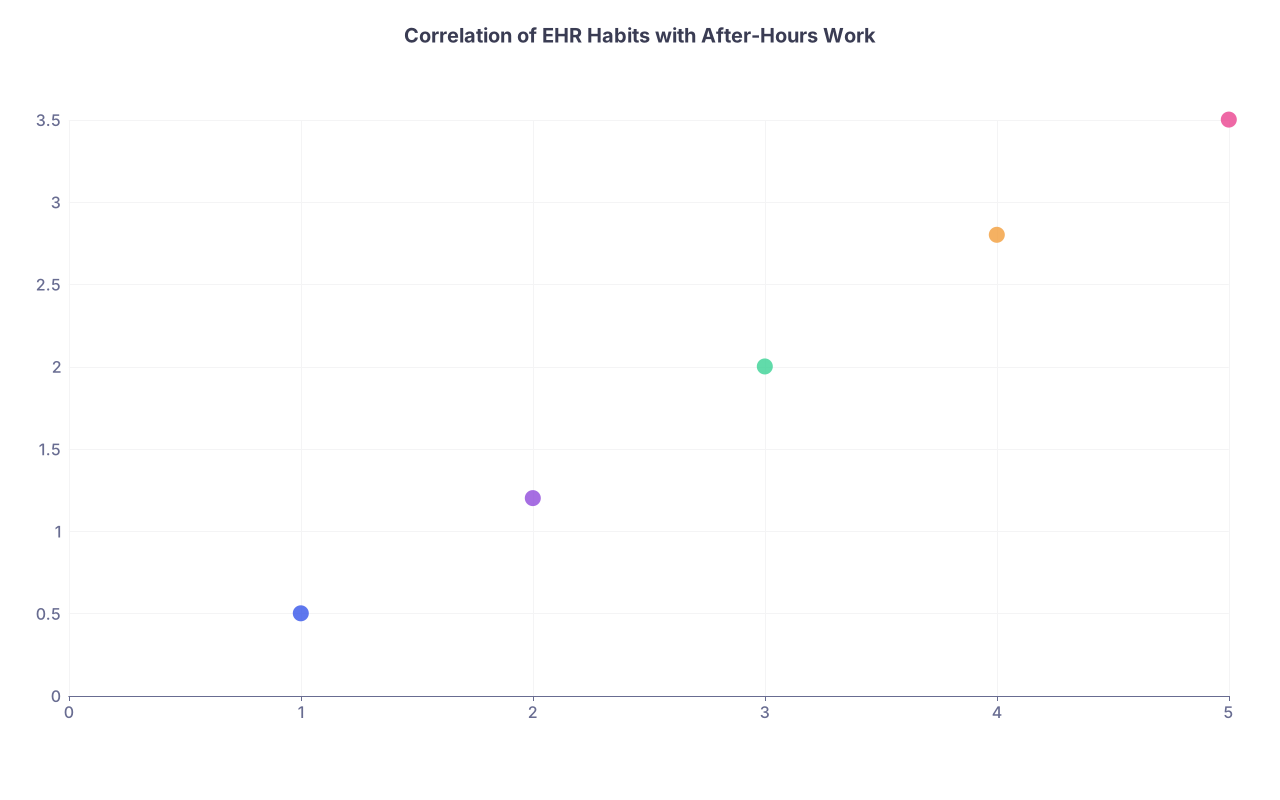
- After-hours work (“pajama time”) is highly variable and correlates more with workflow and delegation than with pure patient volume.
One academic paper from 2020 looking at ambulatory physicians showed a median of roughly 5–6 hours in the EHR per 8 hours of scheduled clinical time. But the range? More like 3 to 8+ hours. Same system. Same rules. Wildly different realities.
That’s not all UI.
That’s habits.
Here’s the kind of spread I’ve seen in real clinics, all using the same EHR, similar panels, same support staff:
| Metric | Efficient MD | Average MD | Inefficient MD |
|---|---|---|---|
| Patients per half-day clinic | 12 | 10 | 8 |
| Notes completed before leaving | 95% | 60% | 20% |
| Avg after-hours EHR per day | 0.5 hr | 1.5 hr | 3+ hr |
| Clicks per simple prescription | 5–7 | 8–10 | 12–15 |
Same EHR. Same “terrible interface.” Totally different experience.
If the software were the sole issue, you would not see this kind of intra-system variability.
The EHR Is a Mirror: It Exposes Hidden Inefficiencies
Before EHRs, sloppy habits were easy to hide.
- You finished notes “eventually” because the chart was just a stack of paper.
- Nobody tracked how many hours you spent on documentation at home.
- Nobody measured how long you took per order or per note.
Now the EHR timestamps everything. It knows:
- When you start and finish notes
- How much you’re doing after 7 pm
- How long your inbox messages sit
- How many actions you take that could’ve been done with a shortcut, a template, or delegation
In other words: the EHR made your inefficiency measurable.
You see this starkly with new attendings. They inherit a senior partner’s panel and the same EHR. Two months in:
- One is finishing most notes same day, leaving on time 3 days a week.
- The other is drowning—15 unsigned notes, 60 in-basket messages, hours behind on refills.
Same software. Different:
- Template discipline
- Use of order sets and favorites
- Willingness to say “no” to unnecessary inbox work
- Ability to structure the visit so documentation happens during the encounter, not as an afterthought
If you walk into a 20-minute visit without:
- A mental framework for the history and assessment
- A consistent way you phrase common plans
- A strategy for documenting as you go
…the EHR will punish you.
On paper, you could scribble a few phrases and “remember the details” later. The EHR forces structure and completeness. It’s unforgiving if your clinical thinking is scattered.
That’s not a defense of bad software. It’s a reminder that the tool is amplifying your process, not inventing it.
The Real Performance Gap: Workflow Mastery, Not System Choice
Everyone wants to believe: “If my hospital would just switch to [insert EHR vendor], I’d be so much faster.”
Reality is uglier. When institutions switch vendors (Epic to Cerner, Cerner to Epic, etc.), the same pattern appears after a short adjustment period:
- The people who were slow are still slow.
- The people who were fast adapt quickly and stay fast.
- The long-term differences in satisfaction are much smaller than the pre-go-live panic would suggest.
There are bad designs—systems that require extra clicks or split related info across multiple screens. But here’s the part nobody likes: within those constraints, there is still a 30–50% efficiency gap that comes down to workflow.
You see it most clearly when you watch two attendings side by side in clinic, same EHR:
Inefficient attending:
- Opens chart during the visit, jumps between 6 tabs repeatedly.
- Types the HPI as a long narrative after the patient leaves.
- Doesn’t use smart phrases, favorites, or order sets.
- Handles inbox messages ad hoc, every time the notification pops up.
- Leaves all prior authorizations and refills to whenever they “find time,” which becomes 9–11 pm.
Efficient attending:
- Opens the chart before the visit, reviews meds/problems in 60–90 seconds.
- Structures the visit so the assessment and plan are built in real time.
- Uses templates and phrases for 80–90% of common scenarios.
- Batches inbox tasks once or twice per session with clear delegation to staff.
- Leaves clinic with 0–2 unsigned notes most days.
Same software. Different deliberate choices.
What’s Truly the System’s Fault vs Yours
Now let’s be fair. Some of your pain is the EHR’s fault. But you need to be honest about which part belongs where.
Legit EHR/system problems:
- Slow load times and frequent crashes
- Poor default layouts that bury high-value data behind extra clicks
- Alert fatigue with non-customizable, low-yield popups
- Lack of usable mobile or remote tools for efficient inbox work
- No investment in training, optimization, or local build refinement
Behavior and workflow problems (that most people blame on the EHR):
- Writing every note from scratch instead of using smart phrases and templates
- Over-documenting irrelevant minutiae “just in case”
- Never cleaning up problem lists, med lists, and histories
- Letting every inbox message come to you instead of routing to nurses/MAs where appropriate
- Charting entirely after the visit because you “don’t like typing in front of patients”
- Ignoring personalization options because “I don’t have time to learn it” (and then donating 200 hours a year to inefficiency)
The truly painful part: the second set is under your control.
Concrete Example: The 2-Hour Gap Hidden in Your Day
Let’s quantify this with a simple scenario: outpatient internal medicine, 20-minute slots, 18 patients per day.
Two attendings. Same EHR. Same support staff.
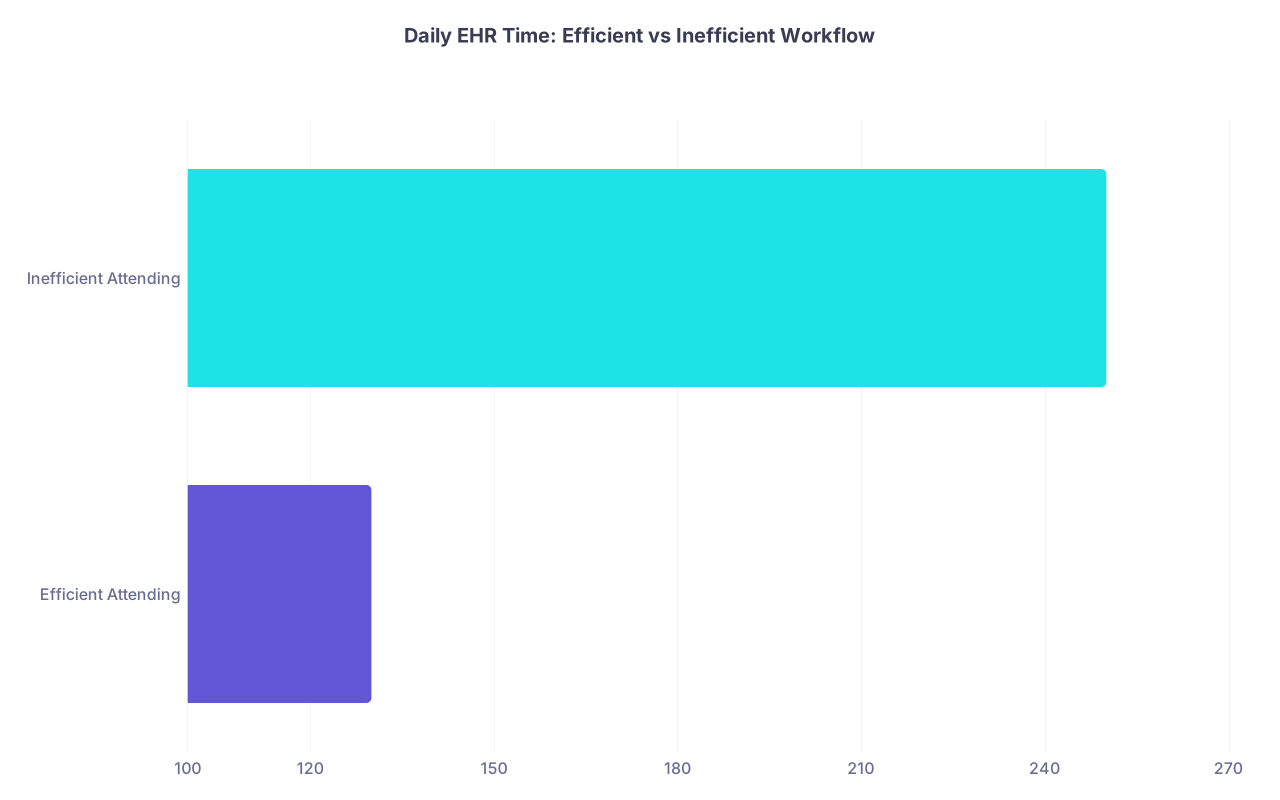
- Attending A (efficient) finishes each note within 2–3 minutes of the visit end by documenting the skeleton during the encounter and using structured templates and phrases. Average EHR time per patient: ~7 minutes total (orders, note, inbox messages).
- Attending B (inefficient) spends ~5 minutes in the room “just talking,” then starts and completes each note after clinic. Average EHR time per patient: 12–14 minutes.
Across 18 patients, that’s a 90–120 minute daily gap. Every day.
You’ll feel like the EHR is brutal if you’re Attending B. Your experience of the exact same system is two extra hours of work.
| Category | Value |
|---|---|
| Efficient Attending | 130 |
| Inefficient Attending | 250 |
That’s not Cerner vs Epic. That’s whether you’re willing to redesign how you think, communicate, and document.
If You Want to Be Faster, Focus on These Levers
You cannot fix national regulations or your hospital’s vendor contract. You can fix how you work inside that reality.
Here are the levers that consistently separate the fast from the miserable:
1. Real-time documentation mindset
The most efficient clinicians don’t treat the note as an after-the-fact essay. The note grows during the visit.
- Type the HPI in bullet fragments while the patient talks, then refine 10–15 seconds at the end.
- Enter orders and patient instructions in front of the patient, not later.
- Dictate brief assessment and plan with the patient in the room when appropriate.
If you insist on “I’ll remember and do it later,” the EHR will punish you.
2. Ruthless standardization of common scenarios
You do not need to reinvent the wheel 40 times a day.
For your top 20–30 visit types (uncomplicated HTN follow-up, type 2 diabetes visit, URI, back pain, refill visit, well adult exam), you should have:
- Note templates that include the right level of detail without fluff
- Smart phrases for your usual counseling language
- Pre-built order sets for labs, imaging, meds you use repeatedly
The clinicians who say “templates slow me down” are usually using bloated, generic garbage. Good templates are skeletal and specific. They save your brain for the 20% of cases that actually require custom thinking.
3. Problem list and med list hygiene
Messy charts cost time. Every. Single. Day.
Take 30–60 seconds per visit to:
- Remove resolved problems.
- Consolidate duplicates.
- Fix obviously wrong entries (e.g., “COVID” on problem list in 2024 with no relevance, 10 years of resolved “UTI” problems cluttering views).
It feels like you’re “doing extra work.” You’re not. You’re paying down technical debt that will otherwise hit you in every visit with that patient for the rest of your career in that system.
4. Inbox boundaries and delegation
I’ve watched attendings turn the inbox into a full-time job. Most of it self-inflicted.
Have a clear rule set:
- What goes to nurse/MA first (refills that meet protocol, routine lab result calls)
- What gets standardized phrases and quick actions
- When you process messages (e.g., twice daily, not every 7 minutes)
If you respond to every message the second it appears, you’re building a workflow optimized for distraction and context-switching. That’s the most expensive way to use any EHR.
5. Actually learning the system
I’ve sat in “optimization” sessions with groups of attendings. Half of them discover in 60 minutes that features they’ve complained about “not existing” have been there for 5 years. Smart tools, text expansion, favorites, filters.
They never took the time to learn.
This is the blunt part: if you’re going to spend 1,500–2,000 hours a year on clinical work inside a system, refusing to spend 10–15 hours getting good at it is irrational. It’s like an interventional cardiologist refusing to learn new cath lab tools and then complaining their cases take too long.

| Step | Description |
|---|---|
| Step 1 | Baseline EHR frustration |
| Step 2 | Start real time notes |
| Step 3 | Build top visit templates |
| Step 4 | Create triage protocols |
| Step 5 | Optimize and personalize |
| Step 6 | Reduced after hours work |
| Step 7 | Document in real time? |
| Step 8 | Use templates and phrases? |
| Step 9 | Inbox rules and delegation? |
Post-Residency Reality: Your Job Market Depends on This
You’re not just fighting the EHR for personal comfort. The job market is quietly grading you on your ability to function in this environment.
Groups and health systems care about:
- RVUs or visit volume
- Patient satisfaction
- Timely documentation and task completion
- “Teamability” with staff and workflows
If you’re the attending who:
- Needs 60-minute slots to keep up
- Leaves incomplete notes for coders to chase
- Takes 3 days to address critical inbox results
- Blames “the EHR” for everything
…you’re expensive. And replaceable.
On the flip side, physicians who can:
- See normal volumes safely
- Finish documentation same day most of the time
- Work smoothly with staff workflows
- Avoid living in the EHR after hours
…are gold. They’re the ones practices fight to recruit and retain.
| Category | Value |
|---|---|
| Doc A | 1,0.5 |
| Doc B | 2,1.2 |
| Doc C | 3,2 |
| Doc D | 4,2.8 |
| Doc E | 5,3.5 |
You can call that unfair. Or you can recognize that in a world where the EHR is not going away, efficient habits are part of your clinical skill set, like interpreting an ECG or managing sepsis.
So, Is the EHR Making You Slow?
Sometimes. Bad design absolutely costs minutes.
But if you’re routinely hours behind, charting at midnight, seething about “the system,” I’d bet most of your time loss is coming from:
- Legacy habits from a paper era that no longer exists
- Avoidance of real-time documentation
- Refusal to invest in personalization and templates
- Lack of boundaries around inbox and documentation volume
The EHR is not just a tool. It’s a mirror. It reflects how you think, how you structure your day, and how disciplined your workflows are.
Years from now, you won’t remember which minor version of Epic or Cerner you were on; you’ll remember whether you were always drowning—or whether you finally decided to treat your own habits as fixable instead of blaming the screen in front of you.