
The fastest way to look incompetent in a modern hospital is not a missed buzzword on rounds. It is a sloppy voice-dictated note with obvious, dangerous errors under your name.
If you use voice recognition for documentation—and you almost certainly do—you are one bad dictation away from confusing colleagues, irritating coders, or triggering a complaint. The tech is powerful, but it is not magic, and treating it like magic makes you look careless.
Let me walk you through the mistakes that quietly destroy your credibility, and how to avoid them.
Mistake #1: Treating Dictation as “Fire and Forget”
Voice dictation is not a brain dump tool. It is not a “talk and sign” system. Yet I routinely see attendings finishing a busy clinic, speed-dictating eight notes in a row, never reading a single one, and mass-signing.
Then radiology calls: “Why did you order a CTA chest for this 2-year-old?”
Turns out they did not. Dictation turned “CT abdomen” into “CT A chest” and the order went through.
The core error: assuming the software is better than you.
You are making three bad assumptions when you dictate and sign without review:
- The engine understood all your words correctly. Wrong. Background noise, accents, masks, speed, and medical jargon all introduce errors.
- The system reliably handles negation. It does not. “No chest pain” becomes “chest pain.” “Denies suicidal ideation” becomes “suicidal ideation.” I have seen both.
- You will remember what you “meant.” In a legal or peer-review context, what you meant does not matter. What you signed does.
The fix is boring and non-negotiable: a review pass before signing. Not skimming the first sentence and calling it good. A targeted review of:
- Chief complaint and HPI opening
- Problem list / assessment statements
- Medication changes and orders
- Impression and plan bullets
If you do not have 20–30 seconds to confirm that the story you told matches the story documented, you have bigger workflow problems than dictation.
Mistake #2: Negation Errors That Flip the Clinical Story
Nothing makes you look more dangerous than charting the exact opposite of what the patient told you.
This is where voice dictation fails in ways that are subtle but catastrophic:
- “No history of diabetes” → “History of diabetes”
- “Denies chest pain, shortness of breath” → “Chest pain, shortness of breath”
- “No suicidal or homicidal ideation” → “Suicidal and homicidal ideation”
Two common ways this happens:
- The engine just drops “no” or “denies” entirely.
- Auto-correct or template expansion overrides the negation.
I have seen residents get called by psychiatry, furious: “Why did you write that this patient is suicidal?”
The resident was sure they said “denies suicidal ideation.” The dictation did not care.
You cannot rely on the software to get negation right. Ever.
Your defense:
- Physically scan for “no,” “denies,” “negative for,” and “not.” Confirm the sentence still makes sense.
- Be consistent in how you phrase negation. For example, always say: “Review of systems: negative for chest pain, shortness of breath, fever, chills.” Avoid half-sentences like “No chest pain, no shortness of breath, no fever, no chills” that can get truncated.
- In high-risk areas (suicidality, advance directives, allergies), state the negation clearly, slowly, and then confirm it on screen.
If there is one part of your note worth a double-check ritual every single time, it is the lines where a missing “no” changes the medical reality.
Mistake #3: Medication and Dose Errors That Make You Look Reckless
Dictation plus drug names is a minefield. The software is not a pharmacist.
Here is what commonly goes wrong:
- Sound-alike fallacies:
“AmLODIPine” → “amiodarone”
“Propranolol” → “prednisone”
“Metoprolol” → “metformin” - Doses mangled:
“15 milligrams” → “50 milligrams”
“0.5” → “5”
“q12 hours” → “q2 hours” - Route and frequency swapped or dropped.
Coders notice. Pharmacists notice. Your colleagues absolutely notice.
And in a deposition, “I meant 1.5 mg” will not carry much weight when the signed note says “15 mg” and the MAR followed it.
Set a rule for yourself:
- Never sign a note without visually confirming every newly started, stopped, or changed medication and dose line.
- Say “one-five milligrams” instead of “fifteen,” and “zero point five” instead of “point five” when dictating high-risk meds.
- Use both generic and brand name for unusual or look-alike/sound-alike medications, slowly: “warfarin, also known as Coumadin.”
This is tedious. That is the point. The tedious parts are what protect you.
Mistake #4: Copy-Forward Meets Voice Dictation = Franken-Notes
In the post-residency world, you are juggling volume, RVUs, metrics. So you copy forward yesterday’s note, then “update” via dictation. This is where people quietly destroy their credibility.
What I see in charts:
- Old problems remain “active” in the assessment even though you dictated that they resolved.
- New issues are dictated into the HPI but never make it into the problem list or plan.
- Contradictions: “No chest pain” in ROS; three lines later, “Patient presents for evaluation of chest pain.”
Voice dictation amplifies copy-forward sloppiness. You think you updated everything verbally; the EHR does not move text automatically to the right place.
The result: colleagues cannot trust your notes, and that reputation spreads faster than you think.
A practical, minimal approach:
- Immediately after dictating, scroll the entire note once just looking for contradictions:
“Anything that conflicts with what I just said?” - Pay particular attention to:
- Problem list vs. assessment section
- ROS vs. HPI
- Past medical history vs. “new diagnosis today”
- Once a week, take one of your own notes and read it cold, as if it is someone else’s. If you cannot tell what actually happened that day, your dictation/copy-forward combo is broken.
Mistake #5: Speaking Like a Human Conversation Instead of a Medical Document
You are not dictating a podcast. You are creating a legal and clinical record.
Voice dictation encourages casual, conversational speech, and that gets you in trouble when you forget that everything leaves a footprint.
Red flags I see in notes:
- Sarcastic or loaded phrases:
“Patient is very needy.”
“Seems dramatic.”
“Noncompliant” thrown around with no explanation. - Slang:
“Off her rocker.”
“Kind of weird.”
“Dude said he fell.” - Vague hedging:
“Probably fine.”
“Seems OK.”
“Guess we will see.”
This reads as unprofessional at best and prejudiced or dismissive at worst. You might think “everyone talks like that” in real life. The difference is your documentation is discoverable.
When using dictation, train yourself to:
- Use neutral, descriptive language:
Instead of “noncompliant,” say “patient has missed 3 of the last 4 dialysis sessions, stating transportation issues.” - Avoid editorializing about personality, unless clinically relevant and described factually.
- Replace filler words (“like,” “you know,” “kind of”) with silence. The software may literally transcribe them.
If you would be embarrassed to hear that sentence read aloud in court or to the patient, do not say it at all.
Mistake #6: Ignoring Accent, Speed, and Environment
Voice engines are much better than they used to be, but they are still sensitive to how and where you speak.
Common self-sabotage behaviors:
- Dictating from the noisy nurses’ station with monitor alarms and hallway chatter.
- Speaking at end-of-day exhaustion speed, slurring sentences under a mask.
- Using a poor-quality built-in laptop mic with the fan blasting.
You end up with “mild chest pain” turning into “my chest pain,” “palpitations” into “palpitates son,” and other nonsense that makes you look like you do not read your own notes.
You do not need a studio. You do need baseline conditions:
- A half-quiet space. Step into an empty room or at least away from the loudest areas for 30 seconds.
- A decent microphone or headset if your institution allows it. The difference in recognition accuracy is not trivial.
- Stable pacing. Speak at a steady, moderate rate. Not fast, not robotic, just consistent.
If you have a strong accent or the system routinely mangles your words, invest 3–5 minutes in training or customizing the dictionary with your common phrases, medication names, and local jargon. That time pays for itself in a day.
Mistake #7: Confidentiality Violations You Do Not Notice
Everyone focuses on HIPAA in the obvious ways—no social media posts, no discussing patients in elevators. Meanwhile, dictation creates a quieter, more insidious risk.
Problem scenarios I have personally watched:
- Dictating in a semi-public hallway where family members, visitors, or other patients can clearly hear names, diagnoses, or sensitive details.
- Using consumer-grade voice assistants (Siri, Google, Alexa) to dictate parts of notes or messages.
- Allowing your phone’s personal dictation software to store or “improve” based on clinical notes that include identifiers.
This is not abstract. If someone overhears you dictating, “Mr. John Smith in room 412 with metastatic lung cancer, prognosis poor…” that is a privacy breach. If your cloud service stores identifiable clinical content, that can be a policy and legal problem.
Your rules should be simple:
- No dictation with patient identifiers in public spaces. That includes cafeterias, elevators, waiting areas, and crowded hallways.
- Use only institution-approved dictation solutions for clinical content. Not your iPhone’s generic dictation, not your smartwatch, not consumer transcription apps.
- Turn off “improve dictation using your recordings” features on personal devices used for any clinical timestamps or scratch notes.
Remember: voice tech companies want data. You are responsible for not feeding them protected health information.
Mistake #8: Blind Trust in Smart Phrases and “Voice Commands”
Modern dictation systems in EHRs let you say “insert COPD template” or “normal cardiac exam” and it will drop in large chunks of text.
These are helpful. They are also dangerous when you forget they are starting points, not final truth.
What actually happens in practice:
- You say “normal neuro exam” on autopilot, even though the patient had a mild facial droop you planned to “watch.”
- You call up a “normal eye exam” paragraph but never remove the part that says “pupils equal and reactive” for the patient with a fixed, dilated pupil.
- Your physical exam and your HPI disagree in obvious, embarrassing ways.
Voice commands make it even easier to create impossible charts with one phrase.
Before you rely on templates triggered by voice:
- Trim your templates. Remove statements you are not actually checking routinely.
- Customize “normal” macros to be conservative. Do not include obscure findings that you do not examine on every single visit.
- When you use a smart phrase by voice, immediately scan that section, not the whole note, just to catch mismatches.
The worst look is “documenting” a perfect, 12-system exam that nobody believes you actually did. Once colleagues think your exam is boilerplate, your notes become background noise.
Mistake #9: Ignoring the Billing and Coding Consequences
Post-residency, you are judged on more than just your medicine. Documentation drives billing and compliance. Dictation errors can cost you money or raise red flags.
I see three main billing-related pitfalls from careless dictation:
- Overdocumentation
Voice plus templates leads you to include a 10-system ROS and exhaustive exam for a visit that was truly focused and brief. That might look like upcoding if audited. - Underdocumentation
You actually did complex decision making, had multiple management options, or serious risk—but your dictated note is a three-line assessment. The visit gets downcoded. - Contradictory risk documentation
HPI and assessment mention serious risk factors, but your plan uses vague, dismissive wording (“probably fine,” “f/u PRN”). Coders cannot justify higher levels.
Here is where a small amount of discipline helps:
- At the end of your dictation, state specifically: “Medical decision making: moderate complexity due to [reason].” Then verify that matches your documented assessment and plan.
- Avoid dictating “normal” for whole systems you did not examine just to hit a bullet count. That game is getting riskier every year.
- Coordinate with your coding team. Ask them once what recurrent dictation habits of yours cause them the most trouble. Fix those first.
Patients do not see this. Admin does. And they absolutely judge your professionalism by how “clean” your documentation is.
Mistake #10: Not Owning What You Sign
This is the final, non-technical mistake: acting like the dictation engine is responsible for errors.
You know the line: “The note was dictated using voice recognition; please excuse any errors.”
That disclaimer does not protect you. It just announces that you do not fully stand behind your own documentation.
Colleagues roll their eyes at that line. Lawyers do not care about it. Admin quietly flags you as someone who does not control their own output.
If an institution allows such a line, it should not be a crutch. At best, it buys you goodwill for a rare typo. Not for a pattern of sloppy, dangerous documentation.
Your mental model needs to be brutal but accurate:
- Every word under your signature is yours, no matter who or what input it.
- The system is a tool. Tools do not share liability. Operators do.
- A reputation for clean, reliable notes is an asset. A reputation for chaotic dictations is a liability.
Take the same pride in your written output that you take in your differential diagnoses. Because people absolutely notice.
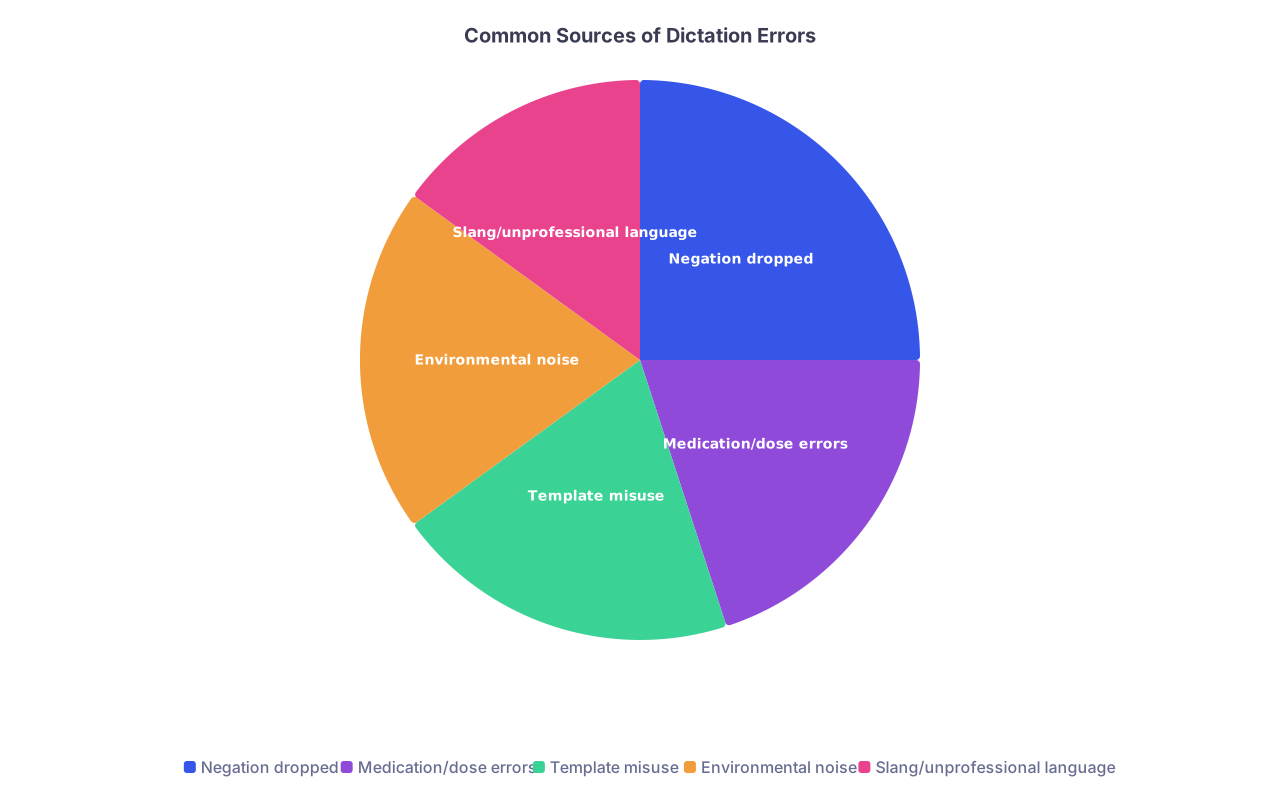
| Category | Value |
|---|---|
| Negation dropped | 25 |
| Medication/dose errors | 20 |
| Template misuse | 20 |
| Environmental noise | 20 |
| Slang/unprofessional language | 15 |

| Step | Description |
|---|---|
| Step 1 | Start dictation |
| Step 2 | Quiet location and good mic |
| Step 3 | Speak clearly and neutrally |
| Step 4 | Use minimal templates |
| Step 5 | Visual review of key sections |
| Step 6 | Edit and correct |
| Step 7 | Sign note |
| Step 8 | Errors found |
| Section | Typical High-Risk Errors |
|---|---|
| Negation statements | Missing "no" or "denies" |
| Medications and doses | Wrong drug or wrong strength |
| Suicidality / ideation | Negation reversed or omitted |
| Allergies | Confusion between NKDA and active allergy |
| Orders / procedures | Wrong test or wrong side |
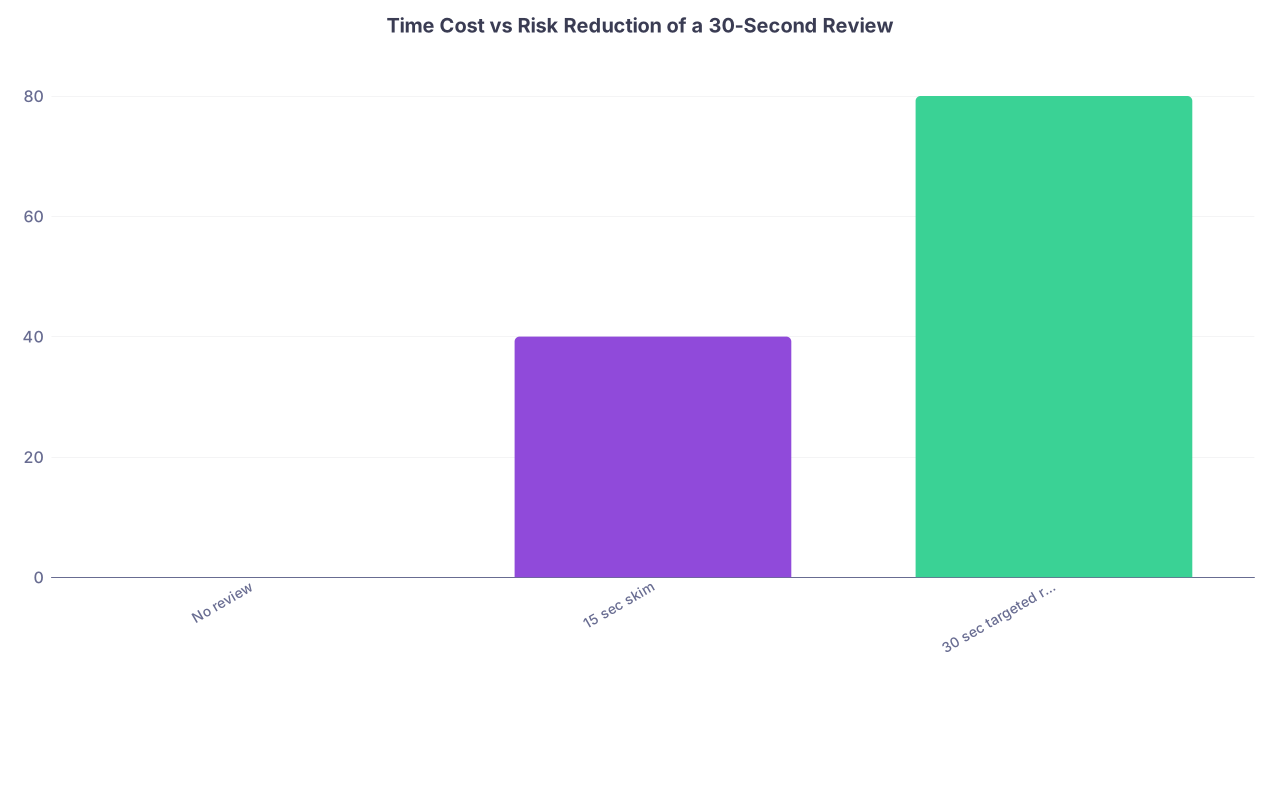
| Category | Value |
|---|---|
| No review | 0 |
| 15 sec skim | 40 |
| 30 sec targeted review | 80 |

The Bottom Line
Three points to remember:
- Voice dictation is not an excuse. You own every word you sign, and sloppy notes make you look incompetent fast.
- The highest-risk errors are small: missing “no,” wrong dose, copied “normal” exams. Build a short, ruthless review habit and catch them.
- Your documentation reputation will follow you. Colleagues trust or distrust your notes long before you realize it. Dictate like that matters—because it does.