
The way most hospitals use clinical decision support tiers is backwards—and it is quietly training clinicians to ignore the very alerts that could prevent harm.
You want a crisp understanding of “soft alerts” vs “hard stops”? That binary is too simplistic. In real systems, you are dealing with a spectrum of interruptiveness, risk, governance, and legal exposure. If you do not understand that spectrum, you will either build a system everyone overrides… or one that paralyzes care.
Let me break this down properly.
1. The Real CDS Stack: More Than Just “Soft” and “Hard”
Before you obsess over hard stops, you need the real hierarchy. In modern EHRs (Epic, Cerner, Meditech, etc.), decision support exists in layered tiers, from invisible to in-your-face.
Think of it like this:
| Tier | Typical Label | Interruptiveness | Override Required? | Examples |
|---|---|---|---|---|
| 0 | Passive | None | No | Links, order sets, references |
| 1 | Informational | Low | No | Non-interruptive banners |
| 2 | Soft Alert | Low–Moderate | Usually No | Inline warnings, dose suggestions |
| 3 | Interruptive Alert | Moderate–High | Yes | Pop-up with justification field |
| 4 | Hard Stop | Maximal | No (or extremely constrained) | Prevented orders (e.g., fatal allergy) |
Here is what those tiers actually look like clinically.
Tier 0: Passive CDS (You Barely Notice It)
No pop‑ups. No red. No beeping. You see:
- Order sets that embed best practices.
- Default doses, routes, and frequencies.
- SmartLinks into guidelines, calculators, or institutional pathways.
- Embedded risk scores (CHA₂DS₂‑VASc, Wells) calculated and displayed, but not screaming for attention.
This is CDS that shapes behavior by design, not by interruption. Underused, but low-risk and high-yield when done well.
Tier 1: Informational Banners and Non‑interruptive Messages
These sit at the top or side of your screen.
- “Patient eligible for sepsis screening protocol.”
- “A1c suggests uncontrolled diabetes; consider medication adjustment.”
- “No documented advance directive.”
You do not have to click anything. They are there if you care to look. Good for awareness, terrible if you expect strict compliance.
Tier 2: Soft Alerts (The Most Misunderstood Tier)
This is where many systems get sloppy.
Soft alerts typically:
- Highlight a field (“Dose above recommended range” in yellow).
- Provide a non-blocking toast notification.
- Mark something with an icon or color (drug–drug interactions labeled “moderate”).
- May offer a “Dismiss” or “OK” button but do not require justification.
Examples:
- Renally cleared medication in a patient with eGFR 40, suggesting dose lowering.
- Duplicate class therapy (two SSRIs) with a warning but easy override.
- Mild interaction (e.g., statin + amlodipine at low dose).
Soft alerts are supposed to be a nudge, not a barrier. The problem: many institutions cram them with low‑value noise. That is how you train an entire medical staff to stop reading anything yellow.
Tier 3: Interruptive Alerts (Strong Soft Stops)
Now we cross into “you must act” territory.
These alerts interrupt workflow:
- Pop‑up windows that require a click to continue.
- Forced selection of an override reason.
- Additional confirmation steps (“Yes, I really want to do this”).
They are technically overrideable, but not frictionless.
Typical use cases:
- Serious, but not absolutely prohibitive, drug–drug interactions.
- Potentially unsafe dosing (e.g., 4× usual max dose) where there might be rare justified exceptions.
- Non-formulary high-cost meds where cheaper alternatives exist.
- High‑risk imaging with repeated contrast or radiation in a short timeframe.
These are your “strong soft stops.” You can continue, but you have to mean it.
Tier 4: Hard Stops (The Nuclear Option)
Hard stops block completion of an action. Full stop.
- You cannot sign that order.
- You cannot release that prescription.
- You cannot proceed without changing something upstream.
Examples where true hard stops are commonly justified:
- Ordering a medication to which the patient has a documented anaphylactic allergy (e.g., IV penicillin after prior anaphylaxis).
- Chemo dosing exceeding protocol absolute maximums.
- Ordering live vaccines in a severely immunocompromised patient where absolutism is warranted.
Even then? You better have emergency overrides, time‑bound exceptions, or clear escalation paths, or you will create dangerous workarounds.
2. Why Tiers Exist: Risk, Workflow, and Liability
CDS tiers are not aesthetic choices. They are risk management tools.
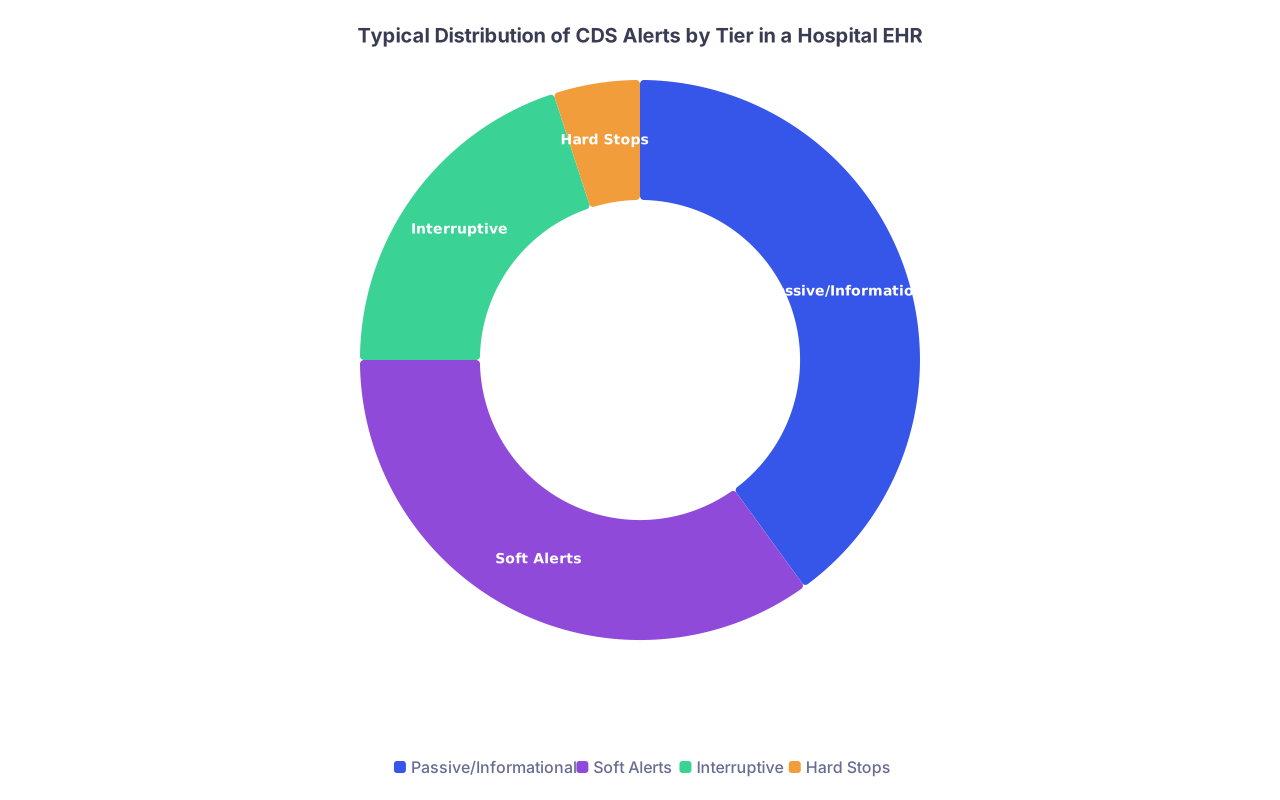
| Category | Value |
|---|---|
| Passive/Informational | 40 |
| Soft Alerts | 35 |
| Interruptive | 20 |
| Hard Stops | 5 |
Look at why each tier exists.
Risk vs Workflow Trade‑off
- Low‑tier (passive/soft) = preserves workflow, low friction, lower assurance of compliance.
- High‑tier (interruptive/hard stop) = high friction, stronger safety net, higher risk of workarounds if overused.
Hospitals get in trouble when they push too many clinically marginal rules into high‑tier alerts. Then doctors start “click‑throughing” blindly, including for the few alerts that actually matter.
Clinical Risk Stratification
You should be mapping each CDS rule to:
- Probability of harm if ignored.
- Severity of harm.
- Time sensitivity (does this need to stop the train now, or just raise awareness?).
- Reversibility (if we proceed and it is wrong, can we recover?).
High probability + high severity + low reversibility → Tier 3 or 4.
A borderline interaction that can be easily monitored or reversed? Tier 1–2.
Legal and Regulatory Pressures
Here is the unspoken part: legal risk drives many bad design decisions.
- Organizations fear “why did your system not warn?” lawsuits.
- So they add alerts for everything.
- Then in court, attorneys discover that 95% of alerts are overridden.
- Which undermines the defense: the system is clearly noise, not real protection.
If you are advising a hospital post‑residency, be explicit: blanket over-alerting is not risk mitigation, it is risk re‑labeling. You trade one type of liability for another.
3. Examples: How Each Tier Works in Real Orders
Theory is cheap. Let’s walk through real-world scenarios.
Example 1: Heparin in CKD
Patient: 78‑year‑old, eGFR 22, admitted with NSTEMI.
Ordering therapeutic enoxaparin.
- Tier 0: Order set defaults to renally adjusted dosing for eGFR <30.
- Tier 1: Banner: “Renal dosing protocol applied based on eGFR 22.”
- Tier 2: Soft alert if provider manually picks a higher standard dose: “Selected dose exceeds renal-adjusted recommendation.”
- Tier 3: Interruptive alert if dose is, say, >2× the recommended maximum for renal patients, requiring justification with forced checkbox: “Emergent situation / non‑standard protocol / error, will correct.”
- Tier 4: Rarely appropriate here. You might allow an override for exceptional cases (e.g., ECMO, special cardiology protocols).
If your system jumps straight to Tier 4 just because eGFR <30, you will block necessary care and push clinicians into unsafe workarounds.
Example 2: Beta‑Blocker in Acute Decompensated Heart Failure
Patient: Hypotensive, on inotropes, new ICU admission.
Resident tries to order metoprolol tartrate.
- Tier 1: Banner: “Patient on inotrope; consider hemodynamic stability before beta blocker.”
- Tier 3: Interruptive alert: “Beta blocker in patient on vasopressor/inotrope. Confirm hemodynamic stability.” Requires you to pick reason (e.g., rate control in AFib, weaning inotrope, etc.).
- Tier 4: Maybe not. There are edge cases where you actually want the drug. Hard stopping this is lazy design.
Design principle: hard stops around physiology are dangerous. Physiology is nuanced. Use interruptive soft stops with forced justification and tight audit instead.
Example 3: Anaphylaxis‑Level Allergy
Patient: Documented anaphylaxis to ceftriaxone (with hypotension, airway involvement).
Provider orders ceftriaxone again.
Here, a hard stop is defensible:
- Tier 4: “Documented anaphylaxis to ceftriaxone. Order cannot be signed. Contact pharmacy/allergy for override process.”
And you build a governance exception, like:
- Allergy verification workflow to correct inaccurate allergy records.
- Allergy specialist override for rare desensitization scenarios, handled outside routine ordering.
This is where hard stops actually belong: situations where going forward is almost never correct, and the risk is catastrophic.
4. How to Decide: Which Rule Gets Which Tier?
You will eventually get asked: “Should this be a soft alert or a hard stop?” The correct answer is: you almost never start at “hard stop.”
Use a structured approach.

| Step | Description |
|---|---|
| Step 1 | Propose CDS Rule |
| Step 2 | Use soft or interruptive alert |
| Step 3 | Consider hard stop with rare override path |
| Step 4 | Use interruptive alert with justification |
| Step 5 | Harm if ignored is catastrophic and likely? |
| Step 6 | Are true exceptions extremely rare? |
Step 1: Define the Clinical Scenario Precisely
Bad: “Alert for high potassium.”
Better: “Alert when K+ ≥ 6.5 mmol/L in patient on digoxin and no recent ECG documented, and provider is ordering IV KCl.”
Specific inputs → fewer false positives → more credible alerts.
Step 2: Assign Severity and Probability
You can map scenarios roughly like this:
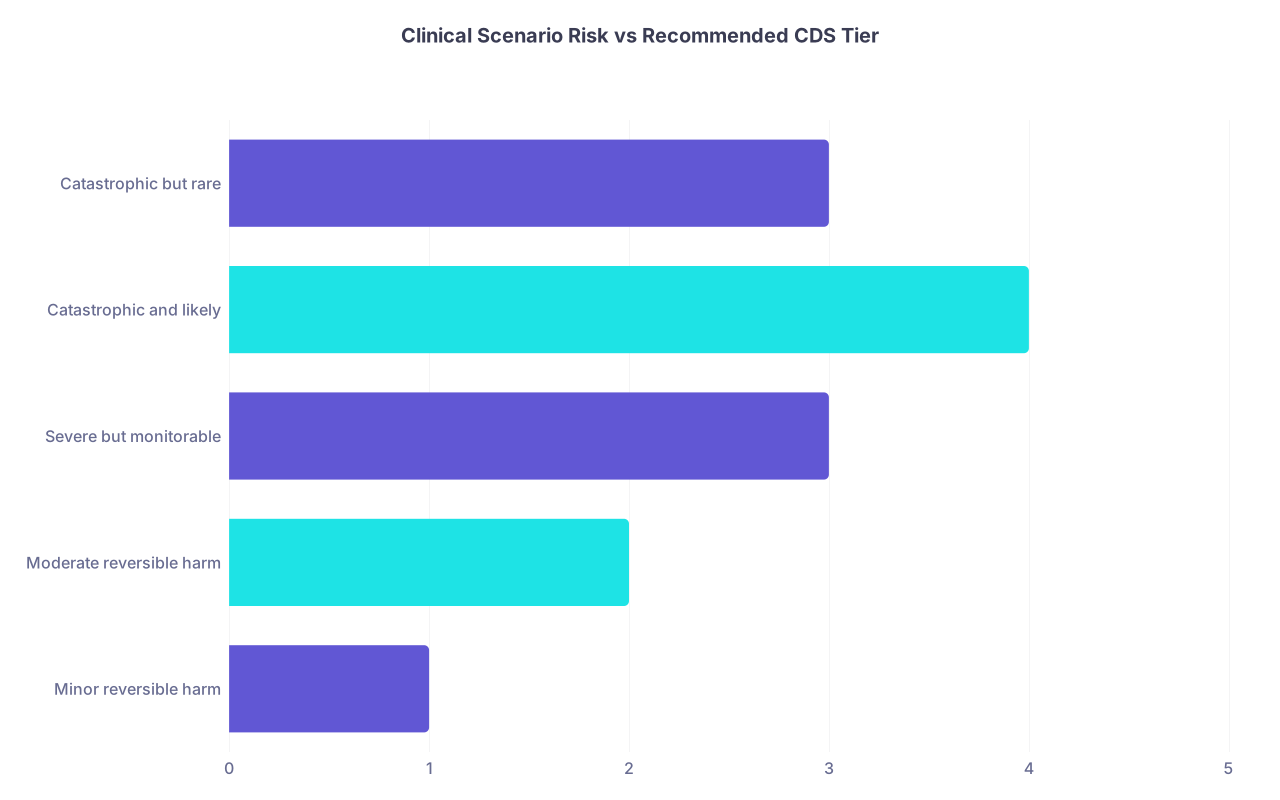
| Category | Value |
|---|---|
| Minor reversible harm | 1 |
| Moderate reversible harm | 2 |
| Severe but monitorable | 3 |
| Catastrophic and likely | 4 |
| Catastrophic but rare | 3 |
Interpretation:
- 1 → Tier 1–2
- 2 → Tier 2
- 3 → Tier 2–3
- 4 → Tier 3–4
- “Catastrophic but rare” often deserves careful human process, not brute‑force hard stops.
Step 3: Decide the Default Tier
Rough guide:
- Passive/CDS content (Tier 0) for routine guidance.
- Informational/soft (Tier 1–2) for moderate‑risk but frequent scenarios, OR early behavior shaping.
- Interruptive (Tier 3) for serious, non‑absolute contraindications, where judgment and occasional override are needed.
- Hard stop (Tier 4) for near‑absolute contraindications with extremely rare and tightly managed exceptions.
If your institution has more than 1–2% of orders hitting Tier 4, you built a trap, not a safety net.
5. Alert Fatigue: Why Your Tiers Fail in Practice
Here is the dirty secret: it is not that clinicians “hate alerts.” They hate bad alerts. And badly tiered ones.
Overexposed to alerts, they adapt:
- Reflex clicking of “OK” without reading.
- Mental sorting: red=maybe important, yellow=ignore.
- Workarounds: entering bogus data to bypass checks (fake weights, fake allergies, etc.).
- Delay in documentation to avoid firestorm of alerts (e.g., holding off reconciling meds).
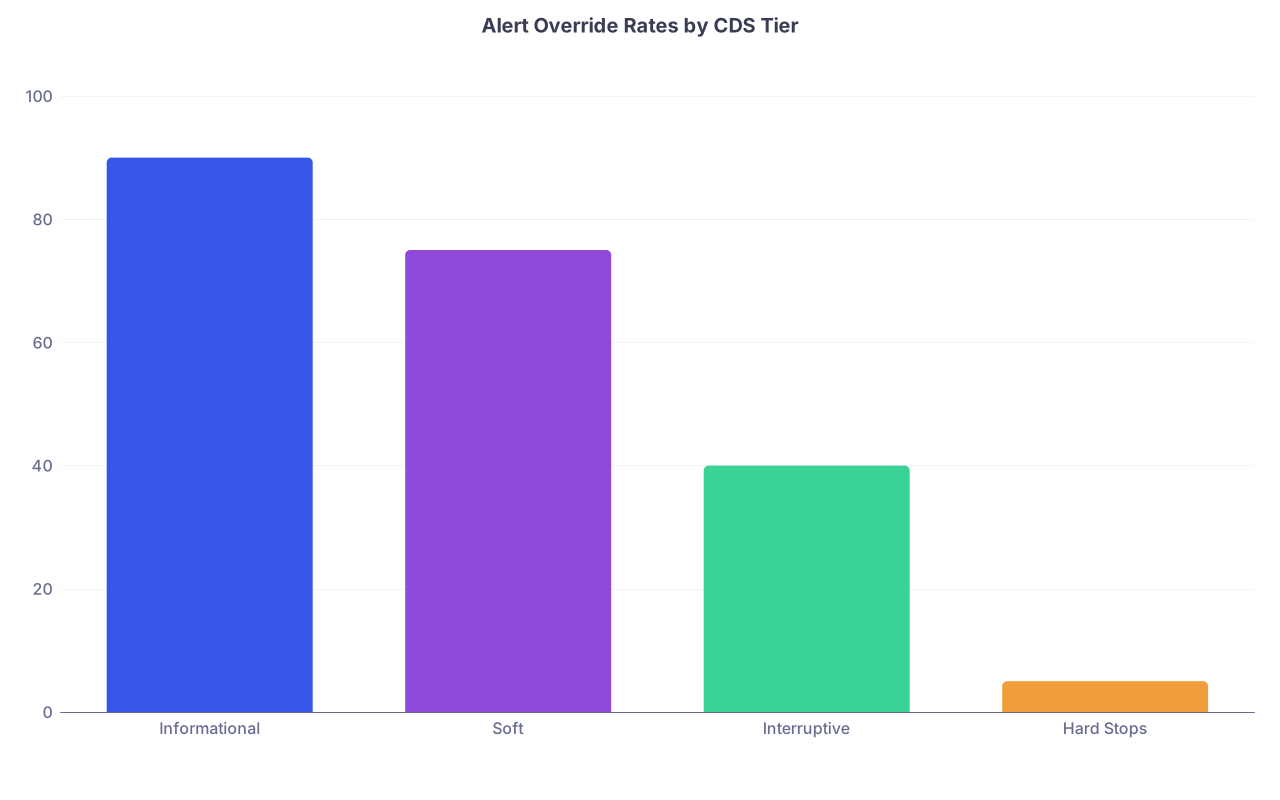
| Category | Value |
|---|---|
| Informational | 90 |
| Soft | 75 |
| Interruptive | 40 |
| Hard Stops | 5 |
Soft alerts with 75–90% override rates are common. That is a system design failure, not a clinician failure.
If you are in a leadership or CMIO‑adjacent role after residency, you should be:
- Demanding override-rate reports stratified by rule and tier.
- Deactivating or retiering alerts with persistent high override and low harm events.
- Involving frontline clinicians in reviewing what actually fires.
An ignored alert is worse than no alert; it creates false security for administrators and lawyers while changing nothing at the bedside.
6. Governance: Who Decides What Becomes a Hard Stop?
If your hospital lets a single pharmacist or IT analyst decide “this should be a hard stop,” you have a governance problem.
Mature institutions use:
- A multidisciplinary CDS committee (physicians from key specialties, pharmacy, nursing, informatics, risk management).
- A formal proposal template: clinical rationale, estimated frequency, target population, proposed tier, potential harms if over‑ or under‑triggered.
- Trial periods at lower tiers (soft or interruptive) with data collection before escalating to hard stop.
Ideally, you treat hard stops like new high‑risk drugs:
- Change control.
- Impact analysis.
- Monitoring after go‑live.
- Clear rollback criteria.
7. Implementation Details: How Soft Alerts and Hard Stops Show Up in Major EHRs
If you plan to work with CDS at a real system level, you need to understand how vendors implement these tiers.
Epic (most common in US academic centers)
- Best Practice Advisories (BPAs) = primary alert framework. They can be non‑interruptive, interruptive, or blocking.
- Order Defaults and SmartSets = Tier 0 passive CDS.
- EPICCARE messages/banners = Tier 1.
- BPAs configured with “hard stop” logic usually require special approval and code-level flags to prevent signing.
Watch for:
- BPA fatigue: dozens of BPAs per order session.
- Copy‑and‑paste or broad shared logic that fires for inapplicable contexts (e.g., pregnancy-related alerts firing on older men because of poor filtering).
Cerner (Oracle Health now)
- Discern Rules drive many alerts.
- PowerPlans embed a lot of passive CDS.
- Interruptiveness is configurable, but historically, Cerner sites can overload medication alerts, especially for drug–drug interactions.
Again, the principle is the same: tiering is local configuration, not just vendor default.
8. Post‑Residency Reality: How This Affects You on the Job Market
You are not just a clinician anymore. You are part of a system that buys, configures, and defends CDS.
As a New Attending
- You will work under existing CDS tiers you had no say in.
- You will be judged on “compliance” with alerts you know are sometimes nonsense.
- You may get e‑mails: “You override this interaction 85% of the time; please explain.”
Knowing the tiers lets you respond intelligently:
- “This alert about X should be informational, not interruptive; here are 10 examples where it fired inappropriately.”
- “We should narrow the firing criteria instead of making this a hard stop.”
As Someone Eyeing Leadership / CMIO / Informatics Roles
You need to speak this language fluently.
You should be able to walk into a meeting and say:
- “We will convert this hard stop to an interruptive alert pending 90‑day review of event rates and override reasons.”
- “Our high‑risk anticoagulation alerts are mis-tiered; prophylactic dose and therapeutic dose are using the same logic. That is why clinicians are ignoring them.”
That is how you become the person people trust to fix the system instead of just complain about it.
9. Design Principles: How to Make Each Tier Actually Work
Some concrete rules that separate good CDS architecture from junk.
For Soft Alerts (Tier 2)
- Keep text short, specific, and actionable.
- Provide a one‑click recommended action (“Adjust dose to 2.5 mg BID”).
- Avoid firing on partial data (e.g., missing weights, outdated labs).
- Tune them over time—silence the worst offenders.
If your soft alerts are vague (“Medication may cause side effects”), you are wasting everyone’s time.
For Interruptive Alerts (Tier 3)
- Require choice of structured override reason. Limit free text to a “Other (describe)” field.
- Limit to high‑yield scenarios where your institution is willing to review overrides.
- Create feedback loops. If many clinicians pick “Alert fired incorrectly,” revise logic.
- Do not chain them. If a user sees three consecutive interruptive alerts for the same order, they will slam through.
For Hard Stops (Tier 4)
- Make them rare.
- Tie each hard stop to a policy and a named clinical owner (e.g., “Allergy & Immunology Committee”).
- Provide clear instructions in the message itself: “To proceed in true desensitization scenario, contact pharmacy X / allergy on call.”
- Build a monitored override path when absolutely necessary (e.g., only certain roles, limited duration, logged at a special level).
If a hard stop message says, “If you believe this is in error, call the help desk,” you already failed.
10. Common Failure Modes You Will See (and Should Call Out)
I have seen the same mistakes across systems:
Promiscuous Hard Stops
Everything that made someone nervous becomes a “DO NOT ALLOW.” Clinicians then engage in data manipulation to get around them (removing allergies, faking labs).Alert Inflation Without Retirement
New alerts keep getting added. Old ones never get removed. Five years later, 50% of alerts are clinically obsolete.Vendor‑Default Over‑Reliance
Sites turn on huge vendor rule sets “out of the box” without tailoring. Those rules were never designed for your specific formulary, population, or workflows.No Tiering Strategy
Each request is evaluated ad hoc, depending on who shouts loudest (pharmacy, risk, nursing, quality). The result: inconsistent severity mapping.Lack of Clinician Involvement
IT configures alerts, clinicians just suffer them. No one does UAT (user acceptance testing) for CDS in the actual clinical context.
You will probably walk into a job where at least three of these are true.
FAQ (Exactly 6 Questions)
1. What is the simplest way to explain soft alerts vs hard stops to non‑clinical stakeholders?
Soft alerts are recommendations you can ignore without justification. They inform and nudge. Hard stops are actual barriers that prevent an order or action from being completed unless very specific override conditions are met. I often summarize it as: soft alerts talk, hard stops block.
2. When is a hard stop clearly appropriate in clinical decision support?
Hard stops are appropriate when proceeding is almost never clinically acceptable and the downside risk is severe or catastrophic. Classic examples include re‑exposure to a drug after documented anaphylaxis, dosing that exceeds known lethal thresholds, or certain chemotherapy protocol violations. If you can list more than a couple of common exceptions, you are probably in hard stop overreach.
3. How can I tell if our soft alerts are doing more harm than good?
Look at override rates and outcomes. If a soft alert fires frequently, is overridden most of the time (e.g., >80–90%), and is not associated with measurable safety improvements, it is likely adding noise. Also listen to clinicians; if they can recite alert text from memory, that is a red flag that the alert is interruptive but low value.
4. Do hard stops reduce legal risk for a hospital?
Not automatically. Over‑aggressive hard stops can backfire if they lead to delays, harm, or unsafe workarounds. In litigation, evidence that clinicians had to circumvent dysfunctional hard stops can be just as damaging as having no CDS at all. Thoughtful, well‑justified hard stops with clear governance and monitoring provide a better medico‑legal position than blanket blocking.
5. How should hospitals decide which CDS tier to use for a new rule?
Use a structured process: define the clinical scenario precisely, estimate harm probability and severity if ignored, assess reversibility, and then match to a tier. Start at a lower tier (soft or interruptive) with data collection, and only escalate to hard stop once you have evidence the risk is both high and not manageable through less intrusive means. Always involve a multidisciplinary CDS committee.
6. As a new attending, can I realistically influence CDS tiers at my hospital?
Yes, but you must be specific and data‑driven. Document examples where alerts misfire, collect screenshots, note patient context, and bring this to whoever oversees CDS (usually informatics, the CMIO, or a CDS committee). Propose concrete changes—“convert this to non‑interruptive,” “narrow the firing criteria,” or “retire this alert if K+ is between 3.4–3.6.” Clinicians who bring well‑framed, evidence‑backed feedback often end up shaping the system more than they expect.
Key points to keep in your head:
- “Soft vs hard” is a spectrum, not a dichotomy. Use the full tier stack wisely.
- Hard stops are rare, high‑stakes tools. If you use them casually, you will break trust and create unsafe workarounds.
- The only CDS that matters is CDS clinicians actually read and respect. Everything else is theater.