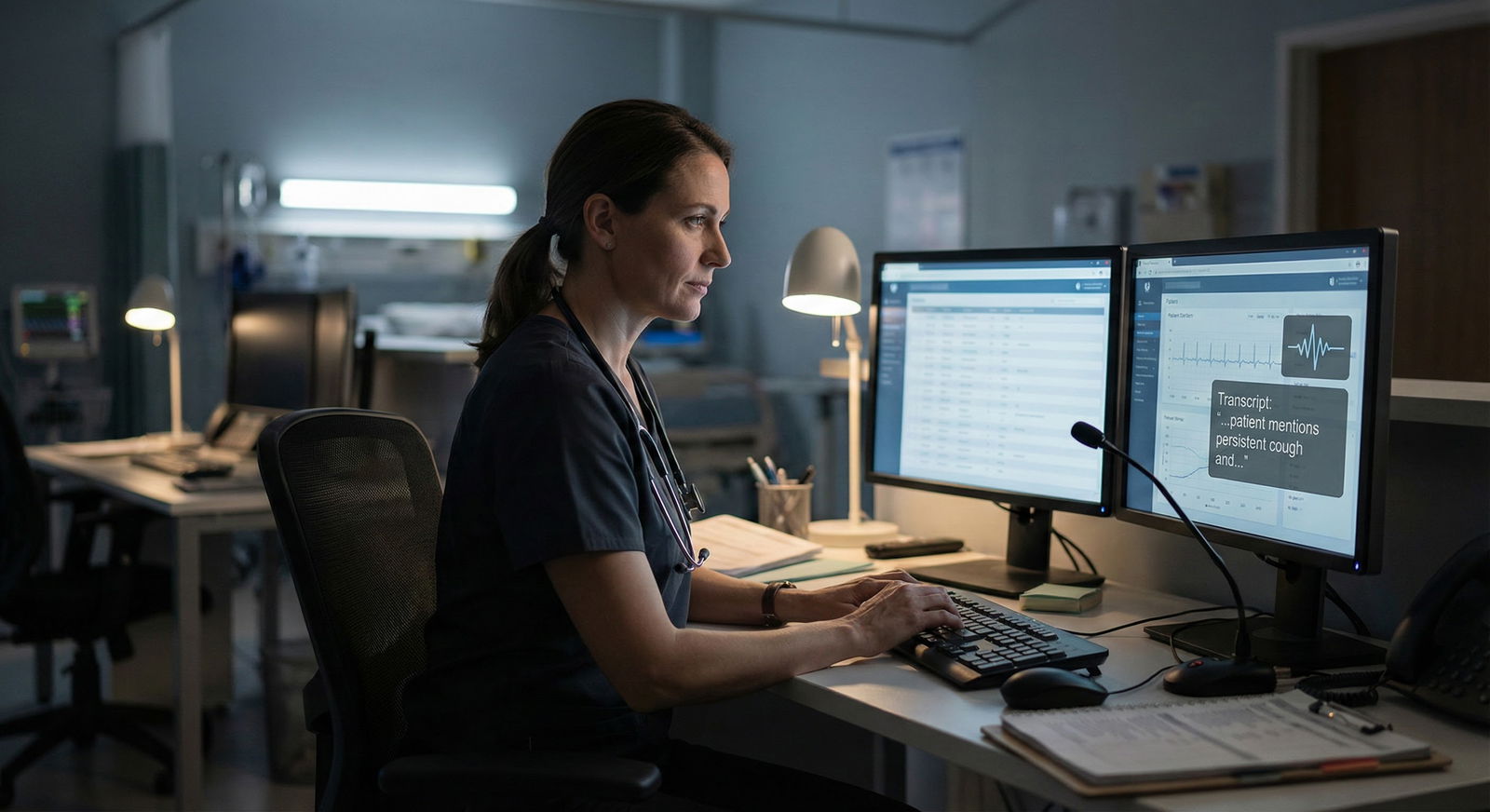
Most physicians underestimate how much NLP is already writing—and rewriting—their notes.
You are not “just” charting anymore. You are feeding a series of natural language processing engines that shape what gets documented, how it is coded, and ultimately how you get paid, judged, and even replaced.
Let me break this down specifically.
What NLP Actually Is (In Your Daily Clinical Life)
Natural language processing (NLP) is not some abstract AI buzzword. In practice, for a working clinician or post‑residency job seeker, it boils down to a set of systems that:
- Listen to you (speech recognition, ambient scribing).
- Read what you type (EHR documentation, messages).
- Extract structure (diagnoses, problems, meds, HPI elements, time spent).
- Transform your language into billing, quality metrics, and decision support triggers.
You interact with NLP in at least four common places:
Dictation / Speech Recognition
Think Dragon Medical One, PowerScribe, Nuance DAX “ambient scribe,” Amazon Transcribe Medical.
These systems first do ASR (automatic speech recognition), then an NLP layer interprets the text for punctuation, formatting, and sometimes clinical concepts.Ambient Clinical Documentation
The mic icon quietly blinking in the exam room while you talk to a patient?
That is an NLP pipeline: audio → transcript → segmenting into HPI / ROS / Exam → generating a structured note.EHR Smart Features
Smart phrases / templates that auto-fill diagnoses, problem lists, orders, and ICD-10 codes based on your text.
Behind the scenes: NLP is mapping your free text (“uncontrolled DM2 with neuropathy”) to structured concepts.Back-End Coding and Quality Engines
After you sign the note, hospital coding software and analytics engines scan your documentation to:- Infer diagnoses for DRG and risk adjustment.
- Identify quality metrics (sepsis, CHF, AMI bundles).
- Flag missing documentation or “query” opportunities.
In other words: your “free text” is not free. It is raw data for multiple NLP pipelines.
](https://cdn.residencyadvisor.com/images/articles_svg/chart-common-clinical-uses-of-nlp-tools-5895.svg "Common Clinical Uses of NLP Tools")
| Category | Value |
|---|---|
| Speech-to-text dictation | 85 |
| Ambient scribing | 30 |
| Auto-coding & billing | 70 |
| Quality metric extraction | 60 |
| [Clinical decision support](https://residencyadvisor.com/resources/medical-technology-advancements/clinical-decision-support-tiers-from-soft-alerts-to-hard-stops-explained) | 40 |
(Percentages approximate adoption or partial use across large systems based on vendor reports and health system data. The exact numbers vary, but the pattern is accurate: dictation and auto-coding dominate.)
Under the Hood: How NLP Turns Your Words into Structured Data
You do not need to become a data scientist. But understanding the basic pipeline helps you exploit strengths and avoid traps.
A simplified clinical NLP pipeline:
Input:
- Audio (your conversation or dictation).
- Text (typed notes, messages, discharge summaries).
Speech Recognition (if audio):
- Converts speech to text.
- Uses medical vocabularies and acoustic models trained on clinical speech (ideally; sometimes not, which is why “metoprolol” becomes “metal pole”).
Preprocessing:
- Sentence splitting.
- Tokenization (breaking text into words / phrases).
- Normalization (e.g., “HTN” → “hypertension,” “dm2” → “diabetes mellitus type 2”).
Clinical Entity Recognition:
- Identifies key concepts: diseases, symptoms, labs, meds, procedures.
- Tools often map to standardized vocabularies: SNOMED CT, ICD-10, RxNorm, LOINC.
Context and Negation:
This is where it gets interesting and where many systems fail in subtle ways.
The NLP engine tries to detect:- Negation: “No chest pain.”
- Temporality: “History of MI in 2012.”
- Experiencer: “Family history of colon cancer.”
- Uncertainty: “Rule out PE,” “Possible TIA.”
Structuring and Coding:
Extracted entities and their context are then mapped into:- Problem lists.
- Visit diagnoses (ICD, SNOMED).
- Procedure codes (CPT).
- Quality flags (e.g., falls risk discussed, depression screen documented).
Output to Systems You Care About:
- EHR note sections (auto-generated HPI/ROS).
- Coding/billing suggestions.
- Population health dashboards.
- Clinical decision support (CDS) alerts and reminders.
That is the path from “The patient denies chest pain but has shortness of breath when climbing stairs” to a risk flag for possible CHF in a population health tool.

| Step | Description |
|---|---|
| Step 1 | Clinician speech |
| Step 2 | Speech recognition |
| Step 3 | Raw transcript |
| Step 4 | Clinical NLP engine |
| Step 5 | Structured concepts |
| Step 6 | EHR note sections |
| Step 7 | Diagnosis codes |
| Step 8 | Quality metrics |
| Step 9 | Billing engine |
How NLP Is Already Shaping Your Notes (Whether You Like It or Not)
Let’s go concrete. You finish residency, join a large health system, and start documenting with their “smart” tools. What changes?
1. Your HPI Is No Longer Just a Narrative
Ambient scribe systems do not just transcribe. They segment.
You say:
“Mrs. Jones is a 68-year-old woman with a history of hypertension and CHF who comes in today for increasing shortness of breath over the last two weeks, especially when walking up stairs. No chest pain, no palpitations, no fever or cough. She has been compliant with her medications.”
The NLP-driven system might produce:
- Chief Complaint: Shortness of breath.
- HPI: Paragraph summarizing timing, severity, modifying factors.
- Past Medical History: Hypertension, congestive heart failure.
- ROS: Negative for chest pain, palpitations, fever, cough.
- Med compliance: Documented.
On the surface, great. Time saver. But notice what happened: the system decided what belongs in HPI vs ROS vs PMH vs Assessment. If it misclassifies—say it treats “No chest pain” as a positive symptom or drops the medication compliance—your note is subtly altered.
If you sign quickly without reading, that “subtle” alteration becomes the legal record.
2. Templates and Smart Phrases React to Your Words
In Epic, Cerner, and others, NLP-enhanced features can:
- Auto-suggest diagnoses when you type certain phrases.
- Trigger decision support: mention “depression screening” and suddenly PHQ-9 reminders appear.
- Populate structured fields from free text: mention “40 pack-year smoking history” and a discrete smoking history field updates.
Your language stops being purely narrative and becomes a series of triggers.
You say “borderline blood pressure” and the system might not recognize “hypertension.” You say “elevated BP, likely HTN” and you might get an auto-suggestion to add essential hypertension as a coded diagnosis.
The practical implication: wording matters. Not just for medico-legal clarity, but for downstream analytics and reimbursement.
3. Coding and Billing Are Increasingly Driven by NLP
Post-residency, your RVUs and employer’s revenue matter. More than you want to admit.
NLP-enabled computer-assisted coding (CAC) systems scan your notes for:
- Specific phrases that support higher-level evaluation and management (E/M) codes (time, complexity, data reviewed).
- Comorbidities that drive risk-adjustment (HCCs in US Medicare Advantage).
- Procedure documentation that justifies additional CPT codes.
If your documentation is:
- Vague (“labs reviewed”, “imaging okay”).
- Lacking explicit linkage (“CHF exacerbation likely due to dietary indiscretion”).
- Missing severity (“severe sepsis with septic shock”).
…then the NLP engine may under-recognize key diagnoses and severity. That means lower codes, fewer HCCs, and underestimation of patient risk.
Now flip it. Over-template with auto-populated, NLP-inferred diagnoses the patient does not really have, and audit risk goes through the roof.
| Clinician Phrase | NLP Interpretation | Coding Impact |
|---|---|---|
| "History of CHF, stable" | Chronic CHF, established | Captures HCC |
| "Some heart failure issues in past" | May miss CHF or code nonspecific | May lose HCC |
| "Mild confusion, possible sepsis" | Uncertain sepsis | May not trigger sepsis DRG |
| "Severe sepsis with acute kidney injury" | Clear sepsis + organ dysfunction | Higher-severity DRG |
| "Abnormal labs" | Non-specific | No additional codes |
| "Leukocytosis, lactate 4.5, creatinine 2.1" | Specific abnormalities recognized | Supports acuity / severity |
You can see the pattern: specificity is not optional anymore. NLP amplifies what you say—or fail to say.
Ambient Scribes and “AI Note Writers”: Promise and Pitfalls
This is where most of the hype lives right now. Vendors promising you will “never type another note.” Reality is more nuanced.
What They Do Well
I have seen ambient scribing systems:
- Capture long, complex patient stories that no one has time to type.
- Pull structured data like medication lists and vitals from the EHR into the note.
- Generate a clean HPI and exam that is at least as good as what an overworked resident would produce at 2 AM.
For a busy outpatient internist or orthopedist, saving even 1–2 hours per day is transformative. Burnout drops. Inbox gets some attention. Dinner with family becomes possible again.
Where They Consistently Struggle
Patterns repeat across products:
Context and nuance.
- Mixing patient speculation with clinician impression (“I think it is my heart” vs “Clinician impression: likely musculoskeletal”).
- Mis-handling sarcasm or hedging.
- Losing subtle risk discussions (“We discussed that while risk is low, PE cannot be entirely excluded”).
Attribution.
- Patient statements vs clinician statements.
- Caregiver comments vs patient’s own report.
Many NLP systems flatten these into a generic narrative. Legally dangerous.
Negation and exceptions.
- “No chest pain, except mild soreness from coughing” sometimes becomes “mild chest soreness.”
- “Denies suicidal intent but has passive death wishes” gets butchered more often than you want.
Copy-paste hallucination.
Some generative models will “helpfully” expand or “normalize” content… adding language you never said. If you do not catch it, you just signed fiction.
You cannot treat AI notes as autopilot. You are still PIC (pilot in command) of every word.
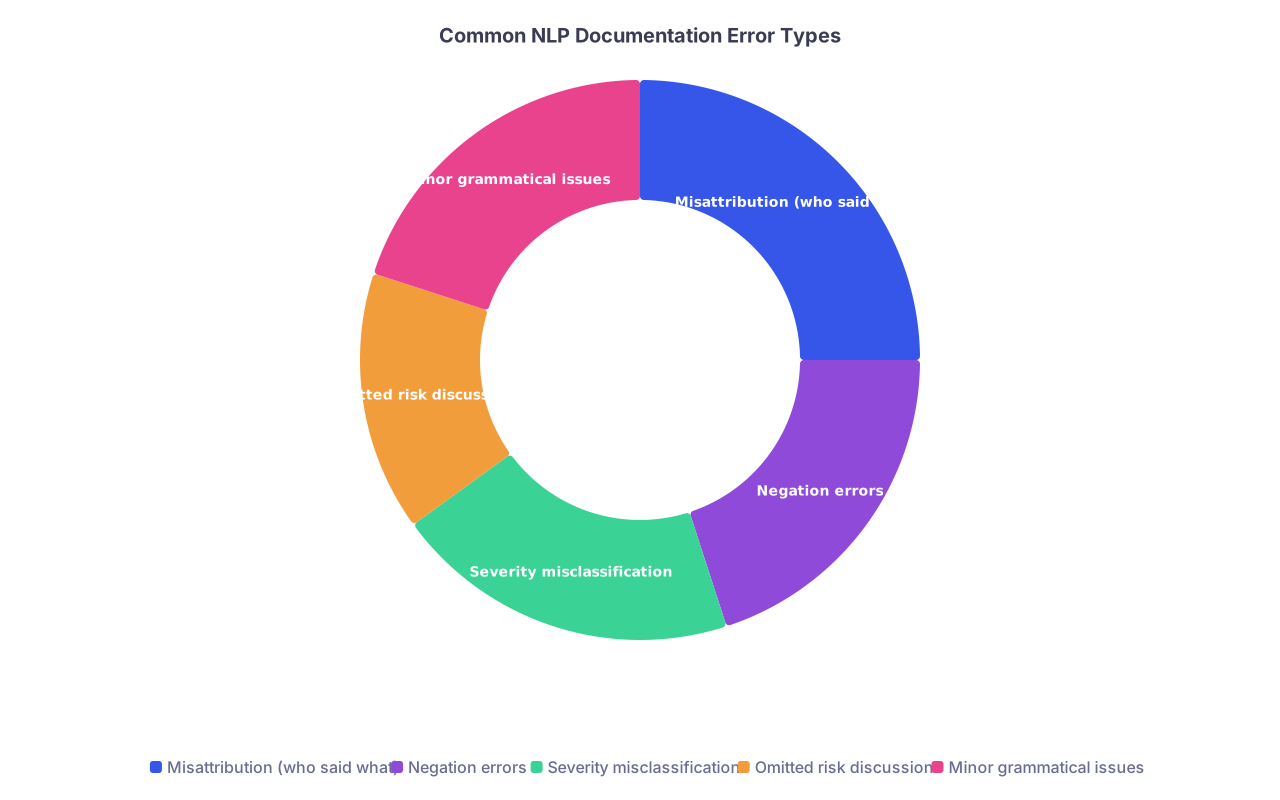
| Category | Value |
|---|---|
| Misattribution (who said what) | 25 |
| Negation errors | 20 |
| Severity misclassification | 20 |
| Omitted risk discussion | 15 |
| Minor grammatical issues | 20 |
How NLP Changes Your Job Market Reality
You are post-residency or early attending. Here is what NLP and AI documentation are doing to the job landscape.
1. Productivity Expectations Rise
Once a group adopts strong NLP-enabled documentation tools, administration sees:
- Faster notes.
- Cleaner coding.
- Higher RVUs.
They do not then say, “Great, everyone can go home earlier.” They raise productivity benchmarks.
I have watched this repeatedly:
- Before NLP tools: 18–20 primary care visits/day, notes half-finished at home.
- After ambient scribe rollout: expectation creeps toward 22–24 visits/day, with less tolerance for backlog.
So if you think, “I will use NLP to make my life easy,” understand someone is likely watching the numbers. Prepare to use the tech to protect your time, not just to increase throughput.
2. Documentation Quality Becomes a Measurable Competency
Organizations increasingly:
- Track note completeness, time-to-sign, and coding distribution.
- Use automated tools to flag “under-documented” encounters.
- Identify outliers in risk-adjustment and HCC capture.
Your facility may literally have a dashboard of your:
- Average E/M level by visit type.
- HCC capture per patient.
- Time from visit to signed note.
Those numbers are powered by NLP and coding engines scanning your notes. That can affect:
- Compensation (in RVU/HCC-based models).
- Renewal of contracts.
- Who gets tapped for leadership roles (“documentation strong vs sloppy”).
If your notes repeatedly confuse or under-feed the NLP engines, you look worse on paper, even if you are clinically excellent.
3. Remote and Hybrid Roles Rely Heavily on NLP
Telemedicine, remote chart review, utilization management, and CDI (clinical documentation improvement) roles all lean on NLP-heavy environments.
Examples:
- Telehealth notes auto-structured by NLP, with decision support for billing levels.
- Utilization review nurses using NLP flagging tools to find charts at risk of denial.
- CDI specialists reviewing NLP-generated “queries” where the system thinks sepsis, malnutrition, or acute organ failure might be under-documented.
If you want flexible, non-traditional roles after residency, you need to be comfortable living with and around these tools.
Practical Strategies: How to Write Notes that Work With (Not Against) NLP
Now the part you actually use tomorrow.
1. Use Clear, Standard Clinical Language for Key Concepts
NLP models are trained on patterns. Give them patterns they recognize.
Prefer:
- “Acute decompensated congestive heart failure” over “heart issues acting up.”
- “Severe sepsis with acute kidney injury” over “really sick with infection and kidneys worsening.”
- “Major depressive disorder, recurrent, moderate” over “has been pretty down again lately.”
Your assessment/plan should read like a coder and an NLP engine were your audience. Because they are.
2. Make Deliberate, Explicit Statements for Critical Context
Context terms that matter:
- Present vs history:
“History of MI in 2018, no current chest pain.” - Causality:
“Acute kidney injury likely due to volume depletion from vomiting.” - Severity:
“Acute on chronic hypoxic respiratory failure requiring 4L O2 from baseline room air.” - Risk/decision:
“Low but non-zero risk for PE discussed; shared decision to monitor outpatient with strict return precautions.”
Spell these out. Do not bury them in vague narrative. NLP can then capture reality more accurately; coders and auditors see a defensible story.
3. Guardrails for Ambient Notes: What You Always Review
If you are using an ambient scribe or AI note generator, have a strict checklist:
HPI:
- Who said what? Patient vs spouse vs clinician.
- Are key negatives preserved and correct (chest pain, SOB, fevers, suicidality)?
- Any invented detail that you never actually discussed?
Exam:
- Does it reflect what you truly did? Ambient systems love to produce “normal” exams.
- Remove autopopulated normals you did not examine.
Assessment/Plan:
- Ensure diagnoses and severity are correct.
- Strip out any “AI-sounding” boilerplate that over- or under-states risk.
If you are signing AI-generated text that says “detailed neurological exam performed and normal” when you did a 15-second cranial nerve screen, you are creating liability.
4. Use Templates Wisely, Not Blindly
Static templates plus NLP is a powerful but dangerous combination.
Good use:
- Baseline structure for common visit types (DM follow-up, pre-op clearance, well child visit).
- Smart phrases that remind you to address quality metrics (foot exam, retinal exam, depression screen).
Bad use:
- Massive Auto-ROS “all systems negative” applied to every note. NLP then thinks you evaluated everything, every time.
- Copy-forward of prior assessments that no longer apply, then partially edited by AI. Leads to contradictory documentation.
Your job: keep templates lean and honest. Let NLP help fill in legitimate details, but do not let it mask gaps in care.
Legal, Ethical, and Patient-Perception Angles
You are not just dealing with software. You are dealing with patients, lawyers, and regulators.
Legal Risk: NLP as Co-Author
Courts, boards, and payers do not care that “the AI wrote that line.” Your name is on the note.
Risks:
- Inaccurate attribution (“patient refused hospitalization” when you actually only discussed it hypothetically).
- Overdocumented exams/procedures (makes you look like you are upcoding or falsifying records).
- Missing key risk discussions (shared decision-making, warnings about red-flag symptoms).
Defensive move: periodically verbalize in your note that you are using an AI or scribe system and that the note was reviewed and corrected as needed. It will not magically protect you, but it shows you are not blindly signing machine output.
Ethics: Consent and Transparency
Ambient recording and AI transcription raise obvious concerns:
- Patients may not realize a third-party vendor is transcribing their visit.
- Audio may be transmitted offsite or to the cloud.
- There are real questions about data ownership and secondary use for model training.
If you are using these tools, you should:
- Know your institution’s consent policy and actually follow it.
- Be prepared to explain—clearly—what is recording, what is stored, and who has access.
- Advocate for opt-out options without penalizing care.
Patient Perception: Are You Listening or Just “Feeding the Machine”?
Most patients do not care about NLP, but they do care that you are focused on them, not the keyboard.
Paradoxically, well-implemented NLP (especially ambient scribing) lets you:
- Face the patient.
- Maintain eye contact.
- Document more detailed histories without typing.
Poorly implemented systems do the opposite: constant corrections, repeated phrases for the AI’s benefit, obvious frustration. Patients pick up on that. It erodes trust.
The test: if your documentation tool makes your conversation smoother and more human, keep it. If it makes you sound like you are dictating to a robot in front of the patient, rethink.
What To Watch For Next: Where NLP in Medicine Is Heading
If you are thinking long-term career, here is where things are clearly moving.
Tighter integration between NLP and decision support.
Your free text will not just shape the note; it will trigger or suppress specific care pathways and guideline reminders.Predictive analytics baked into documentation.
NLP-extracted entities will feed risk models in real time—hospitalization risk, readmission risk, deterioration risk. Your phrasing could change whether that flag flips.More cross-note and cross-encounter analysis.
Systems will track a patient’s narrative across months and years, using NLP to identify missed diagnoses, inconsistent histories, or red-flag patterns.Pressure toward structured conversations.
As models perform better on standardized phrasing, there will be subtle (or not-so-subtle) pressure to speak and write in ways that are “easier for the system.” You need to find the balance between natural patient communication and “machine legibility.”