
The biggest lie in modern medicine is that “the EHR is just a clinical tool.” It is not. It’s a data factory—and if you do not understand who owns that data, you’re the product, not the customer.
You’re out of residency (or close), staring down contracts, productivity bonuses, and RVU dashboards. Behind all of that: data. Your clicks, your notes, your orders, your patients’ lives turned into structured fields. The question is simple but uncomfortable:
Who actually owns the data in your EHR—and what can they do with it?
Let’s unpack this in plain language.
1. Who owns EHR data—legally vs practically?
Let me be blunt: almost nobody in the U.S. truly “owns” EHR data in the way you own your car or your phone. The law doesn’t talk about “ownership” the way you think. It talks about:
- Who controls it
- Who can access it
- Who can use it and for what
Here’s the core reality:
- Patients have rights to their information, but not traditional “ownership.”
- The healthcare organization usually controls the medical record.
- The EHR vendor controls the software and often controls the pipes and the formats.
- You, as the physician, have very little direct control unless it’s written into a contract.
Let’s translate that.
Patients: rights, not classic ownership
Patients have:
- The right to access their records (HIPAA, Cures Act).
- The right to request corrections.
- The right to get digital copies and share them.
But they don’t “own” the EHR in a property sense. They can’t tell Epic, “Delete all data you’ve ever stored about me from every backup.” That’s not how U.S. law is structured today.
Hospitals and practices: record custodians
The medical record is generally considered the property of the healthcare organization that created it (state law sometimes says this explicitly).
That means:
- They decide the EHR vendor.
- They decide retention policies.
- They decide who can see what inside their system.
- They sign the data-use agreements with tech companies, payers, researchers.
You’re often treated as a user, not a co-owner.
EHR vendors: control through infrastructure
Vendors like Epic, Cerner, athenahealth, etc., don’t own the content of the chart—but they own:
- The platform
- The database schemas
- The export tools
- The interfaces (APIs, HL7, FHIR, etc.)
Control of the plumbing is power. If your hospital wants a clean export to move to a new EHR, or you want a copy of structured data for research, you’re negotiating on the vendor’s terms.
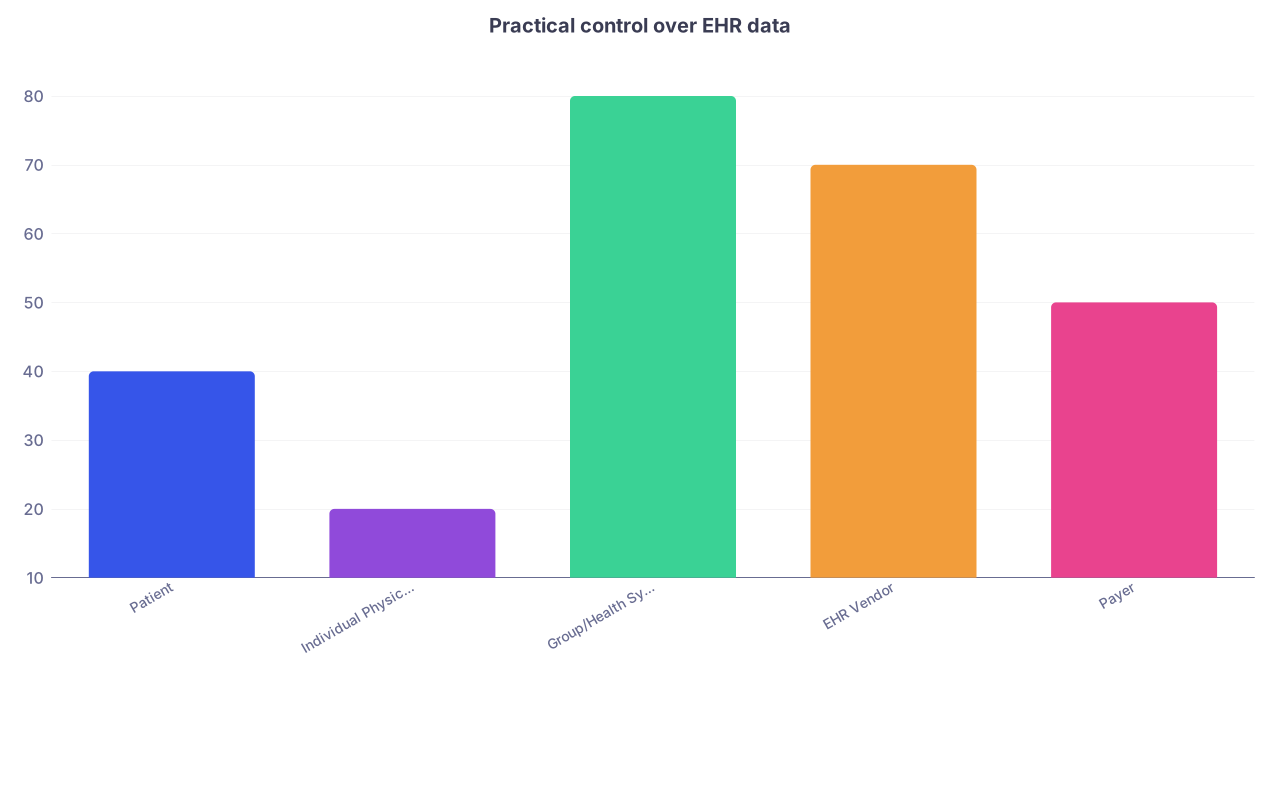
| Category | Value |
|---|---|
| Patient | 40 |
| Individual Physician | 20 |
| Group/Health System | 80 |
| EHR Vendor | 70 |
| Payer | 50 |
Think of that chart as “who usually wins when there’s a conflict.” Physicians are near the bottom.
2. What rights do you have as the physician?
Here’s the annoying truth: your personal legal rights over EHR data are usually very thin. Your practical leverage depends on your role and your contract.
Break it down:
As an employed physician
If you’re an employee of a hospital or large group, their policies and your employment agreement rule everything.
Typically:
- The patient record “belongs” to the institution.
- Your notes are part of that record, not your personal property.
- You can access what you need for clinical care and maybe for quality projects or research (with approvals).
- You often lose all EHR access the day you leave.
You do not get to walk away with a copy of “your patient panel with full data” unless it’s negotiated—and even then, it’s usually limited and heavily de-identified.
As a partner in a private group
You have more leverage, but it’s still not full freedom.
- The practice owns the charts, not you individually.
- Partnership/operating agreements define who controls data, who can sell a de-identified dataset, who signs data-sharing deals.
- If the group sells to a health system, your data goes with the deal.
This is where you should be asking pointed questions in partner meetings. Because that dataset? It might be worth millions in future analytics, AI development, and payer negotiations.
As a researcher or data innovator
If you want:
- Cohorts for research
- A de-identified dataset for AI
- Dashboards for population health
Your rights come from institutional approvals (IRB, data use agreements, legal) and whatever the health system negotiates with the vendor. Don’t confuse “I created the order set and did the work” with “I own the data.”
That’s not how any of this is structured.
3. What can your organization and vendor do with the data?
You need to understand three separate but overlapping buckets:
- Clinical use
- Operational/financial use
- Secondary use (research, AI, commercialization)
Clinical use
This is straightforward: data is used for caring for patients.
- Shared among treating clinicians
- Viewed in consults
- Used in decision support
You’re already living this.
Operational and financial use
This is where it starts to sting:
- Billing optimization
- Productivity tracking (RVUs, visit lengths, template usage)
- Quality reporting for pay-for-performance
- Compliance monitoring (audit trails, “upcoding” detectors)
I’ve seen physicians shocked when administrators bring out a dashboard with their order rates, imaging rates, prescribing habits, documentation times—all pulled from the EHR without a single conversation about “permission.”
If you’re employed, they don’t need your permission. You are generating operational data on their system, using their tools, for their patients.
Secondary use: research, AI, and commercialization
This is where things are moving fast and where most physicians are massively behind.
Common examples:
- De-identified datasets sold or shared with life science companies
- Data used to train clinical AI (diagnostic tools, risk scores, documentation assistants)
- Academic research projects with industry partners
- Payers and health systems combining claims + EHR data to develop proprietary risk models

Is it legal? Often yes, if:
- Data is properly de-identified under HIPAA standards, or
- There’s a Business Associate Agreement (BAA) and appropriate use clauses, or
- Patients have signed broad treatment/operations/research consents depending on state/institution.
Does anyone ask you, the front-line clinician, if you’re okay with your note templates and workflows feeding someone else’s AI product?
Not usually.
4. Why this matters directly to your job and your income
If this all sounds abstract, let’s tie it to what you actually care about as a post-residency physician:
- Autonomy
- Mobility
- Reputation
- Income
1. Your productivity and performance data
Everything you do in the EHR becomes performance metrics:
- Number of visits, procedures, surgeries
- Time spent per encounter
- Documentation lag
- “Click burden” and message volumes
These get used for:
- Compensation formulas (RVU bonuses, quality incentives)
- Renewal or non-renewal decisions
- Internal comparisons (“top decile closers,” “high-utilization outliers”)
You’ll never win a fight about “that data isn’t fair” if you don’t even know what’s being tracked and for how long.
2. Your ability to leave and take patients
When you change jobs, data becomes a weapon and a barrier.
Common pain points:
- Losing full access to old records and relying on faxed PDFs
- Non-competes tied to patient lists and practice data
- No clean way to extract “my clinical history with this population” as structured data
You can’t build longitudinal insights, quality portfolios, or research programs easily if you leave and your data stays locked up.
3. Your role in AI and automation
Here’s the part nobody wants to say out loud: the better the EHR data gets, the easier it is to automate parts of your job.
- Risk scoring
- Protocol-based ordering
- Template-based documentation
- Chatbot triage of inbox and portal messages
If your organization and its vendors own all that workflow data and you have little to no say, you’re not a stakeholder. You’re a training set.

| Step | Description |
|---|---|
| Step 1 | Clinician uses EHR |
| Step 2 | Data captured in logs |
| Step 3 | Data cleaned and de-identified |
| Step 4 | Used to train AI models |
| Step 5 | AI tools deployed in EHR |
| Step 6 | More data from AI usage |
Your future work environment will be shaped by systems trained on your past work, controlled by people who are not you.
5. What should you look for in contracts and policies?
You’re not going to rewrite HIPAA or dismantle Epic. But you absolutely can protect your interests better than most physicians do.
Here’s where to aim your questions and bargaining power.
| Area | What to Look For |
|---|---|
| Data Access After Exit | Read-only vs none, duration, scope |
| Research Use | Your rights to access and publish using EHR data |
| Performance Data | How metrics are used in evaluation/compensation |
| AI/Tech Pilots | Consent, oversight, ability to opt out of pilots |
| Patient Panel Rights | How transitions and patient lists are handled |
Employment contracts
Ask directly:
- Will I have any access to my EHR data after I leave? For how long?
- What data about my work will the organization track and use for evaluation?
- Can I request periodic reports of my performance metrics and raw data?
- If I build templates, order sets, or pathways, who controls those artifacts?
You may not get everything you want, but asking changes the power dynamic. It tells them you know the game they’re playing.
Practice/partnership agreements
You want clarity on:
- Who controls and can license de-identified data sets?
- If the practice sells, how are physicians compensated for data value creation?
- Who approves research, tech partnerships, and AI projects that use your data?
If your group is signing a deal with a big tech company for “innovative AI collaboration” and you’re not in the room, that’s a red flag.
Institutional policies
At a minimum, read (or skim) these:
- EHR use and monitoring policy
- Data governance policy
- Research and data use policies
- AI/innovation governance documents (many big systems now have these)
You’re looking for language about:
- “De-identified data may be shared with industry partners”
- “System activity logs may be used for performance monitoring”
- “Data may be used to improve our tools and services”
Those phrases tell you exactly what’s happening with your work.
6. What you can realistically do—starting now
You’re not powerless. You’re just usually uninformed. Fix that.
Step 1: Map where your data goes
Quick reality check exercise:
- Ask your CMIO or IT: “List the major external data feeds we have—registries, vendors, analytics partners.”
- Ask: “Is our de-identified data shared or sold to anyone? Who?”
- Ask: “Who approves those decisions?”
You’ll be surprised how many people shuffle in their chairs when you ask that calmly in a meeting.
Step 2: Know your own metrics
Get dashboards and exports for:
- Your patient panel characteristics
- Your productivity stats
- Quality measures tied to your name
- Your inbox volumes and response times
You can’t push back on nonsense metrics or negotiate pay if you don’t even know what’s in the spreadsheet.
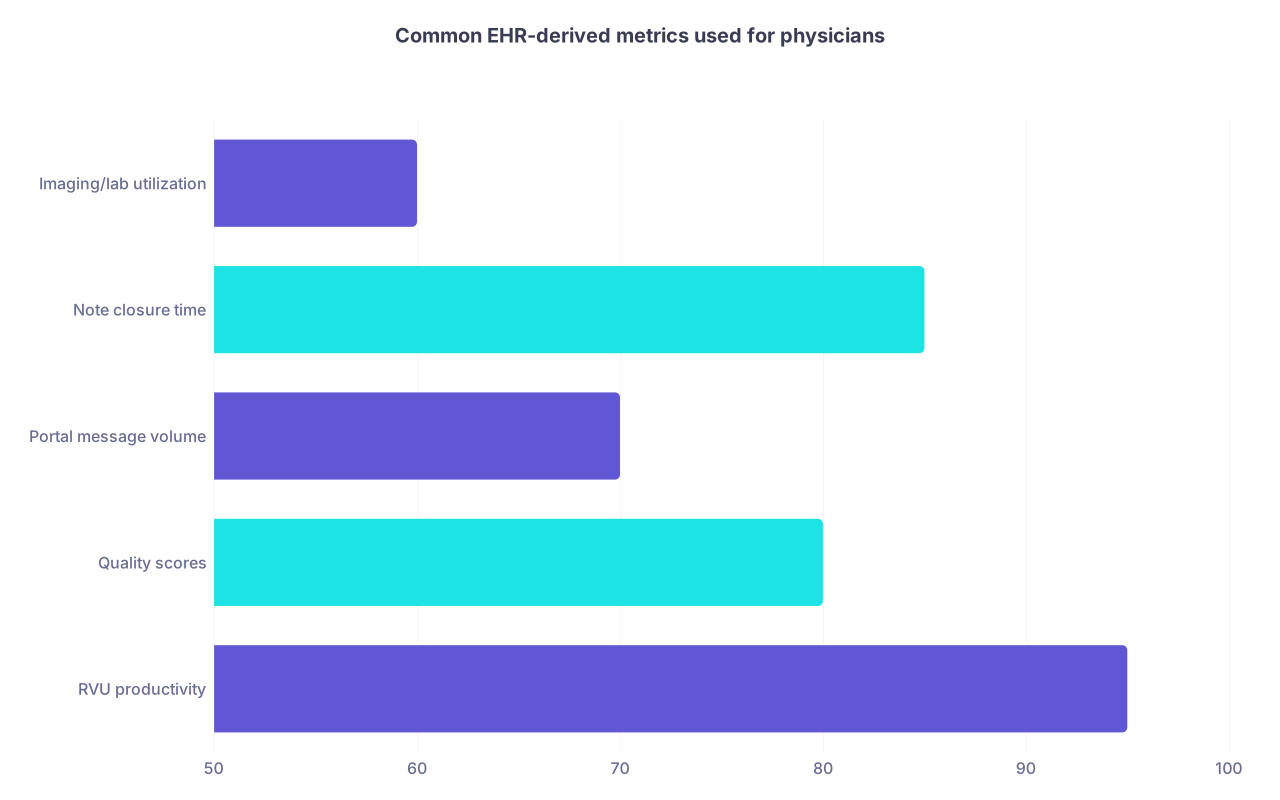
| Category | Value |
|---|---|
| RVU productivity | 95 |
| Quality scores | 80 |
| Portal message volume | 70 |
| Note closure time | 85 |
| Imaging/lab utilization | 60 |
Treat those numbers like you’d treat your credit report. Check them, correct them, and use them.
Step 3: Get involved in data and AI governance
If your institution has:
- A data governance council
- An AI/innovation committee
- A clinical informatics group
Join one. Or ask why they do not exist.
You want clinicians in the room when decisions get made about:
- What external entities get access to de-identified data
- How AI tools are piloted and evaluated
- How physician workflows and metrics are exposed downstream
If only administrators and vendors are at that table, you know where this is going.
Step 4: Think strategically about your own interests
You can use EHR data for your benefit too, for example:
- Build a track record of quality improvement and research output using structured data.
- Develop niche expertise (e.g., “I run the heart failure registry and remote monitoring program”).
- Position yourself as the bridge between clinicians and data teams. That role is undervalued publicly but very valued by leadership.
You don’t have to become a data scientist. You just have to stop acting like a passive data source.
FAQ: Who Owns the Data in Your EHR?
1. Can I “own” my clinical notes and take them with me when I leave a job?
No, not in the way you probably wish. Your notes are part of the legal medical record, which is controlled by the organization. Some contracts or policies may allow limited copies or read-only access after you leave, but that’s a negotiable privilege, not a default right. If ownership or access matters to you, raise it in contract discussions up front.
2. Are tech companies allowed to use my patients’ EHR data to build AI tools?
Yes, under certain conditions. If data is properly de-identified under HIPAA, it can often be used and even licensed with fewer restrictions. If data is identifiable, use typically requires a Business Associate Agreement, research approvals, or explicit consent depending on the scenario. The key point: those deals are usually made at the system level, not with you as an individual physician.
3. Can my employer legally track my EHR activity to evaluate my performance?
Yes. Every major EHR keeps detailed audit logs of your actions. Employers routinely use those logs and derived metrics (visit volumes, documentation lag, order patterns) for productivity analysis, quality dashboards, and sometimes disciplinary actions. You should assume your EHR behavior is fully visible to the organization and governed by internal policies, not privacy rights.
4. Do patients actually “own” their medical records?
In most U.S. jurisdictions, no. They have strong rights of access and control over sharing, but not strict ownership in the property-law sense. The record is usually considered the property of the provider or institution, with patients granted legally protected access and amendment rights. That’s why they can request copies but can’t usually tell a hospital to erase all historical records.
5. What’s the single most practical step I should take about EHR data as a new attending?
Ask for a meeting with your CMIO or IT lead and your practice leadership and say this: “Show me exactly what data and dashboards exist about my clinical work and how they’re used.” Once you see the metrics, you can spot problems, negotiate expectations, and decide where to get involved. That one move pulls EHR data from the shadows into a space where you can actually respond and plan.
Key points to keep in your head:
- You don’t own the EHR data; your organization controls it, and vendors control the pipes.
- Your work is being measured and often monetized, with or without your input.
- If you want any say in how your data shapes your career and your patients’ care, you need to get informed, ask hard questions, and claim a seat at the data table.