
You’re three months into your new attending job. You finally know which door leads to the call room, your clinic template isn’t a total disaster, and you’ve just figured out how to submit your RVUs. Then you get the email:
“We’d love to have physician representation on our IT / AI Steering Committee. You’d be a great fit.”
You’re staring at it thinking: Is this career gold or a time-sucking black hole?
Here’s the answer you’re looking for.
First: Who should even consider joining?
Let me be blunt: not everyone should be on an IT or AI committee. That’s part of why so many of these committees are useless — they’re padded with people who don’t care or don’t understand what’s at stake.
You should seriously consider joining if at least two of these are true:
- You get irrationally annoyed by bad EHR workflows and immediately think, “There’s a better way to do this.”
- You’re already the “tech person” in your group (everyone asks you Epic/Cerner questions).
- You’re interested in AI in medicine beyond the hype — enough to ask, “What’s the validation data? How’s bias handled?”
- You care about how tech impacts patient safety, burnout, and revenue — not just “cool tools.”
- You can say “no” to bad ideas in a meeting full of people who want shiny objects.
If none of those resonate and you’re fighting just to keep up clinically, it’s probably not your time. And that’s fine.
What these committees actually do (and why most doctors misunderstand them)
People imagine hospital IT/AI committees as deep strategy think-tanks. Often, they’re more like this:
- Quarterly meetings where IT presents what’s already half-built
- A list of 30 “provider requests” that all can’t be done “due to limitations”
- Someone saying, “We’ll put that on the roadmap”
- A polite way to say no to department chairs
But the better ones — the ones worth your time — have very real influence:
- Approving or blocking tech purchases: EHR add-ons, AI tools, decision support systems
- Prioritizing which build requests get done this quarter vs. never
- Setting policy: who can use which AI tools, how results are displayed, who’s responsible when the AI is wrong
- Shaping hospital-wide standards: order sets, documentation templates, quality dashboards
The key question: is this committee advisory (we listen to you then ignore you) or decision-making (we vote and that’s binding)?
If they can’t answer that clearly, that’s a red flag.
The Pros: When joining is absolutely worth it
Let’s go through the upside in real-world terms, not the vague “leadership opportunity” fluff HR likes to push.
1. You get a direct line to change the tech that controls your day
If you’re burned out on clicking through 14 screens to order a CT, this matters.
Good committees give you access to:
- The analysts who actually build the orders, smart sets, notes
- The CMIO/CHIO who can pull strings when needed
- The prioritization process for tickets and projects
You go from screaming into the void (“Epic is terrible”) to saying, “This single change will save every hospitalist 30 minutes per shift — here’s how, here’s the workflow, here’s the data.”
And sometimes, it gets built. Fast.
2. You become the person leadership calls when things get real
Epic migration. New AI sepsis tool. Radiology prioritization algorithm. Federated data platform. Leadership will need frontline clinicians who:
- Understand the clinical impact
- Can translate “this is unsafe” into specific, fixable requirements
- Aren’t afraid to say, “We’re not ready to go live”
That visibility is rocket fuel for certain careers.
If you ever want to be:
- Division or department quality lead
- CMIO / CHIO / Medical Director for Informatics
- System-level clinical leader (CMO type roles)
…then having “IT/AI Committee, Chair or Core Physician” on your CV is legitimate proof you can operate above the level of your own clinic.
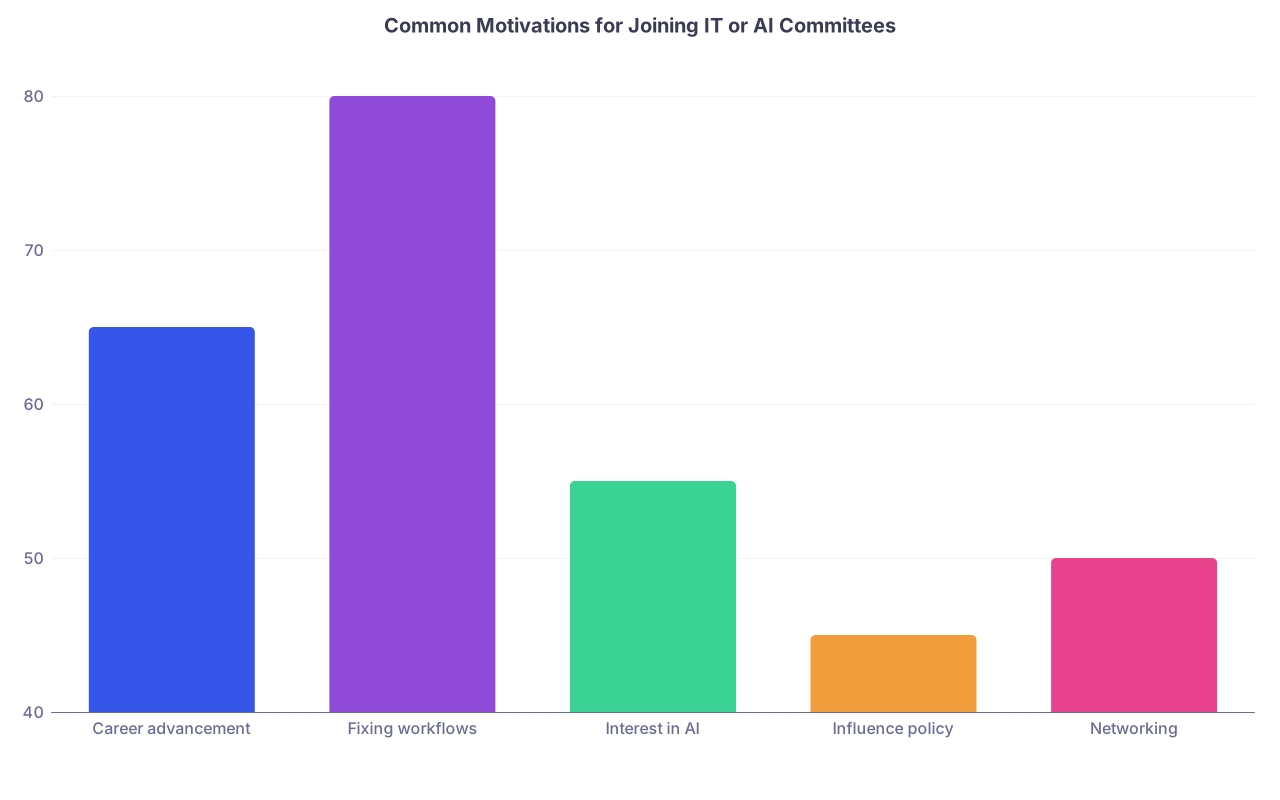
| Category | Value |
|---|---|
| Career advancement | 65 |
| Fixing workflows | 80 |
| Interest in AI | 55 |
| Influence policy | 45 |
| Networking | 50 |
3. Early access to AI tools (and a voice in how safely they’re used)
Hospitals are getting pitched AI nonstop: imaging, documentation, predictive risk scores, workflow tools, chatbots. Someone has to ask the right questions:
- What’s the training data? Does it match our patient population?
- What’s the measured sensitivity/specificity? Compared to what?
- How’s it monitored post-implementation? Who owns that?
- What happens when it’s wrong — legally and clinically?
If you want to be at the center of AI in healthcare instead of reading about it in a press release 6 months later, committee work is where that happens.
You can:
- Steer your hospital away from unvalidated garbage
- Advocate for human overrides and clear UI to avoid alert fatigue
- Push for real pilots instead of immediate system-wide deployments
That’s how you sleep at night when your name is tied to “AI adoption.”
4. Credibility for future non-clinical work
The job market is shifting. Pure clinical careers with no leadership/tech experience are more vulnerable long-term than people admit.
Committee experience helps if you later want:
- Part-time consulting with vendors or health systems
- Roles with payers, startups, or digital health companies
- To move into 50/50 clinical–administrative positions
And unlike a random online course, this is actual institutional experience with real politics, budgets, and constraints.
| Signal Type | Example Experience |
|---|---|
| Pure Clinical | Section head, clinic director |
| Hybrid | IT/AI committee member or chair |
| Tech-leaning | Physician champion for EHR/AI tool |
| Formal | Clinical informatics fellowship/board |
| Executive | CMIO/CHIO role |
5. You build a surprisingly valuable network
You end up in a room with:
- CMIO / CHIO / CIO
- Nursing informatics leaders
- Quality and safety directors
- Sometimes even the COO or CMO
Those people decide:
- Who gets pulled into “special projects”
- Who gets early promotion opportunities
- Who they trust for honest clinical input
If you show up prepared, speak clearly, and avoid useless complaining, they remember.
The Cons: When you should run the other way
There’s real downside. I’ve seen people burn out, get politically burned, or just waste hours they never get back.
1. Time drain with vague expectations
Huge red flag: they can’t tell you the expected time commitment.
Ask for specifics:
- How often do you meet? For how long?
- Are there subcommittee calls? Pre-reading?
- Is there protected time? Is it written anywhere?
If you’re doing:
- Monthly 90-minute meetings
- Plus “ad hoc” workgroups
- Plus reading 40-slide decks before each meeting
…that’s 5–10 hours a month. On top of your full clinical load. Without compensation, in most places.
If your clinic templates are already full and you’re taking notes home every night, this can absolutely make your life worse.
2. No authority, just blame
This is the worst scenario:
- You’re put on a committee with a fancy name
- Decisions are actually made by a small inner circle (often finance + IT + 1 or 2 executives)
- But when front-line clinicians hate a new change, they’re told, “This was reviewed by the physician committee”
So you get:
- No actual control
- But shared responsibility and reputation risk
Ask bluntly: “What decisions specifically does this committee make versus only advise on?” If the answer is fuzzy, they probably see you as a rubber stamp.

| Step | Description |
|---|---|
| Step 1 | Invited to IT or AI committee |
| Step 2 | Politely decline |
| Step 3 | Negotiate terms or decline |
| Step 4 | Join and commit for 1-2 years |
| Step 5 | Reassess after first year |
| Step 6 | Clear time and support? |
| Step 7 | Committee has real influence? |
| Step 8 | Role defined and protected time? |
| Step 9 | Aligns with your career goals? |
3. Political landmines
IT/AI decisions are political because they touch:
- Money (capital spend, vendor contracts)
- Physician happiness (or rage)
- Legal and regulatory risk
- Public reputation when “AI” is involved
If you’re the one saying, “This vendor is unsafe,” and executive leadership wants the press release, you’re now in conflict.
You need a bit of political sense:
- Know when to go one-on-one with the CMIO instead of fighting in the big room
- Document safety concerns when you’re overruled
- Avoid being “the AI person who always says no” or “the pushover who signs off on anything”
If you hate politics and you’re in a toxic or opaque system, committee work can be miserable.
4. Opportunity cost: what else could you be doing?
Every hour in committee work is an hour you’re not:
- Building your clinical niche
- Doing research or QI you actually care about
- Spending time with your family
- Resting, which you probably still need post-residency
You should only join if the upside is clear and aligned with your goals.
How to decide: a brutally practical checklist
Here’s how I’d decide in your shoes. Sit with these questions:
Is your clinical workload stable enough? If you’re drowning, fix that first. Committees won’t rescue you.
Do you have at least a mild passion for tech or AI? If this feels like “one more committee box to check,” skip it.
Does this system actually listen to clinicians? Look around. Did previous big IT changes involve real clinician input, or just “training on what’s already decided”?
Are expectations specific and written down? Push for clarity: time, scope, decision power, term length.
Is there any recognition — protected time, stipend, title? You’re a physician, not free labor. “Leadership experience” alone is not enough payment in 2026.
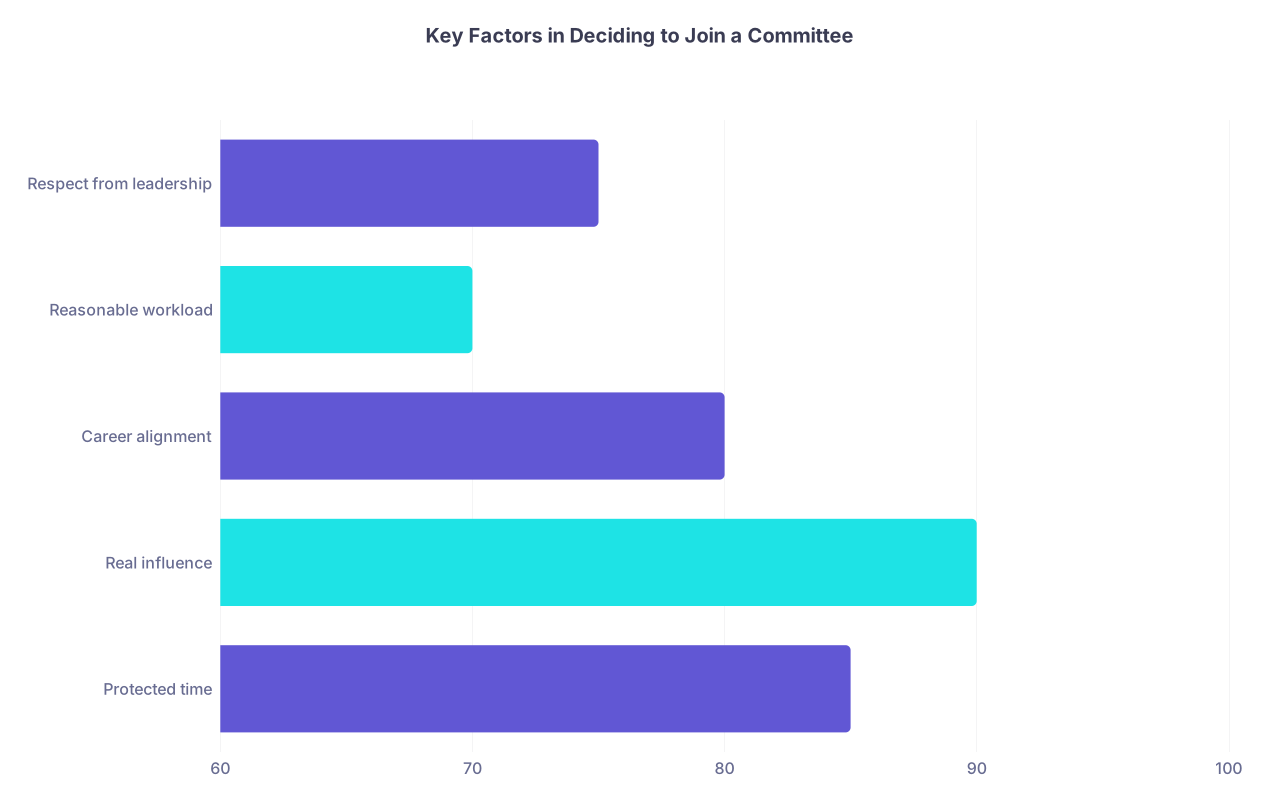
| Category | Value |
|---|---|
| Protected time | 85 |
| Real influence | 90 |
| Career alignment | 80 |
| Reasonable workload | 70 |
| Respect from leadership | 75 |
My rule of thumb:
Join if you can clearly explain to yourself:
- What impact you want to have in 1–2 years
- How this committee is the best path to that impact
- What you’re giving up — and you’re okay with that trade
If you can’t articulate that in two sentences, you’re probably saying yes out of guilt or FOMO.
If you say yes: how to make it actually worth it
Assuming you decide to join, don’t just show up and react. That’s how you become background noise.
Do this instead:
Pick 1–2 clinician-centered priorities
Examples: reduce documentation burden for your specialty; improve safety around a specific AI tool; fix one high-friction workflow. Become the person associated with making progress on those.Learn just enough language to be dangerous
Not coding. Just basic terms: APIs, integration, model validation, specificity vs sensitivity, AUROC, bias and drift, governance. You want IT and AI vendors to realize they can’t hand-wave you.Bring data, not vibes
“The note template is awful” gets ignored.
“This change will remove 30 clicks per admission and save 5 minutes per patient, here’s a short screen recording” gets attention.Put everything through two filters:
- Does this help clinicians or patients?
- Is this safe and auditable when it fails?
Reassess after a year
If the committee is going nowhere, or you’re constantly overruled without transparency, step off. You’re not obligated to endlessly donate your time to a system that doesn’t use it well.
If you say no: how to not burn bridges
You can decline without looking unhelpful.
Try something like:
“I appreciate the invitation. Right now my clinical workload and other responsibilities wouldn’t let me contribute at the level this deserves. If that changes in the future — especially as you start working on [specific project you care about] — I’d be happy to revisit.”
This:
- Signals you’re thoughtful, not apathetic
- Leaves the door open
- Protects your bandwidth while you stabilize in your attending role
Quick scenarios: when my answer is Yes vs No
Yes, you should probably join if:
- You’re in a system that has real physician informatics leaders (CMIO, etc.) who already shipped improvements clinicians actually like.
- You’re already getting pulled into tech questions informally; this just formalizes the work you’re doing anyway.
- You’re even mildly serious about a future in quality, leadership, or informatics.
No, you probably shouldn’t if:
- Your group is understaffed, you’re regularly staying late just to finish notes, and no one is adjusting your schedule.
- The committee is clearly window dressing: big titles, no real scope, no protected time, no track record of change.
- You don’t care about tech except to tolerate it — totally valid, by the way.

FAQs
1. Do I need a formal informatics degree or fellowship to join an IT or AI committee?
No. Most hospital IT/AI committees are desperate for engaged frontline clinicians. A basic understanding of your EHR and a willingness to think systematically about workflows is enough to start. Formal informatics training helps if you want a leadership role (CMIO/CHIO), but it’s not required to be a valuable committee member.
2. Should I ask for protected time or extra pay for committee work?
Yes, you should at least ask. Protected time is more realistic than extra pay in many systems, but both are negotiable if your role is substantial. Phrase it in terms of patient safety and quality: “To do this responsibly, I’d need X half-days per month blocked from clinic so I can prepare and follow through.” If they refuse everything, that tells you how they value the work.
3. Is an AI-specific committee better than a general IT/EHR committee?
It depends on your interests and the hospital. An AI committee is great if you’re especially interested in algorithms, validation, and ethical use of AI. A general IT/EHR or clinical informatics committee often has broader influence over daily workflows. In some systems, AI oversight is a subcommittee of IT. Ask how decisions actually flow before picking one.
4. What red flags mean I should decline immediately?
Three big ones: they can’t describe the committee’s actual authority, there’s no clarity on time expectations, and there’s zero mention of protected time or formal recognition. Bonus red flag: they say things like “we just need a couple of doctors to sign off on this” — that’s code for rubber stamp.
5. How long should I commit if I decide to join?
Aim for 1–2 years. Less than a year and you won’t see projects through; more than two years and you risk getting stuck in a role that no longer serves your goals. When you join, mentally commit to a full year of genuine engagement, then reassess: are you having impact, growing your skills, and building relationships? If not, rotate off.
Key points to leave with:
- Join only if the committee has real influence and the work aligns with your career goals.
- Protect your time — push for clear expectations and some form of recognition or protected time.
- If you do say yes, treat it like a serious role: pick a few priorities, bring data, and reassess your involvement after a year.