
You just finished residency, you’re a few weeks into your first attending job, and it’s 8:45 p.m.
You’ve been home since 6:30. You ate. You showered. And now you’re sitting on your couch with your laptop open, staring at 37 unfinished notes and an inbox that won’t die.
And you’re thinking: “Is it supposed to be this bad? Or am I just really bad at this?”
Here’s the answer you’re looking for: some EHR pain as a new attending is normal. Chronic misery and 2–3 extra hours every night is not.
Let’s put numbers to “normal,” draw the line where it becomes a problem, and talk about concrete ways to get out of the hole.
The Short Answer: What’s “Normal” EHR Inefficiency?
Let me give you a calibration first. This is the ballpark I tell new attendings to use.
For a full‑time outpatient attending (primary care or general specialty) in the first 3–6 months:
Extra EHR time outside scheduled clinic:
30–90 minutes per day is common.2 hours per day, most days → red flag.
Note completion timing:
70–80% of notes done same day is reasonable early on.
Frequently leaving >10 notes per day to “tomorrow” → red flag.Inbox (messages, refill requests, labs):
1–2 short blocks per day (total 30–60 minutes) is typical at the start.
Needing 90+ minutes per day just for inbox → something is off (workflow, staffing, or panel size).
For inpatient attendings:
- Extra time after rounds:
30–60 minutes on the unit or at home finishing notes/orders is common early on.
Still documenting 3–4 hours after leaving the hospital → not normal long term.
That’s the baseline. Early inefficiency? Expected. Feeling constantly underwater? Not something you should just “get used to.”
Why New Attendings Are So Slow in the EHR (Even When You Feel Competent Clinically)
You weren’t this slow as a senior resident, right? That’s the part that messes with people.
Here’s what changes when the badge color changes.
You own every decision
As a resident, you were “drafting” a lot of the work. The attending carried legal and billing responsibility. As an attending, you:- Second-guess more
- Document more defensively
- Read more old notes and external records That adds friction and time.
The EHR is the actual production system now
Residency workflows are training wheels. Attending workflows are the real thing: dot phrases, order sets, routing rules, pre-visit planning, scheduling constraints, RVUs, population health alerts, quality metrics.
Nobody teaches this in any coherent way. You discover it by suffering.You’re doing more non-clinical clicks than you realize
- Prior auth messages
- Disability/FMLA paperwork
- “Can you write a letter stating…”
- Inbox spam from the system (reminders, metrics, “campaigns”)
Clinically, you might be fine. But administratively, you’re getting buried.
Bad builds and bad defaults
Some EHRs are reasonably efficient when set up well. Many are a mess:- No standardized templates
- Useless or outdated order sets
- Terrible routing rules (every lab abnormal routed to you instead of team pools) If you just “accept the defaults,” you inherit someone else’s bad decisions.
So yes, it’s very normal to feel slower and more drained by the EHR in your first year as an attending, even if your clinical brain is firing on all cylinders.
Reasonable Benchmarks by Setting (With Actual Numbers)
Use these as rough guardrails, not perfection targets.
| Setting | EHR Time / Day (Work Hours) | Extra EHR / Day (Home) | Notes Same-Day |
|---|---|---|---|
| Outpatient PCP | 4–5 hours | 0.5–1.5 hours | 70–85% |
| Outpatient Spec | 3–4 hours | 0–1 hour | 75–90% |
| Inpatient Gen | 4–6 hours | 0.5–1 hour | 80–90% |
Key interpretation:
If you’re outside these ranges for more than 2–3 months, you don’t “need to toughen up.” You need system and workflow changes.
What’s Normal by Time Frame? (Month 1 vs Month 12)
Let’s talk trajectory. Because it’s not just about where you are, but whether you’re getting faster.
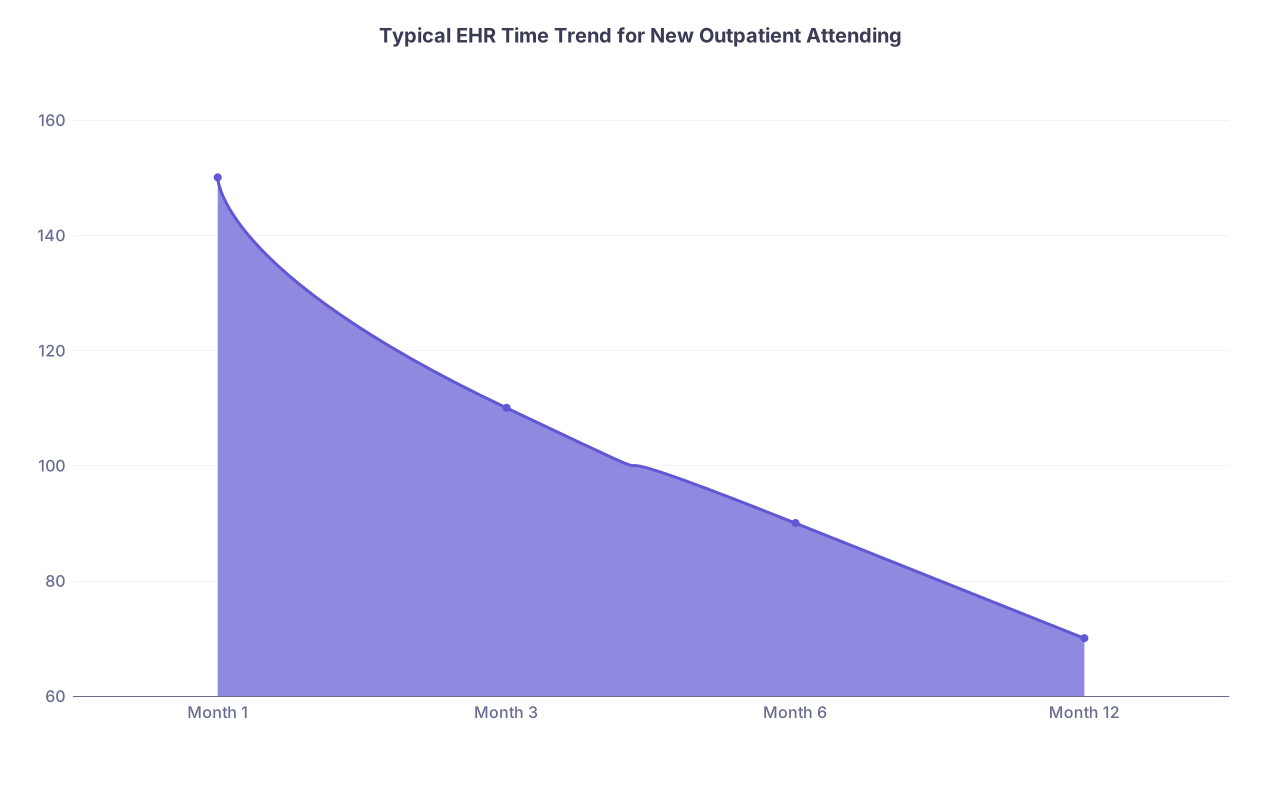
| Category | Value |
|---|---|
| Month 1 | 150 |
| Month 3 | 110 |
| Month 6 | 90 |
| Month 12 | 70 |
Values above are “EHR minutes outside scheduled clinic per weekday” for someone reasonably efficient who’s actively tightening their processes.
Months 0–3: Clumsy and slow is normal
- Extra 60–120 minutes per day at home? Common.
- Needing to come in early or stay late a few days a week? Also common.
- Feeling dumb because your MA finishes their tasks faster than you close notes? Very common.
What should not be happening: being 1–2 clinic days behind on notes consistently or carrying >40 unsigned notes more than occasionally.
Months 3–6: You should see clear improvement
By month 3:
- You’ve built or stolen decent templates
- You know the basic order sets
- You know where common info “lives” in the chart
If at month 6:
- You still regularly do 2+ hours at home
- Your note backlog never goes below “mildly terrifying”
You’re no longer in “learning curve” territory. You’re in “structurally broken workflow” territory.
Months 6–12: Near-attending-normal
By the end of year one, a full-time outpatient attending with average support should be able to:
- Finish ≥90% of notes the same day
- Keep after-hours EHR ≤30–45 minutes on most days
- Have a stable inbox rhythm that doesn’t feel like whack‑a‑mole
If you’re nowhere near that by month 12, something is wrong: panel size, template design, staffing, or your own habits. Often all four.
Where EHR Inefficiency Crosses the Line into “Not Okay”
Here’s where I stop calling it “normal learning curve” and start calling it a problem that needs intervention.
Red flag thresholds:
Chronic after-hours work
- You’re consistently doing >2 hours of EHR work at home at least 3 nights a week.
- Or you’re working both days of most weekends just to keep up.
Persistent backlog
25 open notes for more than 2 days
75 open inbox messages at baseline with no clean slate days
Sleep and life are getting wrecked
- You’re sacrificing sleep several nights per week to finish documentation.
- You’re skipping basic life things (exercise, kids’ events, even just zoning out) because “I have to catch up on the EHR.”
Safety and judgment slipping
- You’re rushing notes so much you’re starting to miss reconciling meds, following up critical labs, or documenting key discussions.
That’s not you being weak. That’s you being trapped in a bad system with no guardrails.
Concrete Things You Can Do in the First 90 Days
Let’s move from diagnosis to treatment. These are changes that actually buy you back time, not motivational posters.
1. Audit a real week of your EHR time
Don’t guess. Track.
- For 5 workdays, jot down:
- Time spent on: notes, inbox, orders, “random admin”
- How many patients you saw
- How many notes done same day
- Repeat for 1 weekend.
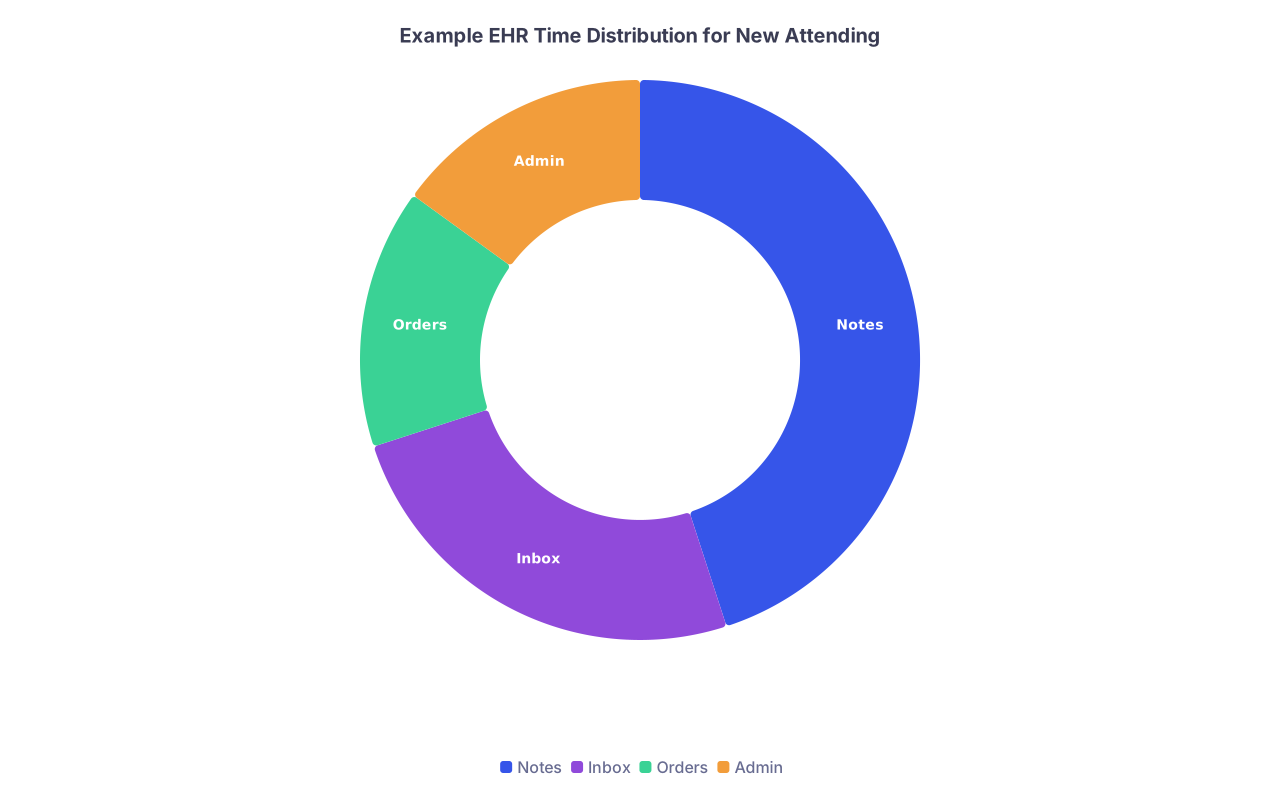
| Category | Value |
|---|---|
| Notes | 45 |
| Inbox | 25 |
| Orders | 15 |
| Admin | 15 |
Once you see the breakdown (notes vs inbox vs admin noise), you know what to attack first.
2. Fix templates and phrases ruthlessly
Bad documentation habits will eat your career alive.
- Build 3–5 rock-solid templates:
- New patient
- Routine follow-up
- Chronic disease follow-up (e.g., DM/HTN)
- Urgent visit
- Telehealth
Each template should do real work: auto-pull meds, problem list, vitals; have prewritten but editable phrases for common plans; and minimal fluff.
You’re aiming for:
- 80–90% of note time spent editing, not free-typing from scratch.
If your system has dot phrases / SmartPhrases / QuickTexts and you’re not using them for:
- ROS
- Physical exam patterns
- Standard counseling (HTN, DM, obesity, smoking)
then you’re burning time for no reason.
Workflow Tweaks That Make a Big Difference
I’ve watched a lot of new attendings turn the corner just by fixing the following.
1. Do “one-touch” notes whenever possible
The worst habit: seeing 3–4 patients, then doing all 4 notes in a batch.
It feels efficient. It’s not. You forget details, you re-open charts, you click around more.
Better pattern:
- Do at least the Assessment & Plan while the patient is still in the room or immediately after they leave.
- Use the MA or nurse rooming time to finish previous note(s).
Even if Subjective/Objective are rough, a solid A/P done in real time will cut your rework in half.
2. Schedule protected inbox time
Inbox will gladly expand to fill your life if you let it.
Set two (or three) fixed windows per day:
- Late morning (e.g., 11:30–12:00)
- End of day (e.g., 4:30–5:00)
- Optional: brief mid-afternoon check
The rule:
Outside those windows, you don’t live in the inbox unless it’s clearly urgent.
Your staff should know how to escalate true urgencies (phone call, in-person, or high-priority route). Everything else can sit.

| Step | Description |
|---|---|
| Step 1 | Start Clinic |
| Step 2 | Pre-visit review |
| Step 3 | See Patient |
| Step 4 | Finish Note A P |
| Step 5 | Place Orders |
| Step 6 | Next Patient |
| Step 7 | Late AM Inbox Block |
| Step 8 | Afternoon Patients |
| Step 9 | End of Day Inbox Block |
| Step 10 | Final Note Cleanup |
3. Offload what is not MD work
If you’re:
- Manually hunting for records
- Filling out every portion of every form yourself
- Managing all refills solo without protocols
You’re functioning as a very over-trained clerk.
Push aggressively:
- Use team pools for refills with clear protocols.
- Have staff pre-fill forms with everything non-clinical before they hit you.
- Ask for record retrieval to be standardized and done before visits when possible.
When It’s the System, Not You
Sometimes you’re not the problem. The job is.
Common structural issues I’ve seen:
Absurd panel size for a new attending
- A new PCP starting at 1.5–2k active patients with weak support? Of course you’re drowning.
No MA or shared MA across multiple clinicians
- If you’re rooming your own patients, doing all vitals and med rec, you’ll be behind no matter how good your templates are.
Terrible EHR build and no training
- No local superuser, no optimization sessions, default templates from 2009.
You are allowed to say: “This is not sustainable, and it’s not acceptable.”
Bring data, not vibes. That one-week audit you did? Gold. Show it to:
- Your medical director
- Clinic manager
- EHR optimization lead (if they exist)
You say: “Here is where the time is going. Here are 3 changes that would help:
- Standard refill protocols
- Protected inbox block built into templates
- Optimization session with IT / superuser”

If leadership shrugs and says “everyone’s suffering, just hang in there” with no interest in improvement, that’s a data point about the job, not about you.
When to Actually Think About Leaving
I’m not quick to tell someone to quit a first job. But there are situations where the EHR burden is a symptom of a structurally bad practice.
Serious consideration to leave if, despite your best efforts over 6–12 months:
- After-hours EHR time stays >10 hours/week
- You’ve clearly articulated workflow fixes and been ignored
- Turnover around you is high
- You’re noticing worsening burnout, irritability, or dread
You only get one early-career nervous system. Burning it out on a broken EHR environment is not noble. It’s just wasteful.
Quick Reality Check: What’s Actually “Normal” Misery?
Let me normalize a few things:
Normal in first months as attending:
- Feeling slower than senior residents
- Needing to block time on weekends occasionally
- Feeling clumsy with templates and order sets
- Being annoyed at the inbox
Not normal to just accept:
- Nightly 2–3 hour documentation marathons
- Constant anxiety about incomplete notes and potential audits
- No interest from leadership in optimizing workflows
The EHR will never be pleasant. But it should be tolerable most days and mostly live inside work hours, not invade your life every night.

FAQ: New Attending EHR Inefficiency
How many hours of EHR work outside the clinic day is actually reasonable?
For a full-time outpatient attending early on, 30–90 minutes per weekday is reasonable, with the goal of trending down to 30–45 minutes or less by around 6–12 months. Regularly hitting 2+ hours most nights, or needing several hours each weekend just to stay afloat, isn’t a “normal” long-term expectation and should trigger changes in workflow or job structure.Is it normal to go home with unfinished notes as a new attending?
Yes, especially in your first 1–3 months. Most new attendings will have a handful of notes that spill into the evening or next morning. What’s not okay is carrying a chronic backlog of 20–40+ notes for days at a time, or constantly feeling like you can’t catch up. Aim for at least 70–80% same-day completion early, moving toward 90%+ with better templates and habits.What’s the single biggest efficiency fix I should focus on first?
Build or steal excellent templates and dot phrases and force yourself to do “one-touch” notes—finish at least the Assessment & Plan in real time for each patient. Those two changes alone usually cut charting time significantly. People obsess over keyboard shortcuts but ignore the fact that their note structure is garbage. Fix the structure first.How do I know if it’s my personal inefficiency vs. a bad clinic/EHR setup?
Track a detailed week of EHR use. If you’re spending time on tasks that clearly could be delegated (record hunting, form grunt work, standard refills) or your panel size and staffing are obviously out of line compared to peers, that’s a system problem. If most of your time is in free-typing notes from scratch and bouncing between tasks with no rhythm, that’s a personal workflow problem. Often it’s both; you fix your piece and then push hard on the system side.Should I be worried about audits if I shorten my notes to be more efficient?
No, as long as you’re documenting clearly what you did, why you did it, and your medical decision making. Auditors care about clarity, completeness for the level of service, and compliance with rules—not about two-page novels. Bloated, copy-pasted notes are actually more dangerous. Concise, structured documentation that captures problems addressed, data reviewed, and risk assessed is safer, faster, and more defensible.
Bottom line:
- Some EHR inefficiency and extra hours are completely normal in the first 3–6 months as a new attending.
- Chronic, heavy after-hours charting and perpetual backlog are not “just part of the job” and usually signal fixable workflow or system problems.
- Track your time, tighten your templates and habits, and push your institution for structural support—because suffering in silence is not part of being a “good” attending.