Opening Statement: Why Clerkship Notes Degrade in Real Time
Your notes are not getting worse because you suddenly forgot how to think. They get worse because clerkship overloads the exact systems that make clear documentation possible. The data shows a simple pattern: cognitive load rises faster than attention can stabilize it, and note quality degrades in real time.
I have seen this on wards a hundred times. A student who wrote crisp, organized pre-clinical writeups starts producing notes with missing timeline details, vague assessments, duplicated plan items, and little logic connecting one sentence to the next. Not laziness. Not lack of intelligence. Load.
Operationally, “sloppier” means four things:
- More omissions: missing symptom chronology, missing medication changes, missing decision rationale
- Less structure: scattered HPI, weak problem list hierarchy, plan items buried in paragraphs
- Weaker assessment/plan language: generic statements instead of actual clinical reasoning
- More documentation errors: copy-forward mistakes, wrong labs, outdated vitals, contradictory statements
That is not a cosmetic problem. It is a patient care problem. A messy font is harmless. A missing reason for why you think the creatinine rose is not.
My position is direct: mindfulness is useful here, and not because it feels calming or virtuous. It is useful because it trains attention control, improves error detection, and makes documentation more consistent under pressure. That is not fluffy. That is applied cognitive performance.
The Mechanism: What Changes on Clerkship, According to the Data
Pre-clinical work is demanding, but it is usually single-channel demanding. You study one subject, in one place, for a block of time. Clerkship is multi-channel demanding. You gather history, watch the clock, anticipate pimp questions, interpret new labs, answer pages, find a computer, and try to write before the plan changes again. Different game.
The numbers matter because ratios matter.
A typical pre-clinical study block may involve:
- 1 main task at a time
- 45 to 90 minutes of relative continuity
- 0 to 2 major interruptions per hour
A typical clerkship morning may involve:
- 4 to 10 patients under active review
- 5 to 15 interruptions per hour, depending on service intensity
- 3 to 8 truly uninterrupted minutes per note
That last number is brutal. If a note needs 10 minutes of coherent thought and you only get 4-minute fragments, quality falls. Predictably.
The chart tells the story. As interruptions increase, omission rates rise. Not perfectly, but clearly. Midday is often the danger zone: rounds are over, orders are moving, pages accumulate, and students are trying to backfill documentation while mentally switching between patients.
Three cognitive mechanisms drive the drift:
Working memory saturation
Most people can actively hold only a limited number of chunks at once. On clerkship, those chunks are not simple digits; they are “CHF exacerbation, diuresis response, morning sodium trend, daughter concerned about discharge, attending wants echo result.” Once working memory saturates, details drop first. Usually the details that make a note trustworthy.Attention residue
After switching tasks, part of your attention stays stuck on the previous one. You leave a diabetic ketoacidosis chart, answer a question about anticoagulation, then return to your pneumonia patient. You think you are back. You are not fully back. The residue shows up as missing HPI transitions, duplicate plan bullets, and half-finished reasoning.Decision fatigue
Every micro-choice costs something: what matters, what can wait, what belongs in the assessment, whether to rewrite or keep moving. Later in the day, the threshold for “good enough” drops. The data on fatigue and performance across high-load professions is consistent: accuracy declines before confidence does. That is the dangerous part. You feel functional right up until the note says the patient has no chest pain two paragraphs after you documented exertional angina.
Clerkship does not merely ask you to write faster. It asks you to think cleanly while interrupted. That is a hostile environment for documentation quality.
Where the Sloppiness Shows Up: Common Documentation Failure Points
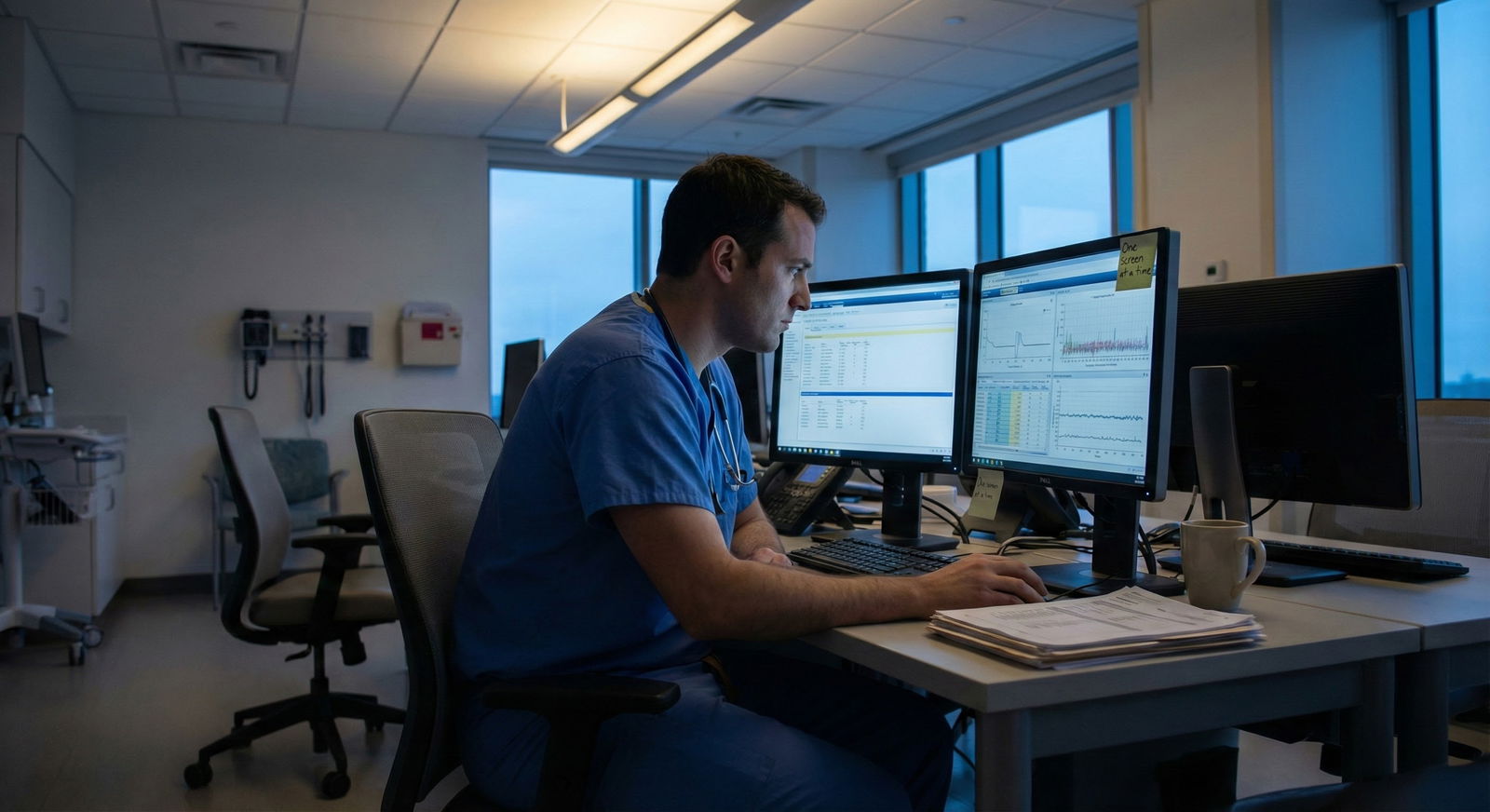
The breakdowns are not random. They cluster in the same places again and again.
1. Incomplete HPI details
This is the highest-frequency problem. The note has the chief complaint but loses the timeline, context, symptom modifiers, or relevant negatives.
Why it happens:
- You are writing from memory after the encounter
- You got interrupted before closing the loop
- Stress narrows attention to the “headline” fact and drops the qualifiers
2. Disorganized assessment and plan
The HPI may be acceptable, but the assessment reads like a list rather than an argument. The plan then duplicates fragments of the assessment or mixes acute and chronic issues with no prioritization.
Why it happens:
- Fatigue weakens your internal structure
- You are documenting before you have mentally ranked the problems
- You are copying attending language without fully processing it
3. Weak problem prioritization
Everything gets equal weight. Mild constipation sits next to sepsis as if they are peers. That is bad documentation and worse clinical thinking.
Why it happens:
- Cognitive overload pushes the brain toward flat lists
- Prioritization requires executive control, which is one of the first functions to degrade under stress
4. Copy-forward and carryover errors
Old lab values, stale physical exam findings, or contradictory statements from prior notes. This is where sloppiness stops being embarrassing and starts being dangerous.
Why it happens:
- Speed wins over verification
- The EHR makes duplication frictionless
- Error monitoring drops when you are rushing
Here is the line I draw hard: cosmetic sloppiness is not the main issue. Slightly clunky prose? Fine. A missing rationale for why the patient is still on broad-spectrum antibiotics? Not fine. Clinically meaningful errors usually involve omission, contradiction, or lost reasoning. Those are the ones that matter.
Why Mindfulness Works: Attention Training, Not Just Stress Relief
People hear “mindfulness” and think scented candles, wellness newsletters, and institutional nonsense. That is a branding problem. The useful version of mindfulness is much more concrete: it is attention training.
The data shows that mindfulness-based practices can improve several functions that matter directly to note quality:
- Present-moment awareness
- Reduced distractibility
- Better monitoring of internal drift
- Improved error detection before submission
- Less reactive task switching
That matters because most clerkship note errors are not knowledge failures. They are attention failures.
Mechanistically, mindfulness helps in three ways.
1. It interrupts automatic pilot
When you are tired, you stop noticing that you are skimming your own reasoning. You type what looks familiar. Mindfulness creates a brief check: “What am I actually saying here?” That one-second awareness shift catches a surprising number of bad sentences and missing links.
2. It improves cognitive recovery after interruption
You cannot prevent every page, question, or hallway ambush. But you can return faster. Mindfulness strengthens the ability to notice that your attention has drifted and deliberately bring it back. That reduces the time penalty of interruptions.
3. It lowers emotional noise
Stress does not just feel bad. It consumes processing capacity. If you are mentally replaying an awkward pimp question or panicking about being slow, some of your bandwidth is gone. Mindfulness reduces reactivity enough to free up working memory for the actual task.
Now the honest part. The evidence does not show that mindfulness turns average students into flawless documenters. Effects are likely modest. But modest effects matter when baseline error risk is high. If a 2- to 5-minute attention reset cuts omissions, rework, or correction burden by even 10% to 20%, that is operationally meaningful on a busy service.
This is exactly where medicine gets silly. People dismiss small cognitive interventions while accepting giant daily inefficiencies as inevitable. Ten minutes of avoidable note cleanup per day adds up fast. So does one preventable documentation mistake.
Practical Protocol: A 3-Minute Mindfulness Workflow Before You Write

You do not need a meditation app, floor cushion, or twenty free minutes. You need a repeatable pre-note reset that fits real ward life.
Use this 3-minute workflow.
Minute 1: Pause and breathe
- Sit down
- Put both feet on the floor
- Take 3 slow breaths
- On the exhale, label the task: “One patient. One note.”
That sounds small because it is small. Good. Small works on clerkship.
Minute 2: Rebuild the patient in your head
Before typing, identify:
- Chief issue today
- Top 3 active problems
- Most important change since last note
- One decision that needs justification
If you cannot state those four items, you are not ready to write. You are about to produce word salad.
Minute 3: Write in a fixed sequence
Use the same sequence every time:
- One-line summary
- Focused HPI or interval events
- Problem list in priority order
- Assessment with explicit reasoning
- Plan linked to each problem
That structure reduces switching costs because it removes unnecessary choices. Fewer decisions. Better output.
A practical script helps:
- “What changed?”
- “Why do I think it changed?”
- “What are we doing next?”
That is the note.
Why this works
The data shows that short resets can outperform brute-force pushing when fatigue is already degrading attention. A 3-minute reset that prevents 2 omissions and 1 round of later editing has a positive return immediately. Even if it adds time up front, it often saves time downstream.
Measure it like a clerk, not like a wellness brochure
Track your own documentation for 1 to 2 weeks before and after.
Use three metrics:
- Omissions per note
Count missing key HPI details, missing rationale, or absent plan elements. - Rework frequency
How often do you reopen a note to fix something substantial? - Time to signature
Minutes from first draft to final sign-off.
If you want one composite score, use:
- Note Efficiency Index = completed notes / (reworks + omissions)
Crude? Yes. Useful? Also yes. The point is to see whether mindfulness changes your output, not whether it sounds enlightened.
Implementation on Clerkship Teams: What Students and Preceptors Can Measure
This works better when teams treat note quality as measurable behavior, not vague professionalism.
A clerkship team can track:
- Note quality rubric scores
- Number of addenda per week
- Frequency of missing assessment/plan elements
- Preceptor correction burden
- Contradictions or copy-forward errors detected before sign-out
For students, the most revealing measures are usually:
- missing timeline details in HPI
- missing rationale in assessment
- disorganized problem prioritization
For residents and attendings, the key operational measure is simple:
- How much editing did this note create?
If a student spends 3 mindful minutes before charting and that reduces 8 to 12 minutes of downstream clarification, editing, and sign-out confusion across the day, the intervention pays for itself. Easily.
The same logic applies at team scale. Cleaner notes improve handoffs, reduce repeated questioning, and make it easier to see what the plan actually is. That is not abstract wellness. That is workflow improvement.
My view is straightforward. Mindfulness is not a cure-all. It will not fix a chaotic EHR, bad supervision, or a service with impossible patient volume. But the data shows it is a low-cost, low-risk intervention with a plausible signal exactly where clerkship documentation tends to fail: attention drift under load.
And that is where this is heading. Medical education is moving, slowly and sometimes grudgingly, toward performance systems that measure cognition in context rather than pretending quality is just a character trait. Good. It should. The next step is obvious: teach students how attention breaks, measure where notes fail, and use practical mindfulness as one tool to reduce the damage. Not as decoration. As method.