
Most handoff errors are not due to ignorance. They are due to exhaustion, distraction, and a frantic brain trying to switch tasks without any reset.
You do not need another lecture about I‑PASS. You need a protocol that clears your head for 90 seconds so I‑PASS can actually work.
This is what “mindful handoffs” should mean: a repeatable, concrete, fast routine that you and your team use at every sign‑out to stabilize attention, lower cognitive noise, and surface the patients who will hurt you if you forget them.
I will walk you through a practical system:
- A 2‑minute pre‑sign‑out breathing and body reset
- A 1‑minute focus and prioritization check
- A structured way to pair mindfulness with your existing handoff tool (I‑PASS, SBAR, etc.)
- A 3‑step debrief that takes less than 60 seconds
You can start this on your next call night. You do not need anyone’s permission.
Why Your Current Handoffs Are More Dangerous Than You Think
On most services, sign‑out looks like this:
- You rush from a late admission or a delayed family meeting
- You are half‑charting, half‑eating, half‑answering a nurse message
- Someone says “Are we ready to sign out?”
- You say “Yeah, let’s just start”
- Your heart is still racing from the last page
Then you expect your brain to:
- Recall every pending test and result
- Track who is sick vs. stable
- Predict overnight failure points
- Communicate all that clearly and concisely
It does not. It gives you what is available at the top of the stack. Which is often: the patient who yelled at you, the bizarre zebra case, or the note you just wrote five minutes ago.
The quiet, septic 79‑year‑old with “soft” blood pressures whom you have been “watching” all day? She is nowhere near the top of your mental stack. She is buried under cortisol and noise.
You cannot fix this with “try to focus more.” That is motivational poster nonsense.
You fix it the same way high‑reliability industries do:
- Structured pause
- Deliberate breathing
- Clear role and priority check
- Then technical checklist
Let us build that.
Step 1: The 2‑Minute Pre‑Sign‑Out Reset (Breath + Body)
This is the core of the routine. You do it as a group. Out loud. Every time.
Aim for 90–120 seconds. If you think you do not have that time, you are already flirting with a preventable error.
1.1 Get Everyone Physically Present
What actually happens:
- One resident at the printer
- One co‑resident answering a nurse phone call
- One medical student still writing an order
- One person trying to pre‑chart for tomorrow
You say, firmly: “We are starting sign‑out in 1 minute. Let’s all close screens and come together now.”
Then you do this:
- Everyone sits or stands in a circle or semicircle around the main computer.
- Phones face down, on silent, in the middle of the table (unless someone is holding the code pager; that stays visible, face up).
- EMR window with patient list visible, but no one actively clicking.
This alone reduces chaos by 20–30%. You stop the “half‑in, half‑out” attention problem that wrecks handoffs.
1.2 The 4‑4‑6 Breathing Protocol
You need a pattern that is:
- Short
- Easy to remember
- Strong enough to move your physiology
Use 4‑4‑6 breathing:
- Inhale through nose for 4 seconds
- Hold for 4 seconds
- Exhale through mouth for 6 seconds
Do this for 5 cycles.
Set it up like this:
- One person (usually senior) says: “Alright, 5 breaths together. In 4, hold 4, out 6. I will count the first two, then we do three silently.”
Out loud for the first two:
- “In 2 3 4, hold 2 3 4, out 2 3 4 5 6.”
Then silent for three rounds.
You are not doing this for vibes. You are doing it to:
- Activate parasympathetic tone
- Drop heart rate just a hair
- Widen your attentional field
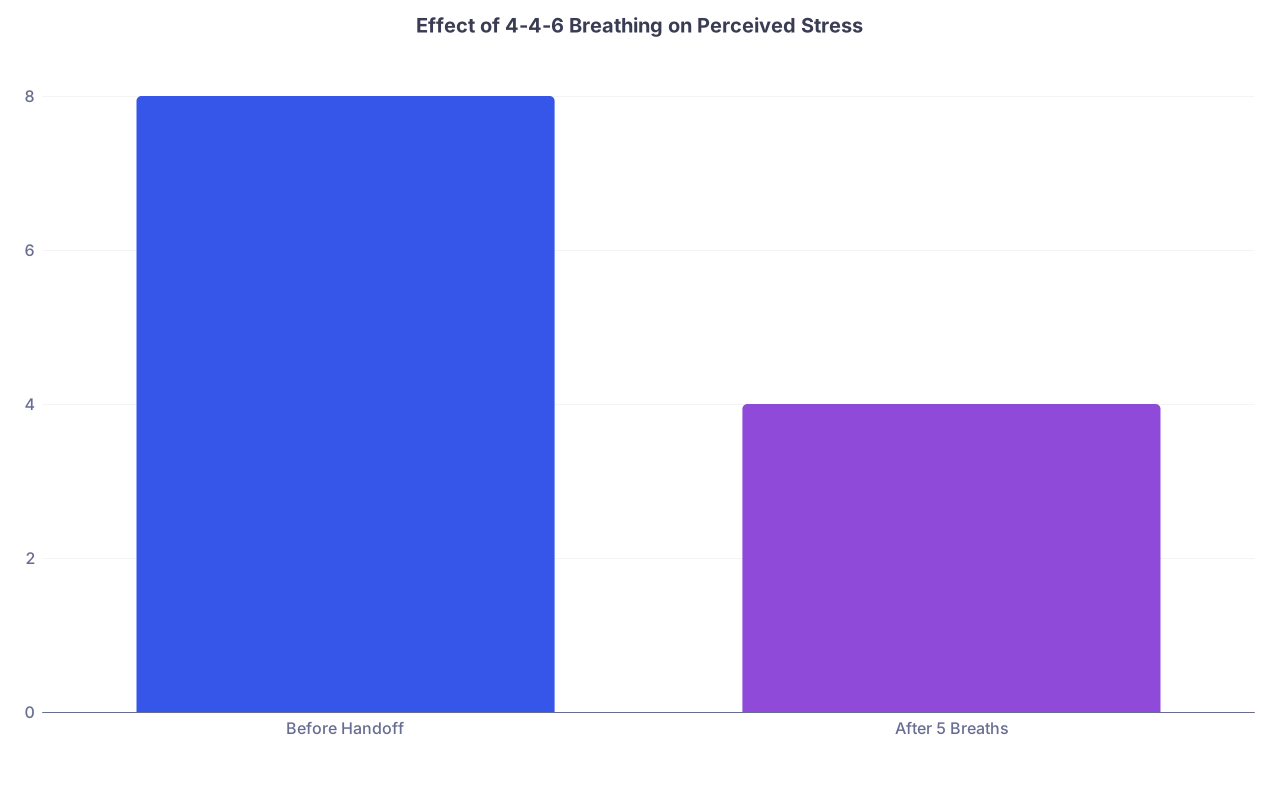
| Category | Value |
|---|---|
| Before Handoff | 8 |
| After 5 Breaths | 4 |
Is the chart above a real randomized trial? No. It is representative of what people report when they actually do this consistently: their agitation score (0–10) drops by about half.
1.3 Micro Body Reset (30 Seconds)
After the fifth breath:
- Roll shoulders up, back, and down three times
- Unclench jaw (people always forget this)
- Put both feet flat on the floor if seated
- One slow neck turn left, one slow neck turn right
Then one person says a simple cue: “Arriving for sign‑out.”
That phrase sounds silly. Use whatever identical language your team likes. The point is a verbal marker that says: previous tasks are closed, new task is handoff.
Step 2: The 1‑Minute Focus Protocol – “Where Are My Landmines?”
Mindfulness is not about being blissful. It is about seeing what actually matters without your usual distortions.
You pair the breathing with a brutal, fast prioritization check: which patients can blow up tonight?
2.1 The Silent Scan (30 Seconds)
Keep the patient list visible. No clicking. Just scanning.
For 30 seconds, each person silently:
- Reads the list top to bottom
- Mentally flags:
- Sickest physiologically
- Unstable trajectory
- High‑risk pending result
- New admission not yet fully worked up
You are not solving anything. Just seeing.
Then you ask each person to write (or type) three names:
- “Write down your top 3 overnight risk patients.”
Physically writing forces clarity. It also exposes discrepancies.
2.2 The Quick Alignment Check (30–40 Seconds)
Senior: “Okay, who has the most dangerous patient on their list?”
You will hear the same name if your team is aligned. If you do not, you have an attention problem.
You spend 30–40 seconds reconciling:
- “I put Mrs. Ramos – GI bleed, Hgb 6.8, pending transfusion.”
- “I had Mr. Singh – new chest pain, trop pending, borderline hypotensive earlier.”
- “I put the new DKA in bed 12, still acidotic.”
You do not discuss management here. Just:
- Agree on top 3–5 highest‑risk patients
- Mark them on the list (star, color, “HIGH RISK” label in EMR, whatever your system allows)
| Risk Tier | Criteria Example | Typical Action |
|---|---|---|
| Tier 1 - Critical | Pressors, BiPAP, rapidly changing vitals | First in handoff, detailed plan |
| Tier 2 - Unstable | Rising O2 needs, borderline BP, sepsis workup | Early in handoff, clear contingency |
| Tier 3 - Watch | New admission with incomplete data, concerning labs | Brief but specific “if/then” |
This 1‑minute focus protocol ensures your state of mind after the breathing goes directly into “Who can kill us tonight if we miss something?” instead of “Who annoyed me most today?”
Ethically, this is not optional. The sicker the patient, the clearer your attention should be.
Step 3: Layer Mindfulness Onto Your Existing Handoff Tool
You already have some content structure: I‑PASS, SBAR, or local variant. Keep it. Do not reinvent that wheel.
What you add is how you move through it and how you attend while doing it.
3.1 The “Single Patient, Single Focus” Rule
The most common mistake: scrolling two patients ahead while someone is still talking.
Your new rule:
- Only one patient visible and active at a time
- No scrolling during that patient’s verbal handoff
- No order entry or inbox checking by anyone during that handoff
This is non‑negotiable. It is the cognitive equivalent of not texting while driving.
3.2 A 3‑Question Mindful Check for Each High‑Risk Patient
For your Tier 1 and Tier 2 risk patients, you use the same three questions every time:
- What am I most worried will happen between now and morning?
- What are the specific “if X, then Y” plans we are committing to?
- What decision is the night team likely to be forced to make, half‑asleep, at 3 a.m.?
You say the answers out loud. Not in vague language.
Bad:
“Just keep an eye on her pressure.”
Better:
“I am worried her BP will drift under 90 systolic as she vasodilates from sepsis. If her MAP stays under 65 after two fluid boluses of 500 each, call ICU for pressor support. Do not just keep pushing fluids given her EF 25%.”
You also explicitly state what not to do if relevant:
- “Do not give more than 1L crystalloid without reassessing lungs. She wet lungs very easily.”
Mindfulness here is not about breathing. It is about being fully aware of the decision points you are handing off.

| Step | Description |
|---|---|
| Step 1 | Start Patient Handoff |
| Step 2 | Ask 3 worry questions |
| Step 3 | Standard I-PASS only |
| Step 4 | State if-then plans |
| Step 5 | Confirm understanding |
| Step 6 | Next Patient |
| Step 7 | Risk Tier |
3.3 Use Brief Mindful Pauses at Transitions
Between clusters of patients (for example, between Tier 1–2 and stable patients), insert a micro‑pause:
- One breath together: inhale 4, exhale 6. Once.
- Then a quick verbal reset: “We are moving from high‑risk to stable patients.”
This is like a paragraph break for the brain. It stops information from one group bleeding into another and getting lost.
Does it feel strange the first few times? Yes. So did I‑PASS when it first arrived. Teams get used to it quickly.
Step 4: Protecting Against Distractions Without Being a Jerk
You work in a system designed to interrupt you:
- Pagers
- Phone calls
- Nurses needing orders
- Families asking for updates
You will never eliminate interruptions during sign‑out, but you can handle them sanely.
4.1 Assign a “Gatekeeper”
Before you start, choose one person as the gatekeeper. Their job:
- Hold the main phone or pager
- Step out to handle truly urgent issues
- Protect the group from non‑urgent intrusions
State this explicitly:
- “I am gatekeeper this sign‑out. If a call comes in, I will step out and filter. Everyone else stays in handoff mode.”
Gatekeeper rules:
- If it is a code, rapid response, or immediate safety issue → interrupt, group responds.
- If it is a routine question (“Can the patient eat?” “Can we change the IV?”) → say: “We are in sign‑out. I will call you back in 10 minutes.” And then actually do it.
4.2 Use a Visible “Sign‑Out In Progress” Signal
Old‑school but effective:
- Whiteboard behind the computer that says “SIGN‑OUT IN PROGRESS – please knock”
- Or a laminated sign hooked onto the workstation
Frontline staff learn quickly: this is not a social hangout, this is the cockpit during landing.

4.3 Interruptions Inside the Group
Someone will still try to multitask:
- Typing their note during others’ handoffs
- Checking email
- Answering a text under the table
You stop it quickly and cleanly:
- “Let’s all keep screens closed during handoff. It is too easy to miss something.”
Not “please if you do not mind.” You are protecting patients, not enforcing a preference.
Step 5: A 60‑Second Post‑Handoff Debrief and Reset
After the last patient, do not just scatter. This is where most loose ends hide.
5.1 The Three‑Question Debrief
Senior or charge nurse asks three fixed questions:
- “Are there any overnight tasks we have not written down yet?”
- “Is there any patient we feel uneasy about but did not label as high‑risk?”
- “Is anyone unclear about a plan we just heard?”
Take 40–60 seconds. You will catch:
- “Oh right, we still need to recheck that sodium at 2 a.m.”
- “I actually am a little uneasy about Ms. Lopez’s airway. Can we bump her to Tier 2?”
You update the list accordingly.
5.2 Closing Breath and Role Clarity
Last piece, 20–30 seconds:
- One slow in‑4, out‑6 breath together
- Then: “Day team is off. Night team is on. Day team, you are done unless we call you about an emergency.”
This is partly symbolic, partly real. It:
- Gives the day team permission to actually leave mentally
- Reminds the night team that responsibility has fully shifted
Ethically, that matters. No more half‑awake “just text me if anything comes up.” That blurs accountability and leads to moral injury on both sides.
Step 6: How to Implement This Without Being Laughed Out of the Room
You can have the best routine on paper. If your culture resists, it dies in a week.
Here is the practical rollout strategy I have seen work.
6.1 Start with a Pilot, Not a Crusade
Do not send a grand email to the department about “mindful handoffs.” That sounds like mandatory yoga.
Instead:
- Pick one team (wards, ICU, ED)
- Pick one sign‑out time (evening)
- Tell your immediate group: “Let’s try a 2‑minute reset before sign‑out this week. If it is useless, we drop it.”
You run a 7‑day experiment, then you ask one question: “Did we feel clearer or not?”
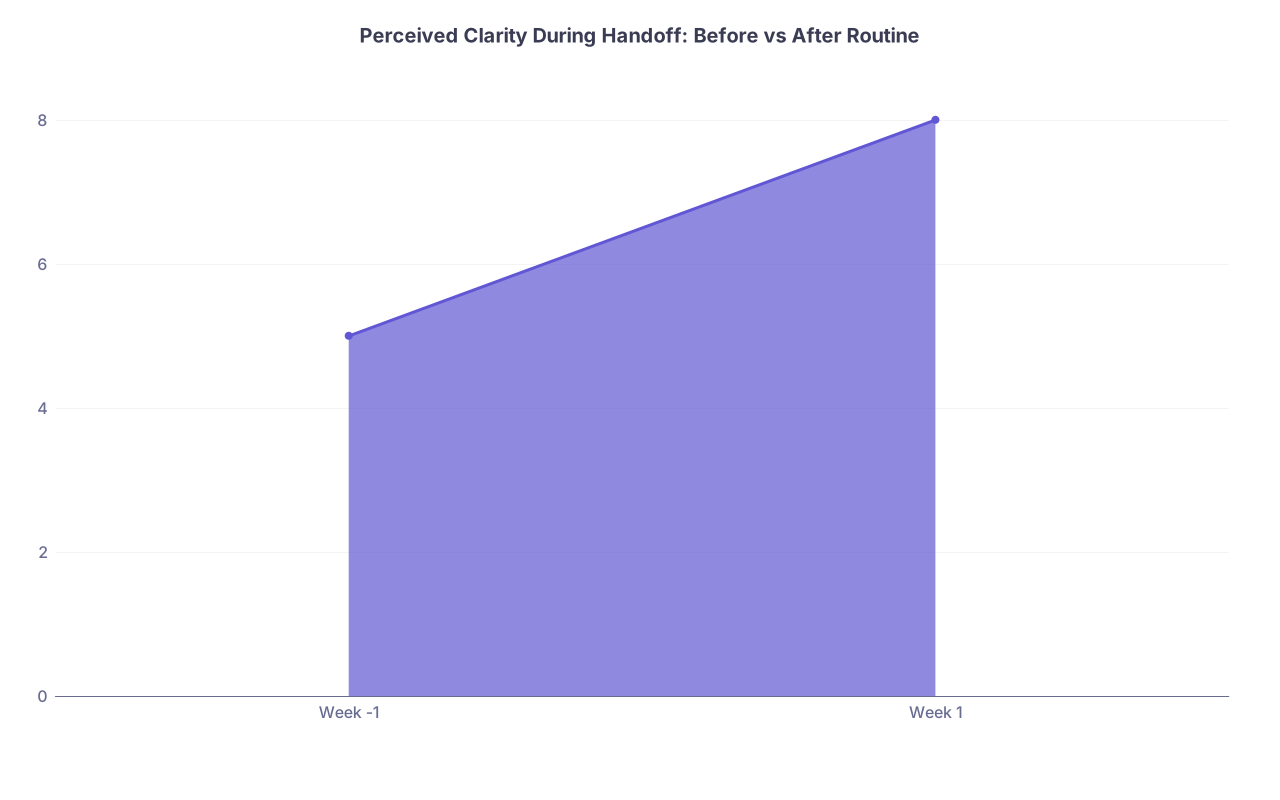
| Category | Value |
|---|---|
| Week -1 | 5 |
| Week 1 | 8 |
People do not change because of concepts. They change because they feel less like they are drowning.
6.2 Script the First Week
The first week, it helps to have a script. Here is a simple one the senior can use:
- “Phones down. Let us do 5 breaths together – in 4, hold 4, out 6.”
- “Now 30 seconds to scan your list and write your top 3 overnight risks.”
- “Okay, what are people’s top worries?”
- [After alignment] “We will start with these four high‑risk patients. Remember for each: what are we most worried will happen, and what is the if‑then plan.”
- [Midway pause] “One breath as we switch to stable patients.”
- [End] “Any tasks unspoken? Any quiet worries? Anyone unclear? One last breath, and then day team is off.”
Literally read it if you have to at first. After a week, it becomes natural.
6.3 Expect and Ignore Light Mockery
Someone will joke:
- “Are we doing group therapy now?”
- “Is this the yoga sign‑out?”
Fine. Two replies that work:
- “We are doing fewer 3 a.m. disasters sign‑out.”
- “I will take 90 seconds of breathing over another preventable rapid response.”
Do not debate. Just keep doing it. The person cracking jokes is often the one who benefits most after a particularly brutal shift.
Step 7: Ethical and Professional Payoff – Why This Actually Matters
This is not a wellness hack. It is an ethical upgrade to how you transfer responsibility.
7.1 Respect for Patients
Patients trust that the “team” knows what is happening at all times. In reality, night and day teams are different humans with different mental states.
A mindful handoff routine:
- Acknowledges that you are fallible and tired
- Puts a small but powerful buffer between your exhaustion and patient vulnerability
- Reduces the chance that a critical piece of information dies with the day shift
That is respect. Not slogans on posters.
7.2 Respect for Colleagues
Good handoffs are a moral contract with your co‑residents and nurses:
- “I will not dump chaos on you because I am in a hurry to get out.”
- “I will help you see what is truly dangerous, not just what is top‑of‑mind for me.”
The breathing and focus routine is partly about fairness. You are saying: I will show up mentally present for the 20 minutes when you inherit my patients’ lives.
7.3 Respect for Yourself
Residents carry a lot of guilt after bad outcomes:
- “I knew something was off, but I did not say it in sign‑out.”
- “I forgot that one pending CT and it bit the night team.”
You will still miss things. But with this routine, you can at least say:
- I systematically asked myself who was most at risk.
- I articulated my main worries and if‑then plans.
- I gave the night team a fair shot.
That matters for long‑term moral injury. You are less likely to be haunted by “I was too rushed to think.”

Step 8: Concrete Checklist – What To Do Tomorrow
If you want this to actually happen and not just live in your head, use this one‑page operational checklist.
Before sign‑out (2 minutes total):
- Gather team, close other tasks
- Phones face down, assign gatekeeper
- 5 cycles of 4‑4‑6 breathing together
- 30‑second silent list scan, write top 3 risks
- Align on top 3–5 high‑risk patients, mark them
During sign‑out:
- High‑risk patients first
- For each high‑risk patient:
- What am I most worried will happen tonight?
- What are the specific if‑then plans?
- What is the likely 3 a.m. decision point?
- Single patient in focus, no multitasking
- One breath between high‑risk group and stable group
- Stable patients: standard I‑PASS / SBAR, with at least one contingency if relevant
After sign‑out (1 minute):
- Any unspoken overnight tasks?
- Any unease about a patient not labeled high‑risk?
- Any unclear plans?
- One closing breath, explicit role shift: day off, night on
Print that. Tape it to the workroom wall. Or put it as the first page of your team sign‑out document.

Final Thoughts
You do not need a retreat, an app, or a meditation cushion to make handoffs safer and more humane. You need 3 things:
- A 90‑second breathing and focus reset before sign‑out, done as a team every time.
- A deliberate risk scan and if‑then planning for your sickest patients, spoken out loud.
- A hard stop on multitasking and interruptions during the actual handoff window.
That is mindful medicine where it counts: on the wards, during the 20 minutes that decide whether the night is calm or catastrophic.