
The standard advice about mindfulness for clinicians is wrong.
You do not need 30 minutes a day. You do not need a silent retreat. And you definitely do not need to feel guilty every time you miss a guided body scan on Headspace.
Let me be blunt: the way mindfulness is sold to medical professionals is perfectly designed to make busy people fail and then blame themselves. “If you cared about your patients, you’d make time.” That’s nonsense. And it’s not what the data actually shows.
Let’s dismantle the time myths and look at what actually works for people who carry pagers, get interrupted, and sign notes at midnight.
The 30‑Minute Myth: How a Research Detail Became a Moral Commandment
The “30 minutes a day” number didn’t drop from the sky. It mostly traces back to classic Mindfulness-Based Stress Reduction (MBSR) programs: 8-week courses, weekly 2.5‑hour sessions, plus “45 minutes of daily home practice.”
Researchers needed a standardized dose. So they wrote manuals: 45 minutes a day, 6 days a week. Then:
- Programs used that as the ideal.
- Review papers used that as the intervention dose.
- Wellness consultants mutated that into: “To get benefits, you should meditate 20–45 minutes daily.”
Notice what happened. A study design convenience turned into a moral bar.
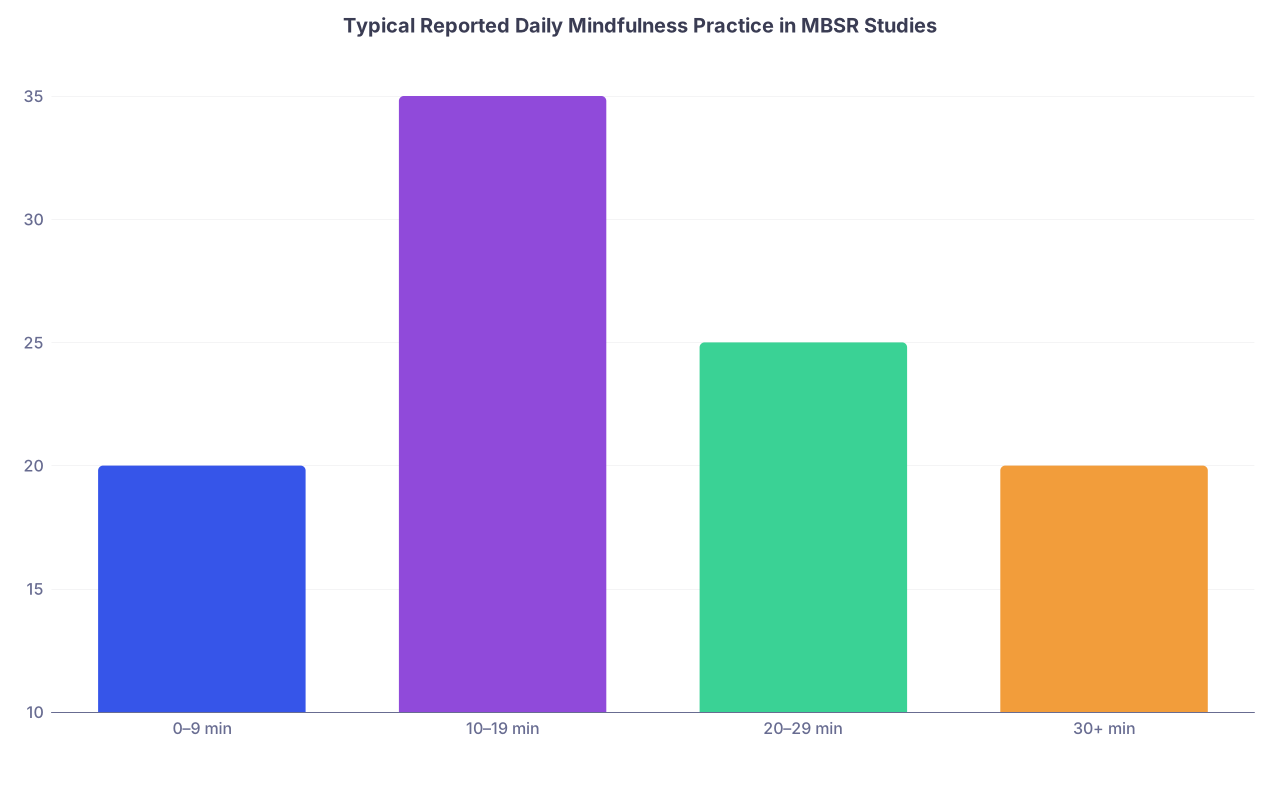
But when you look at the actual numbers—what people really do—it falls apart.
Several MBSR trials report:
- A big chunk of participants don’t do 45 minutes a day.
- Many average 15–20 minutes or less.
- Benefits appear even when adherence is mediocre.
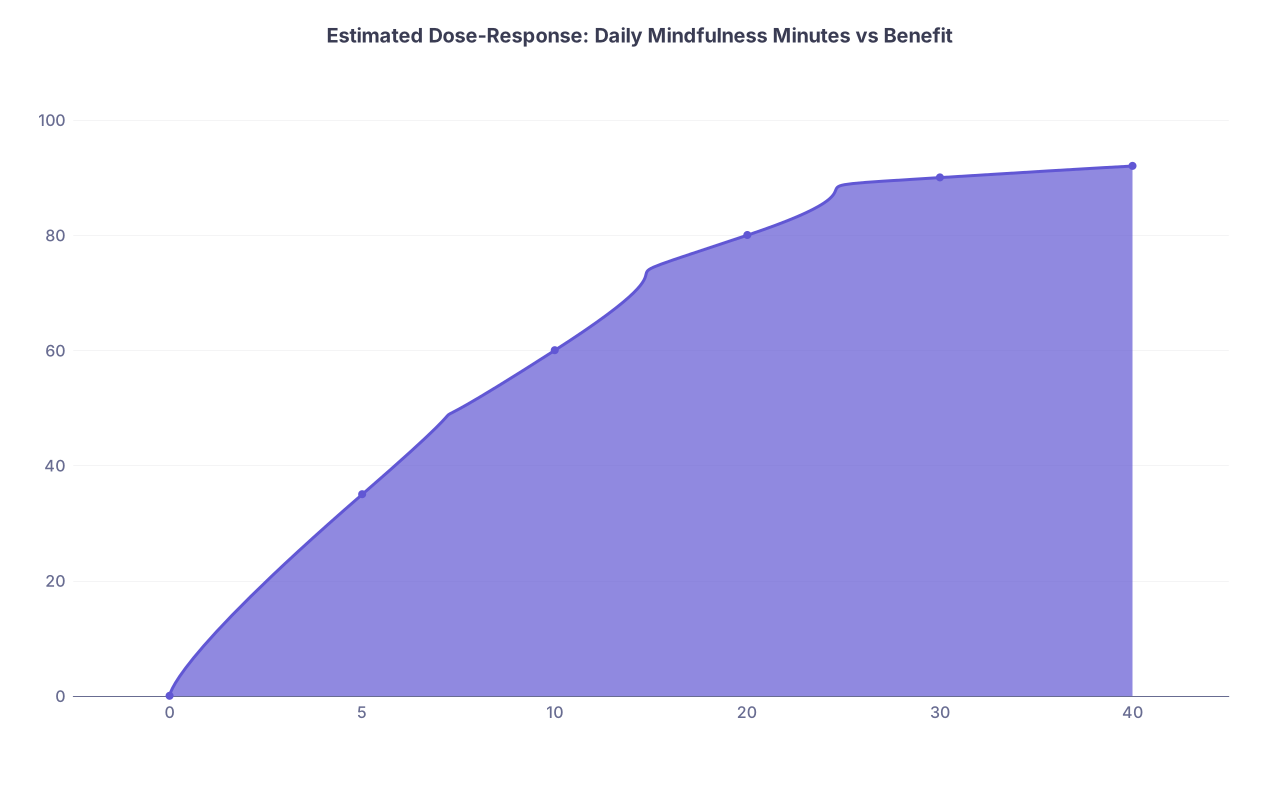
And here’s the key point: the relationship between “minutes meditated” and “benefit” is not a straight line. More is not always proportionally better.
| Category | Value |
|---|---|
| 0–9 min | 20 |
| 10–19 min | 35 |
| 20–29 min | 25 |
| 30+ min | 20 |
In many cohorts, the middle bands (10–29 minutes) show similar improvement in stress, depression, or burnout to the “ideal adherence” group. The “no benefit unless 30+ minutes” story simply isn’t consistently supported.
So where did the moralism come from? Not from the data. From culture:
- Medicine’s obsession with “maximal effort”
- Wellness marketing that sells longer = deeper = more virtuous
- A subtle shaming: if you’re not putting in 30+ minutes, you’re “not serious”
In a profession where you barely have time to eat, this is a recipe for disengagement. Not improvement.
What the Evidence Actually Shows About Time and Benefit
Let’s look at patterns that come up again and again in the mindfulness literature, especially in healthcare workers.
1. Short, consistent practice often beats long, sporadic practice
Across multiple trials in physicians, nurses, and medical students:
- Interventions using brief practices (5–10 minutes, sometimes even micro-practices of 1–3 minutes) show:
- Reduced perceived stress
- Lower burnout scores
- Improved self-compassion
- Better emotion regulation
And participants actually do them. Because they fit into reality.
Meanwhile, traditional 45-minute homework protocols routinely show:
- Low adherence
- High dropout
- Lots of “I felt like I was failing the course”
If you want a parallel from exercise: 10 minutes of brisk walking a day, every day, beats a 90-minute workout that you manage once every two weeks.
2. There’s a diminishing return beyond a moderate dose
Meta-analyses looking at “dose-response” (minutes of practice vs. benefit) suggest a curve like this:
- Going from 0 min to ~10 min/day: big gains.
- Going from 10 to 25 min/day: gains continue, but smaller.
- Going above 30–40 min/day: returns flatten out, at least for basic outcomes like stress and anxiety.
| Category | Value |
|---|---|
| 0 | 0 |
| 5 | 35 |
| 10 | 60 |
| 20 | 80 |
| 30 | 90 |
| 40 | 92 |
These are approximate, not exact numbers, but the shape is real: early practice gives the biggest relative shift.
This isn’t mystical. It’s skill acquisition. The first 5–10 minutes a day train:
- Pausing instead of reacting
- Noticing when your brain is running away
- Redirecting attention deliberately
After that, you’re adding polish, not inventing the skill from scratch.
3. The type of practice matters more than the stopwatch
Mindfulness studies rarely show a unique benefit for “sitting silently for 30 minutes” over:
- Brief mindful breathing
- Body scan “check-ins”
- Mindful walking
- 3-breath “micro-pauses” between tasks
In clinician samples, integrated practices (done in context—between patients, during handwashing, in the elevator) often yield:
- Better adherence
- Higher reported relevance
- Similar improvements in emotional exhaustion and depersonalization
In other words, the stopwatch doesn’t care if you’re on a cushion or in a hallway. Your nervous system just notices: Am I training attention and non-judgmental awareness right now?
Clinical Reality: You Are Not a Monk, You Are a Doctor
Let me give you a scene I’ve heard variations of repeatedly.
Internal medicine resident, PGY-2, on wards:
“Every wellness thing we get told is like, ‘Make sure you’re meditating 20–30 minutes a day, journaling, sleeping 8 hours, and getting regular exercise.’ I’m on nights. I barely shower. And now I’m also failing at wellness.”
If mindfulness becomes yet another metric for self-criticism, it’s failed its ethical purpose.
Mindfulness in medicine isn’t about becoming a monastic; it’s about:
- Reducing harmful reactivity (snapping at nurses, freezing with angry families)
- Improving presence (not mentally writing your note while delivering bad news)
- Noticing ethical tension early (before you rationalize it away)
- Sustaining compassion without burning out
You don’t need a 30-minute block to start doing any of that. You do need repeated, intentional practice within the work.
Micro‑Practices: The Data-Supported Middle Finger to the 30‑Minute Rule
Let’s get practical and stay evidence-aligned.
Several interventions for healthcare workers have leaned into micro-practices—1 to 5‑minute exercises stitched into the day. They’re not just cute hacks; they show measurable effects on stress and burnout.
Here’s the kind of pattern that repeatedly shows up:
| Program Type | Daily Time | Duration | Main Outcome |
|---|---|---|---|
| Classic MBSR | 30–45 min | 8 weeks | Moderate stress ↓ |
| Brief Online Mindfulness | 10–15 min | 4 weeks | Stress & anxiety ↓ |
| Micro-practice Protocol | 3–10 min | 4–8 weeks | Burnout & stress ↓ |
| On-shift Mindful Pauses | ~2 min/use | Ongoing | Momentary stress ↓ |
Again: not all programs are equal, results vary, etc. But you see the point—the benefits show up well below the sacred 30-minute threshold.
Concrete examples you can actually do on a shift
None of this requires a cushion or a candle.
1-minute breath before entering the room
- Hand on the door handle.
- One slow exhale, longer than your inhale.
- Notice your feet, your shoulders, the story in your head (“I’m already behind”).
- Label it: “planning, worry, rushing.” Not bad. Just noticed.
That’s mindfulness.
Three-breath reset at the computer
- Before you click “sign” on your note:
- Breath 1: Feel the air at the nostrils.
- Breath 2: Feel your chest or abdomen moving.
- Breath 3: Ask: “What actually matters in the next 60 seconds?”
You just trained attention and intention.
- Before you click “sign” on your note:
Compassion check in difficult interactions
- During a tough conversation:
- Briefly notice: “This is hard. For me and for them.”
- Ground in one physical sensation (feet, seat, hands).
- Silently: “May we both get through this with less harm.”
That’s not fluff. It shifts your physiological state and your ethical awareness.
- During a tough conversation:
-
- Instead of scrolling email:
- Feel the temperature of the water.
- Notice the urge to rush.
- Stay with 1–2 full breaths, even if the mind complains.
- Instead of scrolling email:
You can accumulate 5–15 minutes of real practice across a day like that. Without a single “meditation session.”
Ethical Clarity: Mindfulness as a Professional Skill, Not a Lifestyle Badge
Let’s bring ethics into this, since your category is “Personal Development and Medical Ethics.”
The ethical problem with the 30‑minute myth is twofold:
It shifts responsibility from systems to individuals
Institutions love promoting high-dose mindfulness: it’s cheap, looks good in newsletters, and subtly implies:
“If you’re still burned out, you must not be meditating enough.”But most structural drivers of burnout—workload, EMR insanity, understaffing, moral injury—will not be fixed by longer sits. Presenting 30 minutes of mindfulness as a cure is ethically sloppy.
It moralizes time in a profession where time is life
When you tell a clinician, “You must protect 30 minutes a day or you’re not serious about your well-being,” you’re effectively saying:- Ignore your childcare duties.
- Ignore your patient messages.
- Ignore your basic rest.
That’s not self-care; that’s another impossible standard. Ethically, a self-care recommendation that’s incompatible with the realities of duty hours and caregiving is junk advice.
Mindfulness, done right, should support:
- Better ethical decision-making (you notice cognitive dissonance faster).
- More humane interactions (less autopilot, more genuine attention).
- Sustainable compassion (you catch resentment and exhaustion before they leak out as cruelty).
For that, you need continuity and honesty. Not a magic number.
How to Build a Realistic Practice as a Clinician
Here’s a pattern that aligns with actual evidence and actual life:
Anchor to existing routines, not empty time slots
You will never “find” an extra 30 minutes. But you already:- Wash hands dozens of times
- Open countless doors
- Log into the EMR repeatedly
- Wait 30–60 seconds on hold with radiology
Attach 30–60 second practices to those. That’s your “daily practice.”
Aim for most days, not every day
Data doesn’t say “miss one day and the benefit vanishes.” You’re not a lab rat in a perfectly controlled experiment.
Consistency over weeks matters; perfection doesn’t.Use guided audio strategically, not religiously
A 10-minute guided practice 3–4 days a week can be enough to:- Learn the basic stance (curiosity, non-judgment)
- Familiarize yourself with watching thoughts/emotions Then you apply that during your day. That’s the transfer that matters.
Track reactivity, not minutes
A more meaningful metric than time is:- How often did I notice I was on autopilot today?
- How quickly did I catch myself before snapping?
- Did I sense moral discomfort earlier than usual?
That’s mindfulness doing its ethical job.
The Silent Cost of the 30‑Minute Myth: Shame and Dropout
There’s one more piece everyone quietly ignores: the psychological fallout of bad dosing advice.
I’ve heard this from too many residents and attendings:
“I tried that course but I couldn’t keep up with the 30-minute homework, so I figured meditation just isn’t for me.”
This is tragic and completely avoidable.
When you give clinicians an unrealistic dose, they:
- Predictably fail to meet it.
- Internalize that as a personal weakness.
- Abandon the tool entirely.
- Miss out on lower-dose benefits they actually could have reached.
From an educator and ethics perspective, that’s malpractice.
A better way: explicitly normalize shorter, flexible practice from the start—and back it up with the data that shorter doses still help.
A Quick Reality Check Flow for Yourself
Use this as a mental algorithm, not another stick to beat yourself with.

| Step | Description |
|---|---|
| Step 1 | Want to start mindfulness? |
| Step 2 | Try 10-20 min formal practice |
| Step 3 | Start with 1-5 min micro-practices |
| Step 4 | Integrate brief pauses into work |
| Step 5 | Keep current dose or slowly increase |
| Step 6 | Adjust type or timing, not just minutes |
| Step 7 | Have consistent 20-30 min daily? |
| Step 8 | Seeing benefit after few weeks? |
Notice what’s not in there: any commandment that says, “Thou shalt meditate 30 minutes or it doesn’t count.”
If You Remember Only Three Things
There is no magic 30-minute threshold.
Benefits start showing at much lower doses. The sharpest relative gains are in the first 5–10 minutes of daily, or near-daily, practice.Integrated, brief practices are not “lesser than.”
For clinicians, micro-practices threaded into work are often more sustainable and more ethically aligned than long sits you’ll never realistically do.Stop moralizing minutes; focus on impact.
The real question isn’t “Did I meditate 30 minutes?” It’s “Did mindfulness make me a little less reactive, a little more present, a little more humane today?”
If the answer is yes, your practice is long enough.