

How Do I Start a Mindfulness Practice as a Med Student With No Free Time?
What are you supposed to do—set up a meditation cushion and light candles in between 28-hour calls and 400 Anki reviews?
Let me be direct: if mindfulness requires “free time,” you will never do it in medical training. The trick is to build a practice that fits into the life you already have, not some fantasy schedule where you’re well-rested and caught up on notes.
Here’s how to actually make that happen.
Step 1: Redefine What “Counts” as Mindfulness
Most med students have the wrong picture in their heads: 30 minutes, cross-legged, eyes closed, perfect silence. That’s nice. It’s also why people quit.
For you, mindfulness needs to be:
- Tiny (30 seconds–5 minutes)
- Embedded in existing routines
- Practical, not precious
Working definition you should use:
Mindfulness = deliberately paying attention, on purpose, to the present moment, with as little judgment as possible.
So yes, these all count as mindfulness if done intentionally:
- A 60-second pause before opening the EMR
- Three slow breaths before you answer a pimp question
- Noticing your shoulders and loosening them while walking between wards and cafeteria
- Eating the first three bites of lunch without your phone
Step 2: Pick One Core Practice You Can Do Daily (3–5 Minutes)
Notice I didn’t say “20 minutes.” I’ve watched too many med students fail by starting too big. Start with 3–5. If you do that consistently, you’re already ahead of 90% of people.
Here’s a simple structure that works even when you’re exhausted.
Option A: 3-Minute Breath Check (Anywhere, No App Needed)
- Sit or stand. Feet on the floor if possible.
- Set a 3-minute timer on your phone.
- Close your eyes or soften your gaze.
- Notice your breath going in and out at the nose or chest.
- Your mind will wander. Fine. The moment you notice, gently return to the breath. Zero drama.
That’s it. No special breathing pattern. Just observe.
Option B: “One Patient” Mindfulness on Clerkships
If you’re on clinical rotations, this can be your entire practice:
- Choose one patient per day.
- Before entering the room, pause for 10 seconds:
- Feel your feet on the floor.
- Take one deeper breath in, slower breath out.
- Silently think: “This is a human being. I will try to be fully here for 60 seconds.”
- Then walk in.
You’re still doing the HPI, exam, whatever. The difference: you’re actually present for at least part of it. That’s mindfulness. And frankly, it’s medical ethics in action.
Step 3: Embed Mindfulness Into Things You Already Do
You don’t have time to add new blocks of activity. Fine. Don’t. Stack mindfulness onto existing tasks.
Think like this: “What do I already do every day, without fail?” Then tie mindfulness to that.
Common hooks for med students:
- Brushing teeth
- Scrubbing in
- Walking between buildings
- Waiting for the elevator
- Washing hands before every patient
- Logging into EMR
- Microwave countdown for reheated food at 11:30 p.m.
Pick two of these and turn them into “micro-practices.”
Example: Hand Washing Practice
Every time you wash your hands before a patient:
- Feel the temperature of the water for 3–5 seconds.
- Notice the sensations in your fingers and palms.
- Take one slow, slightly deeper exhale than usual.
- Then move on.
You’ve just done mindfulness without spending extra time.

| Step | Description |
|---|---|
| Step 1 | Choose Core 3 Min Practice |
| Step 2 | Attach to Daily Anchor |
| Step 3 | Add 1 Micro Practice |
| Step 4 | Use 1 Rescue Technique on Bad Days |
| Step 5 | Reflect Weekly 2 Min |
Step 4: Use “Rescue” Mindfulness for Stress Spikes
You also need tools for when the attending tears apart your note, or when your pager goes off for the 6th time in 10 minutes.
You’re not going to sit for 10 minutes then. You need 10–60 second “rescue” practices.
The 4-6 Rescue Breath (20–40 Seconds)
- Inhale through the nose for a slow count of 4.
- Exhale through the mouth (or nose) for a slow count of 6.
- Repeat 3–5 breaths.
That longer exhale nudges your nervous system out of full-blown fight-or-flight. Do this:
- Outside the room before telling a patient bad news
- In the bathroom after a rough interaction
- Sitting in conference when your heart’s pounding
“Name 3 Things” Grounding (15–30 Seconds)
When your brain is racing:
- Look around and silently name:
- 3 things you can see
- 2 things you can feel (chair under you, feet in shoes)
- 1 thing you can hear
You’ve just brought your mind out of future disaster fantasies and back into the room.
Step 5: Tie Mindfulness to Your Ethics, Not Just “Self-Care”
You’re in the “Personal Development and Medical Ethics” phase. Good. Here’s the uncomfortable truth: unmindful doctors make more ethical mistakes.
Not because they’re bad people, but because:
- They rush and miss info
- They react instead of respond
- They dehumanize patients to cope
- They ignore their own burnout until it’s dangerous
Mindfulness is not just for your anxiety. It sharpens clinical judgment and ethical behavior.
A few concrete links:
- Informed consent: Being present enough to notice that the patient doesn’t actually understand, even though they’re nodding.
- Confidentiality and boundaries: Catching the impulse to overshare, vent in the hallway, or chart something sloppy.
- Bias and stereotyping: Noticing your instant reaction to the “frequent flyer” or “noncompliant” patient before you let that reaction decide your care plan.
So when you’re standing outside a patient’s door, taking one mindful breath, you’re not doing “wellness.” You’re doing your job as an ethical physician-in-training.

Step 6: Design a “No-Free-Time” Daily Plan
Let’s put this together into something you could actually run on a typical brutal day.
Here’s a sample “zero free time” schedule for a clinical student.
| Moment | Practice | Time Cost |
|---|---|---|
| Wake-up (phone alarm off) | 3-minute breath check | 3 min |
| First hand wash before rounds | Sensation + 1 slow exhale | 10 sec |
| Before seeing first patient | 1 mindful breath + intention | 10 sec |
| Lunch first 3 bites | Phone down, just taste | 30 sec |
| Walking between wards | Feel feet for 10 steps | 15 sec |
| After a rough interaction | 4-6 rescue breath (3 reps) | 30 sec |
Total intentional practice: about 5–6 minutes, spread out, with essentially zero “extra” time. This is what a realistic med student practice looks like.
If you’re pre-clinical, swap “hand washing” and “patient room” for “open Anki” or “sit in lecture.”
Step 7: Make It Stick With Stupid-Simple Systems
Willpower will fail the second exam season hits. Systems will carry you.
Use at least two of these:
Tiny Non-Negotiable
Decide your minimum daily practice is 60 seconds. Not 10 minutes. One minute. If you’re in bed and realize you skipped it, sit up, do 10 slow breaths, done. Streak preserved.Visible Cues
- Sticky note on your laptop: “One breath before opening EMR.”
- A small dot sticker on your ID badge = reminder to feel one breath each time you grab it.
Pair with an App (Optional, but helpful)
- Insight Timer: free, simple 3–5 minute timers
- Headspace / Calm: short guided meditations (look for “3-minute” or “5-minute” ones)
Use an app at home. Use bare-bones techniques at the hospital.
Weekly 2-Minute Review
Once a week, ask yourself:- Did I do my 3-minute (or 1-minute) core practice most days?
- Did I use any micro-practices on autopilot yet?
- Was there one moment where more mindfulness would have helped?
Write one sentence in your notes app. That’s your reflection practice.
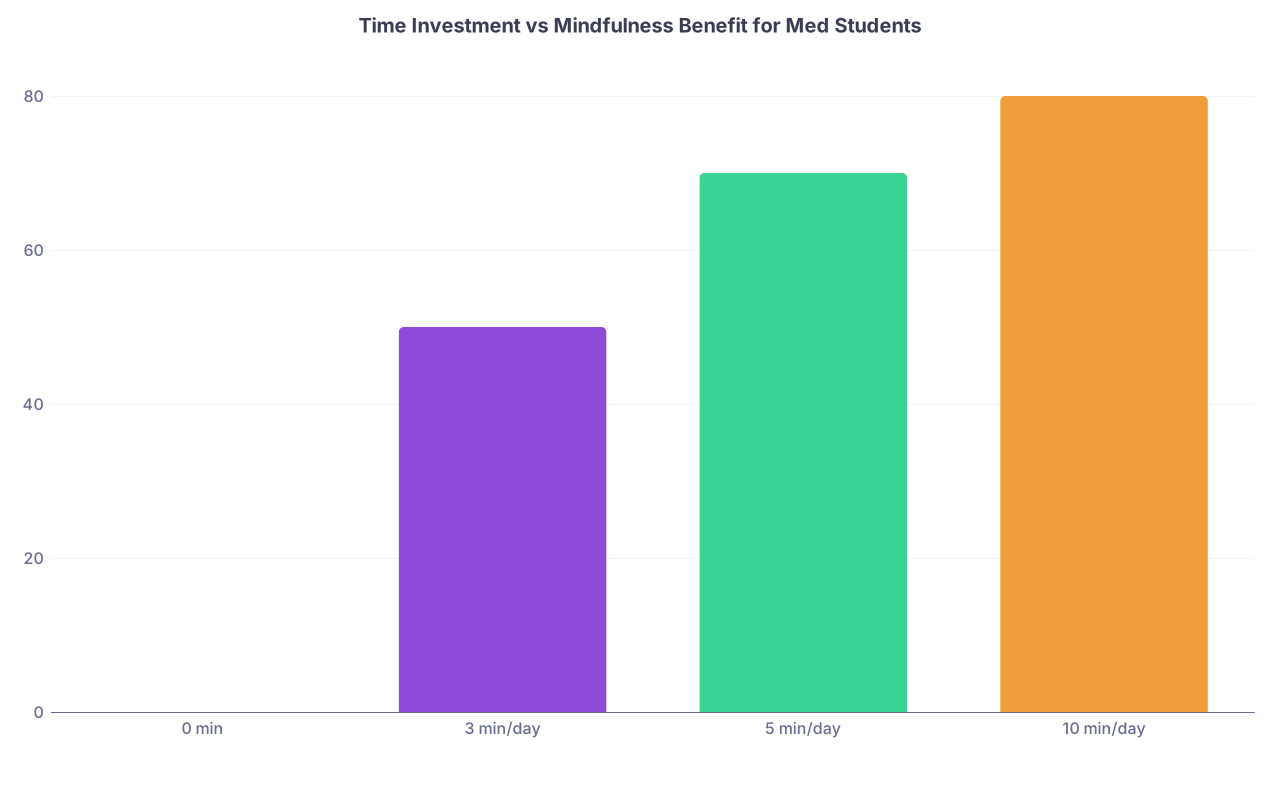
| Category | Value |
|---|---|
| 0 min | 0 |
| 3 min/day | 50 |
| 5 min/day | 70 |
| 10 min/day | 80 |
(Hypothetical benefit index: the point is, 3–5 min daily gets you most of the benefit. You don’t need 30.)
Step 8: Common Mistakes That Waste Your Time
Let me save you some frustration.
Waiting for a “good day” to start
There are no good days in medicine, only slightly less chaotic ones. Start on a bad day; then you know the practice fits reality.Treating mindfulness like a performance
You will not “clear your mind.” Your brain will chatter. The practice is noticing that and coming back. That is the rep.Overcomplicating it
Mixing 5 different techniques in week 1, reading 3 books, downloading 4 apps. Don’t. One core practice. One or two micro-practices. Let it be boring.Quitting when you “miss a day”
You will miss days. Many. The only mistake is interpreting that as failure instead of “ok, restart today.”

Step 9: How You’ll Know It’s Working (Beyond Feeling “Zen”)
You may not feel dramatically calmer at first. That’s fine. Look for these quieter, more relevant changes:
- You catch yourself about to snap at a nurse and choose different words.
- You notice physical tension earlier (clenched jaw, tight neck) and soften it.
- You can sit through a painful feedback session without mentally leaving your body.
- You feel a tiny bit more like a human and less like a productivity machine.
That’s the real payoff. And over years, it adds up—to less burnout, fewer regrets, and more genuine contact with patients.

FAQ: Mindfulness as a Med Student With No Free Time
1. Do I really get any benefit from just 3 minutes a day?
Yes. Not because 3 minutes turns you into Buddha, but because 3 minutes done daily builds the habit of pausing and noticing. The consistency changes your baseline reactivity. I’d take 3 minutes daily over 30 minutes once a week, every time.
2. What if I fall asleep every time I try to meditate?
You’re sleep-deprived. Welcome to medicine. Two fixes: do your 3-minute practice sitting up (not in bed) and earlier in the day, like right after you sit down to study. If you’re on nights, do it when you first get to your workstation, not at the end of shift.
3. Is scrolling mindfulness apps on my phone the same thing?
No. Consuming “mindfulness content” isn’t mindfulness. Listening to a 3-minute guided practice and actually following the instructions is mindfulness. Reading quotes about presence on Instagram is not.
4. How do I avoid looking weird doing this at the hospital?
You don’t need to sit cross-legged in the hallway. No one notices one slow breath at the sink, or a 10-second pause before entering a room. From the outside it looks like you’re just thinking. Keep it subtle and functional.
5. What if mindfulness makes me more aware of how miserable I am?
That can happen at first. You slow down enough to feel just how burned out you are. That’s not a bug; it’s data. Use that awareness to make small protective moves: saying no when you can, asking for help, setting boundaries. Mindfulness without action becomes navel-gazing. Mindfulness with action becomes ethics and self-respect.
Key points:
- Mindfulness for med students must be tiny, embedded, and realistic—think 3–5 minutes and micro-practices, not retreats.
- Tie it to tasks you already do and to your identity as an ethical, present physician, not just “self-care.”
- Consistency beats intensity: one minute every day will do more for you than heroic but rare 30-minute sessions.


