

It’s 4:45 p.m. You’re 40 minutes behind. The EMR is screaming with overdue notes, a family wants “just five minutes,” and a resident just asked you a question you answered yesterday. You catch yourself snapping a little too sharply. You know you’re running on fumes.
You’ve heard mindfulness can help. You’ve probably rolled your eyes at least once. But there’s a quiet part of you that knows: if something doesn’t change, this pace and this level of reactivity aren’t sustainable.
Here’s the question that actually matters:
What kind of mindfulness training is actually worth it for a busy attending who doesn’t have time for fluffy wellness projects?
Let’s sort that out.
First: What Problem Are You Trying To Solve?
Before we get into types of training, you need to be honest about your main pain point. Different setups work for different problems.
Most attendings I talk to fall into one (or more) of these buckets:
Burnout + emotional exhaustion
You’re numb, cynical, or constantly irritated. You feel like you’ve got nothing left for patients or family.Cognitive overload and poor focus
You’re making small errors, forgetting minor things, or needing to re-read the same note three times.Moral distress / ethical strain
Constant goals-of-care conflicts, resource constraints, feeling you’re doing things to patients instead of for them.Sleep and rumination issues
You leave work but your brain doesn’t. 2 a.m. replays of that code, that conversation, that missed finding.
Mindfulness can help with all of that, but not through the same doorway.
Let me lay out the main forms of training and who they actually suit.
The Core Options: What’s Out There and What’s Worth It
Think of mindfulness training like medications. Different classes, different dosing, different side effects. You don’t prescribe everything to everyone.
1. Full-Length MBSR (Mindfulness-Based Stress Reduction)
The classic 8-week program: weekly 2–2.5 hour classes, a full-day retreat, and 30–45 minutes of daily home practice.
Is it effective?
Yes. It’s the gold standard with the most data: lower perceived stress, improved burnout measures, better emotional regulation. Many physician-specific studies use MBSR or modified MBSR formats.
Is it realistic for most attendings?
Brutal honesty: usually no—not in its full form.
If you’re working 60+ hours, have call, and maybe a family, committing to:
- Weekly long sessions, plus
- A full-day retreat, plus
- Daily ~45 minutes of practice
…is a hard sell. I’ve watched multiple attendings start MBSR with good intentions and drop out by week 3 when reality hits.
Who it is worth it for:
- You’re in serious burnout with thoughts like “I might quit medicine.”
- Your schedule has some flex (e.g., academic time, admin support, no current major life crisis).
- You want depth, not just coping hacks.
If that’s you, MBSR or a physician-adapted MBSR is absolutely worth it.
If not, you need something leaner.
2. Modified / Physician-Focused Mindfulness Programs (The Sweet Spot)
This is where I think the value is for most busy attendings.
These are programs specifically adapted for clinicians:
- Shorter sessions (60–90 minutes)
- 4–6 weeks instead of 8
- Realistic home practice (10–20 minutes)
- Content tailored to clinical situations, communication, and ethics
Examples (not endorsements, just real-world options):
- Mindfulness courses run by many academic centers (often labeled “for clinicians” or “for healthcare professionals”)
- Programs based on MBCT (Mindfulness-Based Cognitive Therapy) adapted for stress and burnout
- Some large systems (e.g., VA, academic centers) have internal mindfulness curricula for providers
Why these are worth it:
- They respect your time constraints.
- They explicitly address clinical issues: difficult patients, code status discussions, dealing with error, team frustration.
- They usually emphasize informal practice—using small moments in your existing day (hand-washing, walking between rooms, pre-huddle pause) rather than demanding a massive time block.
If you’re a typical over-scheduled attending, this is probably your best primary option.

3. 10–15 Minute Daily App-Based Training (The Minimum Effective Dose)
Let me be clear: unguided “I’ll just be more mindful” almost never sticks. You need structure.
If you absolutely cannot commit to a live program, the next most realistic thing is a structured app-based course, not just random meditations.
Look for:
- A defined 4–8 week curriculum, not just a big menu of tracks
- Daily 10–15 minute sessions
- A focus on attention training, body awareness, and emotion awareness
Popular ones (again, not endorsements, but what physicians often use): Headspace, Calm, Insight Timer courses, Ten Percent Happier. Some hospitals give free access.
Does this actually help attendings?
Yes, if you treat it as non-negotiable like brushing your teeth. The data on app-only use is weaker than live programs, but there are still decent studies showing reductions in perceived stress and improved sleep.
The problem is adherence. Most people fade out after 7–10 days if they don’t anchor it to something concrete in their routine.
Who this is worth it for:
- Your schedule is unpredictable (ED, anesthesia, hospitalist with crazy shifts).
- You can carve out 10–15 minutes most days but not the same time every day.
- You’re self-motivated enough to practice without a live teacher.
If you go this route, you need a hard rule: for 4 weeks, meditation happens before email, before EMR, before doomscrolling—even if it’s just 10 minutes.
4. Micro-Practices Integrated Into Clinical Work (Non-Negotiable For Everyone)
No matter what you choose above, this is where the real behavior change happens:
- Three breaths before opening the door to a difficult patient
- A 10-second body check while scrubbing or sanitizing your hands
- One slow, deliberate breath before speaking when you’re irritated with a resident
- A 30–60 second pause at the end of the day to mentally name what you’re leaving at work
These micro-practices don’t replace training. They amplify it.
Without them, mindfulness stays “that thing I did in a chair once.” With them, it becomes “how I doctor.”
If you want impact on burnout, ethics, and patient care, you have to bridge the gap between cushion and clinic.
What About Retreats, Apps, Coaching, and All the Extras?
Let me give you the quick take on other common options.
Silent Retreats (1–3 days, or longer)
Invaluable if you’re deep into this and want transformation. Total overkill as your first move if you’re drowning in work and haven’t meditated more than a few hours total in your life.
Unless your burnout is catastrophic and you can realistically step away, this is later, not now.
One-Off Workshops or Grand Rounds
You’ve been to these. Someone comes in, gives a 1-hour “Mindfulness for Physicians” talk, you breathe for two minutes, they give you a worksheet.
Value: awareness-raising only. Do not confuse this with training.
One-on-One Mindfulness Coaching
Can be great if:
- You want integration with leadership issues, conflict, and performance.
- You don’t do well in groups.
- You’re dealing with specific ethical distress and need nuance.
Downside: time, cost, and quality varies widely. If you go this route, make sure the person has real clinical mindfulness training, not just a weekend coaching certificate.
How to Choose: A Simple Decision Framework
Here’s the blunt decision tree.

| Step | Description |
|---|---|
| Step 1 | Busy attending wants mindfulness |
| Step 2 | Choose full or modified MBSR or clinician course |
| Step 3 | Choose 4 to 6 week physician focused program |
| Step 4 | Use structured app based course |
| Step 5 | Start with micro practices and 3 to 5 minute guided practices |
| Step 6 | Integrate micro practices at work |
| Step 7 | Can you commit weekly 60 to 90 minutes for 4 to 8 weeks? |
| Step 8 | Severe burnout or moral distress? |
| Step 9 | Can you do 10 to 15 minutes daily with an app? |
If you want it in plain English:
If you can commit weekly sessions:
Do a clinician-focused program. Go full MBSR only if you’re truly in crisis and can reasonably make the time.If you can’t do weekly sessions, but can do 10–15 minutes daily:
Use a structured app-based course for 4–8 weeks.If you can’t even guarantee that:
Start with 3–5 minute practices and micro-moments during your workday, but be honest that this is “introductory,” not full training.
Here’s a quick comparison:
| Option | Time/Week | Best For | Main Downside |
|---|---|---|---|
| Full MBSR (8 weeks) | 4–6 hrs | Severe burnout, flexible sched | Heavy time demand |
| Clinician-focused short course | 1.5–3 hrs | Typical busy attendings | Limited availability |
| App-based 10–15 min daily | 1–2 hrs | Irregular schedules | Easy to drop off |
| Micro-practices only | <1 hr | Absolute beginners | Limited depth |
How This Connects to Ethics and Professional Identity
You put this under “Personal Development and Medical Ethics” for a reason. You’re not just trying to “feel calmer.” You’re trying to practice medicine in a way you’re not ashamed of.
Here’s where good mindfulness training actually touches ethics:
Reduces reactivity in conflict
You still have that ugly goals-of-care meeting. But you catch the moment when you’re about to bulldoze the family because you’re late for clinic. You pause. You choose your words instead of firing them.Improves error disclosure and reflection
Mindfulness doesn’t prevent every mistake. But it helps you face them without total self-destruction or denial, which is essential for ethical practice and learning.Supports moral courage
When you’re more aware of your own fear, fatigue, and people-pleasing reflexes, you’re more able to speak up when something’s wrong, not just go along with “how we do things here.”Protects against dehumanization
Mindfulness is essentially the opposite of autopilot. Patients shift from “the gallbladder in room 6” back to an actual person in front of you. That’s not soft. That’s clinical quality.
If your mindfulness training doesn’t touch these real-world ethical tensions, it’s probably too superficial.
How to Make Whatever You Choose Actually Stick
Two big reasons attendings “try mindfulness” and say “it didn’t work”:
- They treat it like a one-off wellness event, not a skill.
- They never integrate it into their workday.
Here’s the bare minimum to make it worth your time:
- Pick one primary training path for the next 4–8 weeks. Don’t dabble in five things.
- Block it in your calendar like a case. If it’s optional, your day will eat it.
- Tell at least one colleague or your partner what you’re doing. Mild social accountability helps.
- Choose two micro-practices in clinic (for example: one before entering each room, one at the end of each session). Actually anchor them to behaviors you already do.
- Don’t evaluate it on day 3. Decide in advance: “I’ll judge whether this is useful after 4 weeks of decent effort.”
And here’s the litmus test I use:
After 4–8 weeks, do you notice:
- A tiny bit more space between stimulus and response?
- Slightly less mental whiplash switching tasks?
- Even one or two moments where you caught yourself before saying something you’d regret?
If yes, it’s working. You’re learning. It can get deeper from there.
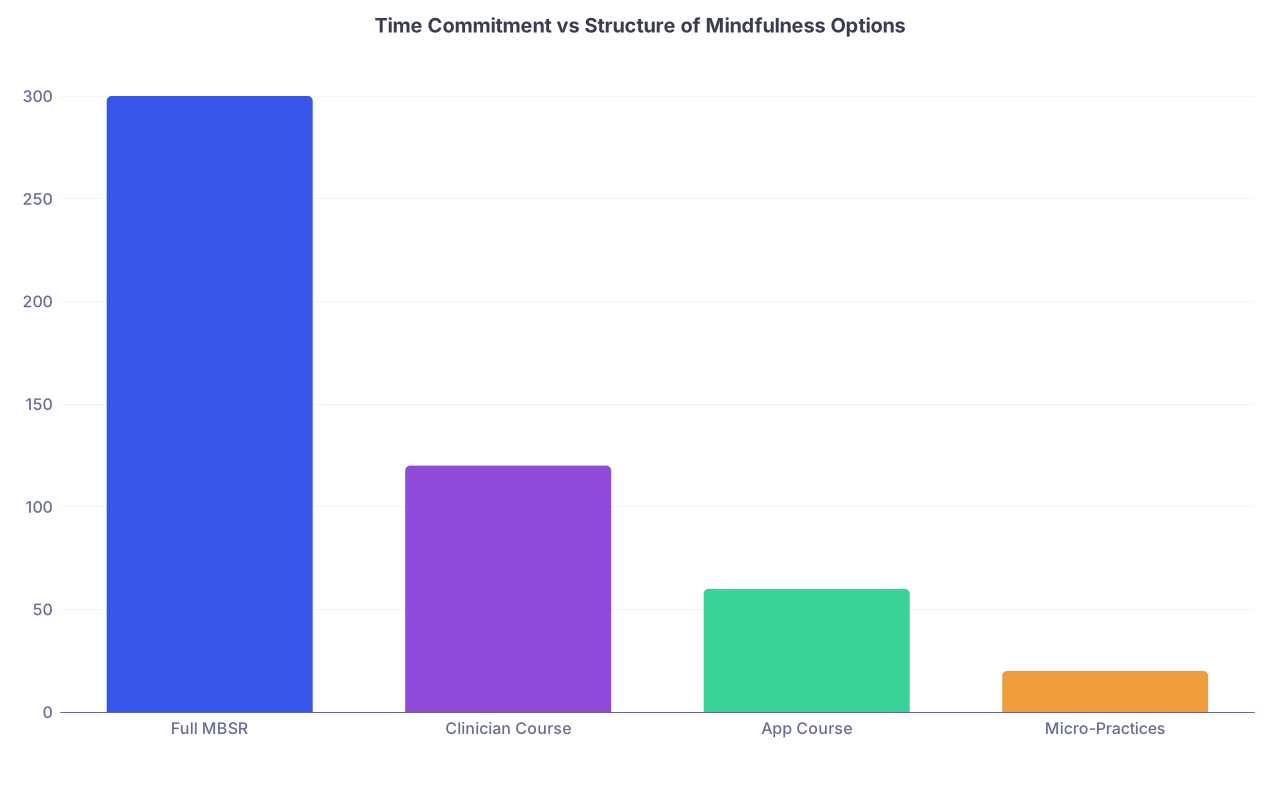
| Category | Value |
|---|---|
| Full MBSR | 300 |
| Clinician Course | 120 |
| App Course | 60 |
| Micro-Practices | 20 |
FAQs
1. If I can only do 5 minutes a day, is it even worth starting?
Yes, if you’re honest about what 5 minutes can do. It won’t transform deep burnout, but it will start to build the muscle of noticing your thoughts and body state. Treat 5 minutes as your entry ramp, with the intent to move to 10–15 minutes or a short course once you’ve proven you can be consistent.
2. Is there any point if my system is toxic and overworking everyone?
Mindfulness won’t fix a toxic system. It’s not a substitute for staffing, fair compensation, or sane schedules—and anyone selling it that way is wrong. What it can do is give you enough clarity and emotional stability to:
- Decide whether and how long to stay
- Advocate more effectively
- Avoid burning yourself down completely while you figure out your next moves
You still need structural change. But internal skills help you survive long enough to push for it.
3. I tried meditation once and my mind wouldn’t shut up. Does that mean it’s not for me?
No. That is meditation. The point isn’t to shut your mind up; it’s to see what it’s doing and return your attention, again and again. If your mind is chaotic, you’re the exact person who benefits. A decent teacher will normalize this in the first session. If they don’t, find another.
4. Are there specific “physician mindfulness” programs you recommend?
I’m not going to promote brands, but here’s what to look for:
- Instructor with both clinical familiarity and recognized mindfulness teacher training
- Clear curriculum (not just “we’ll sit and talk”)
- Homework that includes both formal practice and in-clinic applications
Check what your local academic center, wellness office, or medical society offers before paying a random online coach.
5. How long before I notice any real change?
Frequently:
- 1–2 weeks: You notice occasional moments of “oh, I caught that reaction.”
- 4–6 weeks: Others might comment that you seem “a bit calmer” or less reactive.
- 3–6 months: You start to feel it as part of your identity—how you respond under pressure, not just how you sit on a cushion.
If you’ve done 8 weeks with consistent effort and notice absolutely nothing different, either the instruction was poor or you were multitasking your way through it.
6. Is mindfulness religious? I’m not interested in anything spiritual.
The clinical versions (MBSR, MBCT, most physician-focused programs) are explicitly secular. You’re training attention, body awareness, and emotional regulation, not signing up for a belief system. If someone starts pushing doctrine, gurus, or “manifesting,” that’s not standard clinical mindfulness training—walk away.
Key takeaways:
- For most busy attendings, the best starting point is a clinician-focused, time-limited course or a structured 10–15 minute daily app program, not a massive 8-week MBSR or vague “I’ll be more mindful” intention.
- Whatever you choose, it only becomes meaningful when you embed micro-practices into your actual clinical day—before rooms, before speaking, at the end of shifts.


