
Most clinicians write their hardest notes in the worst possible state of mind. Right after getting yelled at, crying with a family, or pronouncing a death—then sprinting to “close the chart” before midnight.
That is how regret, moral distress, complaints, and board-review letters get written into the record.
Let me give you something better: a concrete, repeatable framework for documenting emotionally charged visits that protects you, honors the patient, and keeps you human.
Why Emotionally Charged Visits Need a Different Documentation Lens
You already know how to document a URI or a stable CHF follow-up. Emotionally intense encounters are categorically different.
They are different because:
- Your nervous system is activated (fight–flight–freeze) while you are trying to be “objective.”
- The patient’s behavior may be extreme, unfair, or frankly abusive.
- Real ethical tension often exists: autonomy vs safety, beneficence vs justice, truth vs hope.
- The chart is not just a clinical record. It is also a legal artifact, a communication tool, and a long-lasting narrative about a vulnerable human.
And if you just blast out a note in whatever state you are in, you will default to one of three bad modes:
- The Defensive Note – every line screams “lawsuit anxiety,” dehumanizes the patient, and reads like a deposition transcript.
- The Venting Note – sarcasm, judgmental language, emotional reactivity smuggled into “objective” phrasing.
- The Ghost Note – bare minimum documentation that fails to show your thinking, your empathy, or the ethical complexity.
You need a different operating system for these visits. One that blends mindfulness, ethics, and practical risk management.
Here is the framework I teach: PAUSE → FRAME → FACTS → MEANING → PLAN → DECOMPRESS.
We will walk it step by step.
Step 1: PAUSE – Regulate Before You Record
You have to earn the right to document by not being hijacked.
The biggest mistake I see? Residents hammering out an angry note two minutes after a patient calls them “incompetent” in front of the whole team.
Your first task is not to chart. It is to regulate.
A 60–120 Second Reset That You Actually Have Time For
You are busy. I know the “go meditate” advice is useless in a slammed clinic. So use something small and precise.
Try this micro-sequence before opening the chart:
Physical reset (20–30 seconds)
- Stand up, roll your shoulders, unclench your jaw.
- Put both feet flat on the floor.
- Exhale longer than you inhale for three breaths (e.g., in for 4, out for 6–8).
Name it (10–20 seconds)
- Silently label, like a clinician:
- “Anger and embarrassment”
- “Sadness and helplessness”
- “Fear of being blamed”
- This is classic “affect labeling.” It decreases amygdala activity; I have watched this literally change how people dictate.
- Silently label, like a clinician:
Intention check (10–20 seconds) Ask yourself one of these:
- “What do I want this note to do?”
- “If risk management or a grieving family reads this in 5 years, how do I want it to sound?”
- “How do I protect patient, team, and myself in one coherent story?”
That is all. One to two minutes. Not a spa day.
If you skip this, everything downstream is contaminated.
Step 2: FRAME – Identify the Core Nature of the Visit
“Emotionally charged” is too vague. Your documentation needs to match the type of intensity.
Broadly, you are dealing with one or more of these visit archetypes:

Conflict-driven
- Angry patient or family
- Complaints about care, accusations, demands for non-indicated tests or meds
- Boundary violations, verbal abuse
Crisis-driven
- Suicidality, self-harm, intimate partner violence
- Impaired capacity, acute psychosis, intoxication
- High risk of harm to self or others
Grief and loss
- New cancer diagnosis, fetal demise, bad imaging results
- End-of-life discussions, code status changes, pronouncement of death
Moral distress and ethical tension
- Patient refusing life-saving care
- Request for non-beneficial treatment
- Resource constraints, difficult discharge situations, unsafe home environment
Name which category(ies) you are in. That decision guides:
- What you must document (safety and capacity elements in crisis; shared decision-making in conflict; empathy and support in grief).
- What risk-management wants to see.
- Where your own emotional “hooks” probably sit.
I tell trainees: Write the first line of your note for the future reader. Something like:
- “Emotionally charged encounter involving disagreement about opioid prescription.”
- “Visit focused on acute suicidal ideation with plan but no immediate means.”
- “Family meeting addressing poor prognosis and transition to comfort-focused care.”
- “Ethically complex situation with patient declining recommended life-saving intervention.”
This frames the rest. It also signals to any future reader: pay attention; context matters here.
Step 3: FACTS – Anchor in Clear, Behavior-Based Description
Once you have regulated and framed, you move into the spine of the note: observable facts and concrete behaviors.
This is where clinicians lose the plot and start writing their feelings as if they were facts.
Avoid these traps:
- “Patient is manipulative.”
- “Family was unreasonable and hostile.”
- “Patient is noncompliant and does not care about their health.”
These are interpretations, not observations. They will burn you later.
Use behavior-based language instead. Document what was said or done.
| Bad / Judgmental Phrase | Better / Behavior-Based Phrase |
|---|---|
| “Patient is drug-seeking.” | “Patient repeatedly requested IV hydromorphone despite explanation that oral regimen is medically appropriate and safe.” |
| “Family was abusive.” | “Family member raised voice, used profanity (‘you people don’t care if he dies’), and pointed finger at staff during conversation.” |
| “Patient is noncompliant.” | “Patient has not taken prescribed insulin for the past 3 weeks, stating ‘I got tired of the shots and stopped.’” |
| “Patient is difficult.” | “Patient repeatedly interrupted explanations, said ‘you are not listening,’ and declined to answer further questions about symptoms.” |
Notice the pattern:
- Describe what they said, how they behaved, what they did or refused, and what you did in response.
- Keep adjectives to a bare minimum, and when you use them, make sure they are clinical (e.g., “tearful,” “agitated,” “pressured speech”) rather than evaluative (“entitled,” “rude,” “crazy”).
The Minimal Factual Skeleton
For an emotionally charged visit, the facts section should reliably show:
- Why the patient was there today (in their words, if relevant).
- Key history and exam findings relevant to the emotional or risk-related content.
- Specific statements that drive risk or ethical issues. For example:
- “Patient stated, ‘I am going to kill myself tonight if you send me home.’”
- “Patient verbalized that she understands the risk of death without surgery and still declines intervention.”
- Actions you took:
- Who you called (psychiatry, social work, security, ethics, risk management, CPS).
- What resources you offered (hotline, transportation, shelter, chaplain).
- How you attempted de-escalation or support.
Do not assume your memory will rescue you in three years when reading this in a deposition. Document the specifics now.
Step 4: MEANING – Explicitly Document Capacity, Values, and Ethics
This is the piece almost everyone skips. And it is often the core of mindful documentation: how the medical facts intersect with the person’s values, capacity, and context.
You are not writing a diary. But you are writing about a human, not a malfunctioning machine. Meaning belongs in the chart—carefully.
Capacity and Insight
If capacity is in question—or likely to be questioned later—document your assessment explicitly.
For example:
- “Patient is able to:
- State the nature of their condition (metastatic lung cancer).
- Describe the proposed intervention (palliative radiation).
- Articulate risks (side effects, fatigue) and alternatives (no treatment).
- Explain their reasoning for declining: wishes to prioritize time at home without additional hospital visits. Assessment: Demonstrates understanding, appreciation, reasoning, and ability to express a choice consistent with longstanding values. Deemed to have decision-making capacity for this decision.”
This is not overkill. This is what protects both the patient’s autonomy and your future self.
Values and Preferences
When patients express values in clear terms, quote or paraphrase them. It transforms a sterile note into a patient-centered ethical record.
Examples:
- “Patient stated, ‘If I cannot recognize my family or walk to the bathroom, I do not want to be kept alive on machines.’”
- “Parent shared that their faith tradition strongly opposes blood transfusions; expressed willingness to consider non-blood volume expanders while declining transfusion.”
You are not moralizing. You are documenting the ethical landscape in which decisions are made.
Acknowledging Emotional Reality Without Turning the Note into a Journal
You can—and should—document emotions. Just do it cleanly and clinically.
Good phrases:
- “Patient appeared tearful throughout discussion; intermittently paused to compose self.”
- “Family expressed shock and disbelief; stated they had not understood the seriousness of the condition.”
- “Patient expressed anger and frustration, saying ‘no one is listening to me.’”
You do not need to write, “This was a very sad visit for the provider.” Keep your emotion awareness for yourself or supervision. The note should reflect your response rather than your raw feelings:
- “Clinician acknowledged patient’s distress and validated frustration; offered additional time for questions.”
Let your behavior show your empathy; no one needs your emotional diary in the chart.
Step 5: PLAN – Show Clear Reasoning, Risk Management, and Follow-Through
Where emotionally charged documentation really matters is in the Plan. This is where future clinicians, risk management, and families look for: Did you think clearly? Did you act responsibly?
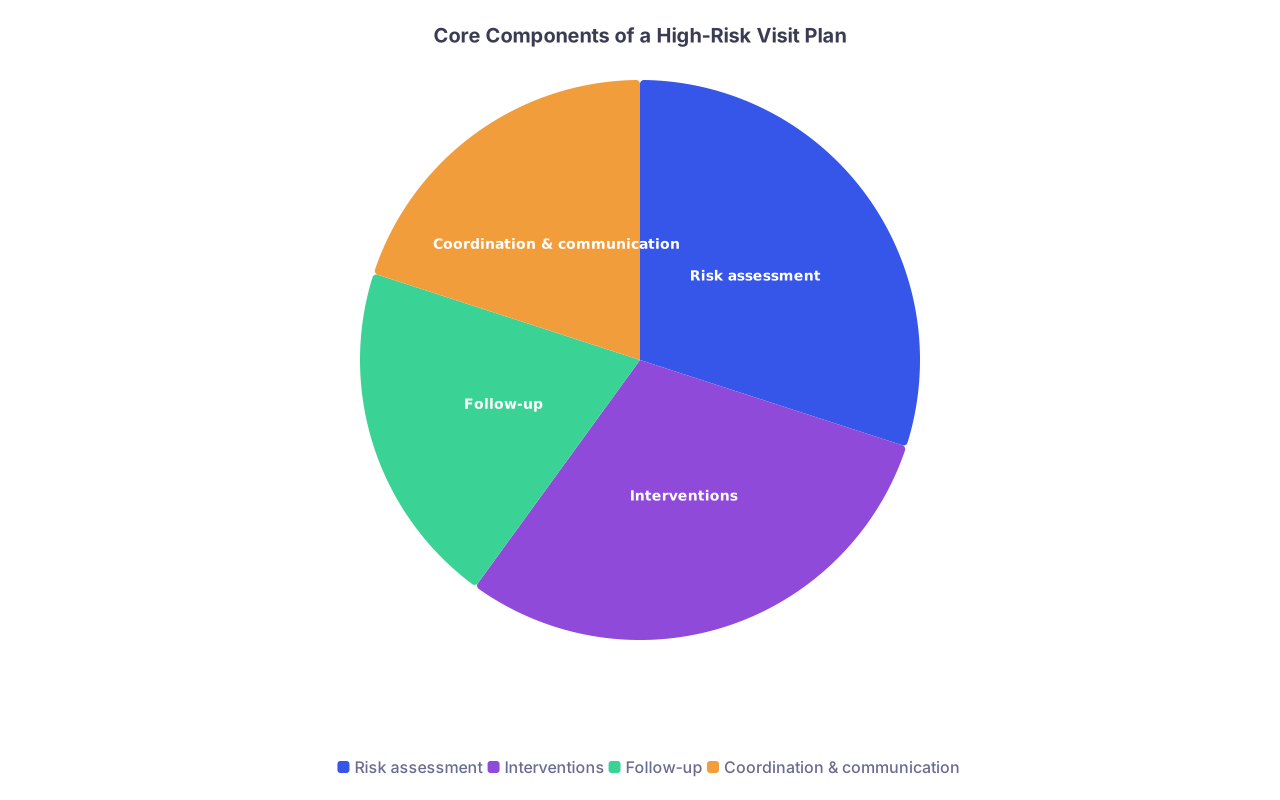
| Category | Value |
|---|---|
| Risk assessment | 30 |
| Interventions | 30 |
| Follow-up | 20 |
| Coordination & communication | 20 |
For Conflict-Driven Encounters
You want the plan to clearly show:
- What was and was not medically appropriate.
- How you maintained boundaries and safety.
- How you preserved continuity and options.
For instance:
- “Explained rationale for not prescribing additional opioids given recent early refills, positive urine for non-prescribed benzodiazepines, and high overdose risk. Offered non-opioid analgesics, referral to pain management, and follow-up in 1 week.”
- “Due to escalating verbal aggression and threats toward staff, security was called. Patient was informed that abusive language violates clinic policy and may result in dismissal from practice. Provided written information on grievance process and patient relations contact.”
You are not just saying “patient was difficult.” You are documenting professional, proportionate responses.
For Crisis-Driven Encounters
Your plan should make it basically impossible for a reasonable reader to say, “They did nothing.”
You should clearly document:
- Suicide / violence risk assessment (including protective factors).
- Consults placed.
- Disposition and means restriction.
- Concrete follow-up.
Example skeleton:
- “Patient endorses suicidal ideation with plan to overdose on available pills; denies past attempts but has access to large quantities of medications at home. Protective factors include expressed responsibility for young children and willingness to accept help.
- Discussed voluntary psychiatric admission; patient agreeable. Psychiatry consulted at 17:45; evaluated patient and accepted for admission to inpatient unit.
- Coordinated with nursing to remove potentially harmful objects from room. Husband contacted with patient’s permission and informed of plan; advised to secure medications at home.
- If patient attempts to leave prior to transfer, plan to initiate emergency hold per policy.”
That is what the future you wants to read.
For Grief and End-of-Life Encounters
Here, the plan must carry the weight of empathy, clarity, and next steps.
- “Reviewed imaging results consistent with disease progression despite current therapy. Discussed that further chemotherapy is unlikely to provide benefit and may worsen quality of life.
- Introduced concept of hospice; patient and spouse expressed interest in focusing on comfort at home.
- Palliative care team consulted; hospice referral placed with patient consent.
- Provided written information about hospice services and emergency contact instructions; confirmed that patient understands we remain available for questions.”
No purple prose. Just clear, kind, structured action.
Step 6: DECOMPRESS – Close the Loop on Your Own Mind
This last step is not about the chart. It is about preventing your next five notes from being contaminated by the one that just hit your nervous system.
Look, you are a finite human running in a high-intensity system. If you repeatedly document difficult visits without any kind of inner hygiene, you will:
- Start writing more cynical notes.
- Overestimate risk in future patients who vaguely resemble this one.
- Carry resentment into the next room.
So after you close the encounter, you do a tiny, intentional debrief. 3–5 minutes when possible, 60 seconds on the worst days.
Options that actually fit real practice:
One-sentence reflection (in your head or on paper, not the chart):
- “The patient was suffering and scared; their anger was not about me.”
- “I did what was medically and ethically sound, even though they disagreed.”
- “That was heartbreaking; I need to be gentler with myself the rest of this shift.”
Micro-body reset:
- Step away from the workstation.
- Three slow breaths, shake out your hands, quick walk to the water fountain.
Targeted peer micro-huddle:
- Find a trusted colleague and say, “I just had a rough one. I am fine, but I need 60 seconds to vent so I do not put this into the chart.”
- Speak for a minute, be done, go back.
This is not indulgent. It is risk management for your future behavior.
Pulling It Together: A Practical Template You Can Use Tomorrow
You can build this into your own “emotionally charged visit” structure. Something like:
Opening / Frame
- One line: type of encounter and the core issue.
Subjective (with emotional and value elements)
- Patient/family statements that drive risk, conflict, or ethical tension.
- Clinically relevant emotional content.
Objective
- Pertinent exam / mental status.
- Behavior description if relevant (agitation, cooperation, threats, tearfulness).
Assessment
- Clinical diagnoses and differential.
- Explicit capacity assessment if relevant.
- Brief risk formulation (low/moderate/high; why).
Plan
- Specific actions taken, consults called, resources provided.
- Safety planning, follow-ups, documentation of informed disagreement/refusal.
- Communication with other team members.
Close your own loop (off-chart)
- Quick reset so you do not carry this into the next room.
You do not have to use that exact structure. The point is to be deliberate, not reactive.
A Note on Legal and Ethical Protection
Mindful documentation is not naïve. It is actually excellent medico-legal armor.
Why?
- Behavior-based descriptions hold up much better in hearings and court than character judgments.
- Clear capacity assessments and documentation of shared decision-making are exactly what ethics committees and risk management look for.
- Showing that you acknowledged emotions, offered alternatives, and involved appropriate resources demonstrates professionalism, not weakness.
What will hurt you is sloppy language written while you are flooded:
- “Patient is a known manipulator, refuses to help herself.”
- “Family being ridiculous and ungrateful.”
- “I explained everything and they still refused; not much else to do.”
I have seen notes like this used to impeach clinician credibility. Do not be that case.
Clinical Scenarios: What This Looks Like in Real Life
Let me give you two quick sketches.
Scenario 1: The “Drug-Seeking” Label
Resident comes out of the room fuming: “He is totally drug-seeking and cursed me out.”
Unstructured note:
- “Patient is drug-seeking and refused non-opioid meds. Became very rude and uncooperative. Declined exam.”
Structured through the framework:
- Frame: “Emotionally charged encounter around pain management and request for additional opioids.”
- Facts:
- “Patient requested IV hydromorphone, stating current oral oxycodone is ‘not enough.’ PDMP shows 3 prescriptions for short-acting opioids from 3 prescribers in last 4 weeks.”
- “When explained that IV opioids are not indicated and pose overdose risk, patient raised voice, used profanity (‘you are useless’), and threatened to leave against medical advice.”
- “Patient declined offered non-opioid analgesics and physical exam, stating, ‘If you will not give me the real stuff, there is no point.’”
- Meaning:
- Not necessarily a capacity issue; no psychosis, understands risks, but high misuse risk.
- Plan:
- “Offered non-opioid analgesics and referral to pain management. Provided education on overdose risk and naloxone. Notified attending and security per protocol due to escalating verbal aggression. Patient left prior to completion of evaluation; documented elopement, vital signs stable at last check.”
Night and day. One is venting. One is professional, specific, and defensible.
Scenario 2: Suicidal Ideation Discharged Home
The scary one: patient dies by suicide after ED visit. Lawyers will live in your note.
Unhelpful note:
- “Patient depressed, suicidal thoughts but no plan. Contracted for safety and told to follow up with PCP.”
Better, via framework:
- Frame: “Visit focused on evaluation of suicidal ideation in context of major depressive disorder.”
- Facts:
- “Patient reports intermittent suicidal thoughts over past month, without specific plan or intent. Denies past attempts. Denies access to firearms; medications at home are limited to sertraline and lisinopril in blister packs.”
- “States main reason for living is responsibility for 2 young children; expresses willingness to seek help if symptoms worsen.”
- Meaning (risk formulation):
- “Chronic elevated risk due to depression, recent job loss. Acute risk assessed as low–moderate given absence of plan/intent, presence of strong protective factors, and good engagement with care.”
- Plan:
- “Discussed inpatient vs outpatient options; patient prefers outpatient management and appears to understand indications for emergent return. Created safety plan including identification of warning signs, coping strategies, and crisis resources. Provided crisis line number, local walk-in clinic information. Psychiatry consulted and agrees with outpatient plan. Appointment scheduled with outpatient mental health within 72 hours.”
Again, not perfect protection against tragedy, but concrete evidence of thoughtfulness.
Simple Mindfulness Anchors While You Type
If you want one mindfulness trick that does not feel like “spiritual cosplay,” use this:
While you type the note, periodically ask yourself:
- “If this patient or their family read this tomorrow, would I stand by every word?”
- “Am I describing what happened, or am I punishing them on the page?”
- “Am I writing in a way that my future self will be grateful for?”
If the answer to any of those is no, fix it now.

| Step | Description |
|---|---|
| Step 1 | Emotionally charged visit ends |
| Step 2 | PAUSE - regulate 1 to 2 minutes |
| Step 3 | FRAME - identify visit type |
| Step 4 | FACTS - behavior based description |
| Step 5 | MEANING - capacity and values |
| Step 6 | PLAN - clear actions and follow up |
| Step 7 | DECOMPRESS - brief self reset |
FAQs
1. Is it ever appropriate to include quotes from a patient that are offensive or profane?
Yes, selectively. If the exact language materially illustrates risk, aggression, or the emotional tone of the encounter, brief direct quotes are appropriate. Example: “Patient stated, ‘I will come back and make you all pay,’” which has clear safety implications. Do not fill the note with gratuitous profanity, but do not sanitize critical threats or key emotional statements either.
2. How do I balance being honest about a patient’s disruptive behavior with avoiding stigmatizing language?
Stick to concrete descriptions of observable behavior and its impact on care. Instead of “noncompliant and manipulative,” write: “Patient repeatedly refused to take prescribed medications despite explanation of risks, and became verbally aggressive toward staff when limits on controlled substances were explained.” This tells the truth without global character assassination.
3. What if I genuinely feel overwhelmed or traumatized by an encounter—should that ever go into the chart?
Your internal emotional state should not be documented as such. The chart is not your therapy space. However, your professional response to the situation belongs there: “Requested assistance from senior physician due to escalating conflict,” or “Engaged security for staff safety.” Process your emotions in supervision, peer support, or personal reflection outside the medical record.
4. How can I apply this framework when I only have a couple of minutes between patients?
Use a scaled-down version: 30–60 seconds to PAUSE (three breaths, name your emotion), a one-line FRAME at the top of the note, rigorous behavior-based FACTS, and a crisp PLAN that explicitly shows safety and follow‑up. The MEANING step can be a single sentence about capacity or values when time is tight. The DECOMPRESS step can be as small as unclenching your jaw and taking three slow breaths before opening the next chart.
Key points:
- Emotionally charged visits require a different approach: regulate first, then document with structure, not reactivity.
- Ground your notes in behavior-based facts, explicit capacity and values, and a clear, defensible plan—this protects both patient and clinician.
- A brief decompression after difficult documentation is not a luxury; it is how you keep your notes, and yourself, from getting progressively harsher over time.