
Last month a first-year fellow closed his laptop in my office and just stared at it. “I spent four years of residency fighting this thing,” he said, tapping the cover, “and now I realize my charting is the only part of my day that’s actually mine.” He hadn’t suddenly fallen in love with Epic; he’d finally understood what mindful charting really is — and what he’d been doing wrong the entire time.
You do not really learn mindful charting in residency. You learn survival charting. Click-fast, cut-paste, bill correctly, avoid audits, meet RVU targets. The unspoken curriculum is: document enough to not get sued, and don’t get behind. But when residents hit fellowship — or their first attending job — they discover the quiet, uncomfortable truth: how you chart is a direct mirror of how you think, how you relate to patients, and how ethically you practice. And most of you are building bad habits in plain sight.
Let me walk you through what fellows admit behind closed doors, and what attendings mutter when residents leave the room.
The Hidden Curriculum of Charting You Never Get Taught
No one sits you down PGY-1 and says, “Your notes are ethical documents and cognitive tools, not just billing artifacts.” Instead, you get:
- Twenty-minute EHR “training.”
- A template from some senior resident who “never gets attendings’ edits.”
- Pressure to pre-chart and pend everything for signatures.
So you learn fast: charting is an obstacle between you and sleep.
In fellowship, the script flips. You start seeing:
- Bad charts that come back to haunt the team.
- Notes used in morbidity and mortality, legal reviews, and ethics consults.
- Your own old notes… and what they say about your thinking.
One pulmonary/critical care fellow told me, “I pulled up a MICU note I wrote as a senior and I was embarrassed. Not because I missed something, but because I could see I wasn’t really thinking. I was documenting impressions I hadn’t earned.”
That’s the first thing residents do not know about mindful charting: the chart is not just a record of what happened. It is a record of how seriously you took your responsibility to think, to notice, to care, and to be honest.
What Mindful Charting Actually Means (Not the Wellness Version)
People hear “mindful charting” and imagine breathing exercises at the workstation. That’s fluff. Mindful charting is three things, brutally simple:
- You actually think before you click.
- You’re honest about uncertainty, risk, and patient values.
- You remember there’s a real human who may read every word you just wrote.
Most residents get maybe one of those on a good day.
Fellows start to grasp this because suddenly they own more of the consequences. They’re the ones signing off on plans, leading goals-of-care discussions, getting called when something went sideways and the story in the chart does not match reality.
They notice patterns. Charts that feel different. Attendings whose notes are strangely… calm. Clear. Precise without being defensive. That’s mindful charting in action.
And it’s not about writing essays. It’s about conscious decisions: what you include, what you do not, and how you frame it.
The 5 Ugly Truths You Only Notice at Fellowship
Let me be direct. These are the things I’ve heard fellows say in workrooms when they finally connect the dots.
1. Your chart is often your only real reflection time — and you’ve been wasting it
Ask most interns: “When do you actually think about your patients?” They’ll say “on rounds” or “while talking to attendings.” Wrong. On rounds you’re performing. With attendings you’re defending. When you sit down to chart — that’s the only quiet moment you have to put the story in order.
Residents treat that time as a data-transfer chore: vitals in, labs in, exam in, assessment out.
Fellows figure out that if they don’t use charting as a cognitive pause, they stop growing. The best of them write notes that force them to answer:
- What’s the single most important problem today?
- What am I actually worried about in the next 24 hours?
- What is the patient worried about?
I’ve seen fellows who, before typing their A/P, stop and ask themselves three questions out loud. Then the note reflects that clarity. And peer-to-peer, you can tell instantly whose thinking is sharp and whose is scattered just by reading their assessment.
Residents usually never realize: you can turn charting from brainless to brain-building without adding time. You just have to stop letting your template do the thinking.
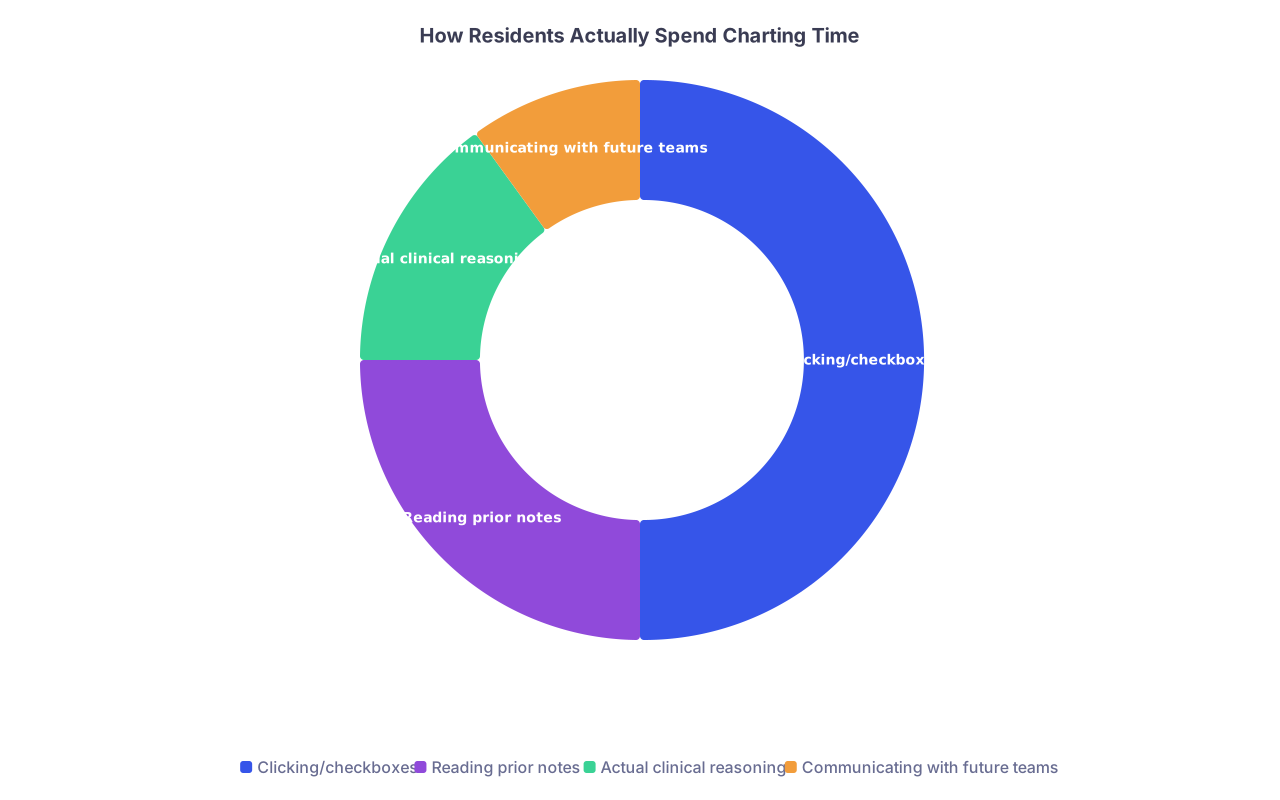
| Category | Value |
|---|---|
| Clicking/checkboxes | 50 |
| Reading prior notes | 25 |
| Actual clinical reasoning | 15 |
| Communicating with future teams | 10 |
2. Copy-forward is not a shortcut; it is a cognitive toxin
Every fellow has a horror story about this.
An ICU fellow pulled up a string of daily notes that all said: “No history of smoking.” The patient had COPD on 2L home oxygen and a 50-pack-year history. It lived in the admission H&P. No one updated the social history section. They just cloned the initial template. Day after day.
In residency, copy-forward feels like a time-saver. In fellowship, you see what it actually is: a machine for propagating lies and outdated assumptions.
You know what program directors say behind closed doors about residents who copy large sections without edits? “Lazy thinker.” “Dangerous in the long run.” “Does not own their data.”
Harsh? Yes. But I’ve heard it verbatim.
Mindful charting doesn’t mean never using templates. It means you consciously decide what deserves a fresh look today. That could be just one problem in a complex patient. But you own that decision.
3. The chart is a legal and ethical document — and patients read it more than you think
You’ve probably had one patient on the floor who pulled up their MyChart and confronted you about a phrase. Fellows see this weekly.
Here’s what nobody told you: with open notes, the odds your words will be read by the patient, a lawyer, a case manager, an ethicist, and another specialty are now sky high. That doesn’t mean you sanitize everything. It means you respect the power of framing.
Compare:
- “Noncompliant with medication.”
- “Reports difficulty obtaining and remembering to take medications; barriers include cost and limited support.”
Same reality. Entirely different moral judgment.
I’ve sat on committees reviewing charts after bad outcomes. The actual medical decision was justifiable, but the documentation looked arrogant, dismissive, or sloppy. That poisons how everything is interpreted after the fact.
Fellows start to write with this awareness, not from fear, but from respect. They document thought process, uncertainty, alternatives discussed. They stop using loaded language that residents throw around without thinking.

4. Sloppy charting quietly destroys team trust
You know who reads your notes most closely? Not attendings. Other residents, nurses, consultants, and your future self.
When fellows start leading services, they suddenly see the downstream chaos from weak documentation:
- Nursing messages, “The note says full code but we had a DNR talk yesterday…?”
- Consultants refusing procedures because “the risk/benefit and goals-of-care aren’t documented.”
- Cross-cover making bad calls at 3 a.m. because the daily plan was vague or contradictory.
Behind the scenes, attendings absolutely keep mental lists of who they trust based on their notes. I’ve heard, “If it’s in her note, I believe it. If he wrote it, I double-check everything.” That affects who gets independence, who gets letters, who gets leadership roles.
Residents often think, “No one reads my full note anyway.” Wrong. When something goes wrong, or the case is complex, people read every line. And they remember who charts like a professional and who charts like they’re trying to beat the clock.
5. Charting changes you — ethically and emotionally — more than you realize
This one is subtle, but it matters most.
If you spend three years documenting people as “CHF exacerbation in bed 5,” your brain starts to see them as that. Just problems. Not stories. Not humans having possibly the worst day of their lives.
Fellows in oncology, ICU, palliative, and ethics will tell you: your language in the chart shapes how you relate to patients at the bedside. If you constantly frame them as obstacles (“refuses,” “difficult,” “demanding”), you will feel more burned out and cynical. Because your own words are feeding that mindset back to you.
Mindful charting is partly a self-protection strategy. You record reality without dehumanizing or dramatizing it. You stay clinically honest without poisoning your own well.
The Anatomy of a Mindful Note (What Fellows Start Doing Differently)
Let me pull back the curtain on how skilled attendings and thoughtful fellows actually structure notes. Not the template skeleton — the thinking.
They quietly do three things residents almost never do consistently:
Name the real problem for today, not just the diagnosis list.
Instead of ten bullets of “HTN, DM2, CKD, CAD, COPD,” you see:
“Primary issue today: worsening hypoxia in the setting of volume overload vs pneumonia; high risk of needing intubation in next 24 hrs.”State their uncertainty explicitly.
Not “sepsis vs SIRS.” That’s lazy.
“Source of infection unclear. Most likely pulmonary given new infiltrate; less likely urinary given clean UA; cannot exclude line infection but exam and history lower suspicion.”
That’s a mind working. And charting in a way that future-you and other teams can follow.Document patient values when they actually matter.
Fellows start writing things like:
“Patient prioritizes staying at home over longevity, willing to accept higher risk of readmission. Chose to defer home oxygen today despite recommendation; understands risks.”
You read that six months later, it still holds up ethically.
Residents tend to write more like this: “Discussed risks, benefits, alternatives; patient verbalized understanding.” Which often means: “We talked quickly, they nodded, I charted the formula.”
The difference is not extra time. It is attention.
| Aspect | Typical Resident Note | Mindful Fellow/Attending Note |
|---|---|---|
| Problem list | Long, unfocused | Prioritized, one clear main issue |
| Uncertainty | Minimized or glossed over | Named and explained |
| Copy-forward content | High, lightly edited | Selective, thoughtfully updated |
| Patient preferences | Generic consent phrases | Specific values and tradeoffs |
| Language about behavior | “Noncompliant,” “refuses” | Describes barriers and context |
Practical Mindful Charting Moves You Can Start as a Resident
You don’t have to wait for fellowship to fix this. But you do have to ignore some of the implicit culture on your team.
Here’s what high-level fellows tell residents privately when they’re actually being honest.
1. Carve out one “anchor” patient each day
You won’t be mindful with every single note on a busy ward month. That’s a fantasy.
Pick one patient per day — usually your sickest, most complicated, or ethically fraught one — and commit to writing a truly thoughtful A/P. That means:
- One line that states the main problem for today.
- Two to three sentences on your differential and what you’re worried about.
- One line that captures patient/family perspective if relevant.
Rest of your list can be efficient. But this anchor patient keeps your cognitive and ethical muscles from completely atrophying.
2. Ban autopilot language for one week
Do a week-long experiment: forbid yourself from using phrases like “noncompliant,” “difficult,” “poor historian,” or “refuses” without one sentence of explanation.
You’ll hate it for two days. Then you’ll notice your mindset shifting. You start asking better questions at the bedside because you know you’ll have to justify that label in writing.
3. Use “if/then” thinking in your plans
Mindful charting is anticipatory. You’re not just documenting what you did; you’re charting how to respond when things change.
Instead of: “Monitor vitals, continue current management.”
Try: “If oxygen requirement increases above 6L or RR > 30, will obtain ABG and page ICU for possible transfer.”
That one sentence does three things: forces you to set thresholds, communicates to cross-cover, and captures your real concerns for the record.

| Step | Description |
|---|---|
| Step 1 | See patient |
| Step 2 | Brief internal summary |
| Step 3 | Set main problem for today |
| Step 4 | Name uncertainty |
| Step 5 | Document plan with if/then |
| Step 6 | Record patient values if relevant |
| Step 7 | What changed today |
4. Read your own note from yesterday before writing today’s
Most residents skim yesterday’s assessment at best. Fellows who grow fast do this:
They read their prior A/P and ask themselves: “Was I right? What did I miss? What changed?” Then today’s note becomes an explicit update, not a rehash.
It takes two extra minutes, but it converts charting into longitudinal reasoning. You’ll be shocked how much more coherent your thinking becomes over a single month.
The Ethical Edge: Where Mindful Charting Protects You and Your Patients
Here’s the part no one says out loud in orientation. Mindful charting is not just a “nice to have.” It’s your shield.
When things go bad — and they will, no matter how competent you are — people will go back through the notes trying to reconstruct: Did this team think? Did they care? Did they communicate?
I’ve reviewed cases where:
- A resident made a reasonable call, but the note reads like they barely noticed the risk.
- Another made the same call, but documented their concern, their rationale, the alternatives they considered, and the patient’s priorities.
Guess who looks negligent and who looks like a conscientious clinician facing a hard problem? Same decision. Different documentation. One gets scapegoated, one gets understood.
Also, ethically, you owe it to your patients to have your chart tell the truth about their story and your role. Not the embellished truth. Not the defensive truth. The honest truth, with your uncertainty showing.
Mindful charting means you don’t hide behind the illusion of certainty. You write like a professional who knows medicine is probabilistic and human.
What Fellows Wish Residents Knew — Before It’s Too Late
By the time you’re a fellow or junior attending, rewiring your charting habits is painful. You’re fast but thoughtless, efficient but ethically flimsy. Changing that feels like slowing down, and everyone is already behind.
So let me give you the distilled version of what fellows say in those late-night conversations when a case rattles them:
- “I wish I’d practiced documenting goals-of-care early, not just ‘full code vs DNR’ but what the patient actually valued.”
- “I didn’t realize how much my notes made cross-cover’s life harder. Now I’m the one getting burned by vague plans.”
- “I used to copy so much. Now I’m digging myself out of years of bad habits.”
- “My notes looked confident but my thinking wasn’t. That’s haunting when you re-read them after a bad outcome.”
You don’t need to be perfect. You do need to be awake. Charting is where you decide whether you’re just moving data… or practicing medicine on the page.