
The most popular “on‑call mindfulness routine” everyone is copying is dangerously overrated—and it will fail you at 3 a.m. when it actually matters.
You know the one. The five deep breaths, the quick body scan, the “notice three things you can see, hear, and feel,” maybe a mindfulness app humming in your pocket. You do it between pages. You feel virtuous. You tell yourself you are practicing “self‑care.”
Until the pager explodes, the ICU admits pile up, your attending is on edge, and suddenly that same routine is making you slower, more dissociated, and guilty for still feeling like a wreck.
Let me be blunt: on‑call is the worst time to use mindfulness sloppily. Done wrong, it will backfire. It will compromise patient care, erode your trust in yourself, and leave you thinking “I guess mindfulness just doesn’t work for me.” That is the real loss.
This isn’t a hit piece on mindfulness. Mindfulness, used correctly, is a powerful tool for ethical, sustainable practice. But you must stop treating it like a universal sedative or a spiritual band‑aid.
Let’s walk through the specific mistakes that make on‑call mindfulness routines fail—and what to do instead.
The Core Problem: You’re Using a Spa Tool in a Trauma Environment
The biggest mistake: importing a “yoga studio” version of mindfulness into a trauma‑level environment.
You were probably taught mindfulness as:
- Slow
- Relaxing
- Eyes closed
- Disengaging from thoughts
- Turning inward
Now picture a real 3 a.m. call scenario:
- Two new admissions
- One rapid response
- A family demanding updates
- A nurse asking for urgent orders
- An attending who “does not want excuses”
If your routine is built for calm, it will betray you in chaos. You end up with:
- Slowed reaction time when speed is ethically required
- Blunted emotional cues when those cues should inform urgency
- A sense of unreality or distance from the situation
- Self‑blame when you still feel overwhelmed after “doing your mindfulness”
Mindfulness on the wards must be:
- Fast
- Functional
- Eyes open
- Oriented to the room and the patient
- Explicitly linked to clinical priorities
If your routine does not match that profile, it is a liability when the pager starts screaming.
Mistake #1: Treating Mindfulness as Relaxation Instead of Orientation
I see this constantly: residents do a few deep breaths, feel a little spaced out, and call it mindfulness.
That is relaxation. Not mindfulness. And when you are on call, that difference matters.
Relaxation aims to downregulate your whole system. Mindfulness, especially in medicine, should orient you:
- To the task
- To the patient
- To the risk
- To your own internal state in a way that clarifies action
If you use a “relax and drift inward” routine right before:
- Calling back a nurse about new chest pain
- Responding to an unstable vital sign
- Entering time‑sensitive orders
you are doing exactly the wrong thing: you are loosening your attention when you need to sharpen it.
That is how errors happen. Missed subtle wording on a nurse page. Overlooking a critical lab because your brain is in “soft focus mode.” I have watched this play out in morbidity and mortality discussions dressed up as “system errors” when the real story was cognitive dulling.
Fix: On call, your mindfulness anchor must be orienting, not sedating. Think:
- “Three breaths while I read the page out loud to myself and underline the key concern in my head.”
- “Label: What is the single most dangerous thing this could be? What is the next physical action?”
Short, sharp, and tied to the decision in front of you. Not a tiny nap for your frontal lobe.
Mistake #2: Using Mindfulness to Suppress Emotion Instead of Name It
A lot of trainees quietly use mindfulness as emotional duct tape.
You feel fear, frustration, or anger. You were told “observe without judgment.” So you:
- Notice the feeling
- Shove it behind a wall
- Call this “letting it go”
Then you go back into the room sounding flat, robotic, or weirdly detached. Nurses pick up on it. Families definitely pick up on it.
The ethical danger: suppressed emotion does not disappear. It leaks. Often in the worst possible ways:
- You become curt with the patient who reminds you of your dying relative
- You delay a tough conversation because “I need to be more mindful first”
- You override your gut feeling that something is wrong because “I am catastrophizing”
Mindfulness should not erase emotion. It should label it and contain it so it can inform, not rule.
A better on‑call micro‑routine looks like:
- “Name it: I feel afraid I’ll miss something.”
- “Allow it: Of course I do. This is high‑stakes.”
- “Refocus: What data do I have? What is missing? What is the next test or exam maneuver?”
Notice: no denial, no pretending you are calm. You acknowledge the fear, then tether your attention back to action.
When you weaponize mindfulness to erase your feelings, you are blunting one of your most valuable clinical tools: your own alarm system.
Mistake #3: The 10‑Minute App Meditation That Destroys Your Bandwidth
Another 3 a.m. classic: the resident in the call room with noise‑canceling headphones, eyes closed, running a 10‑minute guided meditation while the floor is on fire.
You think:
- “I need to regulate before I go back out.”
- “Ten minutes is nothing; I deserve this.”
On a quiet call, maybe. On a messy, unstable night, this crosses an ethical line.
On call, your primary obligation is situational awareness. When you:
- Block out auditory cues
- Ignore the general “vibe” of the unit (yes, it matters)
- Silently hope no one needs you during your “practice”
you have turned mindfulness into a private luxury in a public responsibility zone.
Use apps at home. Use 10‑minute meditations post‑call. On call, your mindfulness tools must be interruptible by design.
Principle: If your routine cannot be safely stopped mid‑breath to answer a code page, it does not belong in your on‑call toolbox.
Mistake #4: Confusing Non‑Judgment with Non‑Accountability
Mindfulness teaches “non‑judgmental awareness.” Many trainees misread this as “I should not feel bad for my mistakes.”
So after a call night where:
- You missed a subtle sign
- You were shorter with a nurse than you wanted to be
- You delayed a difficult discussion
you tell yourself, “I will just observe my self‑criticism without judgment.” Then you move on. No debrief. No repair. No changed behavior.
That is not mindfulness. That is spiritualized avoidance.
Non‑judgment means: do not attack yourself as a person. It does not mean: do not evaluate your actions.
Ethically sound on‑call mindfulness has two phases:
In the moment (containment):
- “Right now I need to stabilize the situation. I will hold the self‑criticism for later.”
After the storm (accountability):
- “What exactly did I miss? What led to that? What is one specific change I will make next time?”
- If your behavior affected someone else: “Do I owe that nurse/patient an apology or clarification?”
You can be both:
- Non‑judgmental toward your worth as a human
- Very clear and direct about your performance gaps
If your mindfulness practice always stops at “I accept myself” but never reaches “I must change this behavior,” it is not supporting your ethical development. It is blocking it.
Mistake #5: Trying to Use Mindfulness to Overwrite Sleep Deprivation
This is where I see things get dangerous.
A resident is on a 28‑hour call. It is hour 24. They are:
- Nauseated from fatigue
- Missing words in H&Ps
- Re‑reading the same lab value three times
They start doing “micro‑meditations” between every page, trying to “stay centered.”
Translation: they are using mindfulness as a fig leaf for unsafe cognitive impairment.
No amount of breath awareness will restore the executive function that chronic under‑sleep has stolen. You can sharpen the edges a bit. You cannot regrow your prefrontal cortex overnight.
Ethically, mindfulness in this state should serve to:
- Make you more honest about your impairment
- Increase your willingness to ask for backup
- Reduce ego‑driven denial
Not to prop up the illusion that “I am fine because I am mindful.”
If your internal script is “I am exhausted but I did a five‑minute meditation so I can push through,” you are placing your pride above patient safety.
The more honest on‑call mindfulness thought is:
- “I notice my thinking is slow and foggy. This is dangerous. I need to double‑check orders and actively pull in others.”
Mistake #6: Turning Mindfulness into a Performance Metric
I hear this a lot from residents:
- “I failed my mindfulness tonight; I got so angry at that consultant.”
- “If I were more mindful, I would not feel so resentful.”
- “I meditated for 15 minutes and still felt anxious—I must be doing it wrong.”
Careful. You have turned mindfulness into yet another way to judge yourself.
When your mindfulness routine becomes a silent grading rubric:
- “Good doctor = calm, unbothered, always composed”
you are on a direct path to shame. And then to burnout. Because real work in medicine will make you angry, frustrated, or anxious sometimes. If those feelings now represent “mindfulness failure,” you will quit the practice or double down into spiritual perfectionism.
Neither helps your patients.
On call, the healthier frame is:
- “My goal is not to feel calm. My goal is to see clearly what is happening inside me and outside me, and still act according to my values.”
You can be furious and still practice mindful restraint. You can be terrified and still practice mindful clarity. That counts.
What a Non‑Backfiring On‑Call Mindfulness Routine Actually Looks Like
Let me lay out a practical alternative. Not pretty. Very functional.
Think of it as a set of micro‑routines you drop into existing workflows, not a separate “mindfulness break.”
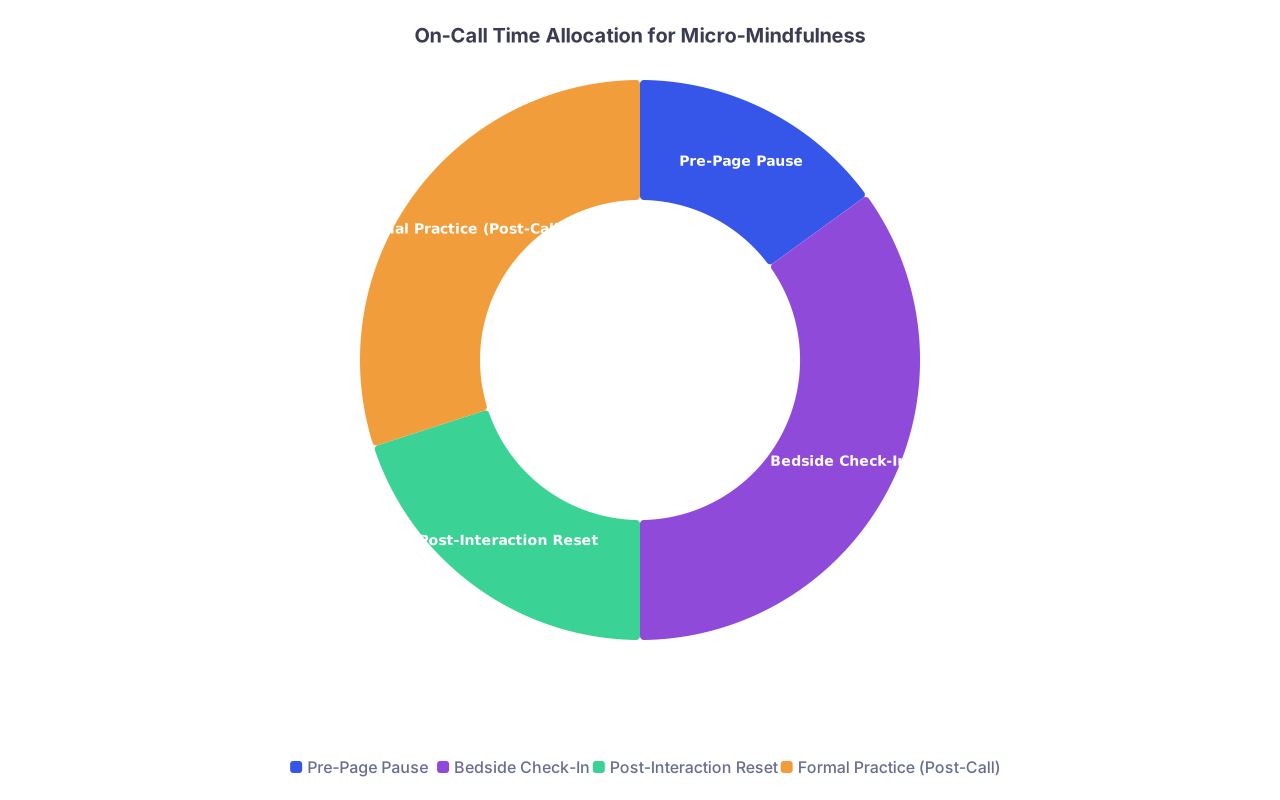
| Category | Value |
|---|---|
| Pre-Page Pause | 15 |
| Bedside Check-In | 35 |
| Post-Interaction Reset | 20 |
| Formal Practice (Post-Call) | 30 |
1. The Pre‑Page 10‑Second Pause
When your pager goes off:
- Read the message once silently.
- Take one slow, deliberate breath.
- Ask yourself, explicitly:
- “What is the most dangerous possible thing this could represent?”
- “What is the first piece of information I need?”
Then you act. No 3‑minute breathing ladder. No app. Ten seconds. Total.
This keeps you:
- Grounded in your body
- Oriented to risk
- Focused on the next necessary action
2. The Doorway Check‑In (Entering a Patient Room)
Before you touch the doorknob:
- Name your top feeling in seven words or less:
“Tired and annoyed; worried I will miss something.” - Decide on one behavioral intention:
“Regardless, I will speak slowly and listen fully to the first answer.”
Takes five seconds. Prevents your internal chaos from setting the tone of the room.
3. The 30‑Second Chart Review Reset
After you leave a difficult encounter and sit at the computer:
- Feel your feet on the floor, back against the chair.
- Take three normal (not dramatic) breaths.
- Ask:
- “Did I say or do anything I should repair later?”
- “Is there any critical follow‑up item I am about to forget?”
Then chart. This reduces “wake up at 4 a.m. post‑call realizing you forgot X” moments.
4. The Post‑Call Ethics Debrief (Non‑Optional if You Care About Growth)
When the shift is over and you have slept, you do this, not a 20‑minute guilt‑ridden replay in your head.

| Step | Description |
|---|---|
| Step 1 | Start Debrief |
| Step 2 | Pick 1 hard moment |
| Step 3 | Write facts only |
| Step 4 | Name thoughts and feelings |
| Step 5 | Identify 1 value at stake |
| Step 6 | Choose 1 concrete change |
| Step 7 | Decide if repair needed |
| Step 8 | End Debrief |
One page in a notebook. 10–15 minutes, max. You are building ethical reflexes, not marinating in shame.
Comparing Bad vs. Functional On‑Call Mindfulness
| Aspect | Fragile Routine (Backfires) | Functional Routine (Holds at 3 a.m.) |
|---|---|---|
| Goal | Feel calm and relaxed | Stay oriented and act ethically |
| Timing | Long blocks, headphones, eyes closed | 5–30 second inserts into existing tasks |
| Focus | Inner state only | Inner state + patient + risk context |
| Effect on speed | Slows reaction time | Sharpens priorities |
| Relationship to emotion | Suppress or “rise above” | Name, contain, and use as data |
The Ethical Line You Must Not Cross
Let me be very clear about one thing.
If your mindfulness routine:
- Makes you less responsive
- Makes you less honest about your fatigue
- Gives you cover to avoid asking for help
- Or provides a story that “I am fine” when you are objectively impaired
then it is not just “unhelpful.” It is unethical.
You do not get extra virtue points for being the resident who “stays mindful” while silently drowning. You get patients who are not getting your best cognition and colleagues who cannot trust your self‑assessment.
Mindfulness in medicine must support three things:
- Clinical clarity
- Emotional integrity
- Ethical accountability
If it is not doing all three, strip it down until it does.
How to Retrofit Your Current Practice So It Stops Backfiring
You do not need to throw out every tool. You do need to audit it ruthlessly.
Ask your current on‑call mindfulness routine these questions:
- Would this still be safe and appropriate if a code blue were announced in the next minute?
- Does this make me more in touch with my actual capacity and limits, or less?
- Am I using this to avoid feeling or to engage more honestly with what I feel?
- After doing this, am I more likely to correct my mistakes, or more likely to “accept” them and move on without change?
If the answers are wrong, you adjust. Or you drop that tool from your on‑call kit and save it for your couch at home.
You need two mindfulness toolboxes:
- One for off‑duty recovery: longer practices, deeper emotional processing, full relaxation.
- One for on‑call functioning: brief, orienting, interruption‑friendly practices tied to decisions and ethics.
Mix them up and you will keep discovering, at 3 a.m., that your “mindfulness” only works when you do not actually need it.

FAQ (Exactly 4 Questions)
1. Is it ever appropriate to do a full 10–20 minute meditation while on call?
Yes, but rarely, and only when you are genuinely off the hook for new responsibilities for that window—such as during a protected nap period with clear backup coverage. Even then, you must stay interruptible. No noise‑canceling headphones that block overhead calls. If you are the primary responder for codes, stat pages, or new admissions, long, immersive meditations are not appropriate. Use them post‑call at home where they can go deep without competing with patient safety.
2. What if my program is pushing a specific app or routine that feels wrong on call?
You are allowed to adapt. Many institutional wellness initiatives are designed by people who have not held a pager in years. If the prescribed routine is long, sedating, or requires you to disconnect from your surroundings, repurpose it for home use and design your own micro‑practices for the wards. You can respectfully tell leadership, “This works well for me off‑duty; on call I use shorter, task‑linked check‑ins to stay oriented.”
3. How do I know if mindfulness is helping my ethics instead of dulling it?
Look at behavior change over months, not vibes in the moment. Are you more likely to speak up when something feels off? More willing to apologize when you snap at someone? More consistent about revisiting tough cases to learn from them? If yes, your practice is supporting ethical growth. If instead you are better at “accepting” things but not at repairing or improving them, your practice has slid into quiet avoidance. That is your signal to retool.
4. What should I do after a call night where my “mindful” choices clearly went wrong?
Do not throw out mindfulness. Upgrade it. After you sleep, do a structured debrief: write down one or two concrete situations, list what happened, what you felt, what you did, and what value you wish you had protected better (e.g., honesty, respect, safety). Then design a specific micro‑intervention for next time—one sentence you will say, one breath you will take at a key moment, one person you will loop in earlier. Mindfulness that does not change what you do next time is incomplete. Use the failure as the curriculum, not the verdict.
Two things to remember:
- On‑call mindfulness that sedates, isolates, or excuses you will fail you at 3 a.m. and put patients at risk.
- On‑call mindfulness that orients, exposes the truth of your state, and pushes you toward concrete ethical action will hold when everything else is coming apart.
Build only the second kind. Discard the first without nostalgia.