
You are in a cramped ED room. Curtain half‑closed, monitor beeping, family huddled in the corner. The patient has been waiting six hours. They just found out their CT is “still pending.” A nurse walks out, the patient snaps: “You people don’t care if I die here.” Volume rising. Face flushed. You feel your own heart rate jump.
Your resident glances at you. The nurse looks like she wants to disappear. This is the moment they send “the attending” in to fix it.
Some attendings walk in and pour gasoline on this fire. Others walk in, say maybe ten words, sit for thirty seconds, and the entire room changes temperature. Voices drop. Shoulders unclench. The patient apologizes. The nurse is suddenly their “favorite nurse.”
That difference? It’s not magic. It’s mindful de‑escalation, and the best attendings are doing the same quiet things over and over again—things they never bother to explain on rounds.
Let me walk you through what actually happens behind those closed doors.
What You Think Is Happening vs What’s Actually Happening
Most students think attendings calm angry patients by:
- Saying the “right” reassuring phrases
- Being authoritative and confident
- Throwing the system under the bus: “We’re just really busy tonight”
That’s the surface.
What’s actually happening is a series of very fast, very deliberate internal moves: self‑regulation, reframing, and choosing responses rather than reacting. It looks casual. It isn’t.
Here’s the unglamorous truth: the attending’s first move is rarely about the patient.
It’s about themselves.
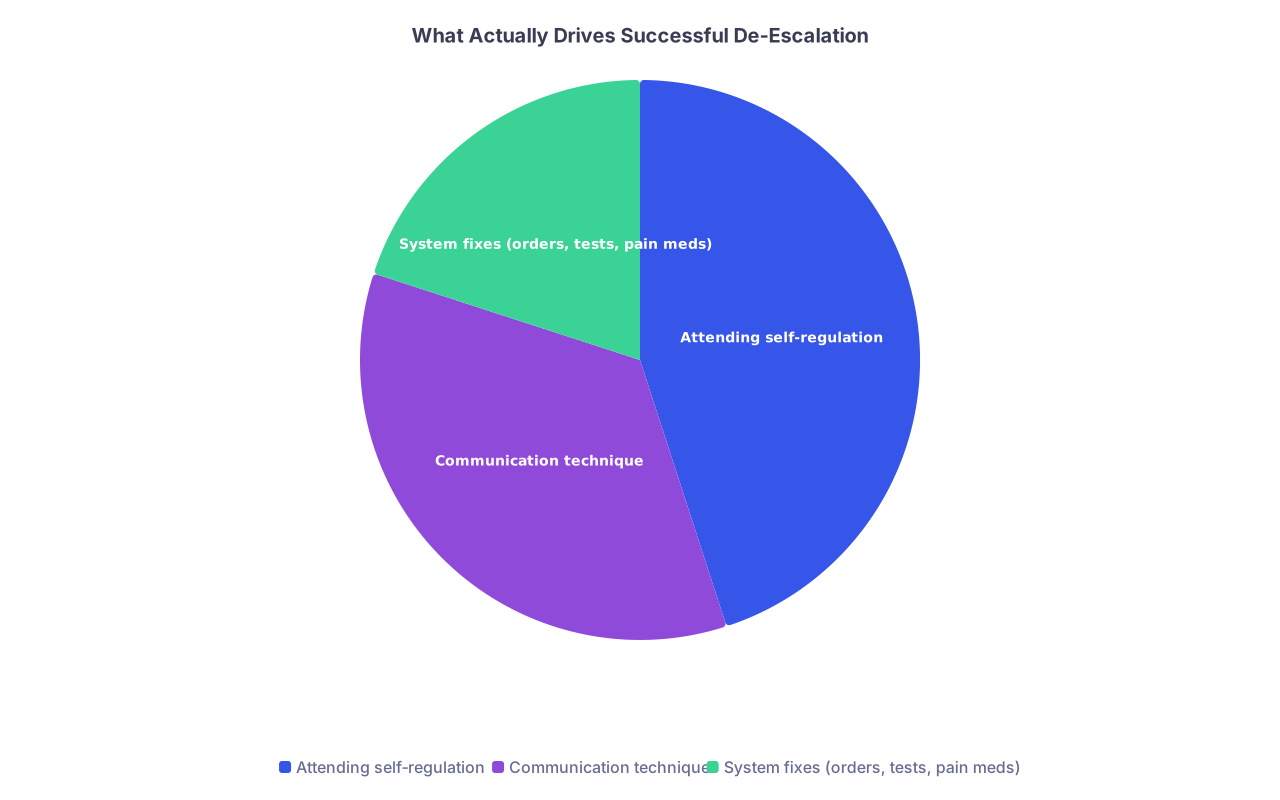
| Category | Value |
|---|---|
| Attending self‑regulation | 45 |
| Communication technique | 35 |
| System fixes (orders, tests, pain meds) | 20 |
The good ones know: if they walk in dysregulated—annoyed, rushed, defensive—it leaks into every word, every micro‑expression. The patient picks it up and escalates more. You’ve seen this: the attending who walks in with clipped phrases and tight jaw, and five minutes later security is hovering in the hallway.
The mindful attending does three things before they even touch the curtain.
Move One: Regulating Themselves Before They Step In
Watch a genuinely good attending when they’re paged about an “angry patient in 14.” If you really watch, you’ll catch these micro‑behaviors they never talk about.
They pause before walking in. Literally one or two seconds. That tiny beat is intentional.
I’ve watched an ICU attending at 2 a.m. outside a room: hand on the door handle, brief exhale, shoulders drop a fraction, gaze steadies. Then they walk in. That is mindfulness in the wild.
What are they doing in that beat?
They’re shifting from reactivity to agency. Often with some very simple, practiced moves:
Name their own state.
“I’m annoyed and tired.” Not poetic. Just real. Mindful attendings do not pretend they’re serene saints. They acknowledge the irritation so it doesn’t drive the bus.Set an intention.
A quiet, specific one: “Aim: safety and calm, not winning a debate.” Or, “My job is to listen for three minutes before I fix anything.” Intention changes tone more than any script you memorize.Do a micro‑reset.
A four‑second breath cycle, grounding through their feet, softening their jaw. You will never see it as “a technique,” but you’ll see the effect: they’re slower, heavier in the room, less twitchy.
I’ve heard faculty talk about this only in burnout workshops, never on rounds. But I watch them do it in front of doors. Every. Single. Day.
If you skip this step and go straight to “Use empathic statements,” you will sound fake and patients will smell it.
Move Two: How They Enter the Room (This Part Matters More Than Their Words)
Students obsess over wording. Attendings obsess over stance.
Watch how a mindful attending physically enters an angry room. You’ll notice:
They do not swoop in at full speed with a chirpy “What’s going on in here?” They also don’t creep in looking scared. Both of those inflame things.
Instead, three boring but powerful things:
Body position.
They get to the patient’s eye level or lower if they can. Chair, stool, even leaning on the counter. Towering over an angry person is a rookie mistake. It feels like confrontation, not care.Angle, not head‑on.
They almost never stand directly squared‑off at the foot of the bed like they’re arguing at a podium. Slightly to the side, body angled, hands visible, not clenched. It signals, “I’m here with you, not against you.”They use the person’s name early.
“Mr. Reyes, I’m Dr. ___, one of the attendings tonight.” Name first, title second. It grounds the interaction in relationship, not hierarchy.
You’ll never see this in a communication skills OSCE rubric, but attendings talk about it to each other: “If you walk in like a cop making a traffic stop, don’t be surprised when the room goes sideways.”
Move Three: The First 30 Seconds of Speech
This is where the “mindfulness” piece and the “de‑escalation” piece actually meet.
The mistake almost every trainee makes: they start explaining. Or defending. Or apologizing so much they lose credibility.
Here’s what seasoned attendings actually do with those first 30 seconds.
1. They validate the emotion, not the accusation
Patient: “You people do not care. I’ve been abandoned in here.”
Weak response: “We do care, sir, we’re just very busy.” (This sounds like arguing with their perception.)
Mindful attending response usually sounds like this:
“Mr. Reyes, looking at your face right now, I can see how fed up you are. Sitting here this long, in pain, and not getting clear answers yet—that would absolutely make me angry too.”
Notice:
- They don’t take the bait of “you don’t care.”
- They don’t rush to defend the team.
- They name what they see: “fed up,” “angry,” “sitting here this long, in pain.”
Behind the scenes, they’re doing something very mindful: they’re staying in direct sensory reality. Face. Voice. Situation. That keeps their own nervous system from jumping into shame/defensiveness.
2. They slow their speech deliberately
This is subtle but deadly effective. When the room is hot, the mindful attending’s voice drops half an octave, pace slows 20–30%. Almost like they’re dragging the whole conversation through sand.
This is not just “good bedside manner.” It’s nervous system co‑regulation. The human brain unconsciously syncs to the slowest, most grounded signal in the room—if it feels safe. A mindful attending uses their voice and pace as the anchor.
3. They ask for the story, but with a frame
Not: “So what seems to be the problem?” (Too broad, sounds like “justify your anger.”)
More like:
“Can you walk me through what’s felt the worst about today from your perspective? I want to hear it in your words.”
Or when they’re really hot:
“Tell me the thing that is making you most angry right now, so I don’t miss it.”
That word “most” is key. It narrows the firehose into something you can actually address.
What You Don’t See: Their Internal Dialogue While the Patient Rants
When a patient is unloading—voice raised, maybe swearing—most trainees dissociate or mount a defense in their head. Mindful attendings run a very different internal script.
I’ve asked them directly in debriefs. The honest ones admit things like:
“I repeat in my head: ‘This is not about me. This is not about me.’ Even if they say my name.”
Or:
“I listen like a detective: what’s the fear under the anger? Abandonment? Loss of control? Pain?”
That’s a mindful stance: seeing anger as a signal, not a personal attack. It lets them do something calm but radical: get curious instead of getting offended.
Here’s what they’re scanning for while nodding and letting the patient vent:
- Are there safety risks here? Weapons, intoxication, psychosis?
- Is the anger specific (“no one updated me”) or global (“this whole place is corrupt”)?
- What’s the primary unmet need? Information, physical comfort, respect, control?
They’re not “just listening.” They’re sorting the data in real time.

The Pivot: How Mindful Attendings Turn the Corner
There is always a turning point, if things are going well. The energy drops from “attack” to “engagement.” A phrase lands. The patient sighs instead of yelling. This is where less experienced people rush to fix everything at once and lose it again.
Mindful attendings make a very deliberate pivot that usually has three parts.
1. They summarize—briefly—but emphasize understanding
Not the robotic: “So what I’m hearing is…” That’s therapy parody. Patients hate it when it’s done badly.
Good attendings will do something like:
“Let me see if I’ve got this straight. You came in at 5 p.m., you’ve been in pain, you were told a CT was coming ‘soon’ twice, and no one has sat down to explain where things actually stand. That’s the part that feels like we don’t care. Did I miss anything big?”
If the patient says, “Yeah, that’s exactly it,” your odds of successful de‑escalation just shot up. Feeling accurately understood is a pressure valve.
2. They take a small, specific piece of responsibility
This is where ethics and self‑protection clash. You’ve been taught (sometimes explicitly) not to “admit fault” because of litigation. Here’s what experienced, mindful attendings actually do:
They take responsibility for process, not outcome.
“I am sorry that we haven’t given you a clear update. That’s on us, and I’m going to fix that part right now.”
Notice they didn’t say “Sorry your CT is delayed because we screwed up.” They apologized for the gap that’s fueling the anger: communication and respect. Completely ethical. Extremely effective.
3. They offer one clear next step, not a grand plan
Early in training, people overpromise: “We’re going to get this CT done asap, talk to the surgeon, and get your pain under control.”
Experienced attendings have learned the hard way: broken promises create more rage.
Instead, they’ll say:
“Here’s what I can do in the next 10 minutes: I’m going to look at your chart myself, check where the CT is in the queue, and come back to tell you straight where things really stand—even if it’s not what either of us wants to hear. Does that sound fair enough for right now?”
That phrase “for right now” is the quiet trick. It shrinks the patient’s time horizon. You’re not fixing their entire hospital experience. You’re stabilizing the next slice of time.
The Stuff They Do Not Do (And You Should Stop Doing Too)
Here’s where I’ll be blunt. I’ve watched residents and junior attendings destroy a salvageable situation in under 30 seconds with a few poisonous habits.
Mindful attendings avoid these like the plague:
Arguing with feelings.
“We do care about you.”
“You’re not being abandoned.”
It does not matter if you are factually correct. You will lose.Weaponizing policy.
“Well, that’s just hospital policy.”
Translation in the patient’s head: “We hide behind red tape.” Mindful attendings might mention policy, but framed as, “Here’s the box I’m working inside, and here’s what I can do within it.”Subtle condescension.
“You have to understand…”
“You need to calm down so I can help you.”
That last one is almost guaranteed to escalate things. Any version of “calm down” is gasoline. A mindful attending might say instead, “I want to help, and I know it’s hard to talk when we’re both heated. Let’s both take a second.”Triangulating staff.
Throwing nurses, techs, or the system under the bus to placate the patient. “They should have told you.” Mindful attendings do not do this. It might win you one patient and lose you a unit of nurses for the rest of your rotation.
| Bad Phrase | Better Alternative |
|---|---|
| "You need to calm down." | "I can see how upset you are. Let’s slow down so I don’t miss anything important." |
| "That’s just hospital policy." | "Here’s the rule I’m working with, and here’s what I can do within it." |
| "We’re doing our best, okay?" | "I know this has felt like not enough. Let me show you exactly what has been done and what is next." |
| "You’re overreacting." | "Given what you’ve been through today, this feels huge. Help me see it from your side." |
| "If you keep yelling, I’m leaving." | "I want to keep working with you. I can do that as long as we both keep this safe." |
The Quiet Role of Ethics and Boundaries
Mindfulness does not mean being a doormat.
Some angry patients are scared, exhausted human beings who will respond quickly to respectful attention. Some are abusive. Some are intoxicated, psychotic, or dangerous.
Mindful attendings recognize two separate questions:
- Can I empathize with what created this anger?
- Is their current behavior acceptable in this shared space?
Those are not the same question. You can say, “Given what’s happened, I get why you’re furious,” and also say, “But I will not let you scream at my nurse and call her names.”
The best attendings draw boundaries clearly, early, and calmly.
A very common script I’ve heard:
“I am here to help you, and I will stay in this room as long as we can talk in a way that’s safe for you and my staff. That means no threats, no name‑calling. If that starts happening again, I’ll need to step out and bring security in. I don’t want to do that. Are you willing to work with me on that?”
Notice:
- They’re explicit about behavior, not character.
- They tie the boundary to safety, not ego.
- They give the patient a chance to agree to terms.
That is ethical. That is mindful. There’s no pretense that “mindfulness” means you absorb endless abuse.
Training Yourself: How to Build This Before You’re “The Attending”
You’re probably thinking, “Okay, but how am I supposed to do all this while drowning in notes and pages?” Here’s the unsentimental answer: the people who handle angry patients well didn’t start learning on day one as attendings. They practiced in smaller, lower‑risk moments.
You can do the same.
Practice on the micro‑annoyances
- When a family member stops you in the hall and says, “We never see a doctor,” notice your spike of anger. Name it. Breathe once. Then answer.
- When a patient snaps, “You’re the third person I’ve told this to,” internally say, “This is not about me,” and get curious: what’s their real fear?
Steal 10 seconds before entering tense rooms
Even as a student, you can pause at the doorway. One exhale. One sentence of intention: “Listen first, fix later.” You will feel the difference in your body. So will the room.
Debrief with the right people
After a bad encounter, don’t just complain to your co‑interns. Ask the attending who handled it well:
“What were you thinking when he started yelling?”
“How did you decide when to draw the line?”
Most will be shockingly honest if you ask like a peer, not a worshipper.

| Step | Description |
|---|---|
| Step 1 | Page about angry patient |
| Step 2 | Brief pause at door |
| Step 3 | Name own state and set intention |
| Step 4 | Enter at eye level, calm body |
| Step 5 | Validate emotion and listen |
| Step 6 | Identify core fear or need |
| Step 7 | Summarize and take limited responsibility |
| Step 8 | Offer clear next step and boundary if needed |
| Step 9 | Follow through and close the loop |
This is the real map. It’s not fancy, but if you walk these steps on purpose 50 times, it becomes automatic.
FAQ: What You’re Probably Still Wondering
1. What if I genuinely don’t have time to sit and listen for several minutes?
Then you have to be very clear and honest. “Mr. Reyes, I have two minutes right now, then I need to get to an emergency next door. I don’t want to ignore your frustration, so in those two minutes, tell me the part that is bothering you the most. After I stabilize the other patient, I’ll send either myself or my senior back to talk more.” Patients hate being blown off. They tolerate limited time when you name it and keep your promise.
2. What if the patient is wrong about the facts and keeps insisting on something false?
Correcting them head‑on while they’re angry is usually useless. First stabilize the emotion: “I can hear how strongly you feel about that.” Once things cool a bit, you can say, “There’s a piece there I see differently based on your labs and scans. Want me to walk you through what I’m seeing?” Facts land better on calm soil.
3. How do I stay mindful when a patient is personally insulting me or my team?
You anchor in two things: your values and your boundaries. Internally: “My job is to act in line with my values, not their mood.” Out loud: “I want to keep helping you, but personal insults toward my staff are not okay. We can be upset and still be respectful. If that can’t happen, I’ll need to step out and come back later with security.” Then follow through. Mindfulness without boundaries is just self‑betrayal.
4. Are there patients you just cannot de‑escalate?
Yes. Intoxication, certain psychotic states, severe personality pathology—sometimes the anger is not responsive to any amount of validation. Mindful attendings recognize when the interaction is no longer therapeutic and shift the goal from “make them like us” to “keep everyone safe and complete medically necessary care.” That might mean security presence, IM meds, or a very firm limit on interaction length.
5. How does this connect to burnout and moral injury? It just sounds like more emotional labor.
Done poorly, it is. Done well, mindful de‑escalation actually protects you. When you see angry outbursts as data—about fear, pain, a broken system—rather than as personal attacks, you stop carrying them home in the same way. Drawing clear, calm boundaries also prevents the “I let people walk all over me” resentment that fuels burnout. The attendings who last are rarely the ones who harden; they’re the ones who stay soft on the inside, clear on the outside, and refuse to confuse their worth with a patient’s worst five minutes.
Key points to keep in your pocket:
- The real work of de‑escalation starts before you open the door: regulate yourself, set an intention, and walk in like an anchor, not a victim.
- Validate the emotion, take small process‑level responsibility, offer one concrete next step, and draw boundaries without drama.
- Practice this on the small encounters now, so that when you are the attending they call into the burning room, you can mean it when you say, “I’ve got this.”