
It’s 6:45 a.m. You’re on nights, you haven’t really slept, and the charge nurse just told you the daughter of the intubated, DNR-CCA patient is demanding “everything” be done, now that her brother is on his way from out of state. The attending is scrubbed in a case. The ICU team is annoyed. The primary nurse is almost in tears. Someone says the words that change the room’s temperature:
“We should probably call ethics.”
You feel that twist in your stomach. Because you know how this goes. You present the case, you try to sound reasonable, and somewhere in there you can feel it: they’re not just judging the case. They’re judging you.
Let me tell you what’s really happening in that room and what ethics committees quietly expect when they talk about a “mindful” physician in difficult cases. It’s not yoga, and it’s not wellness posters. It’s something much sharper and far more practical.
What “Mindful” Actually Signals to an Ethics Committee
In behind-the-door conversations, “mindful physician” has become shorthand for something like this:
“Is this doctor self-aware enough not to make a mess of this case?”
Ethics committees don’t care if you meditate at 5 a.m. They care about whether, when the situation is ugly, you show certain reliable behaviors:
- You can slow down your reactivity under pressure.
- You can separate your own fears, frustration, and moral distress from the actual clinical and ethical questions.
- You can listen to patients and families without needing to win.
- You can tolerate uncertainty without reaching for defensive medicine or rigid dogma.
- You tell the truth, including when it reflects badly on you or your team.
That’s what “mindful” means in practice to people who sit on ethics committees.
They’ve watched hundreds of cases. They know the patterns. They can spot within minutes whether you’ve done any internal work or you’re just showing up with a white coat and a brittle ego.
Let’s break down what they look for.
1. They Expect You to Know Your Own Triggers
You walk into an ethics consult and start with: “The family is being unreasonable.”
An experienced ethics chair hears something very different: “This physician is already escalated.”
Mindful in this context means you’ve done enough internal inventory to know where you’re likely to lose your grip.
I’ve sat in meetings where surgeons fall apart the moment someone suggests “futile” care, because they hear it as failure. I’ve watched palliative docs bristle when a family wants to “keep fighting,” because it feels like a rejection of everything they value about good deaths. I’ve seen residents shut down completely the second someone mentions “resource allocation.”
The ethics committee is quietly asking: does this physician know what’s happening inside their own head?
So they listen for phrases like:
- “I’ll be honest, I’m finding myself really frustrated because…”
- “Part of my reaction here is that I feel we’ve caused some of this by…”
- “I’m aware I feel strongly about X because of prior cases. I don’t want that to cloud this one.”
That doesn’t make you look weak. It makes you look trustworthy.
The nightmare for ethics committees is the physician who insists they’re “just being objective” when everyone in the room can feel the anger, fear, or guilt leaking out of their words.
The unspoken rubric: self-awareness is not optional in hard cases. If you can’t describe your own emotional state, they assume your judgment is compromised.
2. They Expect You to Have Actually Listened Before You Called Them
Let me be blunt. Ethics committees hate being used as “the bad cop” because no one on the team took the time to have real conversations.
The pattern is always the same:
- Fragmented communication.
- Mixed messages from different physicians.
- The family gets confused, then angry.
- Someone throws up their hands and says, “Call ethics.”
A mindful physician doesn’t do that. They don’t outsource basic human conversations.
When committees review charts, they look for evidence of genuine engagement:
- Did you sit down with the family more than once?
- Are your notes copy-pasted clichés, or are there specific quotes and clear documentation of evolving understanding?
- Is there consistency in what the team is saying, or is neurology promising miracles while medicine is charting “terminal decline”?
And then they ask you specific questions:
“Tell us exactly what you told the son about prognosis.” “What did the patient say in their own words, when they were still able to speak?” “When the family said they wanted ‘everything done,’ what did you clarify that to mean?”
An unmindful physician says: “I told them the situation was grave and that we recommend comfort care.” Full stop.
A mindful physician says something more like:
“I told them that even with maximal support, we’re not expecting him to regain meaningful independence or be off the ventilator. I clarified that ‘everything’ might mean dying while attached to machines rather than at home, which they initially hadn’t realized.”
That’s the difference. Specific, careful, reality-based communication versus vague medical euphemisms.
Ethics committees expect you to have exhausted your relational tools before you escalate.
If your first real conversation with the family is happening in front of the committee, you already look negligent.
3. They Expect You to Separate Values Disagreement From Ethics Violation
This one trips up a lot of well-meaning, “ethical” physicians.
You might think something like: “Continuing dialysis in this demented, bedbound 92-year-old is wrong, borderline cruel. I need ethics to stop this.”
What the committee hears is: “I disagree with the family’s values and want backup.”
A mindful physician learns to distinguish:
- “I strongly disagree with this choice”
from - “This choice is ethically impermissible.”
Those are not the same.
Ethics committees are not there to enforce your personal vision of a good life or a good death. They’re there to protect basic principles: autonomy, beneficence, non-maleficence, justice, and professional integrity.
They expect you to arrive having done a certain kind of mental hygiene:
“I find this plan morally troubling for me, but I recognize that under this patient’s stated values, it might be consistent.”
or
“I am concerned that continuing this treatment crosses into non-beneficial, bordering on harmful, and may compromise my professional integrity. I need help clarifying where that line is.”
That’s a mindful framing.
The unmindful version is moral absolutism: “This is wrong. Period.”
Here’s the part no one tells you: Ethics committees often are not judging the family as much as they’re judging whether you can sit with moral distress without trying to force everyone else to adopt your solution.
They respect physicians who can tolerate value conflict and ask:
“What’s ethically permissible here, even if it’s not what I’d personally choose?”
4. They Expect Intellectual Humility, Not Ethical Theater
Some of the least trusted physicians in ethics meetings are the ones who arrive with pre-packaged bioethics jargon and rigid positions from a podcast or a CME module.
They walk in quoting “futility,” “double effect,” “slippery slopes,” like they’re building a legal brief. That might impress a first-year med student. It does not impress a seasoned ethics committee.
What they want instead is your honest uncertainty.
Mindful physicians say things like:
- “Here’s where I’m torn.”
- “Clinically, we can do X. Ethically, I’m not sure whether we should.”
- “Part of me worries I’m overreacting based on a bad outcome I had last year.”
You know why that plays so well in the room? Because it tells the committee you’re actually thinking, not just defending a position.

Behind closed doors, committee members talk like this:
“I can work with someone who admits they’re stuck. I can’t work with someone who’s already decided and just wants us to rubber-stamp it.”
Mindful doesn’t mean spineless. It means you’re clear about what you know, what you don’t, and where your expertise ends.
A surprisingly powerful sentence:
“Here’s what’s medically possible. Here’s what I think is medically reasonable. And here’s where I’m out of my depth on the ethical dimension and need your help.”
That earns respect. Every time.
5. They Expect You to Know the Patient as a Person, Not a Physiology
This is where mindfulness overlaps with something ethics committees almost never say explicitly: they’re checking if you see patients as humans when things get hard.
Look at your own presentations in tough cases. Do they sound like this?
“Eighty-year-old male with multiorgan failure, metastatic cancer, intubated, oliguric, 3 pressors, poor prognosis.”
or like this:
“Mr. S is an 80-year-old former mechanic who’s been very clear with his wife in the past that he never wanted to be dependent on machines long-term. He’s now in multiorgan failure…”
The difference is not sentimental. It’s ethical.
Committees expect you to be the steward of the patient’s story, not just their physiology.
Mindful physicians come to ethics with:
- Prior documented goals-of-care discussions, even brief ones.
- Details about what mattered to the patient before they got sick.
- Concrete statements: “He told his daughter last year, ‘Don’t leave me on machines forever.’”
You’d be shocked how many ethics consults open with: “We don’t really know what she would have wanted,” followed by, “She was actually on hospice for a year but we never really talked about it.”
That’s the kind of thing that, in post-meeting debriefs, gets labeled as a failure of the treating team, not an inevitable mystery.
The unspoken expectation:
If you’re going to involve ethics, you should have at least tried to understand who this person is, not just how their organs are failing.
6. They Expect You to Manage Team Dynamics, Not Escalate the Drama
Here’s one of the most uncomfortable truths:
Half of “ethics cases” are not really about ethics. They’re about dysfunctional teams.
I’ve seen “ethics consults” where:
- The intensivist is furious with the oncologist for “dumping” the patient.
- The primary team feels the surgeon is being a cowboy.
- The bedside nurses feel no one is being honest with the family.
- Everyone is hoping ethics will take a side.
A mindful physician recognizes when the real issue isn’t the family’s decision, it’s the team’s inability to talk to each other like adults.
What committees expect from a mindful physician:
- You’ve talked to your colleagues before the meeting and aligned on the facts.
- You avoid ambushing anyone in the room.
- You don’t use ethics to “win” a turf war.
They pay very close attention to whether you throw colleagues under the bus:
“Well, cardiology keeps promising they can ‘fix the heart’ so that’s part of the problem…”
versus
“There have been mixed messages from different teams, and I’m partly responsible for that. We need help creating a unified message.”
Guess who gets invited back as a trusted voice in the next tough case?
Not the physician who grandstands. The one who takes some responsibility and looks for repair, not blame.
7. They Expect You to Own Your Part of the Story
Here’s something you almost never see written in any ethics handbook, but you hear all the time in post-case reviews:
“If they had just admitted earlier that we’d over-treated or miscommunicated, this might have de-escalated.”
Mindful physicians can tolerate saying things like:
“I think we unintentionally set unrealistic expectations when we talked about prognosis earlier.” “I should have called a family meeting three days ago, and I didn’t. That’s on me.” “In hindsight, we may have crossed into non-beneficial treatment already. I’m uncomfortable with that, and I’d like help redirecting.”
That takes ego strength. And ethics committees notice. They actually relax when they hear that kind of language, because it means they’re not dealing with pure defensiveness.
Unmindful physicians rewrite history on the fly:
- “We’ve always been clear there was no chance of recovery.”
- “The family was told from the beginning this was terminal.”
- “We never promised anything.”
Except the chart doesn’t support that. Or the nurses remember very different conversations.
You want to look like a “mindful physician” in front of ethics? Be willing to admit error and complicity in how the situation evolved. Not theatrically, not to self-flagellate. Just honestly.
Committees are not looking for perfection. They’re looking for integrity.
8. They Expect You to Tolerate Silence and Emotion Without Panicking
Here’s a skill no one teaches in residency, but every ethics committee watches for: can you let a room breathe?
Most physicians in high-stakes family meetings do the same thing: they fill every silence with more data, more words, more reassurance or more pressure. It comes from discomfort.
Mindfulness shows up in your ability to:
- Say something hard.
- Shut up.
- Let the silence sit while the family absorbs it.
I’ve watched family meetings where the most ethically useful “intervention” was a physician saying:
“I’m going to stop for a moment because I said a lot. What questions do you have? Or just… how does that land with you?”
Then they actually sit. Not check their pager. Not stare at the floor. Just be there.

Ethics committees expect you to be able to presence grief, anger, even hostility—without reflexively escalating to “they’re unreasonable.”
A mindful physician knows: people yelling in crisis are not automatically asking for inappropriate care. They’re often reacting to shock, abandonment, or confusion.
So instead of going straight to, “They’re demanding things outside standard of care,” you might say:
“They’re very upset and expressing that as anger. I’m struggling to know how to respond constructively. I’d like help.”
Again, that’s the mindset that gets taken seriously.
9. They Expect You to Know the Line: What You Will and Won’t Do
Mindfulness is not endless flexibility. There’s a hard edge to it that ethics committees respect.
They want to see that you can:
- Recognize when a requested treatment is outside the bounds of acceptable practice.
- Articulate why in plain language.
- Stand your ground without contempt.
The unspoken fear of ethics committees is the physician who will do anything to avoid conflict:
- Keep dialyzing indefinitely.
- Keep transfusing without indication.
- Keep shocking a patient with no realistic chance of recovery.
All because no one wants to say “no.”
A mindful physician works toward clarity like this:
“Medically, we are at the point where continuing chest compressions would only cause trauma without any realistic chance of restoring meaningful life. I cannot, in good conscience, offer that as a treatment option. We can still focus on his comfort and being with him.”
Ethics committees expect you to know where your professional boundaries are before you walk into the room. They can help you articulate them. They cannot supply courage.
Behind the scenes, when they say “mindful physician,” part of what they mean is “someone who can face families honestly with both compassion and limits.”
10. They Expect You to Learn From Hard Cases, Not Just Survive Them
Here’s the real test, and it doesn’t happen in the meeting itself. It happens three weeks later, or during M&M, or in the next borderline case.
Do you change?
Ethics committees pay attention to patterns:
- Are you always calling them for the same type of case?
- Do your notes and conversations get more precise over time?
- Are you involving palliative care earlier, documenting values earlier, aligning your team earlier?
A mindful physician treats each hard case as data about their own practice:
“What did I miss early?” “Where did my bias push me?” “How could I structure my communication differently next time?”
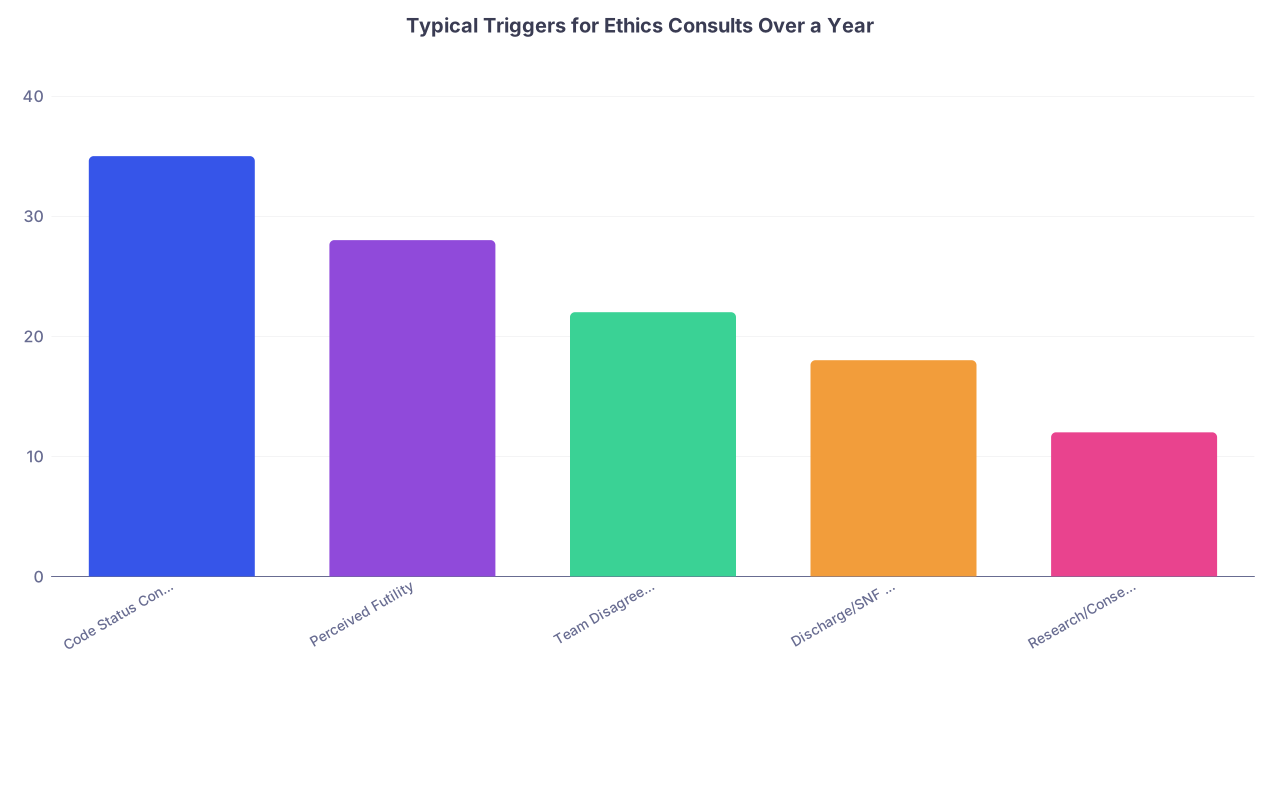
| Category | Value |
|---|---|
| Code Status Conflict | 35 |
| Perceived Futility | 28 |
| Team Disagreement | 22 |
| Discharge/SNF Placement | 18 |
| Research/Consent Issues | 12 |
In private, ethics folks will say things like:
“She’s tough but she grows. Every time she comes back, she’s done her homework.” “He’s stuck. Every case looks the same to him: unreasonable family, nothing to learn.”
Guess which one ends up getting leadership roles, getting asked to sit on the committee, getting trusted with the truly ugly situations?
Mindfulness in this context is longitudinal. It’s not a ten-minute breathing exercise before the family meeting. It’s who you’re becoming case after case.
What This Looks Like in Real Life: A Before and After
Let me give you a concrete contrast, because I’ve seen this almost beat-for-beat.
Case: 72-year-old with advanced dementia, intubated after massive aspiration, now with ARDS, on max support. Prognosis extremely poor for meaningful recovery. Family insists on “no giving up.”
Version 1: The Unmindful Approach
The resident presents to ethics:
“Family is demanding everything. We’ve explained he’s going to die no matter what. They’re unrealistic. We need ethics to declare this futile so we can withdraw.”
In the meeting, the resident:
- Minimizes prior lack of communication.
- Blames the family’s “denial.”
- Talks almost exclusively in vent settings and mortality percentages.
- Gets defensive when someone asks, “What did you tell them early on?”
The committee leaves with:
- Low trust in the team’s communication.
- Morally injured nurses.
- Family feeling attacked by “the ethics people.”
- No one satisfied.
Version 2: The Mindful Approach
Same case. Different physician.
Presentation sounds like this:
“This is Mr. R, 72, with baseline moderate to severe dementia, now in ARDS after aspiration. I want to own that we did not have a good goals-of-care conversation on admission. We were in crisis mode, and I think we set some unrealistic expectations.
Since then, multiple team members have told the family different things. They’re understandably clinging to the most hopeful version. I feel morally distressed because we’ve crossed into treatments that I believe are causing more suffering than benefit, but I also feel guilty because we helped create the confusion.
I’ve told the family I worry we’re now prolonging dying, not life. They hear that as us ‘giving up.’ I need help untangling my own distress from what’s ethically permissible here, and I’d like support in structuring the next family meeting.”
Same committee. Entirely different response.
The physician:
- Admits communication failures.
- Names their own moral distress clearly.
- Distinguishes “I would not choose this” from “this is ethically impossible.”
- Asks for guidance rather than a verdict.
That’s what ethics committees quietly mean when they say, afterward, “She’s a very mindful physician.”
Where You Go From Here
You’re not going to transform into some perfectly centered, ethically enlightened clinician overnight. That’s not the point.
What you can do is start with three concrete shifts in your next hard case:
- Before you call ethics, ask yourself: “What am I feeling, and how might that be shaping my judgment?” Name it—at least to yourself, ideally to the committee.
- Make sure you’ve sat down with the family at least once with full attention, without rushing, and documented that conversation with actual quotes, not clichés.
- Walk into any ethics interaction ready to say one honest, unpolished sentence that admits uncertainty or error.
From there, you build. Case by case. Meeting by meeting. You’ll start to recognize the patterns sooner, to repair communication earlier, to feel your own triggers before they hijack you.

| Step | Description |
|---|---|
| Step 1 | Hard Case Arises |
| Step 2 | Notice Emotional Reaction |
| Step 3 | Engage Family in Real Conversation |
| Step 4 | Align Team and Clarify Facts |
| Step 5 | Decide if Ethics Help is Needed |
| Step 6 | Present Honestly with Self Awareness |
| Step 7 | Reassess and Continue Communication |
| Step 8 | Implement Recommendations |
| Step 9 | Reflect and Adjust Future Practice |
Eventually, something changes in how people talk about you when you’re not in the room.
Instead of “They always dump things on ethics,” you start hearing, “Call them in—this is tough, and they think clearly about these cases.”
With those foundations, you’re not just surviving ethics consults. You’re becoming the person others look toward when cases get morally ugly and no one wants to be the one to speak first.
And once you can stand in that space—aware, honest, and grounded—then we can talk about the next step: not just participating in ethics discussions, but leading them.
That’s a different level of medicine. And it’s coming faster than you think.