
You are in the call room at 2:30 a.m. You just pronounced a patient, two others are boarding in the ED with no beds, and your pager will not stop. The wellness poster above the microwave says, “Just breathe.” You try a few slow breaths and notice…nothing changes. Your heart is still racing, your jaw still clenched, and you are already rehearsing charting excuses for the morning.
This is where most doctors start thinking, “Maybe mindfulness does not work for me.”
Or worse: “If I were stronger, this would work.”
No. The problem usually is not you. The problem is the way mindfulness gets twisted, rushed, or weaponized in medicine.
Let me walk through the nine most common mindfulness mistakes I see doctors make under pressure—and how to avoid them before they do real damage to you or your patients.
1. Treating Mindfulness as Sedation, Not Awareness
The biggest misunderstanding: using “mindfulness” as a way to numb instead of notice.
You know the move. You are furious at an administrator’s email about RVUs, your face is hot, your chest tight. You tell yourself, “Be mindful,” and then try to force calm. Translation: push the feeling away, act unbothered, get back to work.
That is not mindfulness. That is emotional suppression wearing yoga pants.
Suppression under pressure does three dangerous things:
It blunts your internal warning signals.
Anger, anxiety, dread—these are not moral failures. They are data. They tell you when staffing is unsafe, a discharge is premature, or a clinic schedule is reckless. If you use “mindfulness” to feel less instead of see more, you will miss the signal.It leaks out sideways.
I have watched physicians “mindfully” swallow frustration with a chief, then snap at a nurse 10 minutes later. “I am fine” at 2 p.m. becomes sarcasm in sign-out and numbing with alcohol at 10 p.m.It erodes self-trust.
When you internally say, “I should not feel this,” you are telling your nervous system you are wrong about your own experience. That is the opposite of grounded clinical judgment.
What real mindfulness looks like in a high-pressure moment:
- You notice your body: “My hands are shaking, my throat feels tight.”
- You name the mental event: “This is anger. This is fear. This is shame.”
- You do not force any of it away. You give yourself 15–30 seconds to actually feel it.
And then you ask a quiet, ruthless question: “What is this reaction trying to tell me about the situation?”
Do not make mindfulness a moral sedative. Use it as a diagnostic tool for your own mind.
2. Using Mindfulness to Tolerate the Intolerable
The next trap is more dangerous: using mindfulness to endure abusive or unsafe systems.
I have heard some version of this in multiple hospitals:
- “Residents just need more resilience training.”
- “Have you tried meditation for your burnout?”
- “We are offering a 6 a.m. yoga class before your 28-hour call.”
Read that again. Before your 28-hour call.
When mindfulness becomes a way to shoehorn a human into an inhuman system, something has gone very wrong.
Here is the line you must not cross:
If mindfulness is making you more accepting of conditions that violate either:
- basic safety (patient or personal), or
- your core ethical standards
…then it is being misused.
A few red flags:
- You stay silent about a dangerous policy because “I am learning to accept what I cannot change.”
- You absorb chronic understaffing by stretching yourself thinner, telling yourself you are “just being present.”
- You override your impulse to speak up about racism, sexism, or bullying because you want to “stay centered.”
That is not equanimity. That is complicity dressed up as spiritual growth.
Mindfulness should sharpen your ethical perception, not dull it. If you become more aware and stable, you will often feel more discomfort about bad systems, not less. That discomfort is not a problem to be meditated away. It is a prompt for action, even if the action is small: documenting, speaking up, refusing an unsafe assignment.
Do not let anyone sell you mindfulness as a way to make exploitation feel more palatable.
3. Confusing “Nonjudgmental” with “Non-Discerning”
You have heard the phrase: “nonjudgmental awareness.” Then someone in orientation dumbs it down into, “Just do not judge your thoughts or feelings.”
A lot of physicians mishear that as “turn off your inner critic completely” or “accept everything equally.” That is nonsense—and dangerous nonsense in medicine.
Nonjudgmental in mindfulness does not mean:
- All thoughts are equally valid
- All behaviors are equally acceptable
- You never evaluate anything
It means: for a few moments, you stop morally condemning your internal experience. You notice without adding, “I am bad for thinking this” or “I am weak for feeling that.”
But discernment—the ability to see clearly, to discriminate between wise and unwise, safe and unsafe—is non-negotiable in clinical work.
The mistake I see:
- A resident notices dread every time they staff with a particular attending. Instead of asking, “What is happening there?” they decide, “This is just my mind being reactive; do not judge, just breathe through it.” Six months later, they finally name the real issue: that attending regularly humiliates them in front of patients.
Mindfulness should help you see two things:
- “Here is the raw reaction I am having.”
- “Here is the pattern in reality that seems to trigger it.”
You need both. If you stop at #1 and pride yourself on being “nonjudgmental,” you risk ignoring real patterns of harm.
Use mindfulness to reduce self-condemnation. Do not use it to shut off your clinical and ethical judgment.
4. Turning Mindfulness into a Performance for Others
Another common error: mindfulness as branding.
You know the type. The wellness champion who talks constantly about meditation, has a calm voice on rounds, quotes Thich Nhat Hanh in faculty meetings—and then sends scathing emails at midnight, ignores feedback, and blows up when things go off schedule.
Performative mindfulness is worse than no mindfulness at all, because:
- Colleagues stop trusting the whole concept.
- You widen the gap between your image and your actual inner state.
- Patients can sense the inauthenticity, even if they cannot name it.
I have watched program directors proudly mention “we integrate mindfulness” because residents get a 45-minute guided meditation twice a year during didactics. Meanwhile, the culture penalizes anyone who admits emotional distress. That hypocrisy teaches residents one thing: pretend calm, never show weakness.
The personal version of this mistake: you try to look centered rather than be honest.
You say “It is all good, I am staying present” when your stomach is in knots. You adopt a soft voice, slower speech, some kind of Zen persona. That persona then becomes a prison—you cannot drop it without feeling like you are failing at being “the mindful one.”
Better path:
- Practice privately first.
- Share your practice selectively, with people who actually want to know.
- Let others see your edges: “I am trying to stay present, and I am also really angry right now.”
Do not use mindfulness as part of your professional costume. If it is not helping you be more real, it is not working.
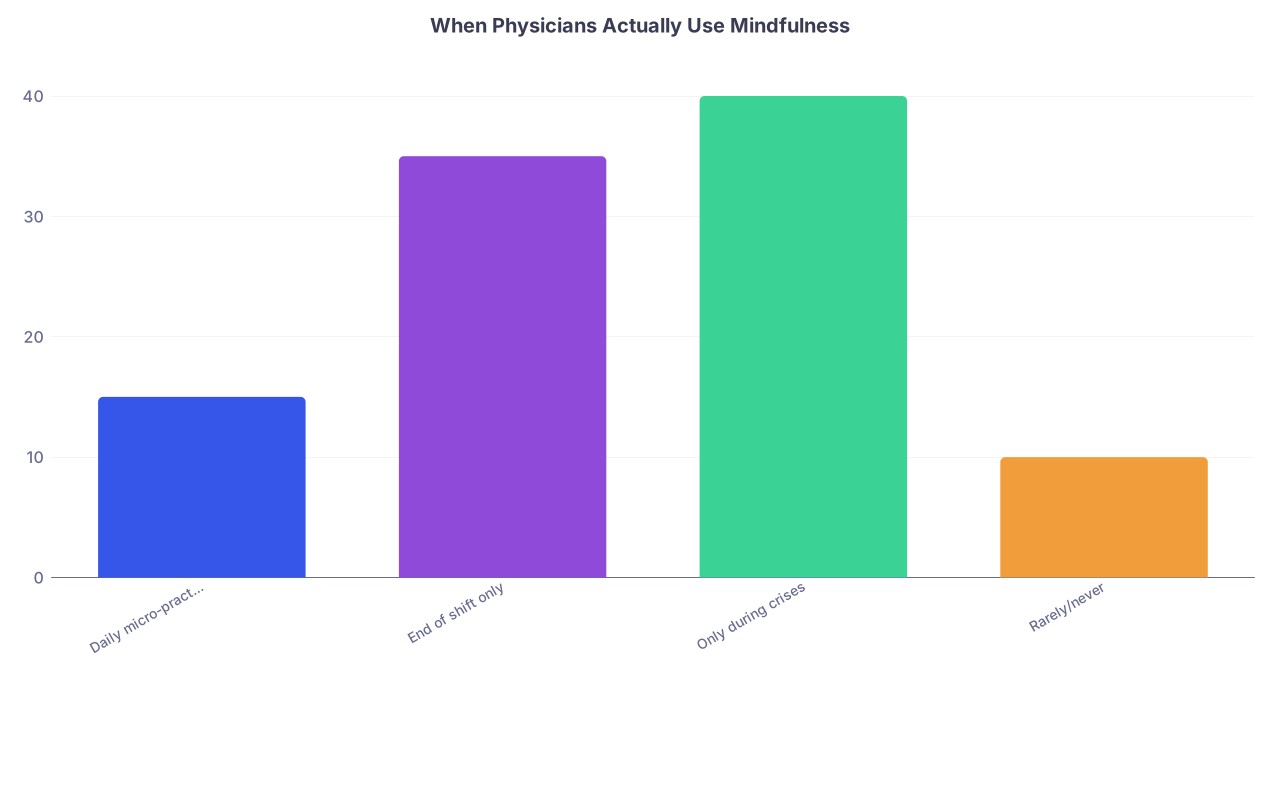
5. Grabbing Mindfulness Only as an Emergency Tool
This one is almost universal: treating mindfulness like adenosine. Only pulled in the crash.
You ignore your body all day, skip meals, never check in with yourself. Then a code goes badly, a complaint lands in your inbox, or you lose a patient you cared about—and now you remember that someone told you to breathe.
By then, your nervous system is already in red alert. It is like trying to learn to swim while you are drowning.
| Category | Value |
|---|---|
| Daily micro-practice | 15 |
| End of shift only | 35 |
| Only during crises | 40 |
| Rarely/never | 10 |
If mindfulness exists in your life only as a crisis patch, you will conclude it “does not work.” Of course it does not. Nothing works well if you only deploy it at maximum intensity with no baseline practice.
Think of it like procedural skills:
- You do not learn central lines during a crashing patient’s arrest.
- You should not first try to use mindful attention mid-complaint meeting with risk management.
The ethical angle here: when your nervous system is chronically maxed out, you are more prone to:
- snap judgments about “difficult” patients,
- defensive medicine,
- documentation that is more about self-protection than clarity.
A minimal, sane practice under pressure might look like:
- 30–60 seconds of deliberate attention before the first patient: feeling your feet, your breath, setting one intention (“Listen more than I talk” is a good start).
- A 10-breath pause before calling a family with bad news.
- A 1–2 minute reset after a code, even if it is in the bathroom stall.
These micro-practices build a habit of checking in so that when the big waves hit, you are not starting from zero.
Do not wait for disaster to “remember” mindfulness.
6. Using Mindfulness to Bypass Guilt and Moral Injury
Here is a darker one. Physicians use mindfulness to feel less bad about things they should feel bad about.
Example I have seen more than once:
A hospitalist discharges an unhoused patient to the street in cold weather. No shelter beds, no placement, social work exhausted every option. The doc feels awful. Then they think, “I am ruminating. I should be more accepting. I did my best.”
Sometimes that is true. Often it is not the whole story.
There are three layers here:
- Real limits. You truly did what was possible in a broken system.
- Your own contribution. Maybe you did rush the encounter, did not push as hard with admin, did not call that extra resource.
- Systemic harm. Even when you did your best, the outcome is ethically disturbing.
Mindfulness gets misused at layer 2 and 3. Instead of letting guilt sharpen your understanding and maybe your advocacy, you meditate to “let it go.” You turn “non-attachment” into “non-responsibility.”
That is not spiritual. It is anesthesia.
A healthier use of mindfulness here:
- Sit with the discomfort fully.
- Name the different parts: “Part of this is systemic. Part of this is my own choice earlier today. Part of this is grief that I cannot fix this.”
- Then ask, very concretely: “What will I do differently next time, if anything? And what, if anything, will I do outside this encounter (QAPI, advocacy, documentation) so that this pattern is visible?”
Mindfulness should help you metabolize moral pain into clarity and, where possible, action. Not neutralize it to preserve your comfort.
7. Forcing Patients into “Mindfulness” They Did Not Consent To
Another mistake: using mindfulness on your patients without their consent, especially as a subtle way to control them.
You have definitely seen this:
- The “mindful breathing” pushed on a patient who is legitimately furious about a delay or error.
- The chronic pain patient told to “just observe” their pain without adequate medication on board.
- The psychiatric patient whose distress is attributed to “lack of present-moment awareness” instead of trauma, biology, or social determinants.
Sometimes we do this out of helplessness. You have nothing to offer fast enough, so you reach for something. Sometimes it is more defensive: “If I can get them to breathe, maybe they will stop yelling.”
The line you must not cross:
If you are suggesting mindfulness mainly to make your experience of the patient easier, be honest with yourself about that.
There are real ethical concerns here:
- Power dynamics. When a physician suggests something “calming,” many patients will feel pressured to comply, even if it invalidates their anger or grief.
- Blame. “You are still anxious? Are you doing the breathing exercises?”—as if they failed to cure themselves.
- Substitution. Using mindfulness where medication, housing support, safety planning, or analgesia are actually indicated.
If you choose to offer mindfulness-based strategies to patients:
- Frame them as optional tools, not expectations.
- Explicitly validate their emotions first: “Your anger makes sense.”
- Never use mindfulness as a precondition for care (“Try some breathing while you wait another 3 hours in the ED”).
Do not weaponize “calm down and breathe” as a behavioral restraint.
8. Treating Mindfulness as a Lone-Wolf Fix for Systemic Distress
This one blends personal error with institutional gaslighting.
You feel burned out. You blame yourself for not meditating enough, not being “balanced,” not doing enough yoga on your day off. You internalize the idea that if you were really mindful, the schedule, the metrics, and the moral compromises would bother you less.
That is exactly what some systems hope you will believe.
| Context | Misuse of Mindfulness | Healthy Use of Mindfulness |
|---|---|---|
| Burnout | “Fix your resilience” | “Clarify what is unsustainable” |
| Moral distress | “Let go of guilt” | “Listen to what guilt is saying” |
| Systemic problems | “Accept what you cannot change” | “See clearly where change is needed” |
| Difficult colleagues | “Just observe your reaction” | “Name patterns and set boundaries” |
Blaming yourself for not being mindful enough distracts you from legitimate system failures:
- unsafe patient loads,
- EMR-induced insanity,
- chronic understaffing,
- misaligned incentives.
The personal mistake here is buying into the fantasy that inner work alone will fix what is, in part, an outer problem.
Yes, attention training can help you suffer less unnecessarily. It can make you more efficient, less reactive, more grounded. It cannot make it ethically fine to take 16 patients on nights without backup.
The balanced stance:
- Use mindfulness to see clearly what is happening in you.
- Use that clarity to draw honest conclusions about your work environment.
- Refuse the shame script that says if you just meditated more, you would enjoy being chronically exploited.
Do not let mindfulness become a smokescreen for institutional irresponsibility.
9. Skipping Real Training and Expecting Magic
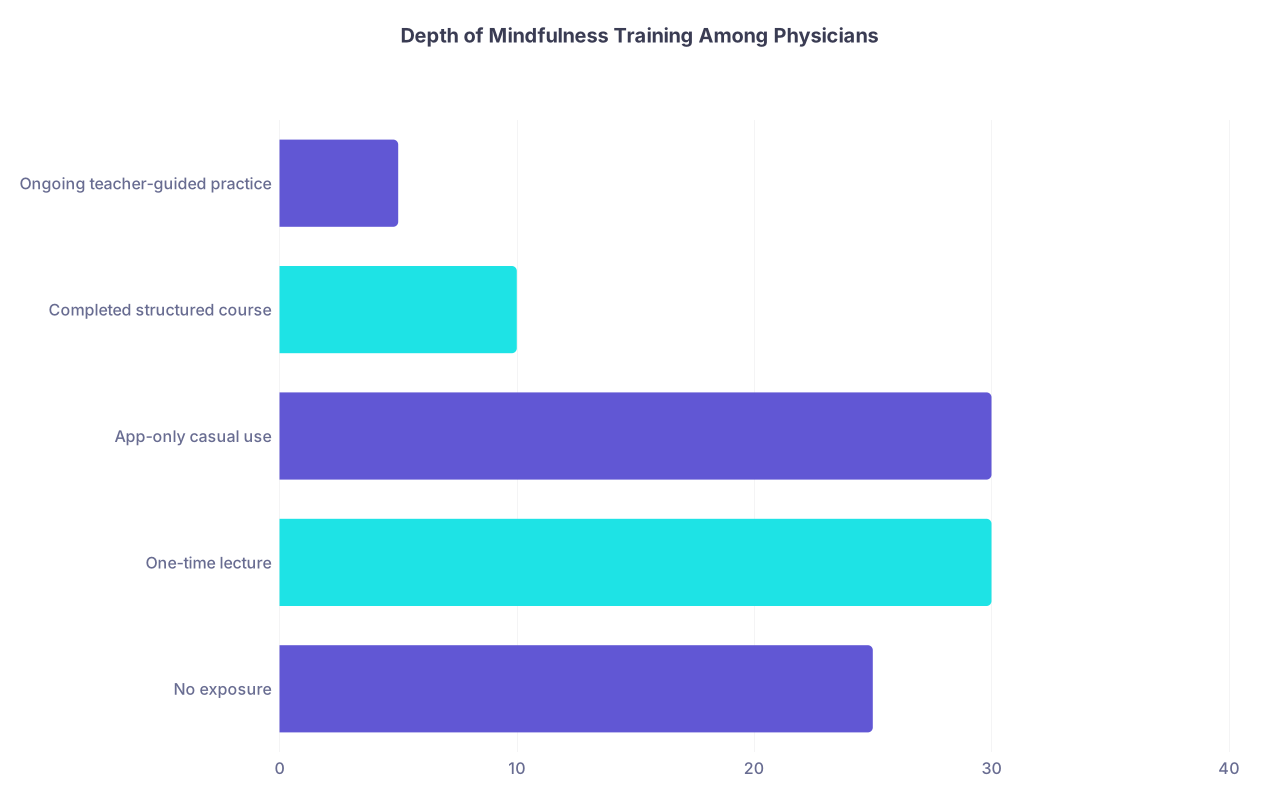
Last one, and it underpins all the others: physicians thinking they can “pick up” mindfulness from a podcast and then deploy it like a new drug.
You would not respect someone who skimmed UpToDate and then declared themselves an expert in your subspecialty. Yet many smart doctors assume that understanding the idea of mindfulness is the same as having a practice.
Common shortcuts:
- A 3-minute app meditation once a month, usually while multitasking.
- Half-listening to a talk on burnout during grand rounds.
- Doing “mindful walking” once, which was really just walking while thinking about email.
Then, when it fails under pressure, the conclusion is, “I guess this just is not for me.”
No. You tried the equivalent of reading a review article and calling it fellowship.
| Category | Value |
|---|---|
| No exposure | 25 |
| One-time lecture | 30 |
| App-only casual use | 30 |
| Completed structured course | 10 |
| Ongoing teacher-guided practice | 5 |
The ethical issue: when you half-learn a powerful psychological tool and then apply it to yourself and others, you can:
- Miss warning signs of worsening distress.
- Overpromise what mindfulness can do for trauma, depression, or psychosis.
- Undermine trust when patients perceive the mismatch between your words and reality.
If you want mindfulness to hold under real clinical pressure, it needs some structure:
- A defined daily or near-daily practice, even if just 5–10 minutes.
- At least one stretch of more immersive training (e.g., an 8-week MBSR course, physician-specific program, or similar).
- Occasional contact with a qualified teacher—someone who can call you out when you are spiritualizing avoidance or bypassing ethical questions.
Think of this as professional responsibility, not self-care fluff. You would not use a powerful medication after skimming an abstract. Do not do that with your own mind.
A Few Practical Guardrails
Let me pull this down into something concrete you can actually use next shift.
First, a simple litmus test for any “mindful” move you make:
- Does this help me see reality more clearly, or does it help me tolerate what I would otherwise question?
- After I practice, am I more honest about my feelings, or more numb?
- Am I using this to connect more fully with patients, colleagues, and my own values—or to shield myself from them?
If the answer keeps landing on “tolerate / numb / shield,” you are off track.
Second, a micro-sequence you can run in under a minute between patients:
- Feel your feet on the ground.
- Take 2–3 slow exhalations, a bit longer than your inhale.
- Ask: “What am I feeling right now, honestly?” (Name one word.)
- Ask: “What does this feeling suggest about what I need or what is happening here?”
- Decide: “Do I need to act on that now, or simply keep it in awareness?”
This keeps mindfulness as awareness-plus-discernment, not just breathing exercises.

| Step | Description |
|---|---|
| Step 1 | Pause 10 to 30 seconds |
| Step 2 | Notice body sensations |
| Step 3 | Name one emotion |
| Step 4 | Consider boundary or action |
| Step 5 | Let pass and refocus |
| Step 6 | Document or speak up |
| Step 7 | Signal of real problem? |
Third, one firm ethical boundary:
Mindfulness should never be used to:
- justify cutting corners on care,
- silence reasonable complaints,
- excuse disrespectful behavior,
- or convince you to accept what violates your values.
If you feel that drift happening—pull back.
Key Takeaways
Mindfulness is not sedation or self-blame. If your “practice” makes you more numb, more tolerant of harm, or more willing to excuse bad systems, you are misusing it.
Under pressure, use mindfulness to increase clarity and ethical discernment, not to bypass anger, guilt, or moral distress. Those emotions often carry critical information.
Do not improvise with half-learned techniques on yourself or your patients. Treat mindfulness like any other powerful tool in medicine: learn it properly, use it honestly, and never let it replace safety, advocacy, or basic human decency.