
It’s 2:37 a.m. You’re in the call room, pager on your chest, half-typed note open on the computer. You open Headspace/Calm/a random YouTube meditation and tell yourself, “I just need to be more mindful. Maybe I’m burning out because I’m not doing mindfulness right.”
You sit. You breathe. Your mind races through:
- “Why am I still thinking?”
- “Good residents don’t feel this resentful.”
- “Maybe if I were more mindful, I wouldn’t be this exhausted.”
You finish the 10 minutes. Nothing feels better. Now you’re not just tired, overworked, and angry—you’re also blaming yourself for not “using mindfulness” correctly.
That’s the trap.
This is where a lot of residents quietly slide into a worse type of burnout, all while dutifully ticking the “wellness” box their program keeps pushing.
Let me be blunt: mindfulness, used badly, can absolutely make your burnout worse. Not better. Worse.
Let’s go through the mistakes that do the most damage—and how to avoid them.
1. Treating Mindfulness as a Fix for a Systemic Problem
The biggest mistake? Thinking your personal meditation practice is supposed to “solve” a toxic system.
Residency is structurally brutal:
- Unsafe ratios
- Chronic understaffing
- Unrealistic documentation loads
- Constant emotional trauma without real debriefing
Then someone from GME stands up at noon conference and says, “We’re implementing a mindfulness initiative to reduce burnout.” Translation you hear: we won’t fix the call schedule, but here’s a breathing app.
How this makes burnout worse
You start to internalize a lie:
“If I were more mindful, I wouldn’t feel this burned out in the same environment everyone else is working in.”
Which quietly flips into:
“If I can’t cope, that’s my personal failure, not a problem with the system.”
That’s psychological gaslighting—self-inflicted, but trained into you.
What actually happens:
- You stop trusting your own distress signals.
- You begin to tolerate worse and worse conditions because you “should be able to handle it.”
- You feel increasingly defective when mindfulness doesn’t “work” on a 28‑hour call with 20 admits and no backup.
Mindfulness is a tool.
Systemic dysfunction is a structural problem.
Do not confuse the two.
How to avoid this
Use mindfulness for you, not for the system.
- Mindfulness = tool for emotional awareness and clarity.
- Leadership = responsible for workload, staffing, schedules, and resources.
A quick rule of thumb:
- If your mindfulness practice brings more clarity about what’s unacceptable and helps you set limits → you’re using it appropriately.
- If your mindfulness practice just helps you continue in clearly harmful conditions without changing anything → you’re misusing it.
2. Using Mindfulness to Suppress Legitimate Emotions
Another subtle mistake: using mindfulness like emotional duct tape.
I’ve seen residents do this repeatedly:
- Angry at an attending who belittled them in front of a patient → “I’ll just breathe through it and let it go.”
- Sick to your stomach about a patient death that nobody debriefed → “I’m just going to observe this feeling and let it pass.”
- Furious about racist or sexist comments from staff → “I need to be equanimous and not reactive.”
That’s not mindfulness. That’s suppression in a fancy outfit.
Why this backfires
What you think you’re doing:
- Being calm
- Being professional
- Being emotionally mature
What you’re actually doing:
- Invalidating your own emotions
- Storing unresolved anger, grief, and moral distress
- Teaching yourself that “good doctors” don’t feel strongly about injustices
Those emotions need:
- Naming (“I feel angry because this was disrespectful and unsafe.”)
- Validation (“This should upset me. It violates my values.”)
- Some form of action (feedback, boundary-setting, debriefing, advocacy—even if small)
Mindfulness that skips those steps and jumps straight to “let it go” is not healing—it’s numbing.
How to avoid this
When you’re using mindfulness and a strong emotion shows up, ask yourself:
- “Is this emotion inappropriate or just uncomfortable?”
- “If a friend described this situation to me, would I tell them they ‘just need to breathe’ or would I say, ‘yeah, that’s messed up’?”
Use mindfulness to:
- Notice the emotion with curiosity.
- Clarify what value is being violated.
- Choose a response that aligns with your ethics and limits.
Do not use mindfulness to:
- Convince yourself that you’re the problem for feeling anything.
3. Turning Mindfulness Into Another Performance Metric
Residency already gives you 900 ways to feel like you’re failing:
- Not enough procedures
- Not enough publications
- Not fast enough notes
- Not enough “initiative”
Now toss in: “Not doing mindfulness correctly.”
Here’s what this looks like in real life:
- You sit to meditate and your mind is racing: “Clearly I’m bad at this.”
- You skip a session because you’re post-call and exhausted: “I’m not committed enough to my wellness.”
- You compare yourself to that one co-resident who swears by their daily 30‑minute practice: “If I were serious about not burning out, I’d do that too.”
Congratulations, you just turned a potential support into another stick to beat yourself with.
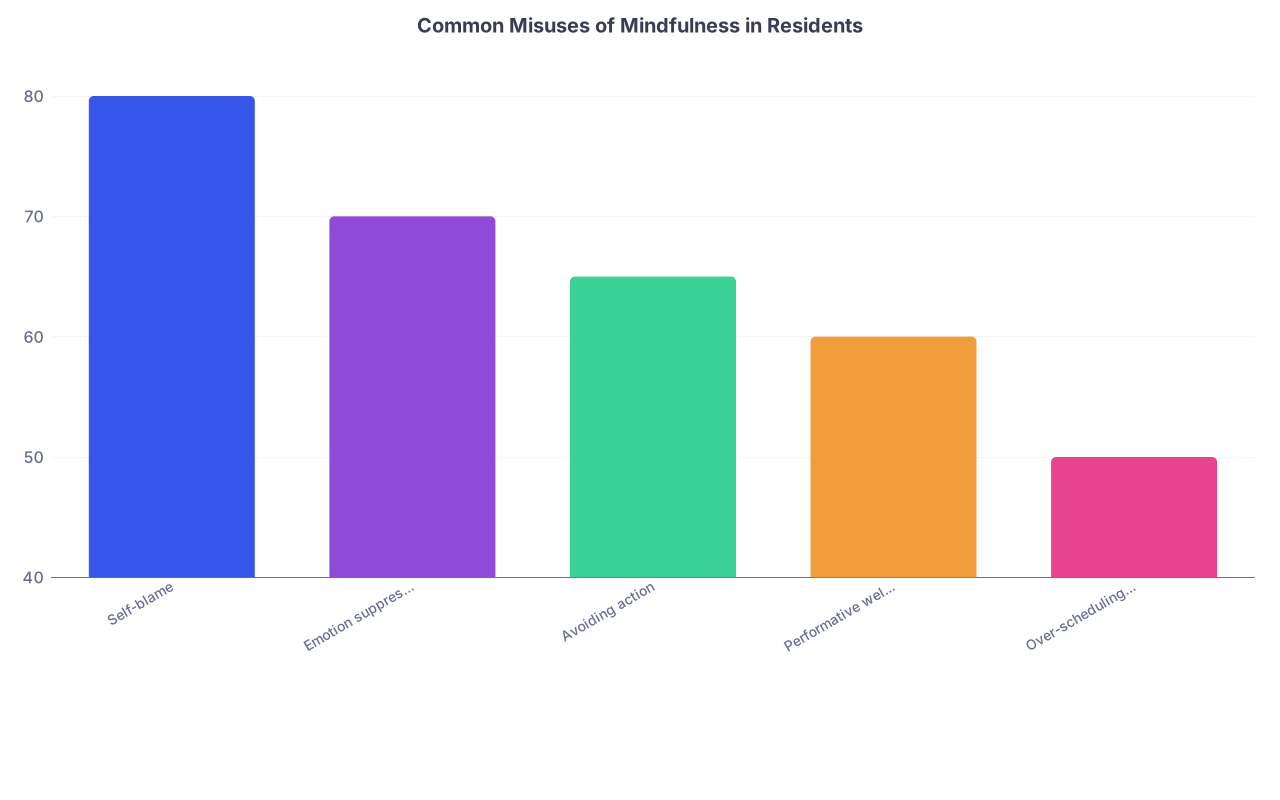
| Category | Value |
|---|---|
| Self-blame | 80 |
| Emotion suppression | 70 |
| Avoiding action | 65 |
| Performative wellness | 60 |
| Over-scheduling practice | 50 |
Why this is so toxic
The whole point of mindfulness is non-judgmental awareness.
If every session turns into:
- “I can’t clear my mind.”
- “I’m not Zen enough.”
- “I only did 3 minutes, that doesn’t count.”
Then mindfulness becomes just another evaluation, another exam you’re failing.
That accelerates burnout:
- You feel defective even in your coping strategies.
- You lose trust in tools that might help if used sanely.
- You avoid introspection altogether because it feels like grading yourself.
How to avoid this
Set some ground rules:
No performance scoring.
The only meaningful question after a meditation: “Do I feel a tiny bit more connected to reality, or not?” If the answer is “not today,” fine.Micro-practice is real practice.
One mindful breath at the Pyxis counts. Two seconds of pausing before you answer a snarky comment counts.Stop comparing practices.
You don’t need to match your co-resident’s 30-minute sessions. Your life, service, and brain are not theirs.
4. Using Mindfulness to Tolerate Ethical Violations
Now we get into darker territory.
Residency puts you in situations where:
- You’re pressured to discharge a patient faster than feels safe.
- You see corners cut on informed consent.
- You watch attendings or seniors speak to patients in ways that you know are wrong.
- You feel complicit in care that’s dictated by billing, not medicine.
Some residents start using mindfulness here as a sedative:
- “If I stay calm and observe, I can detach from this discomfort.”
- “Everyone else seems fine with this. Maybe I’m just too sensitive.”
- “I’ll just focus on the present moment and my breath, and not get worked up about system stuff.”
That is not mindful. That’s moral injury with a meditation soundtrack.
Why this can wreck you long-term
When you use mindfulness to numb moral distress instead of see it clearly, you set yourself up for:
- Deep cynicism (“That’s just how medicine is, nothing matters.”)
- Self-disgust (“I’ve become the doctor I promised I’d never be.”)
- Emotional shutdown (“I don’t feel much of anything about patients anymore.”)
That’s the advanced form of burnout. The stage where people start fantasizing about leaving medicine, or actually do.
How to avoid this
Use mindfulness here as a moral clarity tool, not as anesthesia.
When you feel ethically disturbed:
Pause and notice:
- “My chest is tight.”
- “I feel sick about this discharge plan.”
- “This consent conversation felt wrong.”
Name it privately:
- “This is moral distress.”
- “This clashes with my values about patient autonomy/safety/dignity.”
Decide on one action, however small:
- Ask a clarifying question on rounds.
- Document your concern in the chart appropriately.
- Debrief with a trusted senior or mentor.
- File an incident report if safety is compromised.
Mindfulness should make you more sensitive to ethical red flags, not more tolerant of them.
5. Making Mindfulness Another Time Debt in an Already Impossible Day
You know this move:
- You’re on q3 call.
- You haven’t had a proper meal in 16 hours.
- You’re behind on notes and haven’t peed since 11 a.m.
And you’re thinking, “I still need to get my 20 minutes of mindfulness in or I’m going to burn out.”
This is how “self-care” rhetoric gets weaponized against residents.
You start scheduling calm instead of actually getting what you need: rest, food, boundaries, decent staffing.

Why this can intensify burnout
When mindfulness is forced into your day like a non-negotiable, it becomes:
- Another obligation
- Another thing you “failed” if you skip
- Another demand on your minimal free time
And guess what you often sacrifice to fit it in?
- Real sleep
- Unstructured downtime
- Actual human connection (calling a friend, talking to your partner)
Mindfulness without the basics (food, sleep, safety) is like putting “ergonomic” tape on a broken chair and then being surprised when you still hurt.
How to avoid this
Hierarchy of needs, as applied to residents:
| Level | Priority Item |
|---|---|
| 1 | Sleep (as much as possible) |
| 2 | Food and hydration |
| 3 | Physical safety |
| 4 | Basic social connection |
| 5 | Mindfulness / reflection |
If you’re consistently skipping 1–4 to squeeze in 5, you’re misusing mindfulness.
Reasonable approach:
- Use micro-moments: 3 conscious breaths before entering a room, a 10-second reset after a code.
- Reserve longer practices for days off or lighter rotations, without guilt when it’s not possible.
- Never sacrifice sleep for mindfulness. That’s a losing trade.
6. Letting Institutions Use “Mindfulness Programs” as Ethical Cover
This one is ugly, but you need to see it clearly.
I’ve watched hospitals and programs do this:
- Keep punishing schedules.
- Ignore staffing concerns.
- Cultivate a culture of fear around speaking up.
Then proudly roll out:
- “Mindfulness rounds”
- “Wellness Wednesdays”
- An institution-wide subscription to a meditation app
It becomes a shield. “We care about resident wellness—we offer mindfulness.”
Meanwhile, none of the structural drivers of burnout change.

| Step | Description |
|---|---|
| Step 1 | Excessive workload |
| Step 2 | Resident distress |
| Step 3 | Institution provides mindfulness app |
| Step 4 | Resident feels they should cope better |
| Step 5 | Less vocal complaints |
| Step 6 | Institution assumes problem addressed |
How this traps you
You start doubting your own experience:
- “If there’s a wellness committee and a mindfulness series, maybe I’m supposed to be okay.”
- “Maybe everyone else is coping and I’m just not resilient enough.”
- “If I complain, I’ll look ungrateful—they’re giving us resources.”
The damage:
- Real concerns go underground.
- You stop trusting your early-warning burnout signs.
- The system gets less feedback, and nothing meaningful changes.
How to avoid this
Two things can be true at once:
- Your program might genuinely want to help.
- Their mindfulness initiatives can still function as avoidance of deeper problems.
Your job is to keep your reality-testing intact.
Use this mental checklist:
- Have call schedules, caps, or staffing actually changed?
- Do people who speak up about workload face retaliation or support?
- Are wellness efforts co-designed with residents or just handed down?
Mindfulness should support your ability to advocate for yourself and your patients—never replace that advocacy.
7. Using Mindfulness Without Real Support or Processing
There’s another misuse: trying to “mindfulness” your way through intense trauma without any other support.
Example scenarios:
- First time a patient your age dies unexpectedly and you’re the one calling the family.
- A medical error you were involved in (or blamed for) leads to serious harm.
- Code after code after code, with no formal debrief.
You tell yourself:
- “I’ll just sit with the feelings.”
- “I can process this by meditating on it.”
- “I should be able to handle it internally.”
Nope. Not solo. Not reliably. Not safely.

Why “solo mindfulness” can magnify harm here
When you sit alone with big trauma:
- Your mind can spiral into self-blame.
- You replay events obsessively.
- There’s no external reality check.
Mindfulness without guidance in these situations can increase:
- Shame
- Hypervigilance
- Detachment
You need other humans here:
- A trusted attending who actually listens
- A peer debrief
- A therapist, especially one familiar with medical culture
- Sometimes even formal institutional support (if available and safe)
How to avoid this
Use mindfulness as part of your processing, not the whole thing.
Reasonable steps:
- Notice: “This hit me harder than usual.”
- Acknowledge: “This is bigger than what I can handle alone with an app.”
- Reach out:
- “Can we talk about that case?” to a senior.
- “I’m not okay after that” to a co-resident.
- Schedule with a therapist, not as a failure, but as basic hygiene.
Mindfulness should help you recognize when you need connection and care, not convince you you can white-knuckle everything with “awareness.”
8. So What Is a Healthy Use of Mindfulness in Residency?
Let’s be specific. Mindfulness is not the enemy. Misuse is.
Healthy uses look more like this:
Brief reality checks in chaos
Two breaths before responding to a snide comment, so you choose your response instead of reacting from pure rage.Name what’s actually happening
“I’m overwhelmed and under-supported. No amount of breathing makes that okay, but naming it keeps me from turning it into ‘I’m weak.’”Early detection of your own limits
You notice you’re becoming numb to bad outcomes and that scares you enough to get help sooner rather than later.Aligning with your values
You sit for 5 minutes after a rough shift and ask: “Did I act in line with who I want to be as a physician today? Where did I compromise, and why?” Not to shame yourself, but to stay awake ethically.Supporting—not replacing—advocacy
You use calm awareness to bring up workload concerns more clearly, not to shut yourself up.

FAQs
1. How do I know if mindfulness is actually helping me or making burnout worse?
Ask yourself after a week or two of whatever you’re doing:
- Do I feel more honest with myself or more numb?
- Do I feel more clear about what’s not okay, or more resigned?
- Do I feel more compassionate toward myself, or more critical?
If it’s numb, resigned, or critical, you’re probably using mindfulness to suppress or self-blame instead of to see clearly.
2. Is it wrong to use mindfulness to “get through” a rough rotation?
Not wrong. But be careful. Short-term coping is fine—everyone does it. The problem is when “getting through” turns into:
- “This is just how medicine is, forever.”
- “If I just keep meditating, I can tolerate anything.”
Use it to survive a bad block, sure. But also use the clarity it gives you to make actual decisions later: about future jobs, fellowship, boundaries, or whether a particular environment is simply not sustainable for you.
3. What if my program pushes mindfulness hard and I’m not into it?
You’re allowed to have your own relationship to this stuff. Options:
- Use small pieces that feel authentic (brief pauses, body scans before sleep) and skip the performative group sessions if they irritate you.
- If it feels safe, give clear feedback: “What would help burnout more is X (better staffing, safer caps, protected education) rather than more apps.”
- Don’t let anyone convince you that not loving mindfulness means you’re “not working on yourself.”
4. If I’m already pretty burned out, is mindfulness a bad idea?
It’s not inherently bad, but it’s not a magic restart button either. If you’re already deep in:
- Emotional exhaustion
- Depersonalization
- Dread of going to work
Then mindfulness alone is not going to turn that ship. You probably need:
- Sleep and schedule changes
- Real social support
- Maybe professional help (therapy, sometimes meds)
- Possibly a serious look at whether your current environment is salvageable
Mindfulness can be a gentle tool in that mix—short, non-judgy check-ins. But if every sit turns into “I hate everything and I’m trapped,” don’t force it. Stabilize first.
Final Takeaways
- Mindfulness is a tool, not a cure for a broken system. If it’s making you blame yourself for systemic problems, you’re misusing it.
- Never use mindfulness to silence your own ethical alarms or emotions. Awareness should sharpen your values, not erase them.
- If your “wellness practice” feels like another performance metric or time debt, strip it back. Keep only what genuinely supports you, not what looks good on a residency brochure.