
Mindfulness in medicine has been watered down into branded breathing breaks and app subscriptions. That’s not mindfulness. That’s stress cosmetics.
If you’re a physician or trainee, you’ve probably sat through some “wellness” session where someone dimmed the lights, told you to close your eyes, and walked you through a five‑minute “mindful breathing exercise.” Then they checked a box, sent a satisfaction survey, and went back to scheduling unsafe patient loads.
Let me be blunt:
Most of what hospitals sell you as “mindfulness” is a misinterpretation at best, and a distraction from structural problems at worst.
The irony is that real, evidence‑based mindfulness is much more powerful—and much less fluffy—than the caricature you’ve been shown.
Let’s separate myth from data.
What Mindfulness Actually Is (And Is Not)
Mindfulness isn’t “thinking about your breath” or “trying to relax.”
The clinically useful definition comes from Jon Kabat‑Zinn’s work (which spawned MBSR, the program that actually has data behind it):
Paying attention, on purpose, in the present moment, and without judgment.
Three key elements that usually get lost:
- Sustained attention – training the mind to stay with an object (breath, sound, bodily sensation, thought) and returning when distracted.
- Meta‑awareness – noticing that your mind has wandered, or that you’re emotionally triggered, while it’s happening.
- Non‑reactivity – seeing thoughts and feelings as events, not commands. “I’m a terrible doctor” becomes “There is a thought that I’m a terrible doctor.”
That’s the core. Not candles. Not spa music.
What it’s not:
- Not primarily about relaxation (many people feel more distressed at first).
- Not positive thinking.
- Not zoning out.
- Not an excuse to tolerate unsafe systems.
When you strip it down to “deep breathing at noon,” you lose everything that makes it clinically and ethically interesting.
Myth #1: “Mindfulness = Stress Relief Tool Hospitals Can Hand Out”
This is the most common misconception: mindfulness as a quick‑fix coping hack layered on top of a broken system.
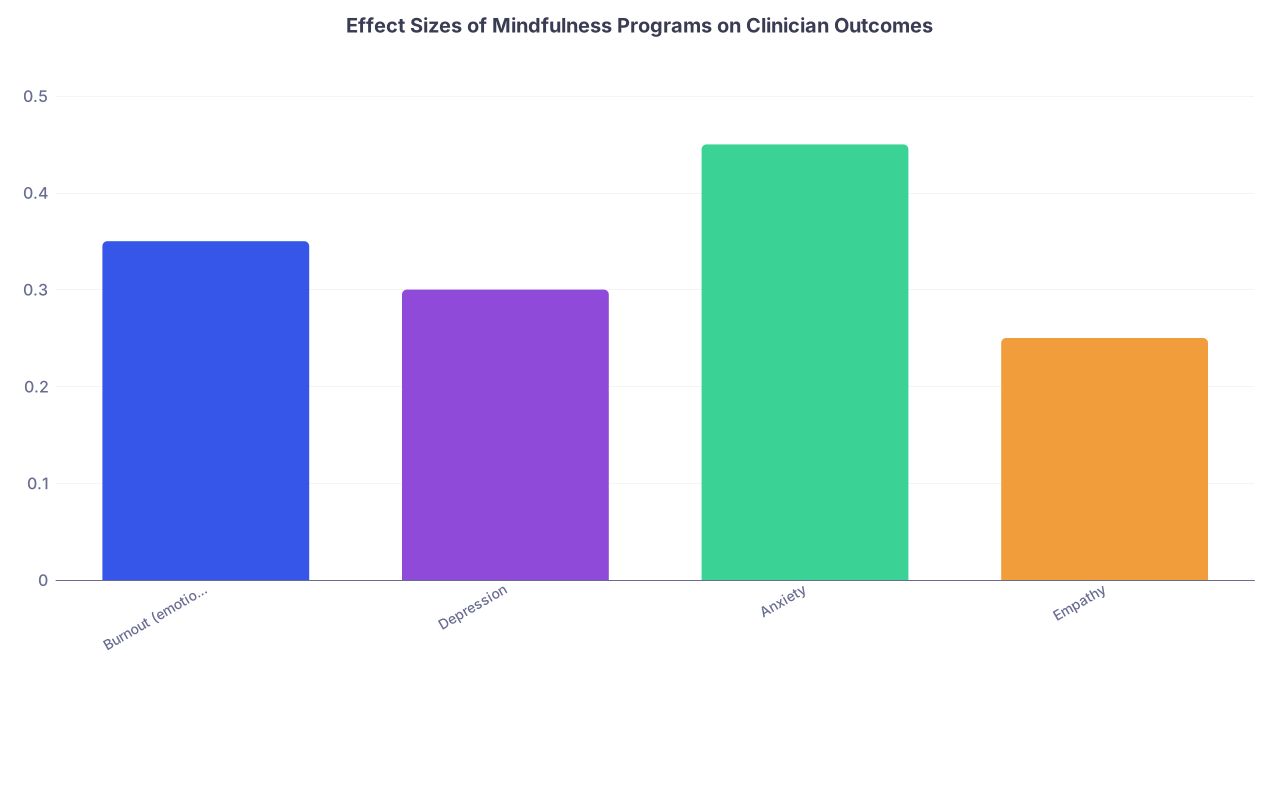
Does mindfulness reduce stress? Sometimes. Dozens of RCTs show small to moderate effect sizes on anxiety and stress scores in clinicians. But when you look closely at the data, the story is more nuanced.
| Category | Value |
|---|---|
| Burnout (emotional exhaustion) | 0.35 |
| Depression | 0.3 |
| Anxiety | 0.45 |
| Empathy | 0.25 |
These Cohen’s d numbers (roughly from meta-analyses of clinician-focused mindfulness interventions) are not magic. They’re in the “helpful but not life-changing” range—about the size of many psychotherapies, smaller than what you’d expect from fixing chronic understaffing.
I’ve seen hospitals roll out 6‑week mindfulness courses and then act as if they’ve solved burnout. Meanwhile:
- RVU expectations stay insane
- Documentation burdens climb
- Moral injury from unsafe patient ratios remains untouched
Then leadership points at the wellness slide deck and wonders why their “mindfulness initiative” didn’t stop people from quitting.
Mindfulness can help clinicians suffer less in the same bad system. That’s not a trivial benefit; it matters for people on the edge. But pretending it substitutes for addressing structural harm is dishonest.
The ethical problem:
Using mindfulness to increase tolerance for exploitation is not wellness. It’s manipulation with a soft voice and nice music.
Real mindfulness in medicine should be paired with system change, not used as white noise over moral injury.
Myth #2: “It’s Just Deep Breathing and Body Scans”
If your entire experience of mindfulness is “feel your feet on the floor” and “take three deep breaths,” you’ve seen about 2% of what serious mindfulness practice entails.
Look at what’s in MBSR, MBCT, and other programs that actually have RCT backing:
| Component | Typical Dose/Structure |
|---|---|
| Formal sitting practice | 30–45 min, 6–7 days/week, 8 weeks |
| Body scan | 30–45 min sessions |
| Gentle mindful movement | 20–40 min sessions |
| Inquiry/dialogue | Group discussion after practice |
| Daily informal practice | Multiple brief moments during day |
Notice what’s missing from that table:
“90-second breathing break at Grand Rounds.”
Mindfulness as studied in trials is:
- Skill training, not a one-off event
- Repetitive, like physical therapy for your attention and emotional reactivity
- Cognitively demanding, especially early on
The dose used in most positive studies is closer to 20–45 minutes per day, not “two minutes between OR cases.”
Does that mean it’s pointless to do shorter practices? No. Brief, on-the-spot practices can be useful:
- Before difficult family meetings
- After code events
- When you feel the urge to snap at a nurse or student
But those micro-interventions work better when built on a base of actual training, just like a single sprint works better if you’re consistently conditioned.
The hospital version often goes like this:
Give people micro-doses only, declare victory, then blame the individual when they’re still burned out. That’s backwards.
Myth #3: “Mindfulness Makes You Passive and Detached”
A persistent fear: if physicians get “too mindful,” they’ll become disengaged. Numb. Less driven. Like Buddhism will steal their edge.
The data shows nearly the opposite.
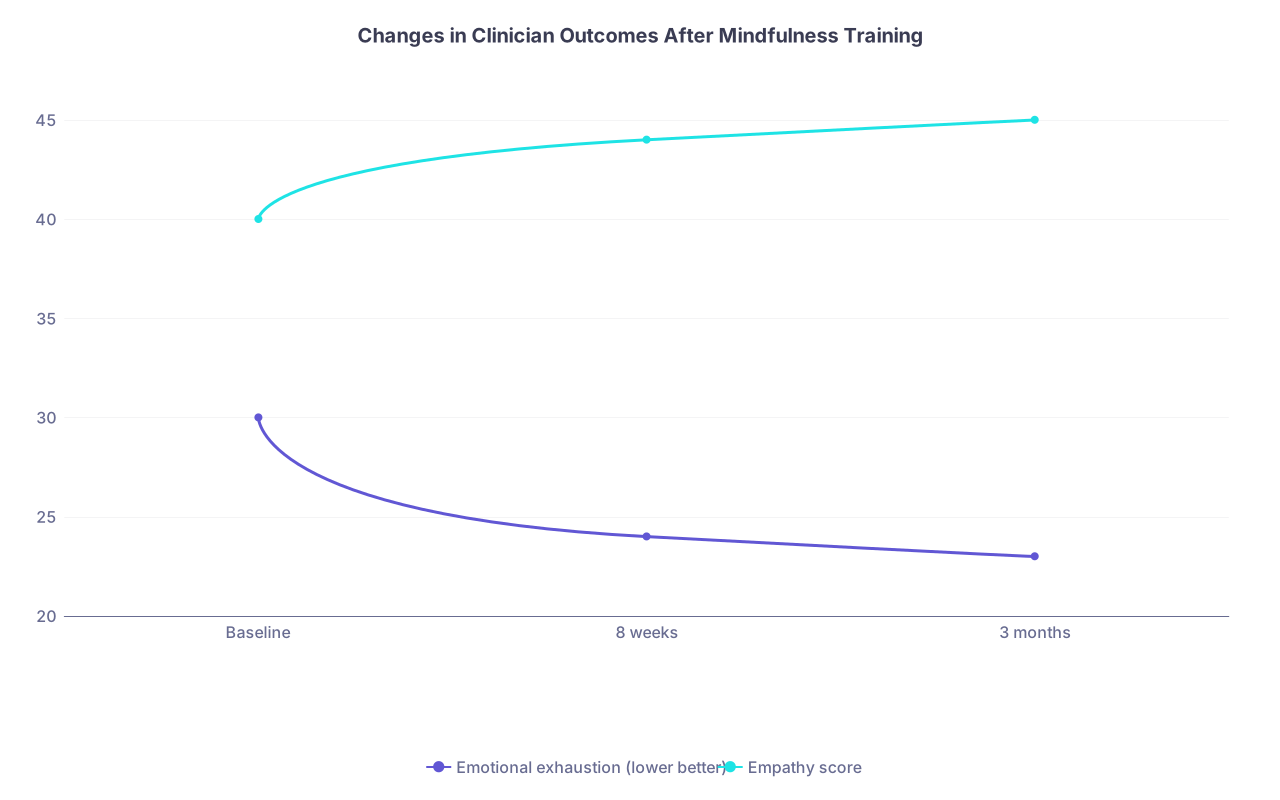
Several RCTs and longitudinal studies of clinicians have found:
- Reduced emotional exhaustion, but no decrease in professional efficacy.
- Sometimes improved empathy and patient-centered communication.
- Better conflict management and less reactivity with staff and patients.
| Category | Emotional exhaustion (lower better) | Empathy score |
|---|---|---|
| Baseline | 30 | 40 |
| 8 weeks | 24 | 44 |
| 3 months | 23 | 45 |
That combination—less emotionally fried, more emotionally present—is the opposite of disengagement.
Why? Because real mindfulness doesn’t shut down emotion. It stabilizes your relationship to emotion.
Instead of:
- Anger → Immediate sharp reply, charting revenge, or silent seething
you get: - Anger → “There is anger here” → conscious choice about what aligns with your values
That’s not passivity. That’s response flexibility. Which is exactly what you want when you’re dealing with distressed families, confrontational consultants, or system failures.
The “detached zombie” version of mindfulness comes from misunderstanding the “non-judgment” part. Non-judgment doesn’t mean “don’t care.” It means:
- See clearly first.
- Act intentionally second.
You can be deeply mindful and fiercely outspoken about unethical policies. In fact, that combination is probably safer—less likely to erupt, more likely to be strategic.
Myth #4: “Mindfulness Is a Personal Hobby, Not a Professional Skill”
This is where a lot of physicians tap out. They put mindfulness in the same bucket as yoga retreats and herbal tea.
But if you strip away the hype, mindfulness overlaps with several core professional competencies:
- Situational awareness in emergencies
- Cognitive control under stress
- Bias recognition in clinical reasoning
- Ethical reflection in morally gray situations
The ethical angle is underappreciated. Plenty of bioethics consults are really about clinicians who can’t see past their immediate emotional storm—outrage at a family, disgust at a patient’s choices, or hopelessness about a trajectory.
Mindfulness gives you a split second of space:
“I’m furious at this family right now” becomes “I notice anger arising when this family rejects our recommendations.”
That shift sounds small and academic. It isn’t. It’s the difference between reacting from anger and responding to anger.
That’s directly tied to:
- Respecting patient autonomy without seething resentment
- Avoiding subtle retaliatory behaviors (slow responses, less attention)
- Not letting personal moral distress spill out as cruelty
Ethical practice isn’t just what you believe about right and wrong. It’s whether you can see your own mind clearly enough not to be hijacked by it.
That’s mindfulness territory.
Myth #5: “There’s No Real Evidence—It’s Just Wellness Hype”
The wellness industry has abused mindfulness. But the core practices have a pretty solid evidence base, especially when used in structured programs.
For physicians and other healthcare workers, multiple RCTs and meta-analyses show:
- Small to moderate reduction in burnout scores
- Reduced symptoms of depression and anxiety
- Improvements in mindfulness facets like non-reactivity and non-judging
- Occasional improvements in empathy and communication
There are limits and caveats:
- Many studies are small, from single institutions.
- High risk of selection bias (people who sign up are already interested).
- Follow-up is often short (2–6 months).
- Effect sizes are not massive.
But “not a panacea” is not the same as “no evidence.”
Contrast this with what hospitals happily invest in:
- Motivational posters
- Pizza “wellness” nights
- Resilience webinars with zero empirical backing
Mindfulness programs, when properly structured and voluntary, actually outperform a lot of the nonsense dressed up as clinician support.
We also have growing mechanistic data: changes in attention networks, default mode network connectivity, emotional regulation circuits. Is it fully nailed down? No. But it’s miles beyond vibes and good intentions.
Where Physicians Actually Misuse Mindfulness
Here’s where things go sideways in real life.

| Step | Description |
|---|---|
| Step 1 | Mindfulness Concept |
| Step 2 | Marketed as Quick Fix |
| Step 3 | Used to Avoid System Change |
| Step 4 | Turned Into Relaxation Only |
| Step 5 | Mandatory Sessions |
| Step 6 | Blame Individual for Burnout |
| Step 7 | Ignore Ethical Dimension |
I’ve seen all of these:
Mandatory “mindfulness” sessions
Nothing kills genuine contemplative practice faster than forcing it. Coercion is anti-mindful by design.Implied blame
The subtext: “If you were more mindful, maybe the 28 patients you’re covering wouldn’t bother you so much.” That’s gaslighting, not support.Reduction to “calming down”
When mindfulness is framed solely as relaxation, any increase in discomfort (which is common early in practice) is treated as failure. People quit right when it could help.Stripping ethics out of the conversation
Mindfulness practiced seriously tends to increase moral sensitivity, not mute it. That can make moral injury more apparent, which institutions often do not want.
Real mindfulness is uncomfortable. You start actually feeling the cost of your work instead of staying numb. That’s where the ethical questions show up:
“Is what we’re doing to residents even remotely acceptable?”
“Is this ‘productivity goal’ compatible with patient safety?”
That’s not a bug. That’s the point.
So What Does Serious, Useful Mindfulness Look Like for Physicians?
No incense. No five-day silence retreat in the middle of fellowship. Something like this:
A realistic but real dose
10–20 minutes of daily formal practice is actually doable for most clinicians if they take it as seriously as gym time.Evidence-based structure
Programs modeled after MBSR/MBCT or physician-specific interventions, not “inspirational speaker who meditated once at a conference.”Voluntary participation
If it’s mandatory, it’s performative. And you’ll get people rolling their eyes through the whole thing.Explicit boundaries
Clear statement up front: “This is not a substitute for changing toxic schedules, unsafe staffing, or abusive cultures.”Integration into real clinical moments
Micro-practices at natural fault lines in the day:- Before opening the EMR in the morning
- After a code or bad outcome
- Before difficult conversations
- Transitioning from clinic to home
Ethical framing
Linking mindfulness explicitly to:- Noticing bias when treating stigmatized groups
- Seeing when frustration is about the system, not the patient
- Recognizing moral distress instead of swallowing it whole

Done this way, mindfulness becomes less “spa add-on” and more “core mental skill for practicing medicine without losing your mind or your ethics.”
Mindfulness and Medical Ethics: The Part No One Teaches
Let’s connect the dots clearly.
Ethical practice in medicine hinges on:
- Clear perception
- Emotional balance
- Reflective capacity
- Ability to tolerate uncertainty and distress
Mindfulness directly trains all four:
Clear perception
You practice seeing what’s actually happening instead of what your anxiety, anger, or fatigue wants you to see.Emotional balance
You learn to feel grief, frustration, fear—without being swept away or reflexively shutting down.Reflective capacity
You build the habit of asking, “What is going on in me right now?” before acting. That’s the core of ethical self-scrutiny.Distress tolerance
Complex end-of-life decisions, nonadherence, cultural clashes—none of those get simpler. You just get better at not panicking internally.

The biggest myth is that mindfulness makes you okay with whatever’s happening. No. It makes you see what’s happening clearly enough that you can decide, consciously, when not to be okay with it.
That discernment is the backbone of moral courage.
How to Approach Mindfulness Without Drinking the Kool-Aid
If you’re skeptical, good. You should be. Here’s a grounded way to start:
- Treat it like skills training, not belief adoption.
- Commit to a specific, limited experiment: e.g., 10–15 minutes a day for 6 weeks, plus 3 micro-pauses during the workday.
- Use a structured program or app rooted in MBSR/MBCT, not whatever corporate wellness is peddling this month.
- Track something real: sleep quality, how often you snap at people, how quickly you ruminate after a bad outcome.

You’re not signing up for a religion. You’re running an experiment on your own cognitive and emotional habits, with decades of data suggesting it might help.
The Bottom Line
Three things to walk away with:
- Mindfulness is not deep breathing or relaxation; it’s training attention and non-reactivity, and the real thing takes consistent practice, not wellness snacks.
- The evidence shows small to moderate benefits for clinician distress and functioning, but it does not fix broken systems—and using it to mask structural harm is ethically suspect.
- Done seriously, mindfulness sharpens ethical clarity and emotional stability, making you less reactive, more present, and more capable of acting on your values—not more passive.
If your institution is selling you mindfulness as a way to “cope better” with impossible conditions, be wary.
If you’re considering mindfulness as a way to suffer less, think more clearly, and stay human in an inhuman system, that’s much closer to what the data—and the practice—actually support.