
The culture of medicine has it backwards: emotional numbing is celebrated as “professionalism,” while genuine mindfulness is treated like a wellness side hobby. That’s upside down.
The Big Myth: “If You Feel Less, You’ll Break Less”
Let me be blunt: the old-school advice to “toughen up,” “grow a thicker skin,” or “not let it get to you” is not resilience. It is psychological self-harm dressed up as professionalism.
There are two very different strategies clinicians use to survive emotional load:
- Mindfulness – turning toward your experience with awareness, curiosity, and boundaries.
- Detachment / numbing – turning away from your experience, disconnecting from yourself and others.
Hospitals often reward the second one. The problem? The data is painfully clear: detachment correlates with burnout, depression, worse patient care, and more medical errors. Mindfulness does the opposite.
Let’s separate the marketing from the mechanism.
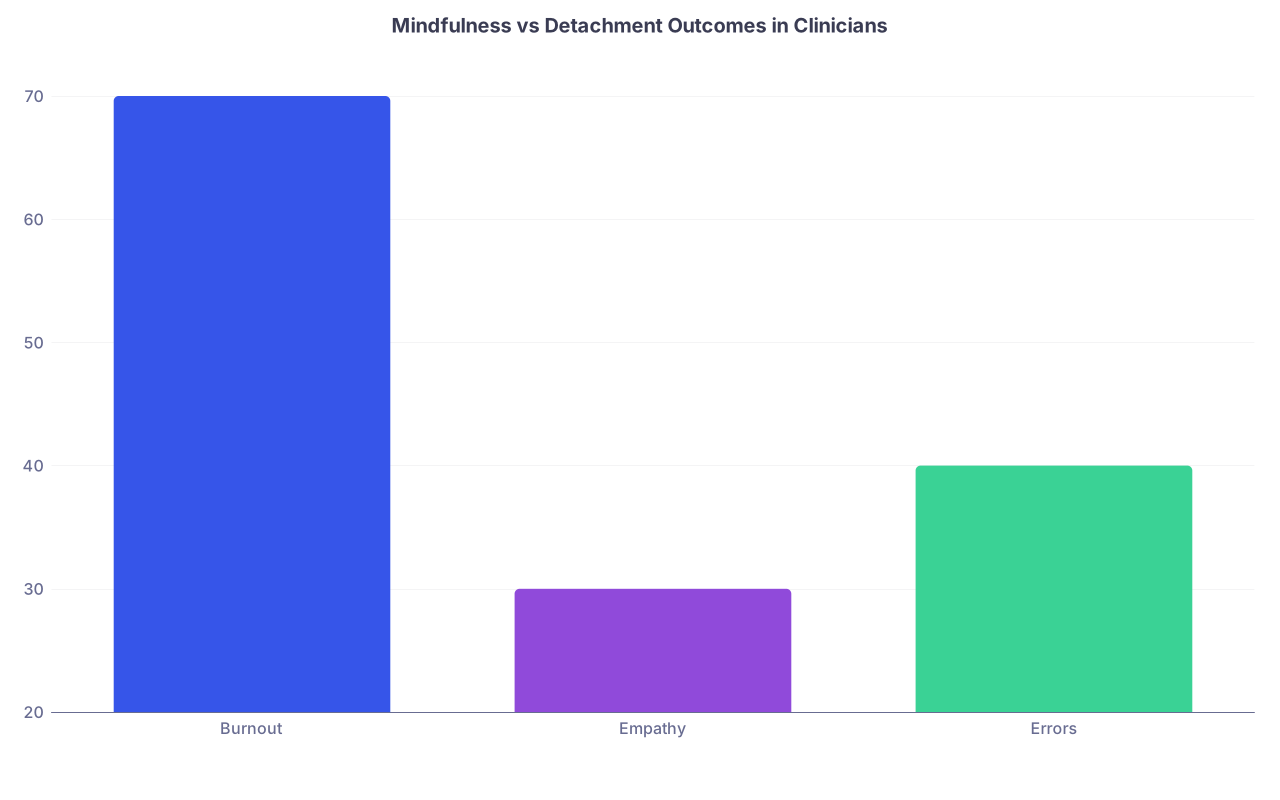
| Category | Value |
|---|---|
| Burnout | 70 |
| Empathy | 30 |
| Errors | 40 |
(Think of this bar chart as an illustration: high numbers = worse for burnout and errors, low numbers = better. Detachment sits on the high side for burnout and errors; mindfulness sits on the low side.)
What Mindfulness Actually Is (And Is Not)
Half the confusion comes from people using “mindfulness” as a buzzword for… anything vaguely calm.
Let’s be precise.
Mindfulness is:
- Moment-to-moment awareness of your internal and external experience
- With an attitude of curiosity rather than judgment
- While not automatically reacting or suppressing
You notice your anger at a rude consultant. Your grief after a code. Your anxiety before a difficult conversation. You see the thoughts (“I’m not cut out for this,” “I can’t handle another death”) as mental events, not absolute truth.
You don’t fuse with them. You also don’t shove them in a box and call that “coping.”
Mindfulness is not:
- Being calm all the time
- Emptying your mind
- Relaxation alone
- Detaching from your emotions
- Ignoring your distress better than your peers
If anything, mindfulness makes you more aware of your distress—then gives you better options than “implode” or “shut down.”

What About “Professional Distance”?
Here’s the sleight of hand I see all the time on wards: people use “professional distance” as a euphemism for “I can’t afford to feel this.”
Real professional distance is boundary-setting:
“I’ll be fully present during this encounter, and I won’t bring every piece of it home.”
Fake professional distance is:
“I won’t let myself feel much at all; it’s safer that way.”
One is mindful containment. The other is emotional amputation.
Detachment: The Coping Strategy That Backfires
The research literature uses several labels for emotional numbing: depersonalization, disengagement, emotional exhaustion, sometimes “detached concern.” Whatever you call it, the pattern is the same.
You start by telling yourself: “If I don’t feel this fully, I won’t burn out.”
Reality: it often accelerates burnout.
What The Data Actually Shows
A few highlights from the mountain of evidence:
Burnout and depersonalization
Maslach Burnout Inventory studies consistently show that depersonalization (treating patients like objects, “the gallbladder in 12,” the “trainwreck in bed 3”) is not protective. It’s one of the three core components of burnout and strongly associated with emotional exhaustion and poorer mental health.Mindfulness and burnout
Multiple RCTs with physicians, residents, and medical students show that mindfulness-based interventions reduce emotional exhaustion and depersonalization and increase sense of personal accomplishment. Not theory. Measured.Patient care and errors
Higher burnout and depersonalization correlate with:- More self-reported medical errors
- Worse patient satisfaction
- Lower empathy scores (Jefferson Scale, etc.)
Mindfulness on the other hand is associated with better self-reported attention, fewer mistakes, and improved patient satisfaction.
Mental health
Emotional numbing is linked to depression, PTSD, substance misuse, and decreased help-seeking.
Mindfulness-based therapies are frontline treatments for anxiety, depression relapse, chronic pain, and yes—clinician distress.
No, mindfulness won’t turn your 28-hour call into a spa day. But the idea that numbing is “the only way to function” is simply false. It’s a short-term patch that degrades the system over time.
| Factor | Mindfulness Trend | Detachment Trend |
|---|---|---|
| Burnout (emotional) | Decreases | Increases |
| Depersonalization | Decreases | Increases |
| Empathy | Increases or preserved | Decreases |
| Self-reported errors | Decreases | Increases |
| Depression/anxiety | Decreases | Increases risk |
“But If I Let Myself Feel, I’ll Fall Apart”
This is the most common fear I hear from trainees. It’s also based on a misunderstanding of how emotions work.
People imagine emotions as a dam: if you open the gate even a little, you’ll be swept away. So you keep stacking sandbags—sarcasm, dark humor, distancing, speed, constant distraction.
In reality, emotions are more like waves. If you feel them in real time, they rise, crest, and fall. Quickly.
If you suppress them, they don’t disappear. They just go underground and show up as:
- Irritability at minor things (“Why is the med student still here?”)
- Cynicism (“Families are all the same…”)
- Numbness outside of work (no joy, no interest, just Netflix and scrolling)
- Somatic junk: headaches, GI issues, insomnia
Mindfulness doesn’t mean sobbing in front of every patient. It means acknowledging your internal reaction early so it doesn’t hijack you later.
“I feel a tightness in my chest when I see this teenager with repeat overdoses.”
That tiny moment of awareness gives you a millimeter of space. And that space is where discernment lives.
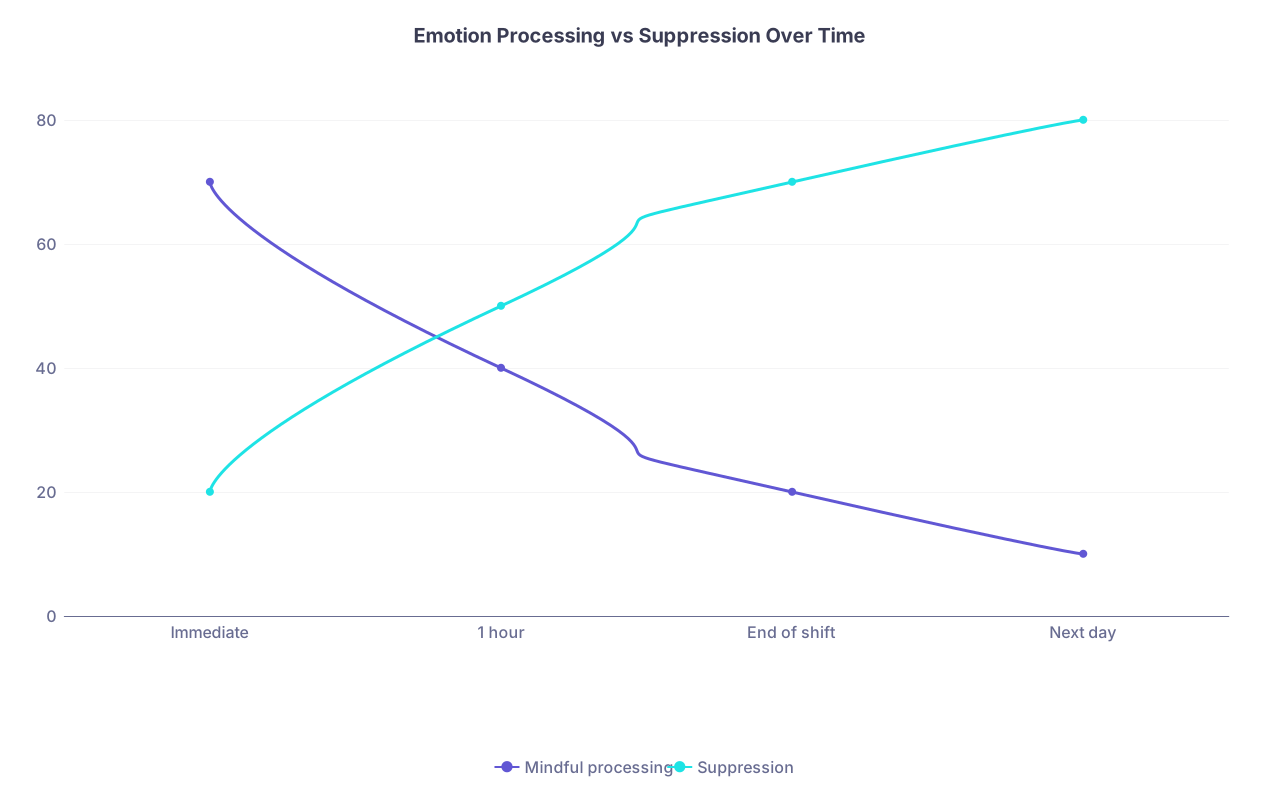
| Category | Mindful processing | Suppression |
|---|---|---|
| Immediate | 70 | 20 |
| 1 hour | 40 | 50 |
| End of shift | 20 | 70 |
| Next day | 10 | 80 |
(Again, conceptual numbers. But the pattern matches what study after study and countless clinicians report.)
What Mindfulness Looks Like in Real Clinical Life
Let’s ground this. Because if your idea of mindfulness is a 10-day silent retreat during residency, of course you’ll write it off.
Here’s how mindfulness actually fits medicine:
Scenario 1: The DNR Conversation That Gut-Punches You
You’re talking to a patient’s daughter about DNR status. She looks like your aunt. Voice cracks. You feel your own throat tighten.
Detached mode:
You clamp down hard. Stay “all business.” Push through. Then you find yourself snapping at a nurse 30 minutes later, because that emotion didn’t just vanish.
Mindful mode, 10-second intervention:
You notice: “My chest is tight. I feel sad.”
You silently take one slower breath as she pauses. You mentally label, “Sadness. Tenderness. This matters.”
You keep your voice steady, but not robotic. After the conversation, you give yourself 30 seconds alone in the stairwell: hand on chest, 5 slow breaths, acknowledging, “That was heavy.” Then you move on.
Outcome difference? Massive, over hundreds of encounters.
Scenario 2: Dehumanizing Humor on Rounds
You’re on surgery. Attending refers to a patient as “the trainwreck in 412.” Everyone chuckles. It’s standard fare.
Detached mode:
You join in or stay silent, but inside you flatten your own discomfort. “This is just how people cope.” You slowly normalize it. Also normalize feeling less.
Mindful mode:
You notice the quick punch of unease in your gut. Label it. “Discomfort.” You do not need to challenge the attending mid-rounds, start a lecture, or stage a revolution. You simply refuse internally to accept the narrative that dehumanizing the patient is required to protect you. Later, maybe you talk with a peer or mentor about how to not absorb this culture fully.
That microscopic act of awareness is a line in the sand: “I’m not going to anesthetize my humanity to survive this job.”

| Step | Description |
|---|---|
| Step 1 | Stressful Clinical Event |
| Step 2 | Suppress Emotion |
| Step 3 | Short Term Numbness |
| Step 4 | Increased Burnout |
| Step 5 | Name Emotion |
| Step 6 | Brief Pause or Skill |
| Step 7 | Integrated Experience |
| Step 8 | Resilience Over Time |
| Step 9 | Notice Internal Reaction |
Mindfulness Is Not a Free Pass for Bad Systems
Let’s deal with another bad take: “We’ll give residents a 4-week mindfulness course instead of fixing the call schedule.”
No. That’s cosmetic wellness.
You can be the most mindful human on the planet and still be ground down by:
- Unsafe staffing
- Toxic attendings
- Punitive error culture
- Endless admin tasks misbranded as “care”
Resilience skills are not a substitute for structural reform. They’re a way to stay intact while you push for structural reform, and a way not to lose yourself in a broken system.
Mindfulness does not say, “It’s fine.”
It says, “This is what’s happening in me as I witness how not fine this is—and I’ll choose my actions with clear eyes, not just reflexive shutdown.”
Detachment, in contrast, often locks you into passivity. If you have to stay numb to endure the system, you’re less likely to challenge it. You’re in survival mode, not change mode.
Practical, Evidence-Based Mindfulness for Clinicians (Without the Fluff)
You do not need incense, mantras, or a meditation app subscription to start using this. The literature supports some very simple, repeatable moves.
Micro-skills that actually fit a shift
One-breath check-ins
Before you open the next chart, one breath:
“What’s happening in my body? What’s the dominant emotion?” Name it once. Move on.The 3-label rule
After a tough encounter, silently label three things:
“Angry. Sad. Tired.”
Research on affect labeling shows this decreases amygdala activation and increases prefrontal control. Translation: less hijacking, more choice.Mindful transitions
Leaving the hospital? Don’t just slam the door and drive. Sit in your car for 60 seconds. Feel the steering wheel, your feet, your breath. Mentally mark: “Work day ended.” That tiny ritual creates boundary rather than emotional spillover.Compassion without fusion
When you feel pulled into a patient’s suffering, practice:
“I care deeply. And their suffering is separate from me.”
That’s compassion with boundaries, not detachment.

What about formal training?
When programs actually invest in structured mindfulness for clinicians (8-week MBSR, MBCT-inspired programs, or brief adapted curricula), studies show:
- Reduced burnout scores
- Improved mood and sleep
- Sustained effects months later in many groups
The ones that work best aren’t preachy or spiritualized. They explicitly talk about:
- Dealing with difficult patients
- Handling mistakes and shame
- Navigating moral injury and ethical distress
If your institution offers something like this and it’s run by serious people, not just PR, it’s usually worth your time.
The Ethical Angle: Detachment Isn’t Neutral
Since you flagged “medical ethics,” let’s be clear: emotional numbing doesn’t just hurt you. It distorts clinical judgment.
When you’re detached, you’re more likely to:
- Miss subtle cues of suffering (because you’re not tuned into affect)
- Slide into paternalism (“we know what’s best; they’re just difficult”)
- Normalize dehumanizing language and attitudes
- Undervalue communication and overvalue task completion
Patients feel it. Families feel it. The “I don’t want to bother them; they seem rushed and distant” comments on feedback forms are not random.
Ethically, medicine doesn’t just require competence. It requires presence. Respect. Humanity. Chronic detachment erodes all three.
Mindfulness, on the other hand, supports core ethical principles:
- Autonomy – you’re more likely to actually listen, not rail-road
- Beneficence/non-maleficence – you notice when your fatigue or frustration is about to spill into decisions
- Justice – you see your own biases faster when you’re actually aware of your inner reactions
You can’t uphold values you’re not present enough to notice yourself betraying.

FAQ (3 questions)
1. Isn’t some emotional detachment necessary in high-acuity settings like trauma or ICU?
You need functional focus, not emotional anesthesia. In a code, it makes sense to temporarily bracket your feelings to run the algorithm. That’s acute compartmentalization, which is healthy if you circle back later and let the emotions catch up. Chronic detachment—never revisiting what things cost you, never feeling much of anything—is where the damage happens. Mindfulness actually improves that in-the-moment focus while preserving your capacity to process afterward.
2. I tried meditation and hated it. Does that mean mindfulness isn’t for me?
No. “Sitting for 20 minutes following your breath” is one delivery method, not the entire concept. You can practice mindfulness through brief pauses, body scans in the shower, noticing emotions during documentation, or mindful walking between wards. If a particular style grates on you, discard the style, not the underlying skill: awareness + non-automatic response.
3. How do I practice mindfulness without becoming emotionally overwhelmed by all the suffering I see?
Counterintuitive truth: people get overwhelmed more when they’re half-aware and unskilled, not when they’re fully present with boundaries. The key is pairing awareness with three things: naming (“this is grief”), grounding in your body (breath, feet, contact points), and a clear inner line (“I can care deeply without absorbing all of this as mine”). That combination lets you feel more precisely but be hijacked less often.
Key points: Emotional numbing is not resilience; it’s a burnout accelerator dressed up as professionalism. Mindfulness isn’t about being calm or detached—it’s about accurate awareness plus choice, which the data consistently links to better outcomes for both clinicians and patients. You don’t need to become a monk; you need a few honest, repeatable skills that let you stay human in a system that keeps trying to turn you into a machine.