
The way most clinicians are taught to “get consent” for bad news is broken. And if you follow it blindly, you will harm patients, retraumatize families, and burn out faster than you think.
The worst part? You will walk out of the room thinking you “did it right” because you followed a checklist. That is the consent room trap.
This is not about whether to disclose bad news. You must. It is about how easily “mindfulness” and “shared decision‑making” get twisted into rituals that look ethical but feel brutal to the person in the bed.
Let me walk you through the errors I have seen over and over. On rounds. In family meetings. In OR consent areas at 6:45 a.m. Where otherwise good clinicians unintentionally weaponize the consent process.
The Consent Room Trap: What It Actually Is
The consent room trap is simple: you confuse saying the right words with doing the right thing.
You think:
- “I sat down.”
- “I asked for permission to share information.”
- “I explained risks, benefits, and alternatives.”
- “I asked them to repeat back what they understood.”
So you must have been “mindful,” “patient-centered,” and “ethical.”
Wrong. You can hit every line of SPIKES, NURSE, or whatever acronym you learned, and still:
- Rush the patient’s emotional process.
- Offload your anxiety onto them.
- Make them feel blamed for a decision they did not truly understand.
- Turn “mindfulness” into a performance rather than a practice.
The trap is that the room looks right. Quiet. Chair. Maybe a box of tissues. You ask, “Is this an OK time to talk about your results?” You feel virtuous.
But mindfulness is not asking one permission question. It is continuous, minute‑to‑minute attunement. And that is where people slip.
Mistake 1: Confusing “Permission” With Pressure
The most common script I hear:
“Is now an OK time to talk about your scan results?”
Sounds gentle. Respectful. Mindful.
Except you just walked into a semi-private room with two nurses charting inside, the TV on, and the patient alone without their spouse they have told you repeatedly they want present.
If they say “no,” they feel like they are wasting your time. If they say “yes,” they feel ambushed. Either way, they are set up to fail.
The subtle coercion you are probably missing
You are not neutral. You are the person with the white coat, the data, and the keys to the OR. They read your body language:
- Your hand still on the doorknob.
- Your laptop half‑open.
- Your team behind you, waiting.
Your “Is now an OK time…” is not a true open choice. It is a leading question. They know the “right” answer is yes. Many will comply, then later say, “They never gave me a choice.”
This is exactly how consent gets weaponized. It becomes a way to protect you legally and psychologically, not to protect them.
How to avoid this mistake
Do not pretend you are asking an open question if you are not willing to accept “no” and immediately adjust.
You need three things before you even start:
- The right people are there (or consciously chosen not to be).
- The right environment exists (privacy, time, minimal interruptions).
- The right you walks in (regulated, not sprinting between five tasks).
If any of those are missing, say so plainly:
“I need to talk with you about your biopsy results. This is an important conversation. I can do it now, just you and me, or we can wait 30–60 minutes so your partner can be here and we can move somewhere more private. What would feel safest and most helpful to you?”
Then honor the answer. No eye‑rolling, no sigh, no glance at your watch. If you are not prepared to honor “no,” do not ask the question.
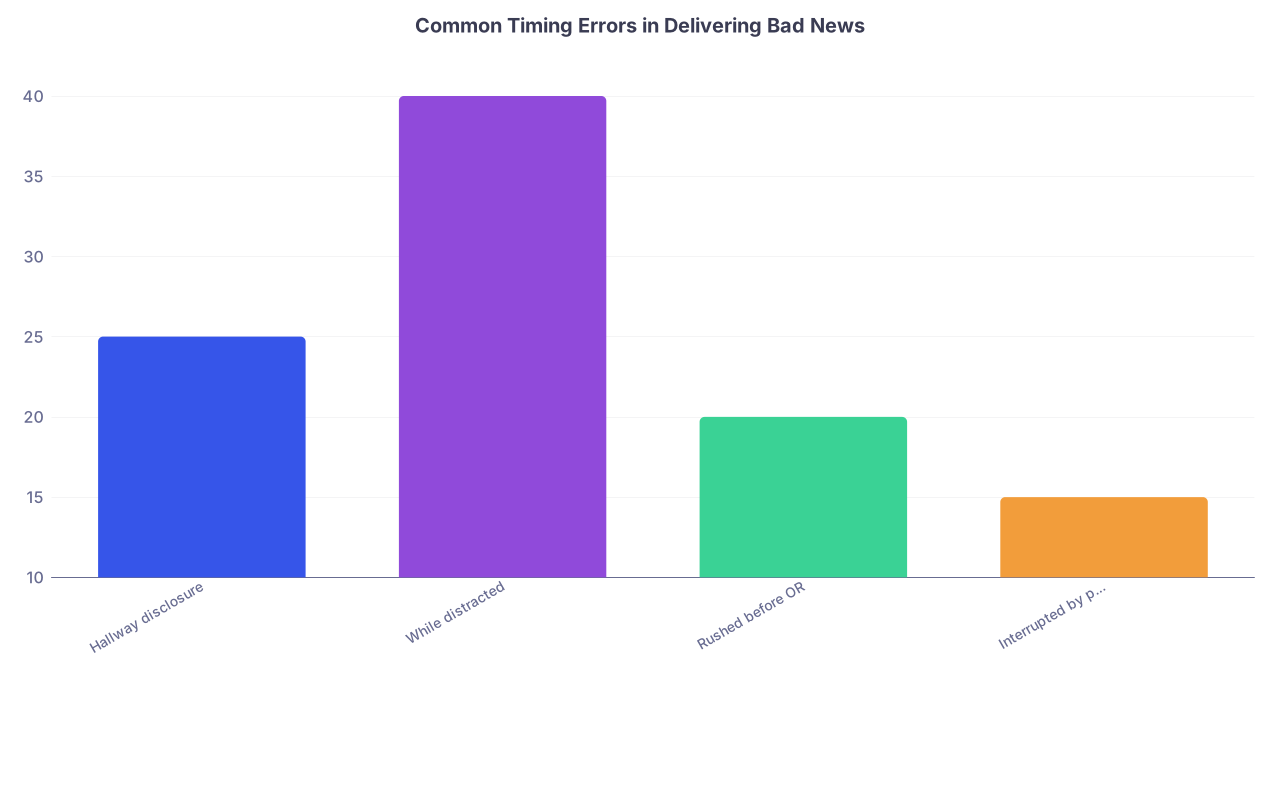
| Category | Value |
|---|---|
| Hallway disclosure | 25 |
| While distracted | 40 |
| Rushed before OR | 20 |
| Interrupted by pager | 15 |
Mistake 2: Treating Mindfulness as a Performance, Not a State
A lot of “mindfulness in medicine” training degenerates into theatre.
You learn to:
- Pull up a chair.
- Make eye contact.
- Pause after key phrases.
- Name emotions: “I can see this is very hard to hear.”
All fine. All useless if your nervous system is on fire and you are not actually present.
Patients are not stupid. They can feel when you are reciting from memory. They will not call you out on it. They will just absorb the message: “I am alone with this.”
The tell‑tale signs you are performing, not present
You know you are in performance mode if:
- You are mentally composing your note while they are speaking.
- You are monitoring the time more than the person’s breathing.
- You are waiting for your turn to say the “empathetic” line.
- You feel relieved the instant you can exit the room.
I have watched residents do this after a half‑day communication workshop and think they are experts. They check the boxes. They leave patients stunned and abandoned.
What actual mindful presence looks like
Mindful presence is not a script. It is:
- Slowing your breathing before you enter.
- Walking in with only this person in your mental field, for these minutes.
- Noticing your own urge to fix, explain, or rush—and not acting on it.
- Letting silence sit longer than is comfortable for you.
Here is the test: after the conversation, if I ask the patient, “Did you feel like your doctor was here with you?” their answer tells me who you are, not your checklist.
You want to avoid the trap? Stop trying to look mindful. Work on being regulated enough to stay present for someone’s shock or grief without shutting it down.
Mistake 3: Hiding Behind Protocols When Hearts Are Breaking
Another trap: using protocols like SPIKES as armor.
SPIKES is fine as a scaffold:
- S – Setting
- P – Perception
- I – Invitation
- K – Knowledge
- E – Emotions
- S – Strategy/Summary
The mistake is turning it into a rigid algorithm you cling to when the room goes sideways.
Scenario I have seen countless times:
Resident: “What is your understanding so far?” Patient: “I know the mass is probably nothing.” Resident (thinking: I must follow the steps): launches into structured explanation of staging, treatment options, survival curves. Patient hears white noise after the word “cancer.”
The resident is not bad. They are scared. They grab the safety rail of the protocol and forget the human.
The ethical risk of protocol‑driven conversations
When you prioritize your structure over the patient’s pace, you commit a subtle ethical error. You respect form more than autonomy.
You can technically say:
- “I assessed their understanding.”
- “I explained the diagnosis clearly.”
- “I checked for questions.”
But if the person emotionally left the room two minutes in, you have not obtained meaningful consent, no matter how many boxes you ticked.
Ethical consent is not an information dump. It is a process of shared understanding over time. That requires flexibility.
How to use protocols without becoming robotic
Use frameworks as guardrails, not chains.
- If the patient’s body language screams “overwhelmed,” you shorten the knowledge dump.
- If they keep looping back to, “So this means I might die?” stop listing side effects.
- If they ask the same question three times, that is data: their brain is not encoding. Slow down.
You are allowed to say: “I have given you a lot. I do not expect you to remember everything. We can revisit this tomorrow. I will also write down the key points and who will call you next.”
That is mindful consent. It respects the limits of human cognition under stress instead of pretending the 15‑minute conversation can do it all.
Mistake 4: Dumping Decisions on Patients Who Are Not Ready
The ugliest version of the consent room trap is this:
You deliver new life‑altering information and then immediately ask for a high‑stakes decision as if they have been preparing for this all week.
“We found a large mass on your CT. There is a high chance this is malignant, and the safest course is to operate in the morning. We can also watch and wait, or biopsy first, but that carries X, Y, Z risks. What would you like to do?”
Sometimes, that is clinically real. The window is narrow. But here is the error: pretending the choice is neutral and that the patient is truly in a position to weigh it carefully right now.
The illusion of “shared decision making”
“Shared decision making” becomes unethical when:
- The patient is in acute shock.
- They do not have their support system present.
- You have not yet anchored what matters most to them (function, time, comfort, independence, etc.).
- They barely understand the disease, let alone its trajectories.
You are not sharing a decision. You are forcing an apparently voluntary choice from someone whose cognitive bandwidth is shredded.
I have watched dozens of patients later say: “I felt like I had no option,” even when the chart is full of meticulous documentation about “risks and benefits explained, patient verbalized understanding.”
Your mindful duty is to buffer, not externalize, your own anxiety about “getting a plan in place.”
The alternative: staged decisions
When possible, separate:
- The news itself.
- The first emotional reaction.
- The decision conversation.
Sometimes you compress them. Often you do not need to.
Instead of barreling forward:
- “Today I want to focus on making sure you understand what we found and what it means at a high level. Tomorrow (or this afternoon), once you have had time to think and talk with your family, we can go over the different treatment paths and what each would look like for you.”
And if the decision truly cannot wait hours:
- Name that explicitly.
- Own your role in recommending a path.
- Do not pretend this is a consequence‑free menu.
“This is a lot to take in. If we wait even 12–24 hours, your risk of X rises significantly. If I were in your situation, I would recommend we proceed with surgery tonight. We can also consider option B, but that carries higher risk of Y. Can I walk you and your partner through those trade‑offs out loud?”
You are not removing their autonomy. You are sharing moral responsibility instead of hiding behind “It was their choice.”
Mistake 5: Ignoring the Body in a “Mindfulness” Conversation
Mindfulness talk in medicine is weirdly disembodied. We teach people to say “I can see this is hard,” but not to notice the actual human organism in front of them.
Bad news hits the nervous system first. Then the mind scrambles to catch up.
Here is what you miss if you only listen to words:
- The patient’s jaw locks, but they keep asking “rational” questions.
- Their breathing becomes shallow, but they nod.
- Their hands go cold and clamp the bedrail.
That person is not “doing great with the news.” They are dissociating. Their consent is not informed; it is reflexive.
Basic embodied checks you are probably skipping
Stop making this mistake. Do three simple things:
- Track their breathing and pace yourself accordingly. If they hold their breath, you stop talking.
- Name what you see without analysis. “I notice your hands are clenched; can we pause for a second?” This brings them back.
- Offer concrete physiological anchors. “Can we take three slower breaths together before I go on?”
This is not wellness‑retreat nonsense. It is trauma‑aware communication. You are helping their brain come back online enough to understand you.
Mistake 6: Letting System Pressures Dictate Your Ethics
Do not underestimate this one. You can be personally compassionate and still behave unethically because the system is squeezing you.
You know the lines:
- “We need to move the bed.”
- “OR time is tight; we need that consent signed.”
- “Family meeting has to be quick; we are already an hour behind.”
So you start cutting corners:
- You give serious news in the hallway “just for a minute.”
- You deliver a prognosis with the TV on and a roommate snoring three feet away.
- You ask for a decision while a transport tech is literally waiting at the door.

Here is the error: you stop naming the conflict. You start acting like this is just “how it is,” and therefore acceptable.
Ethics erodes silently that way.
How to resist without burning yourself out
You are not going to fix hospital operations from the bedside. But you can refuse to pretend that system constraints are patient preferences.
You can say out loud:
- To the patient: “This hallway is not ideal for this conversation. I am sorry the system puts us in this position. I want to give you the information you need and then later we can sit somewhere quieter to talk through your questions.”
- To the team: “We will be five minutes late to the next room; this person just heard they have metastatic disease.”
Will you annoy some people? Yes. Will you always get the space you want? No.
But you will keep your moral compass from quietly recalibrating to “whatever is fastest is fine.”

| Step | Description |
|---|---|
| Step 1 | Need to Deliver Bad News |
| Step 2 | Proceed with full conversation |
| Step 3 | Name constraints to patient |
| Step 4 | Schedule better time and place |
| Step 5 | Give essential info now |
| Step 6 | Plan follow up discussion |
| Step 7 | Assess understanding and emotions |
| Step 8 | Is setting adequate |
| Step 9 | Can delay safely |
Mistake 7: Pretending One Conversation Is Enough
Here is a hard truth: the patient will not remember most of what you say in the first bad‑news conversation.
Not “might not.” Will not.
Their recall will be distorted by:
- Shock.
- Prior beliefs (“The last doctor said it was benign.”).
- Family members’ interpretations.
- Google, Dr. Facebook group, and late‑night catastrophizing.
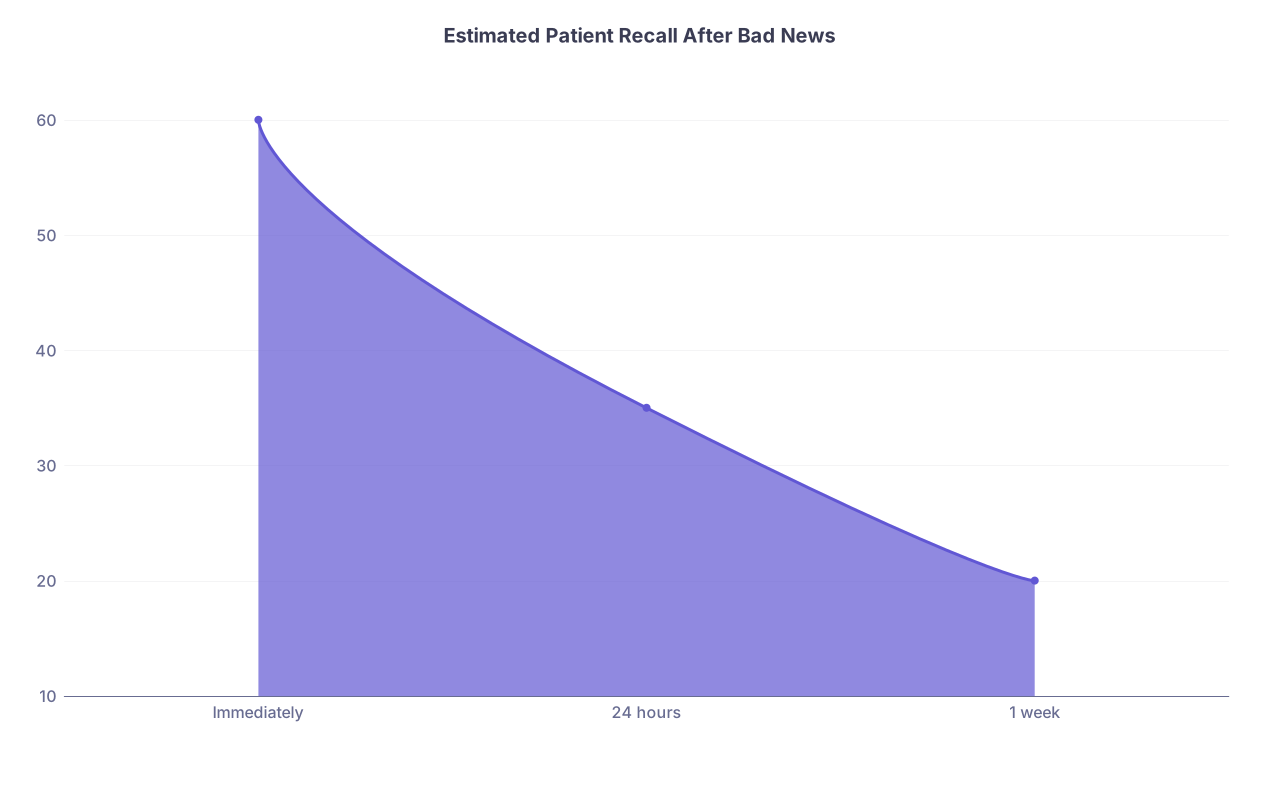
| Category | Value |
|---|---|
| Immediately | 60 |
| 24 hours | 35 |
| 1 week | 20 |
You commit the consent room trap when you behave as if that first conversation did the ethical heavy lifting. You document it, you pat yourself on the back, you move on.
The bare minimum follow‑up that most people skip
Mindful practice means building in at least one deliberate re‑touch:
- A brief bedside check the next day: “Tell me what you remember from what we discussed yesterday.”
- A phone call after discharge to clarify: “What questions have come up now that you have had time to think?”
- A scheduled family meeting where the primary surrogate can ask the questions the patient was too stunned to formulate.
You are not repeating yourself for fun. You are converting the initial, fragile “consent” into something closer to informed, shared understanding.
You avoid many downstream conflicts that way. Families yelling, “No one ever told us.” Patients saying, “I would have never agreed to this if I understood.” Often they are not lying. They truly did not encode what you thought you clearly explained.
A Quick Reality Check: How You Can Audit Yourself
If you want to know whether you are already falling into the consent room trap, do a brutal self‑audit on your last 5–10 bad‑news encounters.
Ask yourself, honestly:
| Question | Your Answer (Yes/No) |
|---|---|
| Did I truly allow them to say no to the timing? | |
| Was the setting private enough for real disclosure? | |
| Did I feel rushed or mentally elsewhere? | |
| Did I push for decisions while they were in shock? | |
| Did I schedule or perform a follow-up conversation? |
If you have more than one or two “No” answers where the answer should have been “Yes,” you are already in the trap. A lot of people are. The system practically shoves you there.
The solution is not self‑flagellation. It is conscious course‑correction.
How to Practically Do Better Without Needing a Retreat
You do not need a month‑long mindfulness retreat to stop making these errors. You need small, ruthless habits.
A few that actually work:
- Ten‑second pause at the door. Feel your feet, slow one breath, decide: “For the next X minutes, this person is the only thing in my world.”
- Always open with context, not a question. “I need to share important results about your heart. This may be hard to hear. We can do it now or wait for your partner to join us. What would you prefer?”
- Use one sentence, then silence. “The biopsy shows this is cancer.” Then count to 10 in your head before speaking again.
- Ask one grounding question instead of five cognitive ones. “What is the thing you are most worried about right now?” Then actually listen.
- Close with a built‑in follow up. “You do not have to remember all this. I will come back this afternoon / tomorrow morning so we can go over it again and answer new questions.”
These are not heroic. They are realistic. They work even on a bad call night. They protect your patients—and, frankly, your own conscience.

The Bottom Line: What You Cannot Afford to Get Wrong
You will deliver bad news thousands of times in a career. You will have good days and terrible ones. But if you want to stay both ethical and sane, you cannot keep stepping into the same trap.
Remember three things:
- Consent is not a script; it is a state. If the person is shocked, dissociated, or alone without their supports, your pristine explanation does not equal meaningful consent.
- Mindfulness is not theatre. Chairs, eye contact, and empathy phrases mean nothing if you are rushed, checked‑out, or using protocols to protect yourself instead of the patient.
- One conversation is never enough. Build in follow‑ups, explicitly share responsibility for decisions, and stop pretending that “we talked about it once” is ethically adequate.
Avoid these mistakes, and the consent room stops being a trap—for them, and for you.