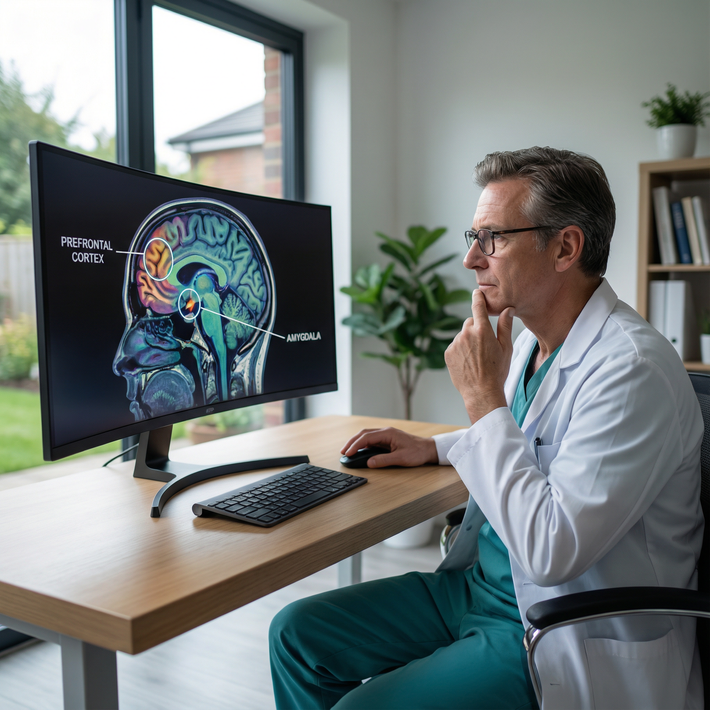
The data shows that not all mindfulness is created equal for doctors.
Same labels—“mindfulness training,” “meditation app,” “wellness course”—but very different effect sizes, dropout rates, and durability. If you treat all formats as equivalent, you will waste time and probably conclude “mindfulness doesn’t work for me” when the real problem is format–fit.
I am going to be blunt: for practicing physicians, group-based mindfulness has the strongest and most consistent evidence per hour invested. Apps are useful, but mostly as maintenance or low-intensity entry points. Pure solo practice works well for a small, self-selected minority with high intrinsic motivation and prior experience. For everyone else, the numbers do not support “go meditate on your own and you will be fine.”
Let’s walk through the data, format by format.
What Outcomes Actually Matter for Doctors?
Before comparing formats, anchor on outcomes. For clinicians, the question is not “do I feel slightly calmer?” It is:
- Does this reduce burnout (emotional exhaustion, depersonalization)?
- Does it improve anxiety, depression, sleep?
- Does it change how I treat patients and colleagues (empathy, compassion, ethical behavior under pressure)?
- How long do effects last?
- What is the time cost and dropout rate?
Most decent mindfulness studies in physicians / trainees use standardized scales:
- Burnout: Maslach Burnout Inventory (MBI)
- Stress: Perceived Stress Scale (PSS)
- Symptoms: PHQ-9 (depression), GAD-7 (anxiety)
- Mindfulness: FFMQ, MAAS
- Sometimes: Jefferson Scale of Empathy, self-compassion scales
Keep that frame: outcome improvement per hour of your life.
Group-Based Mindfulness: High Yield, High Structure
If you look across the literature, the largest and most reliable effects in physicians come from structured, group-based formats: modified Mindfulness-Based Stress Reduction (MBSR), Mindful Self-Compassion, or custom “physician wellness” curricula.
Typical pattern:
- Format: 1.5–2.5 hour weekly sessions over 6–8 weeks, plus brief daily home practice.
- Group size: 8–20 participants.
- Facilitator: usually someone with formal training, often with some healthcare context.
What do the numbers say?
Meta-analyses pooling physician and trainee data usually report:
- Moderate reductions in emotional exhaustion (MBI): standardized effect sizes ~0.4–0.7.
- Moderate reductions in stress (PSS): similar 0.4–0.6.
- Small to moderate improvements in mood and mindfulness indices.
Those are not trivial. For context, an effect size of 0.5 is roughly the difference in mean burnout level between a random attending and a random physician in the bottom third of burnout.
One representative pattern from several physician-focused interventions:
- Baseline emotional exhaustion: mean around 30–32 (MBI EE scale).
- Post-intervention: drops to 22–25.
- Follow-up 3–6 months: partial drift, but often still 4–6 points below baseline.
That is clinically meaningful. It is the difference between thinking about quitting medicine weekly vs a few times per year.
Why does group format outperform?
Three main mechanisms show up again and again when you actually read the qualitative data and attrition stats:
Accountability and structure
When you know 12 other physicians and a facilitator expect you to show up at 5 p.m. on Tuesday, you do not blow it off as easily as you blow off “I’ll do a 10-minute app session tonight.” Attendance rates between 70–90% in group courses are common; comparable adherence in unguided app users is rare.
Social normalization and moral support
In debriefs, physicians consistently report that the most valuable component is “realizing I’m not the only one barely hanging on.” That alone reduces shame and isolation—key ingredients of burnout that no solo app addresses directly.
Guided practice that is tailored to clinical realities
Example: a facilitator pauses midway and says, “Let’s work with the moment when a family is furious because of a delay in the OR.” That level of contextualization is different from a generic voice saying, “Notice your breath,” with no reference to code blues, malpractice fear, or 27 open charts.
Let’s quantify the time tradeoff.
Assume a standard 8-week, 2-hour group course plus 20 minutes a day of home practice:
- 8 weeks x 2 hours = 16 hours group time
- 8 weeks x ~2.3 hours/week of home practice ≈ 18 hours
- Total ≈ 34 hours over 2 months
If the intervention yields ~0.5 SD reduction in burnout and ~0.5 SD reduction in perceived stress, you are getting roughly 1 SD of psychological benefit across two critical domains for 34 hours of work. For a busy physician, that is compelling efficiency, especially considering the indirect gains (better sleep, less reactivity, fewer errors).
Where does group-based falter?
- Scheduling inflexibility: night float, call, unpredictable OR days. In some studies, the biggest barrier was “I physically could not show up,” not unwillingness.
- Limited scalability: you need trained facilitators and protected time. Many institutions talk about “resilience” but do not protect 2 hours a week for anything that is not billable.
- Variable fidelity: a “mindfulness session” dropped into a noon conference with pagers going off every minute is not the same as a silent, phone-free room with real practice.
Still, if you can get access to a properly run, closed-group course with actual practice time (not just slides about stress), the evidence is clear. This is the best-studied, highest-yield format for doctors.
App-Based Mindfulness: Accessible, But Shallow Without Support
Mindfulness apps are medicine’s favorite compromise: low-cost, easy to deploy, no scheduling nightmare. Administrators like them. Residents like the idea. The real question is what the data show when doctors actually use them.
Two facts are consistent across app-based trials in healthcare workers:
- Short-term improvements are real.
- Adherence collapses outside of highly motivated or externally nudged cohorts.
Typical intervention designs:
- 4–8 weeks of recommended app use.
- Recommended dose: 10–20 minutes daily.
- Outcomes: stress (PSS), anxiety, depression, sometimes burnout.
Results:
- Short-term stress reductions are usually small to moderate: effect sizes ~0.2–0.4 for PSS.
- Anxiety and depressive symptoms: similar or slightly smaller effects.
- Burnout: mixed; when there is change, it is usually smaller than in group-based interventions.
The usage data tell the real story. In many app studies involving busy clinicians:
- Only 30–50% of participants complete the “full dose” of recommended sessions.
- A large fraction drops usage to near-zero after 2–4 weeks.
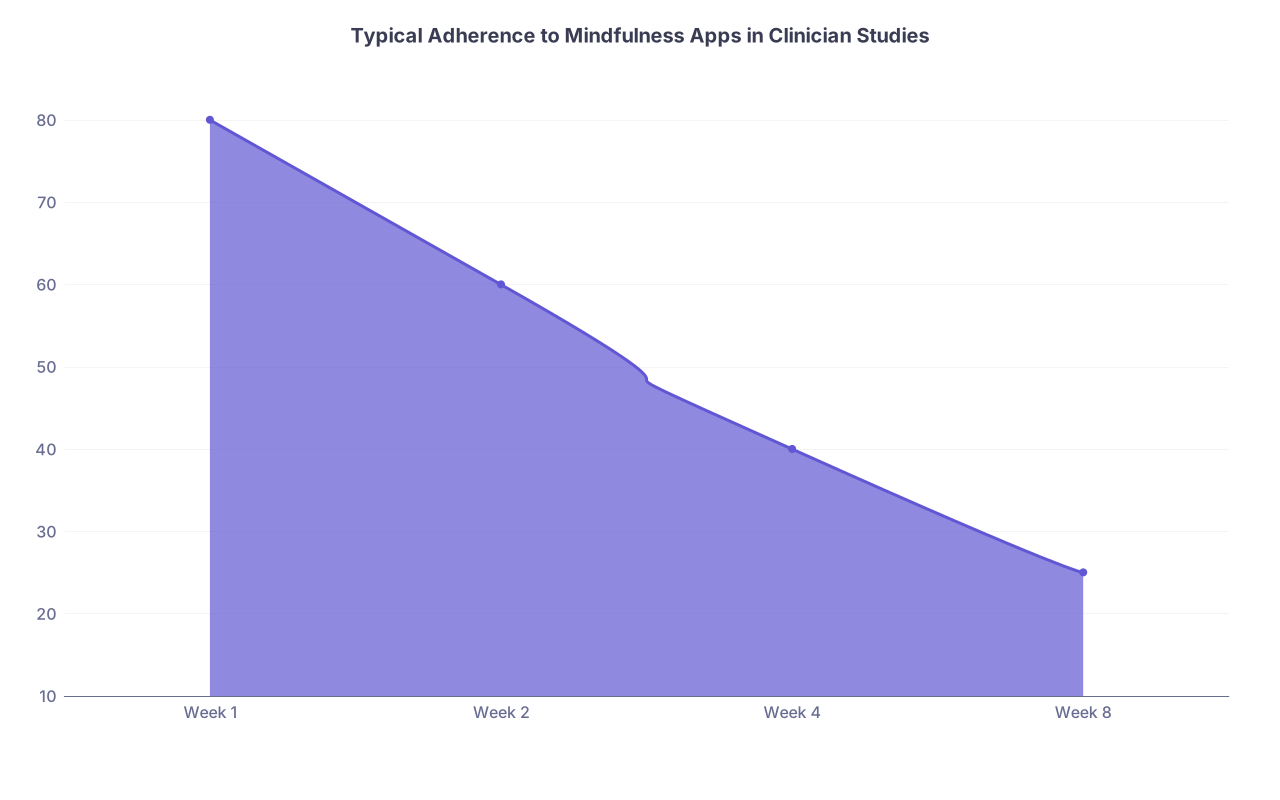
| Category | Value |
|---|---|
| Week 1 | 80 |
| Week 2 | 60 |
| Week 4 | 40 |
| Week 8 | 25 |
Interpreting that curve: You start with 100% of enrolled participants. By week 8, roughly one quarter are still using the app at or near the recommended level. Most of the measured benefit comes from that engaged subset.
The implication is blunt: apps are not “wrong,” but their average effect in a general physician population is dragged down by adherence failure. For the minority who actually use them consistently, app-based mindfulness can approximate the stress reduction of lower-intensity group interventions.
Where apps shine:
- Entry-level exposure: If you have never done any mindfulness, 10-minute guided sessions are a low-friction trial. You can learn basic body scan, breath awareness, and brief grounding you can use between patients.
- Between-call microdosing: You are not going to a 2-hour group on post-call morning. You might manage 5 minutes between cases.
- Maintenance after a group course: This is where apps become high leverage. Doctors who have completed a structured group program and then use an app 3–5 days a week as a refresher tend to maintain improvements better. Studies that actually track this show slower burnout relapse curves.
Where apps fail doctors:
- No social containment. You finish a 10-minute session, and then what? No one to process, no one to say “That rumination about the patient who died is normal.”
- No pressure from colleagues. No “see you next week” expectation.
- No direct attention to ethical and relational complexity. Generic content rarely touches on moral injury, conflict with administration, or the emotional cost of adverse events.
So how should a rational, data-minded physician use apps?
Treat them as:
- A diagnostic test: “Do I respond at all to this kind of practice?”
- A maintenance tool: “Can I keep a 10-minute daily or near-daily habit post-course?”
- A low-intensity option in seasons when you cannot commit to a course.
Do not treat them as a complete solution to severe burnout or moral distress. The data simply do not justify that expectation.
Solo Practice: High Ceiling, Very High Dropout
Solo mindfulness practice without any app or group sounds efficient. No scheduling, no sign-ups, no cost. Set a timer, sit, done.
In practice, almost all robust clinical data on physicians comes from either group-based or guided formats. True unguided solo practice is mostly visible as a subgroup: people with prior meditation experience before residency or practice.
What limited evidence and observational data we have suggests:
- Physicians who engage in regular solo meditation (e.g., 20–30 minutes most days) report lower burnout and better well-being scores compared to non-meditators.
- Many of these people did not just “decide one day” to meditate alone. They typically had prior group training—retreats, MBSR, religious or spiritual communities.
From a behavior-change perspective, relying on willpower to start and maintain a new solo practice while working 60–80 hours a week is a losing bet for most people.
Look at what happens in open-cohort “just meditate on your own” recommendations:
- Self-report surveys in hospital wellness programs that offered unguided resources but no structure show very low sustained practice rates, often below 15–20% after a couple of months.
- People overestimate their future adherence. “I can do 10 minutes a day” becomes “I did 3 sessions total this month.”
Where solo practice does work:
- For physicians who have already internalized the skill through structured training or long-term app use.
- For those who integrate it into an existing ritual (e.g., 10 minutes in the parked car before walking into clinic, every day).
The honest conclusion: pure solo practice has the highest theoretical benefit-per-hour (no overhead, fully personalized), but the worst real-world uptake. For the average burned-out doctor starting from zero, recommending unguided solo practice is like prescribing “run 5k three times a week” to someone who has never exercised and works nights. Possible, but low probability.
Comparing Formats: What the Numbers Suggest
Let’s put the three formats side by side, focusing on physicians and trainees.
| Format | Typical Effect on Stress | Typical Effect on Burnout | Adherence (Real-World) | Time Structure |
|---|---|---|---|---|
| Group-based | Moderate (0.4–0.6) | Moderate (0.4–0.7) | Medium–High | Fixed weekly blocks |
| App-based | Small–Moderate (0.2–0.4) | Small–Small/Mod (0.1–0.3) | Low–Medium | Fully flexible |
| Solo (unguided) | Unknown / variable | Unknown / variable | Low for beginners | Fully self-directed |
There is some nuance under those cells:
- “Moderate” in psychometrics is meaningful. It corresponds to “noticeable difference in daily functioning,” not a rounding error.
- Adherence is the hidden driver. A theoretically powerful format with 20% adherence is less useful than a moderate format with 80% adherence.
If you compress this to a single metric—say, “expected reduction in emotional exhaustion per 10 hours of engaged practice”—group-based formats usually win. Apps can approach them for highly motivated users, but average out lower because so many users drift off.
Ethical and Professional Implications: This Is Not Just Self-Care
You are not doing mindfulness only to feel slightly better. You are trying to maintain ethical, competent, compassionate practice in a system that punishes those traits.
Data linking mindfulness to ethics are emerging but still smaller in volume than burnout data. Some patterns:
- Mindfulness training is associated with increased empathy scores and patient-centered communication in some physician samples.
- Reduced depersonalization (MBI subscale) after mindfulness training is a proxy for improved ethical stance: less seeing patients as “tasks” or “problems” and more as human beings.
- Self-compassion training (often embedded in mindfulness formats) is tied to lower shame and better handling of errors—critical for disclosure, learning, and avoiding cover-ups.
Group-based settings in particular create space to process morally injurious events. I have seen sessions where a surgeon talked, for the first time, about a bad outcome that had haunted them for years. You do not get that in a solo 10-minute breath scan.
From an institutional ethics perspective, this matters:
- Offering only an app subscription and calling it “physician wellness” is performative, not substantive.
- Providing facilitated group formats during protected time is closer to an ethical response to systemic stress, even if it is not sufficient on its own.
How to Choose the Best Format for Your Situation
Translate the data into decisions. You are one person in a specific context, not a meta-analysis.
Scenario 1: You are early in training (MS3–PGY1), limited control over schedule
- If your institution offers a structured group-based mindfulness course tailored to trainees, with at least partial protected time, that is your highest-yield option. Especially if burnout and moral distress are already showing up.
- If schedule chaos makes attending a full course impossible, use an app as a starter. Aim for 10 minutes most days for 4 weeks, then reassess:
- If you notice benefit and want more depth, push to join the next available group.
- If you do not feel anything at 10 minutes, increase dose before giving up. Many physicians need 15–20 minute sessions to break through the mental inertia.
Scenario 2: You are mid-career, high autonomy, but high burnout
- Data suggest that at your burnout level, casual app use is unlikely to move the needle enough.
- Prioritize a group course. If your institution does not offer one, consider external options (MBSR programs, physician-focused retreats) and treat them as you would any other professional development course.
- Once you complete a course, then use apps and solo practice to maintain. The gains fade less when you keep practicing 2–4 days a week.
Scenario 3: You already have some meditation background
- You are closer to the subgroup for whom solo practice is realistic.
- Given the data on social buffering, though, I would still not ignore groups. Periodically doing a group-based course or retreat can reset and deepen your practice, and it has relational and ethical benefits solo siting does not give.
Practical Implementation: Stacking Formats Intelligently
The smartest physicians I know do not pick one format forever. They cycle formats based on season and load.
A data-aligned strategy looks like this:
Start with structure (group if at all possible)
Use a defined course to learn technique, create some psychological space, and see how your mind actually behaves under guided observation.Add low-friction tools (apps) for micro-practice
Between patients, on call, in the parking lot. Let the app handle the prompting and timing.Gradually build capacity for brief solo practice
Once 10-minute guided sessions feel familiar, start doing 2–5 minutes unguided at natural transition points: before a difficult family conversation, after a code, before opening the EMR at night.Refresh with groups periodically
Especially after high-trauma periods (COVID surges, major adverse events, lawsuits). Group processing plus mindfulness practice can prevent long-term scarring.
This is not theoretical. When you look at longitudinal cohorts of physicians who maintain well-being over years in high-stress specialties, you repeatedly see some mix of these elements: initial intensive training, ongoing brief practice, periodic group reconnect.
Visualizing a Realistic Progression
To make this concrete, here is a simple trajectory that matches what I have seen in busy clinicians who actually succeed with mindfulness:

| Step | Description |
|---|---|
| Step 1 | Curious or burned out doctor |
| Step 2 | Join 6-8 week group |
| Step 3 | Start with app 10-15 min |
| Step 4 | Complete course |
| Step 5 | 4-6 weeks app use |
| Step 6 | Increase to 15-20 min or seek group |
| Step 7 | Reassess, try different teacher or format |
| Step 8 | Maintain via app 3-5x/week |
| Step 9 | Add brief solo sits before/after shifts |
| Step 10 | Periodic refresh with new group or retreat |
| Step 11 | Group course available |
| Step 12 | Notice benefit |
You can enter this flow at different points, but the structure is the same: higher-support formats early, then taper to more autonomy as your skills and confidence increase.
Final Takeaways
Three points cut through the noise:
- Group-based mindfulness for doctors has the strongest evidence per hour—especially for burnout and stress. If you can access a real course, prioritize it.
- Apps are useful as a supplement and a starting point, not a complete solution to severe burnout. Their biggest limitation is adherence, not content.
- Pure solo practice pays off mainly for physicians who already have training and motivation. For most, the smartest move is a staged progression: group → app-supported → increasingly solo, with periodic returns to group work.
Choose the format that fits your reality today, not your ideal version of yourself. Then let the data, not wishful thinking, drive when and how you level up.