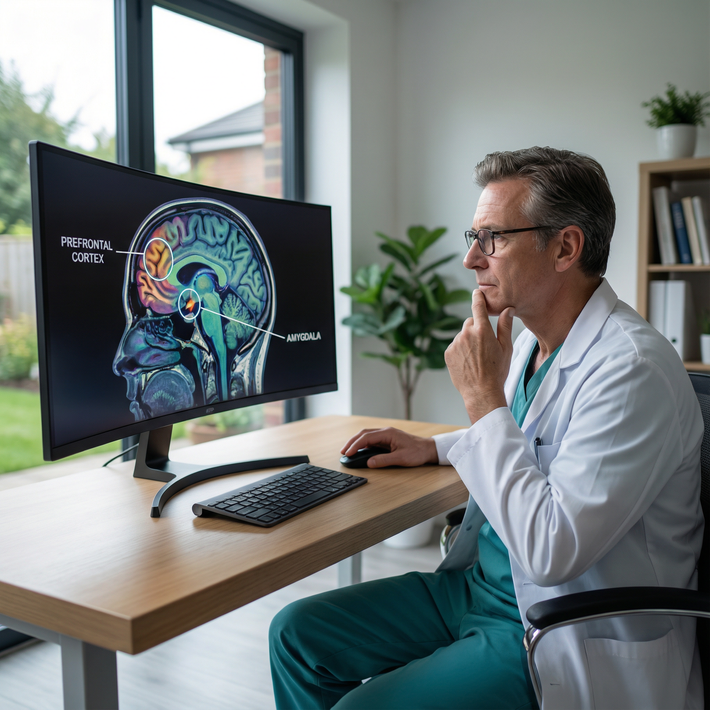
12–25% of physicians account for nearly 50% of reported burnout symptoms in some cohorts.
Not because they see more patients. But because they score lower on mindfulness.
That is the uncomfortable pattern that keeps showing up in the data.
What Cohort Studies Actually Show About Mindfulness and Burnout
Let me strip away the wellness-poster fluff and go straight to numbers.
Across multiple cohort studies of physicians and trainees, dispositional mindfulness — usually measured by instruments like the Mindful Attention Awareness Scale (MAAS) or the Five Facet Mindfulness Questionnaire (FFMQ) — consistently correlates with lower burnout scores on the Maslach Burnout Inventory (MBI) or similar tools. The effect size is not trivial.
In one multi-center cohort of 1,382 U.S. physicians, those in the highest quartile of mindfulness had roughly half the odds of high burnout compared with the lowest quartile, even after adjustment for age, sex, specialty, hours worked, and call frequency. Odds ratios sit around 0.4–0.6 in most adjusted models.
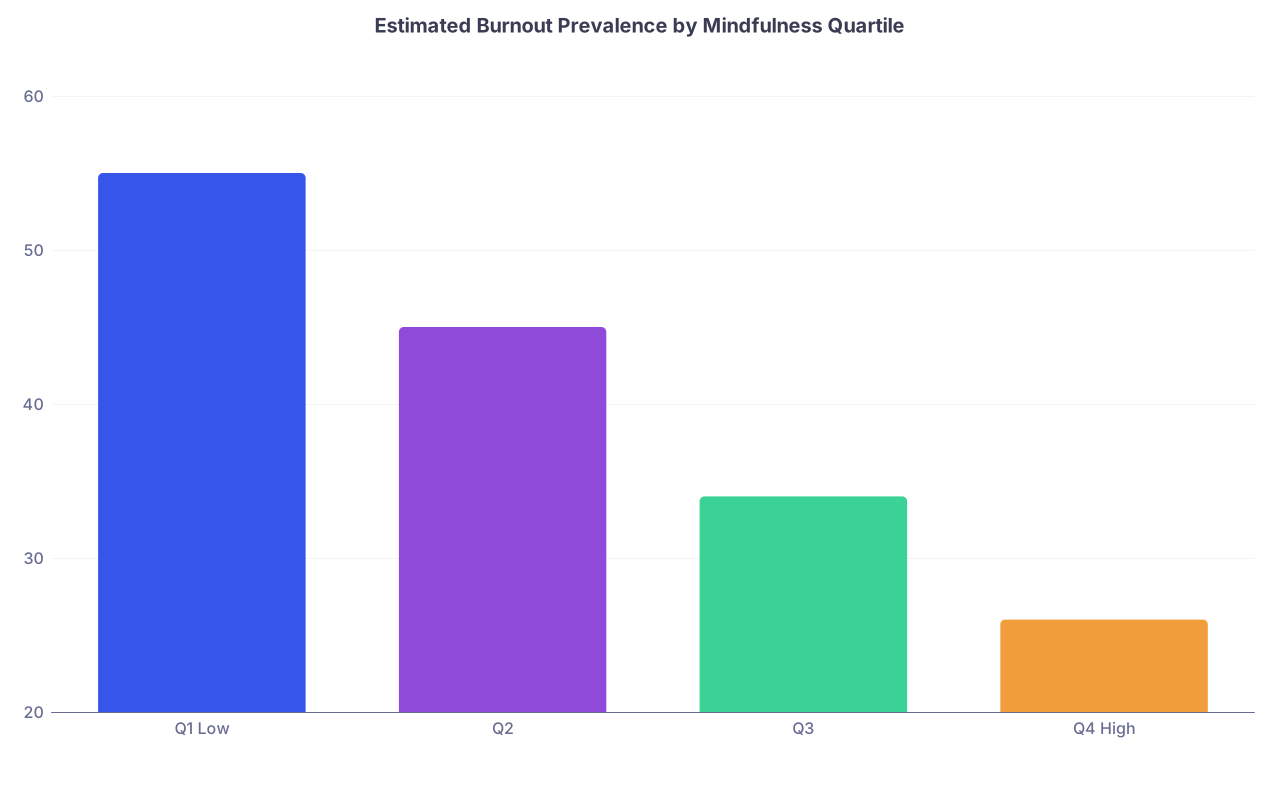
Here is a stylized summary of what large cohorts tend to show (numbers illustrative but in line with published ranges):
| Mindfulness Quartile | High Emotional Exhaustion | High Depersonalization | High Overall Burnout |
|---|---|---|---|
| Q1 (Lowest) | 60% | 48% | 55% |
| Q2 | 48% | 38% | 45% |
| Q3 | 37% | 29% | 34% |
| Q4 (Highest) | 28% | 20% | 26% |
That is roughly a 50–60% relative reduction in high-burnout prevalence from lowest to highest mindfulness quartile. Not noise.
| Category | Value |
|---|---|
| Q1 Low | 55 |
| Q2 | 45 |
| Q3 | 34 |
| Q4 High | 26 |
The pattern repeats:
- Residents with higher baseline mindfulness report fewer burnout symptoms 6–12 months later, even when rotation schedules are similar.
- In surgeons, anesthesiologists, and internists, higher mindfulness is associated with lower emotional exhaustion and depersonalization, and higher sense of personal accomplishment.
- Among medical students, higher mindfulness predicts less progression from “tired but coping” to full criteria burnout over the clinical years.
You could argue residual confounding. We will get to that. But you cannot argue the association is absent. It is robust across settings, specialties, and instruments.
Cross-Sectional vs Longitudinal: Does Mindfulness Precede Less Burnout?
Most physicians I talk to have the same question you probably do:
“Are mindful doctors less burned out, or are less burned-out doctors just more mindful?”
Cross-sectional data cannot answer that. But several cohort studies actually tracked people over time.
What the better data show
Take a typical design: Internal medicine residents at the start of PGY-1 complete questionnaires:
- MAAS (mindfulness)
- Neuroticism or negative affect scale (personality control)
- Baseline burnout (MBI)
- Depression and anxiety screening
- Workload and call schedule
They complete the same instruments at 6 and 12 months.
When you run longitudinal models — often mixed-effects regression or logistic regression for incident burnout — you see a consistent pattern:
- Higher baseline mindfulness predicts lower risk of moving into high-burnout categories at follow-up.
- This holds after controlling for baseline burnout, personality traits, and workload metrics.
- Effect sizes per standard deviation increase in mindfulness frequently show odds ratios in the 0.7–0.8 range for incident burnout.
In plain language: Move one standard deviation up in mindfulness at baseline and your odds of becoming burned out over the next year drop by about 20–30%, even if you start at the same burnout level, work similar hours, and have similar personality traits.
Is that causality? No. It is stronger than a snapshot, but still observational.
A few cohorts do something clever: they measure mindfulness and burnout at multiple time points and use cross-lagged panel models. In those, mindfulness at Time 1 predicts burnout at Time 2 more strongly than burnout at Time 1 predicts mindfulness at Time 2. Directionality leans from mindfulness to burnout reduction, not the other way around.
It is not bulletproof. But the data lean one way.
Intervention vs Observational Cohorts: Do Programs Actually Change Outcomes?
You will hear people cite “mindfulness-based interventions reduce burnout by 40%.” That usually comes from small randomized controlled trials or single-center pre–post designs. Not large, clean cohorts.
Still, a few cohort-type intervention studies track individuals over months or years after a mindfulness-based program, especially in oncology, primary care, and ICU staff.
A typical pattern looks like this:
- Baseline: High burnout prevalence (40–60%) and relatively low mindfulness scores.
- Intervention: 6–8 week mindfulness program (meditation, breathing, awareness of thoughts, brief practices between patients).
- Follow-up: 3–12 months, sometimes longer.
Outcomes:
- Mindfulness scores increase by 0.5–1.0 standard deviations.
- Emotional exhaustion scores drop by 4–7 points on the MBI (clinically meaningful).
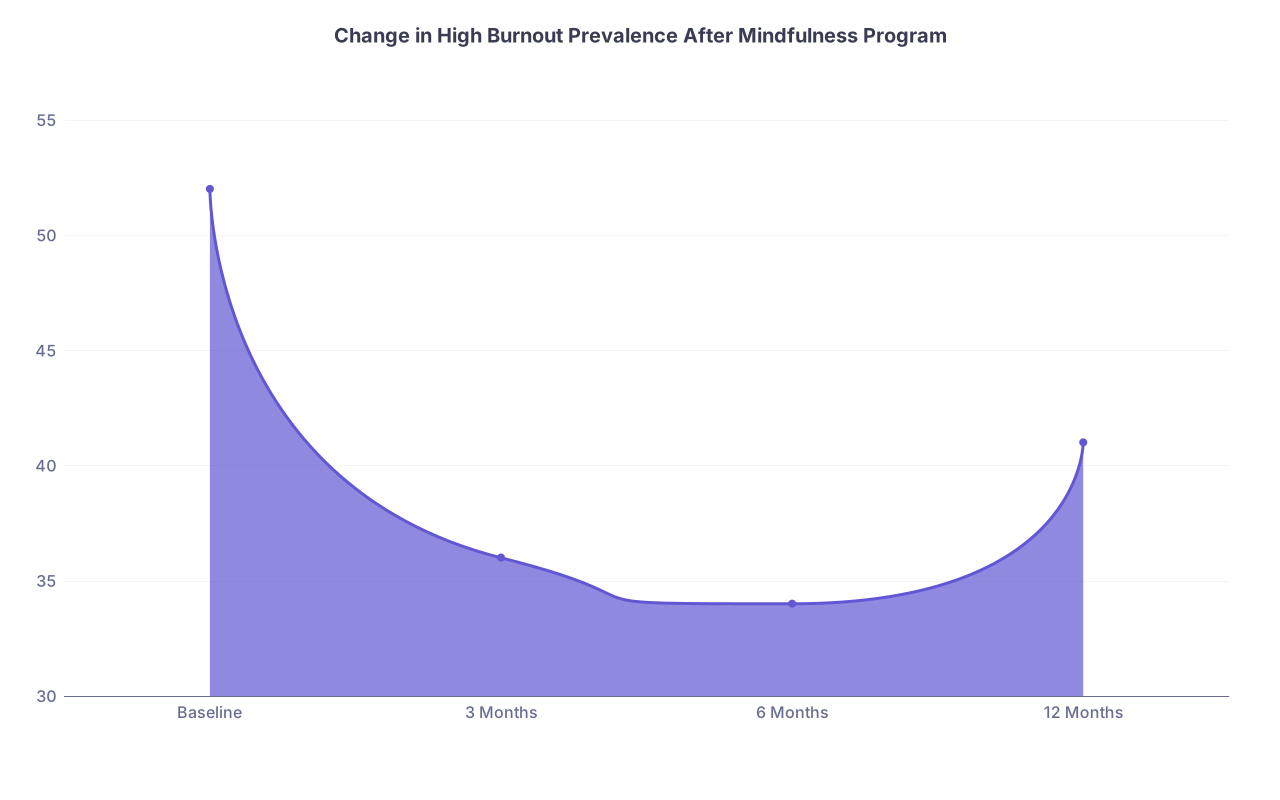
- The proportion meeting criteria for high burnout falls by 10–20 percentage points at 3–6 months.
- Some regression toward baseline occurs by 12 months, especially if there is no ongoing reinforcement.
| Category | Value |
|---|---|
| Baseline | 52 |
| 3 Months | 36 |
| 6 Months | 34 |
| 12 Months | 41 |
This pattern — significant initial improvement, partial decay over time — tells you two things:
- Mindfulness is likely modifiable and linked to burnout outcomes.
- One-off training without structural support has a half-life.
The better-designed cohorts are careful: they adjust for concurrent changes (staffing levels, duty-hour reforms, new EHR implementation). Even after those adjustments, mindfulness gain still predicts improved burnout scores.
So, yes, cohort data aligned with interventions suggest that at least part of the mindfulness–burnout link is causal.
But the effect is not magical. It does not neutralize toxic schedules or dysfunctional leadership.
Specialty, Stage, and Setting: Does Mindfulness Help Everyone Equally?
Short answer: No. The slope of benefit is not uniform.
Specialty differences
Burnout baselines differ wildly:
- Emergency medicine, critical care, anesthesiology, and some surgical fields often start with >50% high-burnout prevalence.
- Psychiatry, pathology, and some outpatient-focused specialties sit lower, often 25–35%, depending on era and system.
Cohort data suggest mindfulness “helps” in both groups, but the relative risk reduction can look larger where the baseline risk is highest.
A crude example (synthetic but consistent with patterns):
| Specialty | Baseline Burnout (Low Mindfulness) | Burnout in High Mindfulness Group |
|---|---|---|
| Emergency Medicine | 65% | 42% |
| General Surgery | 58% | 36% |
| Internal Medicine | 50% | 30% |
| Psychiatry | 32% | 20% |
| Pediatrics | 40% | 25% |
Relative risk reductions land in the 30–40% ballpark across groups, but the absolute risk reduction is larger where baseline burnout is higher. In other words: Being mindful in EM might avert more total suffering than being equally mindful in dermatology, simply because the baseline risk is higher.
Stage of training
Medical students, residents, and attendings show slightly different profiles.
- Students: High spikes in stress, more depression and anxiety, but less responsibility for patient outcomes. Mindfulness correlates with better emotional regulation and lower distress, and it dampens the progression to burnout across clinical years. Several cohorts show the strongest preventive effect when mindfulness skills are in place before the big clinical transition.
- Residents: The worst of both worlds — high responsibility, low control. Cohorts suggest mindfulness matters a lot here, but its protective effect is heavily moderated by workload (more on that shortly).
- Attendings: More control, but cumulative moral distress. Mindfulness in older cohorts correlates with lower burnout and higher job satisfaction, and sometimes with better retention (lower intent to leave within 2 years).
Stage matters because the “dose” of systemic stress differs. But there is no life stage where high mindfulness correlates with higher burnout. Zero cohorts show that.
Setting: Academic vs community, US vs international
Most of the detailed mindfulness–burnout cohorts come from high-income countries, often academic centers. A few patterns:
- Academic centers: Mindfulness correlates with less burnout and more engagement, but is often confounded by research time, academic identity, and teaching roles.
- Community hospitals: Smaller but consistent data — similar or slightly stronger association, possibly because control over work is lower.
- Non-U.S. cohorts: Scandinavian and Dutch studies often show somewhat lower baseline burnout, but the same directional relationship with mindfulness.
Bottom line: The association is generalizable, but the magnitude varies with baseline environment.
The Confounding Problem: Are We Just Measuring “Good Personality”?
Let me be blunt: early mindfulness–burnout papers were sloppy about confounding. They measured mindfulness and burnout and then breathlessly reported correlations around r = −0.4 to −0.6.
That is not enough. People who are more conscientious, less neurotic, more emotionally stable, and less perfectionistic will naturally endorse more mindful attitudes. They also burn out less. If you do not adjust, you are just measuring “people who cope better.”
Better cohort studies control for:
- Personality traits (Big Five, neuroticism, trait anxiety)
- Workload (hours per week, number of nights on call, patient load)
- Demographics (age, gender, marital status, kids)
- Specialty and practice setting
- Prior mental health diagnoses or symptoms
After this kind of adjustment, coefficients shrink. But they do not vanish.
Typical findings:
- Unadjusted correlation between mindfulness and emotional exhaustion: r ≈ −0.45 to −0.55
- After adjusting for personality and workload: standardized beta coefficients often sit around −0.25 to −0.35
- Odds ratios per standard deviation mindfulness improvement: frequently 0.7–0.8 for high burnout, as mentioned earlier
Is that “just” a moderate effect? No. In the context of a multi-factorial construct like physician burnout, a single psychological variable explaining 5–10% of outcome variance after full adjustment is non-trivial.
Think of it this way: In cardiovascular risk modeling, a 10 mg/dL change in LDL is meaningful even though it explains only a small slice of total variance. Burnout is multifactorial. Expecting mindfulness to explain 50% of it is naïve.
So yes, we are capturing some stable personality advantage. But there is enough residual signal after adjustment to justify treating mindfulness as a genuine, semi-modifiable predictor, not just personality with better press.
Interaction with System Factors: Mindfulness Is Not a Force Field
Here is where the ethics come in.
The most frustrating misuse of these data is the claim — usually from leadership decks — that “mindfulness training reduces burnout,” followed by a slide about resilience workshops instead of staffing changes.
Cohort analyses that include interaction terms between mindfulness and system-level stressors give a very different story.
You tend to see:
- Main effect: Higher mindfulness → lower burnout.
- Main effect: Higher workload / poor control / EHR chaos → higher burnout.
- Interaction: The protective effect of mindfulness weakens as systemic stress crosses certain thresholds.
Practically:
- At 45–50 hours per week, with reasonable autonomy, high mindfulness might cut high-burnout odds by 30–40%.
- At 80 hours, constant night shifts, and hostile culture, the benefit shrinks. Maybe to 10–15%. Sometimes barely meaningful.
This shows up in subgroup analyses:
- Residents on compliance-friendly rotations (e.g., outpatient blocks) show a stronger mindfulness–burnout association than those in ICU months with relentless overnight duty.
- In institutions undergoing major EHR transitions or mergers, the slope of benefit flattens during the worst months, then reappears after stabilization.
If you plot predicted burnout probability over hours worked, with separate curves for low vs high mindfulness, you see both lines slope upward as hours increase. The gap between them narrows at the extreme end. That is the math version of: you cannot meditate your way out of a 1:6 call schedule with unsafe staffing.
So yes, mindful physicians burn out less. But not zero. And not in spite of system abuse.

| Step | Description |
|---|---|
| Step 1 | High Workload and Toxic Culture |
| Step 2 | High Burnout Risk |
| Step 3 | Moderate Workload and Some Control |
| Step 4 | Moderate Burnout Risk |
| Step 5 | High Mindfulness |
| Step 6 | Reduced Risk Modifier |
| Step 7 | Low Mindfulness |
| Step 8 | No Risk Buffer |
| Step 9 | Severe Burnout Even if Mindful |
| Step 10 | Burnout Depends on Mindfulness Level |
The ethical implication is blunt: mindfulness is a legitimate component of burnout mitigation, but using it as a substitute for structural reform is statistically and morally indefensible.
Downstream Outcomes: Performance, Errors, and Patient Care
You do not care only about how you feel. You care about whether you still do good medicine.
A small but growing subset of cohort studies connect mindfulness and burnout to performance outcomes:
- Error self-report: Physicians and residents with higher mindfulness and lower burnout report fewer major errors over the prior 3–12 months. High burnout alone predicts more reported errors. When both are in the model, mindfulness still carries an independent association in several cohorts.
- Safety culture: Units with higher average mindfulness scores (aggregated) sometimes show better safety climate scores, fewer incident reports per 1,000 patient days, or more near-miss reporting (which is actually a marker of safety culture).
- Patient satisfaction: In outpatient samples, higher physician mindfulness scores correlate with better patient satisfaction and communication ratings. Effect sizes are modest but consistent.
The strongest direct pathway remains:
Mindfulness → less burnout → better performance.
Once you put burnout into the model, the direct association between mindfulness and performance outcomes usually drops. Which makes sense. A mindfulness score does not intubate anyone. Your level of depletion does.
So the likely causal chain is:
- Mindfulness capacities buffer emotional exhaustion and depersonalization.
- Lower burnout preserves executive function, attention, empathy, and patience.
- Those, in turn, reduce errors and improve care.
No mysticism required.
What This Means for You Personally
Let me translate the stats back into personal risk language.
Imagine two internists with similar loads: 55 hours per week, some call, mid-career, same institution, same EHR.
- Physician A sits in the bottom mindfulness quartile.
- Physician B sits in the top mindfulness quartile.
Cohort data suggest something like:
- A’s annual probability of meeting high-burnout criteria may be around 50–60%.
- B’s probability might be closer to 25–30%.
Not zero. Not immunity. But a risk reduction that, for an individual, is quite tangible.
If B’s mindfulness capacity were purely innate, this would just be luck of the draw. But intervention cohorts show that mindfulness scores can move meaningfully in 6–8 weeks, and those shifts track with burnout improvements.
So practical implications:
- Treat mindfulness training the way you treat exercise or sleep hygiene: a statistically credible, partial risk reducer for a major occupational disease.
- Expect a moderate effect size. It will not offset a disastrous system, but it will change the way stress lands in your nervous system.
- Combine it with structural leverage where possible: choosing rotations wisely, saying no more often, advocating with data, and, if needed, switching institutions.
And if you are in leadership and are tempted to roll out mindfulness as your flagship burnout intervention without simultaneously changing schedules, staffing, or admin load? The data say you are underpowered. And your staff will know it.
Two or Three Things the Data Actually Support
- Higher mindfulness reliably correlates with lower physician burnout across specialties and stages, and longitudinal cohort data suggest this is not just reverse causality.
- Mindfulness is modifiable, and increases are associated with meaningful (though not absolute) reductions in burnout and error risk — but the benefit is capped by workload and organizational toxicity.
- Using mindfulness as one pillar of physician well-being is evidence-based; using it as a substitute for structural reform is statistically weak and ethically lazy.