
What exactly happens to the therapeutic relationship when you turn a patient visit into a story about your own meditation practice?
You probably already know the party line: “Be authentic. Share your mindfulness journey. It builds trust.”
That half-truth is driving a lot of quiet damage in exam rooms.
I have watched well‑intentioned clinicians—smart, kind, genuinely committed to mindfulness—wreck rapport, blur boundaries, and even trigger complaints to leadership because they misunderstood one thing:
Mindfulness in medicine is about your presence, not your personal practice story.
When you over‑share your mindfulness practice with patients, you make a predictable set of mistakes. They are avoidable. But only if you see them clearly.
Let’s walk through the big traps before you step in them.
Mistake #1: Turning the Visit Into Your Mindfulness Testimonial
The most common—and most costly—error is subtle: using patient time to talk about you.
It usually starts innocently:
- “When I struggled with anxiety, meditation really helped me…”
- “On my last retreat, I learned a practice that changed everything…”
- “In my own mindfulness journey, I realized that pain is mostly perception…”
You probably think you’re normalizing, building connection, destigmatizing. Sometimes you are.
But very often, you are doing something else:
You are shifting the center of gravity from their suffering to your story.
Red flags you are over‑sharing
You have crossed a line when:
- You are talking more about your experience of mindfulness than theirs.
- You feel a little rush—almost like you are giving a talk, not doing a visit.
- The patient looks more polite than engaged.
- You catch yourself using phrases you also use in presentations or workshops.
- You are correcting or reframing their experience based on mindfulness concepts you like.
That last one is dangerous.
“I hear that you’re in a lot of pain, but remember, pain is just sensations plus resistance.”
I have heard that sentence. Out of a physician’s mouth. To a patient with metastatic cancer.
That is not “mindful medicine.” That is spiritualized minimization.
Why this is ethically shaky
This mistake collides with several core principles:
- Beneficence: Patient time must be used for their benefit, not your self‑expression.
- Non‑maleficence: Minimizing or reframing too aggressively can feel like gaslighting.
- Respect for autonomy: Patients did not consent to being an audience for your inner life.
Worst of all, patients will not usually confront you about it. They just do not come back.
Mistake #2: Blurring Professional Boundaries Under the Banner of “Authenticity”
There is a growing culture in medicine that worships “authentic self.”
I support authenticity. I am not interested in robotic doctors.
But authenticity with patients has limits. And mindfulness talk is a fast way to blow past them.
I have seen clinicians share:
- The exact details of their own panic disorder and medication history.
- Their divorce and how mindfulness “saved” them.
- Their trauma history and how retreats “healed their inner child.”
- Their spiritual or religious beliefs wrapped in mindfulness language.
That is not boundary‑aware authenticity. That is leakage.
The quiet harm of “too much information”
Patients do not need to carry your story on top of their own. When you over‑share:
- They may feel obligated to comfort you (“Wow, that must have been hard for you, doc”).
- They may censor themselves, not wanting to “trigger” your stuff.
- They may lose confidence in your clinical objectivity.
- They may feel pulled into a quasi‑friend role instead of patient.
None of this is what they signed up for.

Clear line: self‑disclosure must serve their needs, not yours
Ask one brutal question before you share anything personal:
Am I saying this mostly to help them right now, or because it feels good to reveal me?
If you feel the slightest emotional relief in “finally talking about it,” stop. That is for your therapist, peer group, or supervisor. Not your patient.
Holding your own experience with discipline is part of ethical practice. Mindfulness is supposed to strengthen that discipline, not dissolve it under the excuse of being “real.”
Mistake #3: Imposing Mindfulness As If It Were a Neutral Clinical Tool
Mindfulness is not morally or culturally neutral. It has roots, meanings, and implications.
Yet I routinely hear:
- “Everyone can benefit from mindfulness.”
- “Meditation is just like going to the gym for the mind.”
- “This is evidence‑based, so it is not religious.”
Those statements are oversimplified. And they set you up to unintentionally coerce patients toward a practice that may conflict with their values, history, or beliefs.
Where this goes wrong in real clinics
Classic scenarios:
- A devout religious patient hearing mindfulness as a competing spiritual system.
- A trauma survivor being told to “sit with their body sensations” without proper titration.
- A patient with psychosis or dissociation pushed into body scans that make symptoms worse.
- A skeptical or science‑only patient feeling subtly judged for not wanting to meditate.
You may never hear the worst fallout directly. They just stop meditating. Or stop seeing you.
But sometimes you do hear it. I have heard versions of:
- “My last doctor kept bringing up meditation like it was a cure‑all. I felt pushed.”
- “She told me if I really committed to mindfulness I might not need meds.”
That last one moves you dangerously close to non‑standard care if you are not careful.
Evidence is real. But limited.
Yes, there is solid evidence for mindfulness‑based interventions—for specific conditions, in specific formats, delivered with training.
No, that does not justify treating your personal practice as a universally appropriate treatment you can casually recommend to everyone.
This is where many clinicians hide behind a sloppy understanding of “evidence‑based.”
Mindfulness is an adjunct, not a substitute for standard care, unless you are operating inside a structured, validated program with proper consent and oversight.
Mistake #4: Using Mindfulness Language To Dodge Real Clinical Work
Another quiet misuse: weaponizing mindfulness buzzwords to sidestep hard tasks.
I have heard clinicians say:
- “Let’s just be with what is” — instead of exploring pain control options.
- “Notice the anxiety and let it pass” — instead of discussing medication or therapy referrals.
- “Can you accept this moment exactly as it is?” — to a patient needing social work help, not spiritual framing.
This is not mindfulness. This is avoidance in a mindfulness costume.
Why this is so tempting
You are overbooked. Burned out. You have 15 minutes and three problems per visit.
Mindfulness phrases feel elegant. Wise. Efficient.
One well‑placed line about “acceptance” and you can move on.
But the patient hears:
- “Your suffering is yours to manage internally.”
- “If you struggle, it is because you are not accepting enough.”
- “We are done here; I do not have more to offer.”
That is ethically lazy. It also destroys trust.
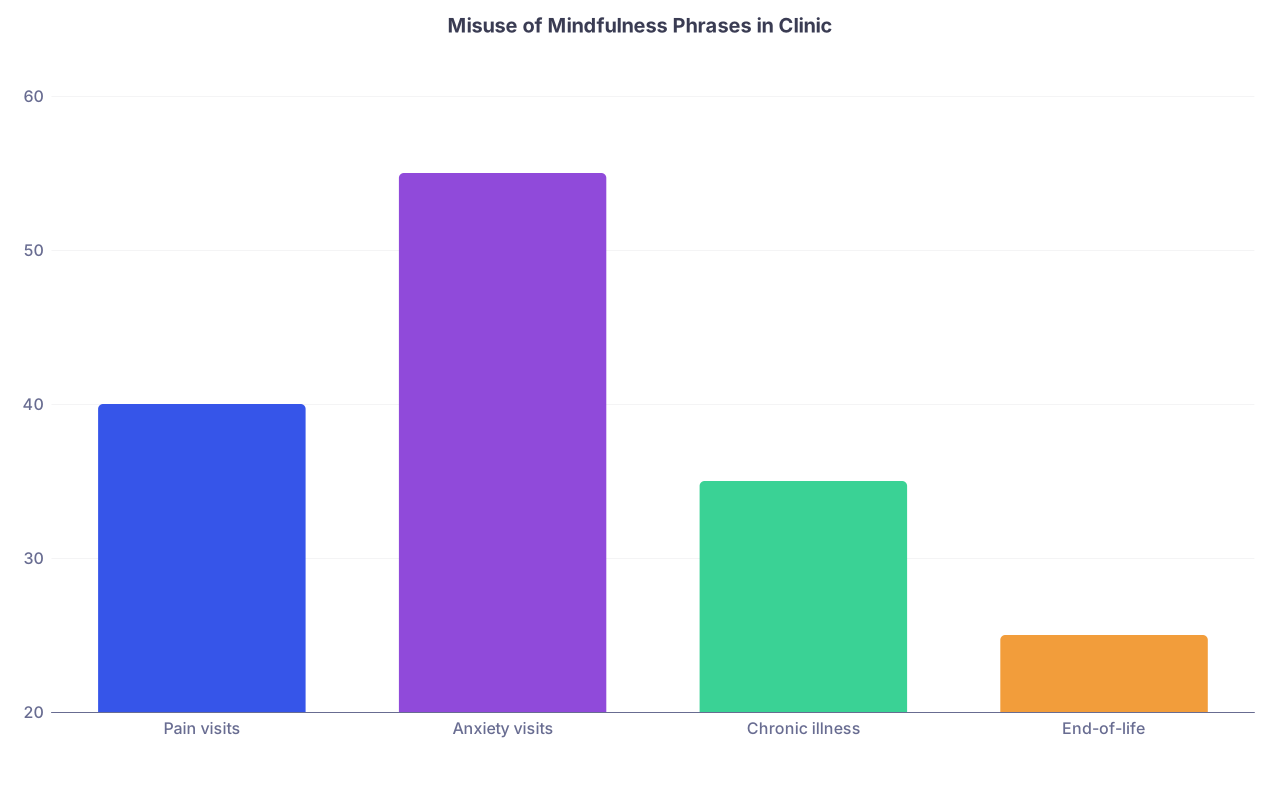
| Category | Value |
|---|---|
| Pain visits | 40 |
| Anxiety visits | 55 |
| Chronic illness | 35 |
| End-of-life | 25 |
Mindfulness is not a shortcut to closure
You still must:
- Adjust meds when indicated.
- Order imaging when warranted.
- Address social determinants.
- Refer to psychiatry, psychology, palliative care, or social work when appropriate.
Mindfulness may complement those moves. It must not replace them.
If your use of “mindfulness” consistently leaves you doing less standard clinical work, you are not being mindful. You are cutting corners.
Mistake #5: Disclosing Practice Details That Confuse Role and Power
There is a strain of mindfulness culture that romanticizes retreats, lineage, and “deep practice.”
Patients do not need to know:
- That you just did a 10‑day silent vipassana retreat.
- That you hope to become a meditation teacher after leaving clinical work.
- That your primary identity is now “contemplative physician” rather than “internist.”
When you foreground this, you subtly shift your professional center. Patients pick up on it.
How this lands on real people
I have watched a patient say, half‑joking, to a very spiritual resident:
“So are you my doctor or my monk?”
That line stayed with me.
If patients are unsure whether you are primarily:
- A clinician offering evidence‑based care
or - A spiritual or contemplative guide offering a path
…you have muddied the frame.
In medicine, the frame matters. It anchors expectations, consent, and trust.
You might feel your contemplative identity is central to who you are. Fine. But bringing that entire identity into the exam room does not necessarily help your patients.
Talk to colleagues about your retreat. Talk to a supervisor about how it changes your relationship to medicine.
Do not process that live in front of a patient.
Mistake #6: Sharing Too Early, Too Fast, With the Wrong Patients
Even appropriate mindfulness disclosure can be badly timed.
Pattern I see all the time:
First or second visit with a new patient. You notice anxiety, chronic pain, insomnia. You light up inside: “Mindfulness could help.”
You barely know their history, personality, or belief system. But you introduce your practice, your training, your passion. Maybe you even give a mini‑lesson.
They nod. Smile. Thank you.
Then never schedule the follow‑up.
Not everyone wants your mindfulness story
Some patients will never want to hear about it. Others might—but only after:
- They trust your clinical competence.
- You have listened deeply to their story.
- You have already addressed immediate, concrete concerns.
There is an order of operations here.

| Step | Description |
|---|---|
| Step 1 | Patient visit |
| Step 2 | Address main complaint |
| Step 3 | Establish rapport over time |
| Step 4 | Do not disclose practice |
| Step 5 | Offer brief, neutral option |
| Step 6 | Respect preference, move on |
| Step 7 | Share minimal, focused details |
| Step 8 | Is mindfulness directly relevant now? |
| Step 9 | Did patient show genuine interest? |
If you skip straight from A to I, you are disclosing for you, not them.
Be especially cautious with:
- Early encounters
- Highly distressed or vulnerable patients
- Those with severe mental illness
- Those from cultures or faiths you do not understand well
“Start small and late” is safer than “start big and early” when it comes to mindfulness disclosure.
Mistake #7: Confusing “Being Mindful” With Talking About Mindfulness
The most ironic mistake: thinking patients need to hear that you are mindful, instead of feeling it through your behavior.
Patients usually want:
- A doctor who does not rush them.
- Someone who actually listens without interrupting.
- A clinician who can sit with their fear or grief without flinching.
- Clear explanations without condescension.
All of that can come directly from your mindfulness practice. Without you ever saying the word “mindfulness.”
Many of the best “mindful clinicians” I know never mention their meditation cushion. Or their apps. Or their retreats.
Patients only know:
- “She really hears me.”
- “He is calm, even when I am a mess.”
- “I feel safe with them.”
That is what you should be aiming for.
| Approach | What Patients Actually Experience |
|---|---|
| “I meditate daily” | Neutral; may feel irrelevant or awkward |
| Long practice story | Time taken away from their concerns |
| Steady presence | Safety, trust, willingness to disclose |
| Slow, careful speech | Sense that you respect their experience |
| Pausing before reply | Feeling genuinely considered |
If you have to announce how mindful you are, you probably are not as grounded as you think.
Safer Ways to Integrate Mindfulness Without Over‑Sharing
You do not have to hide your practice completely. You just need to stop using patients as your processing ground.
Here is a cleaner way to bring mindfulness into care without slipping into the traps above.
1. Lead with options, not identity
Instead of:
“I have a strong personal mindfulness practice and it changed my life.”
Try:
“There is an approach called mindfulness‑based stress reduction that has helped some people with anxiety and pain. If you are interested, I can share resources.”
Notice the shift. You are not the star of the story. The intervention is.
2. Use minimal, targeted self‑disclosure (when clearly useful)
Sometimes a single, brief line can help:
- “Some patients—and I include myself here—find that simple breathing practices can ease anxiety a bit in the moment. It is not magic, but it can be one tool among many.”
Then stop. If the patient asks more, you can expand slightly. But you do not need to give your full narrative arc. This is not a podcast.
3. Separate roles clearly
If you truly want to guide patients in mindfulness as a central modality, consider:
- Formal training in MBSR, MBCT, or similar programs.
- Clear consent where patients know they are entering a mindfulness‑focused intervention.
- Documentation that distinguishes between standard medical care and contemplative guidance.
Do not stealth‑convert a standard primary care follow‑up into an informal mindfulness workshop.
Quick Self‑Audit: Are You Over‑Sharing?
Ask yourself, honestly:
- Do I talk about my own practice in more than 1 in 10 visits?
- Do I feel a little disappointed when patients are not interested in mindfulness?
- Have I ever left a visit thinking more about how aligned I felt than about whether the patient’s concrete needs were met?
- Has any patient, colleague, or supervisor ever hinted I might be “too into mindfulness” with patients?
If you are nodding yes, you are at risk of the mistakes we just walked through.
This is fixable. But not by doubling down. By pulling back, and recalibrating.

Two Non‑Negotiables You Cannot Afford to Miss
Keep it simple. If you remember nothing else from this, remember:
Your mindfulness practice is for regulating you, not impressing or shaping patients.
Use it to be more present, less reactive, more precise. Patients should feel the effects, not hear the backstory.Any self‑disclosure about mindfulness must be rare, brief, and clearly in service of patient benefit—not your identity.
When in doubt, say less. Listen more. Let your presence do the talking.
You can be deeply mindful and deeply ethical. But only if you stop using the exam room as a stage for your practice narrative, and return it to what it is supposed to be:
A space for their story, not yours.