
When Mindfulness Becomes Avoidance: Red Flags for Medical Trainees
What if the “mindful breathing break” you’re proud of is actually just you hiding from a hard conversation with a patient?
Mindfulness is everywhere in medicine now. Wellness seminars. Mindful surgeon workshops. Burnout retreats with guided meditations and herbal tea.
Used well, it can keep you from crashing.
Used badly, it becomes a polished, ethically-flavored way to avoid what you do not want to face: difficult patients, painful feedback, your own mistakes, or the sheer moral weight of what you’re doing.
I’ve watched trainees tell themselves they were “regulating their nervous system” when they were really just scrolling Instagram in the call room instead of talking to the family in the waiting area who’d been asking for updates for three hours.
Let me be blunt: misusing mindfulness is not just a personal growth issue. It can become a professionalism problem. An ethical problem. A patient safety problem.
Let’s talk about the red flags.
](https://cdn.residencyadvisor.com/images/articles_svg/chart-how-trainees-misuse-mindfulness-4907.svg "How Trainees Misuse Mindfulness")
| Category | Value |
|---|---|
| Procrastinating difficult tasks | 40 |
| Numbing emotional distress | 30 |
| Avoiding feedback or evaluation | 20 |
| [Justifying boundary violations](https://residencyadvisor.com/resources/mindfulness-in-medicine/the-mindfulness-mistakes-that-quietly-erode-clinical-boundaries) | 10 |
1. The “Mindful Pause” That’s Actually Procrastination
There’s a big difference between a 3‑minute grounding before you enter a family meeting and a 45‑minute “mindful reset” that just happens to delay you from giving bad news.
The red flag is not the practice itself. It’s the pattern.
You might be slipping into avoidance if:
- You meditate instead of writing the note that requires you to admit you missed something.
- You do a “body scan” before returning a call to a rude consultant… and somehow you’re still scanning 30 minutes later while pages pile up.
- You open your meditation app every time you need to respond to criticism or fill out an incident report.
The internal script usually sounds like this:
“I’m not avoiding; I’m practicing self‑care so I don’t burn out.”
Or: “It’s better for the patient if I’m centered first.”
Nice story. Sometimes true. Very often… cover for delay.
Ask yourself a hard question:
If I removed the mindfulness label and called this what it is — “I’m putting this off because it’s uncomfortable” — would my behavior look different?
A practical test
Next time you reach for a mindfulness practice, ask:
- Is there an urgent patient care task I am knowingly delaying?
- Would my senior be okay if I explained exactly how I used this time?
- Am I willing to tell the patient/family, “I waited to come see you because I needed 30 minutes for my mindfulness practice”?
If the honest answer to #3 makes you cringe, you’re probably procrastinating, not practicing.

2. Using Mindfulness to Numb Instead of Feel (Moral Injury in Disguise)
There’s a myth floating around that being “mindful” means you do not react. No anger. No grief. Just serene acceptance while the healthcare system chews people up.
That’s not mindfulness. That’s emotional shutdown with yoga pants on.
I’ve heard this too many times from trainees:
- “I just tell myself to accept the moment and let go when we send someone home who clearly needs admission but has no insurance.”
- “I breathe and remind myself not to judge when I see yet another preventable complication from lack of follow‑up.”
- “I observe the feeling of unfairness when I get blamed for a system failure… and then I let it drift away.”
Careful. Some of that is healthy. Some of it is you anesthetizing your moral distress instead of facing it.
Red flags that you’re numbing, not noticing:
- You feel less and less upset about things that should bother you: racism toward patients, unsafe ratios, disrespect from staff.
- Your self‑talk is “Notice the anger and let it go” — but there’s never a second step where you reflect or take any constructive action.
- You tell yourself that “non‑attachment” means accepting bad behavior or unsafe practices without speaking up.
Mindfulness done right helps you tolerate distress long enough to respond wisely. Not make you a zen robot who never says, “This is wrong.”
In medical ethics terms: if your mindfulness practice systematically deflates your sense of justice, beneficence, and responsibility, it’s corrupted. It’s not a neutral wellness tool anymore; it’s enabling moral injury.
3. “Compassion” as an Excuse to Avoid Boundaries
Here’s a sneaky one: using mindfulness buzzwords to disguise weak or inconsistent boundaries.
I’ve seen trainees say:
- “I’m practicing compassionate presence,” while letting a verbally abusive patient or family member trample them repeatedly with no limits set, then venting and resenting them for hours.
- “I try to hold space for everyone,” while staying way past their shift consistently, doing work that should be handed off, then bragging about their “mindful dedication.”
- “I’m being non‑judgmental,” while never addressing a colleague’s unsafe shortcut because “that’s their path.”
You are not enlightened because you tolerate endless disrespect. You are just exhausted and increasingly bitter.
Red flags:
- You feel proud of how “present” or “accepting” you are, but underneath you’re seething, fantasizing about quitting, or trash‑talking the same patients and staff members.
- You use words like “holding space,” “compassionate witnessing,” or “radical acceptance” to justify not giving clear feedback or enforcing reasonable boundaries.
- You say yes to everything, then label it “karma yoga” or “mindful service,” while your charting, sleep, and personal life fall apart.
Ethically, medicine asks you to balance beneficence (doing good) with non‑maleficence (do no harm) — and that includes not harming yourself through chronic boundary violations.
Mindfulness should support firm, humane boundaries, not erase them.

| Step | Description |
|---|---|
| Step 1 | Discomfort arises |
| Step 2 | Mindful engagement |
| Step 3 | Avoidant mindfulness |
| Step 4 | Clarify task |
| Step 5 | Take needed action |
| Step 6 | Long break ritual |
| Step 7 | Delayed action |
| Step 8 | Increased stress |
| Step 9 | Choose response |
4. Mindfulness as a Shield Against Feedback and Growth
One of the nastiest misuses I see: turning mindfulness into a spiritual shield so criticism cannot land.
You might recognize these patterns:
- After being told your note was incomplete, you say internally, “I observe the feedback without attachment,” then change nothing about your documentation.
- A senior tells you your tone with nurses was dismissive. You go for a “mindful walk” to ground yourself, but never actually apologize or examine your behavior.
- You get concerning comments on an evaluation — “slow, avoids responsibility” — and respond by doubling down on self‑compassion meditations without seeking specific guidance.
The mistake here is subtle: you’re applying mindfulness only to your hurt feelings, not to the content of what you’re being told.
Genuine mindfulness toward feedback sounds more like:
- “My chest feels tight and I want to defend myself. Let me breathe… okay. What parts of this feedback might be accurate?”
- “I notice shame and anger. They’re here. Now, what concrete changes can I try on my next shift?”
Red flags that you’re using mindfulness as armor:
- You can quote all the self‑compassion gurus but cannot give a single example of behavior you’ve changed in response to evaluations.
- You keep framing harsh but accurate feedback as “their projection” or “their stress,” never as something you might actually need to fix.
- You feel weirdly proud of how “unbothered” you are by criticism — not because you’ve mastered the content, but because you’ve numbed the sting.
You do not get ethical credit for being “calm” in the face of feedback if that calm is just you refusing to adjust to protect your ego.
| Situation | Healthy Mindfulness Response | Avoidance Disguised as Mindfulness |
|---|---|---|
| Need to give bad news | 2–3 min grounding, then go talk to patient/family | 30+ min “reset” while delaying conversation |
| Negative evaluation | Feel emotions, seek specifics, adjust behavior | Meditate, journal, but make no concrete changes |
| Moral distress on service | Notice distress, discuss with team, pursue advocacy | “Accept what is,” do nothing, grow more cynical |
| Overload on shift | Ask for help, triage tasks, use brief centering | Disappear to “meditate,” leave colleagues hanging |
5. When “Non‑Attachment” Becomes Not Caring Enough
Another common distortion: using Buddhist‑flavored language to justify detachment from outcomes you should absolutely care about.
You’ll hear things like:
- “I try not to cling to whether patients live or die. I just show up.”
- “I don’t attach to exam scores or evaluations; I focus on the present moment.”
- “I release all expectations about performance; that’s just ego.”
Fine, if you’re at a 10‑day silent retreat. Dangerous if you’re in the ICU.
Non‑attachment does not mean you stop trying to do your best, stop caring if you improve, or stop being accountable for outcomes where your actions matter.
Red flags you’ve slid into unhealthy detachment:
- You make recurrent small mistakes and shrug them off as “part of the journey” without systematically correcting them.
- You rationalize poor preparation — not reading before cases, not reviewing labs — with “Whatever happens is what’s meant to be.”
- You tell yourself you’re “releasing perfectionism,” but your reliability and thoroughness are clearly dropping.
The ethical core of medicine still holds: you have duties — to competence, to safety, to honesty. Mindfulness should help you meet those duties with less anxiety, not excuse you from them.
If you find yourself less and less emotionally invested in getting better, you’re not being mindful. You’re disengaging.
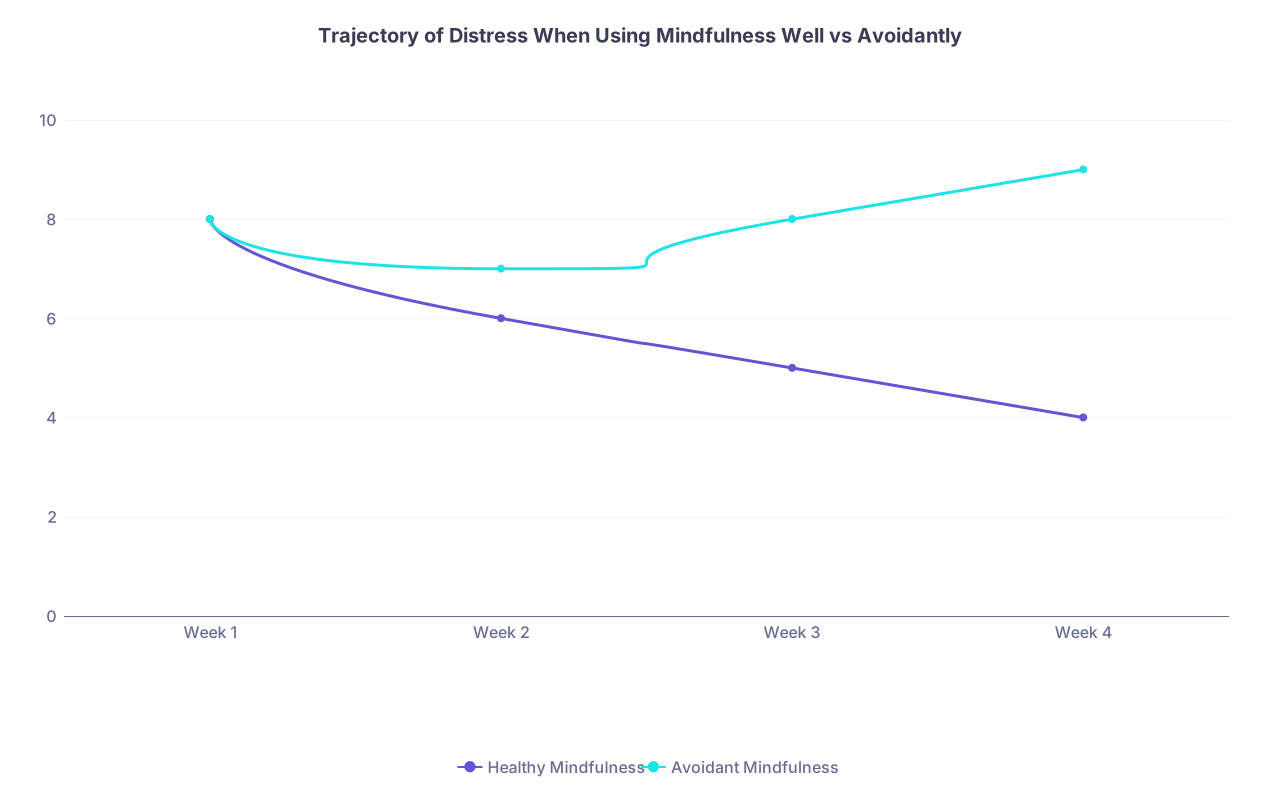
| Category | Healthy Mindfulness | Avoidant Mindfulness |
|---|---|---|
| Week 1 | 8 | 8 |
| Week 2 | 6 | 7 |
| Week 3 | 5 | 8 |
| Week 4 | 4 | 9 |
6. Spotting the Early Warning Signs in Yourself
You won’t wake up one day and suddenly be “using mindfulness unethically.” It creeps.
Here are early‑stage warning signs to catch:
Your mindfulness time keeps expanding when tasks get harder.
On easy days, you do a 5‑minute sit. On high‑acuity days? Now you magically need 25 minutes every few hours. Curious.You feel virtuous after “self‑care,” but key work is still undone.
Notes late. Orders unsigned. Family meetings postponed. But hey, you journaled and stretched, so it feels justified.You start resentfully judging others as “not mindful enough.”
You roll your eyes at seniors who “push through” or nurses who “don’t regulate,” while you quietly underperform and call it spiritual growth.Your emotional vocabulary shrinks to mindfulness clichés.
Everything becomes “just sensations,” “just thoughts,” “just stories,” and you stop describing concrete problems clearly enough to fix them.
You’re in dangerous territory when mindfulness makes it easier to rationalize behavior you’d call out in someone else.
7. How to Use Mindfulness Without Losing Your Ethical Backbone
Let’s fix this. Mindfulness is not the enemy. Misuse is.
Here’s how to keep it honest:
Tie every practice to a concrete action
Mindfulness should lead toward something, not just away from discomfort.
For example:
- “I’ll do 3 minutes of breathing, then walk straight to Room 12 and update the family.”
- “I feel defensive about this feedback. Let me notice that for 2 minutes, then email my attending for one specific suggestion.”
- “I’m overwhelmed. I’ll ground myself for 60 seconds, then call my senior and clearly state what I need help with.”
No action plan afterward? High risk it’s just avoidance.
Use time limits like your license depends on it
If you’re on clinical duty, your mindfulness breaks need hard edges.
Set a 2–5 minute timer. When it ends, you move. No negotiation. No “just one more body scan.”
If you “lose track of time” repeatedly while supposedly meditating, you’re not being mindful. You’re dissociating.
Invite external reality checks
Ask one trusted senior or peer:
“When I say I’m taking mindfulness breaks or doing self‑compassion work, does my behavior actually look more engaged and responsive — or more checked‑out and avoidant?”
And then shut up and listen.
If people keep hinting you disappear when things get hot, believe them. Adjust.
Make ethics part of your practice
Before or after a meditation, ask yourself:
- “What is my responsibility here?”
- “Is there anyone who’s depending on me right now?”
- “If this were my family member, how would I feel about what I’m choosing to do next?”
If your mindfulness practice never touches questions of duty, accountability, or impact on others, it’s incomplete for life in medicine.

8. When You Realize You’ve Been Avoiding: What Now?
Suppose you’re reading this and thinking, uncomfortably, “That’s me.” Good. That discomfort is useful.
Do not make the classic second‑order mistake: using self‑compassion to avoid changing.
The move is:
Name where you’ve been avoiding — specifically.
“I’ve been meditating instead of returning difficult phone calls.”
“I’ve been using acceptance language to swallow moral distress instead of raising concerns.”Own the impact.
Whose care got delayed? Who had to pick up your slack? How did your learning suffer?Adjust your rules.
For example: “No meditations longer than 5 minutes while on call; no practice that delays time‑sensitive patient contact.”Tell someone you trust what you’re changing.
Accountability is the antidote to avoidant mindfulness.
Mindfulness done right is brutally honest. It’s not always soft or soothing. Sometimes it tells you, very clearly: you are hiding. Stop.