
The most dangerous thing after a bad outcome is not the error itself. It is what you do—or fail to do—with the next 24 hours.
You can spend it spiraling in shame, defensively rewriting the story, or numbing out. That is how clinicians burn out, harden, and repeat the same patterns. Or you can treat the next day as structured, mindful, ethical work. A deliberate reset.
Here is a 24‑hour, mindfulness‑centered reflection timeline. Hour by hour. At this point you should…
The First Hour: Containment, Not Analysis
0–15 minutes: Ground your nervous system
Right after the code is called, the family is told, the note is written—your adrenaline is still flooding.
At this point you should:
- Step out of the room or unit, even for 3 minutes.
- Plant both feet on the floor, back against a wall or chair.
- Take 10 slow breaths:
- In for a count of 4
- Hold for a count of 4
- Out for a count of 6–8
Silently name what is happening:
- “My heart is racing.”
- “My chest feels tight.”
- “I feel sick and shaky.”
You are labeling sensations, not judging them. This interrupts the automatic “I am terrible” narrative and shifts you back into observer mode.
15–30 minutes: Contain the story
Your mind will start writing a catastrophic script:
- “I killed this patient.”
- “Everyone saw me fail.”
- “I will be reported. I will be sued. I will be fired.”
At this point you should:
- Name the story:
- “This is the ‘I am unsafe and unfit’ story.”
- “This is the ‘I will be punished’ story.”
- Gently separate facts from story:
- Fact: “The patient arrested at 09:52.”
- Fact: “We started compressions within 1 minute.”
- Story: “No one will ever trust me again.”
You are not excusing anything. You are refusing to confuse emotion with evidence.
30–60 minutes: Do the immediate, ethical things
This is where people either step up or hide. Hiding feels safe in the moment, and costs you later.
At this point you should:
- Ensure required notifications happen:
- Tell your senior/attending clearly: “I am worried my decision at X may have contributed.”
- Make sure risk management / safety reporting is triggered if indicated.
- Document with clarity, not self‑protection:
- Stick to timeline.
- Avoid speculative blame on others.
- Note discussions with family and team.
Mindfulness here is radical honesty with yourself, not self‑flagellation. You are aligning your actions with your values in real time, even while flooded.
Hours 1–4: Stabilize and Create Safe Space
Hour 1–2: Secure a brief, protected pause
If you keep barreling through the shift pretending nothing happened, you pay for it later at 3 a.m. staring at the ceiling.
At this point you should:
- Ask explicitly: “Can I step away for 10 minutes to get my head straight?”
I have heard PGY‑1s mumble “I’m fine” while clearly dissociating. It never ends well. - Hydrate and eat something small:
- A few bites and some water are not luxury; they are basic neurobiology.
- Do a 5‑senses grounding drill:
- Name 5 things you can see.
- 4 things you can feel (clothing, chair, shoes).
- 3 things you can hear.
- 2 things you can smell.
- 1 thing you can taste.
This is not “wellness fluff.” It is how you pull your brain out of pure limbic reactivity so you can think clinically again.
Hour 2–3: A micro‑debrief with a trusted person
You do not need a full M&M right now. You do need one non‑performative, non‑defensive conversation.
At this point you should:
- Pick wisely:
- Senior resident you respect.
- Attending known to be calm under fire.
- Peer who will not catastrophize with you.
- Use a tight structure:
- 2–3 minutes: “Here is what happened medically.”
- 1–2 minutes: “Here is where I think I might have gone wrong.”
- 1–2 minutes: “Here is what I am feeling right now.”
Then stop talking. Listen to their initial perspective. You are not trying to litigate the whole case; you are anchoring yourself to shared reality.
Hour 3–4: Decide on boundaries for the rest of the shift
The rest of the day can either be vaguely haunted by the event, or consciously structured around it.
At this point you should:
- Decide what you will not do for the rest of this shift:
- No repeatedly re‑checking the chart to re‑traumatize yourself.
- No gossiping in the hallway to see who blames whom.
- Decide what you will do:
- Complete essential tasks safely.
- Write down one line for later: “I want to revisit: [specific decision point].”
- Make a concrete plan for when you will sit with this (e.g., “Tonight at 8 p.m., 30 minutes”).
You are not avoiding reflection. You are scheduling it, so it does not devour you or your patients today.
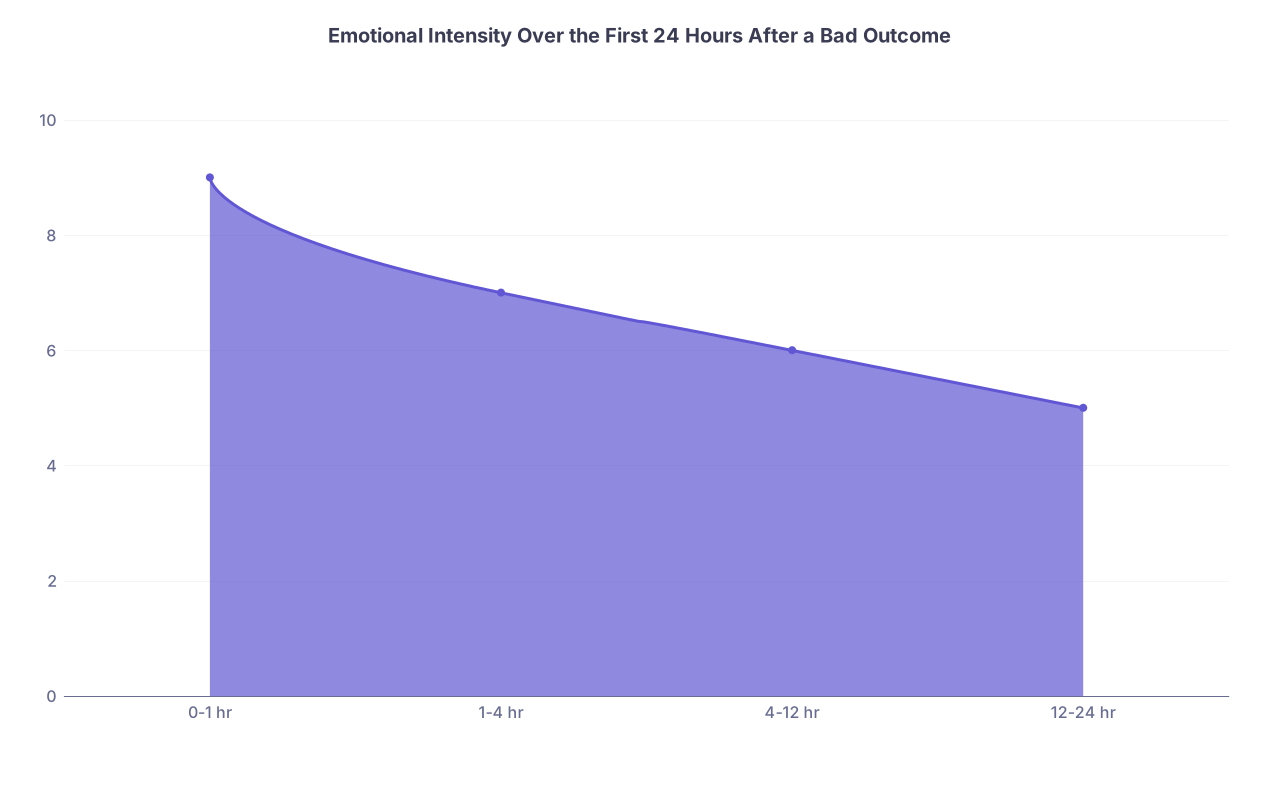
| Category | Value |
|---|---|
| 0-1 hr | 9 |
| 1-4 hr | 7 |
| 4-12 hr | 6 |
| 12-24 hr | 5 |
Hours 4–12: The First Structured Reflection
This is usually when your shift ends or slows. Fatigue shows up. The family’s faces replay. The “if only” reel starts.
Hour 4–6: Transition home (or to call room) deliberately
The commute is where rumination sets in. Or where you start to numb.
At this point you should:
- Choose one mindful transition ritual:
- Walk from the hospital to the parking lot without your phone out, consciously saying: “I am leaving the building. I am still carrying the event. That is okay.”
- On public transit, pick one sensory anchor: the feel of the seat, the sound of the train.
- Set a mental container:
- “Until I get home, I will only review facts, not what‑ifs.”
- When your brain starts “If I had just…”, gently label it: “Future reflection—parking it for later.”
Hour 6–8: First deeper sit (10–20 minutes)
Once you are in a private space—call room, your room, a quiet office—this is where actual mindfulness practice starts.
At this point you should:
- Sit or lie down, spine supported. Set a timer: 10–20 minutes.
- Body scan, fast version (5–7 minutes):
- Start at the top of your head, down to your toes.
- For each region: notice tension → allow it → soften 5–10%.
- When you catch yourself replaying the code, label it “thinking,” then gently return to the body.
- Name the dominant emotion accurately (5–10 minutes):
- Not just “bad.” Be specific:
- Shame
- Fear
- Sadness
- Anger at self
- Anger at system
- Say it silently: “This is shame.” Or, “This is fear.”
- Not just “bad.” Be specific:
You are training yourself to feel the emotion without becoming it. Clinicians who skip this step often become rigid and defensive; they never learn to tolerate their own emotional states.
Hour 8–10: Ethical and clinical reflection (brief, structured)
You will want to autopsy every second. Not yet. You are still too close. So you give yourself a narrow, disciplined window.
At this point you should:
- Take 10–15 minutes to write, with a pen and paper if you can.
- Use a three‑column structure:
| Column 1: Facts | Column 2: My Role | Column 3: Unanswered Questions |
|---|---|---|
| Objective events in time order | Specific actions/inactions | What I want to review later |
| No adjectives | No global self-judgments | Good prompts for M&M or supervision |
| Example: “BP dropped from 110 to 70 at 02:12” | Example: “I did not call attending until 02:20” | Example: “How fast should I escalate refractory hypotension in septic shock?” |
Set a timer. When it rings, stop. Close the notebook. You will come back to it.
Hour 10–12: Sleep hygiene, even if sleep is imperfect
You are not going to process this well on zero sleep. And yes, your brain will want to replay the entire case at 2 a.m.
At this point you should:
- Do one short, concrete wind‑down:
- Warm shower or wash your face slowly and deliberately.
- Change into different clothes turning off “work mode.”
- Avoid:
- Diving into the chart.
- Long post‑mortem text threads with colleagues.
- Alcohol “just to take the edge off.” It usually makes the 3 a.m. spiral worse.
- Try a 5‑minute breath practice in bed:
- Inhale 4 counts, exhale 6–8 counts.
- If strong images arise, label “image,” then back to breath.
Even 3–4 hours of broken sleep is better than staring at the ceiling doom‑scrolling your own mind.
Hours 12–18: Turning Toward, Not Away
Morning comes. The event did not disappear. Good. This is where growth actually happens.
Hour 12–14: Morning check‑in and self‑compassion drill
At this point you should:
- Take 5 minutes before checking your phone or email.
- Ask yourself three questions and write the answers in 1–2 sentences each:
- “What am I feeling right now about last night?”
- “What do I need this morning to function safely?”
- “Who, if anyone, do I need to update or talk with today?”
Then, a short self‑compassion practice (yes, really):
- Put a hand on your chest or forearm.
- Silently say:
- “This is hard.”
- “Other clinicians go through this.”
- “May I treat myself with the same fairness I would offer a colleague.”
If that feels cheesy, fine. Do it anyway. I have seen surgeons who laugh at this privately say it was the only thing that kept them from quitting after a complication.
Hour 14–16: Intentional review with resources
Now and only now do you start to pull in external information and more detailed analysis.
At this point you should:
- Decide on one primary learning goal for today:
- Example: “Understand whether my timing of antibiotics met standard of care.”
- Example: “Review evidence on fluid vs vasopressor sequencing in septic shock.”
- Spend 30–45 minutes with focused study:
- Guidelines (e.g., Surviving Sepsis Campaign).
- Reference text or UpToDate section.
- Prior similar cases if easily accessible.
Keep it practical, not obsessive. You are hunting for 1–2 “next time I will…” items, not exoneration or proof of guilt.

Hour 16–18: Planned discussion with a senior or mentor
The worst thing you can do is fish for reassurance: “You think I didn’t mess up, right?” The best: bring specific questions grounded in your review.
At this point you should:
- Request a short meeting: 15–30 minutes is enough.
- Go in with a clear structure:
- 3–4 minute concise case recap (you have already practiced this on paper).
- 3–5 minute honest self‑assessment:
- “I think these parts were sound.”
- “I am worried that this decision at [time] was suboptimal.”
- 3–5 minute targeted questions:
- “In your practice, how early would you have called for ICU transfer here?”
- “What signals would you have watched for that I might have missed?”
Write down their key points. You are building a process, not just surviving this one event.
Hours 18–24: Integration and Ethical Commitment
Most people stop here. They either feel temporarily reassured (“It was unavoidable”) and drop it, or permanently condemned (“I am unsafe”) and freeze. Both are mistakes.
You need one more step: turning this into a concrete, ethical, mindful plan.
Hour 18–20: Values‑based reflection
This is where “mindfulness in medicine” either becomes real or stays a bumper sticker.
At this point you should:
- Sit down for 15–20 minutes with your earlier notes.
- Ask and answer, in writing, three questions:
“What values of mine were activated in this event?”
Examples:- Patient safety
- Honesty with families
- Humility and teachability
- Collegial responsibility
“Where did my actions align with those values?”
Be specific:- “I disclosed uncertainty to my attending.”
- “I stayed with the family afterward, even though I wanted to disappear.”
“Where did my actions fall short of those values—without self‑hatred?”
Example:- “I delayed calling for help because I did not want to look incompetent. That conflicts with my value of prioritizing patient safety over ego.”
This is ethics work, not self‑punishment. You are clarifying the kind of clinician you intend to be under stress.
Hour 20–22: One concrete change
All the insight in the world is useless if it does not alter your behavior on the next call night.
At this point you should:
Choose one specific, implementable change. Not ten.
Good examples:
- “On my next shift, any patient with worsening hypotension on two boluses gets an attending call within 5 minutes, no exceptions.”
- “I will create a 1‑page septic shock checklist and keep it in my pocket.”
- “I will practice delivering bad news with a simulated script once this week.”
Write it as an “If–Then” plan:
- “If [scenario], then I will [action].”
Such as: “If a patient is not improving as expected within 1 hour, then I will ask another clinician to review the case with me.”
- “If [scenario], then I will [action].”
You are not promising never to make a mistake again. You are building a system to make certain kinds of errors less likely.

| Period | Event |
|---|---|
| First Hour - 0-15 min | Ground body and breath |
| First Hour - 15-30 min | Contain catastrophic stories |
| First Hour - 30-60 min | Notify team and document |
| 1-4 Hours - 1-2 hr | Brief pause and grounding |
| 1-4 Hours - 2-3 hr | Micro-debrief with trusted person |
| 1-4 Hours - 3-4 hr | Set shift boundaries |
| 4-12 Hours - 4-6 hr | Mindful commute/transition |
| 4-12 Hours - 6-8 hr | First formal mindfulness sit |
| 4-12 Hours - 8-10 hr | Short written factual review |
| 4-12 Hours - 10-12 hr | Sleep hygiene and rest |
| 12-24 Hours - 12-14 hr | Morning emotional check-in |
| 12-24 Hours - 14-16 hr | Targeted guideline review |
| 12-24 Hours - 16-18 hr | Mentor/supervisor discussion |
| 12-24 Hours - 18-20 hr | Values-based reflection |
| 12-24 Hours - 20-22 hr | Choose one concrete change |
| 12-24 Hours - 22-24 hr | Reconnect with life outside medicine |
Hour 22–24: Reconnect with your non‑clinical self
This step is routinely dismissed as “soft.” I have watched attendings 15 years in who have no identity outside outcomes. They shatter when something goes wrong.
At this point you should:
- Do one small, non‑medical, non‑optimization activity:
- Walk outside without listening to a podcast.
- Cook something simple.
- Sit with a partner, friend, or pet with no case discussion for 15 minutes.
- If you want to share about the event with someone close, set boundaries:
- “I had a hard case. I do not want to discuss medical details, but I could use company.”
- Or: “I have about 5 minutes of venting in me, then I want to do something else.”
You are reminding your nervous system: “I am more than this outcome. I am still a person in a larger life.” That perspective, paradoxically, makes you safer and more ethical in your next clinical encounter.

Putting It All Together
You do not control every clinical outcome. You do control whether the next 24 hours are chaotic self‑destruction or structured, mindful integration.
Here is the compressed version:
- 0–4 hours: Stabilize your body, contain catastrophic stories, act ethically with notifications and documentation, and get a brief, honest check‑in with a trusted colleague.
- 4–12 hours: Transition out of the immediate crisis; do a first real mindfulness sit, write down a factual timeline with your role and unanswered questions, and protect some sleep.
- 12–18 hours: Check in emotionally, study one targeted clinical question, and have a focused, non‑defensive conversation with a senior or mentor.
- 18–24 hours: Reflect on your values, choose one concrete practice change, and reconnect with the parts of your life and identity that are not defined by this one case.
Do not try to “feel done” with it in 24 hours. That is not the goal. The goal is to exit the first day without hiding, collapsing, or hardening.
Open a blank page right now and write down three headings: “Facts,” “My Role,” and “Unanswered Questions.” Start filling them in for your most recent hard case. That is your first concrete step toward a mindful, ethical response instead of a purely reactive one.