
The usual clinic day chews physicians up because we let it. You’re not “too busy for mindfulness” — you’re just using the wrong kind of mindfulness at the wrong time.
You do not need a 30‑minute cushion, Himalayan bells, or a yoga mat. You need 10–60 second anchors, built into the exact flow of a real clinic day. From the moment you badge in to the last chart you close.
This is that timeline. Hour‑by‑hour, door‑by‑door.
Before Clinic Starts: 15–30 Minutes Before First Patient
At this point you should be setting the tone, not checking the inbox.
T‑30 to T‑20 minutes: Arrival reset (2–3 minutes)
- Put your bag down.
- Do not open the EHR yet.
Anchor: 10‑breath arrival check
- Sit or stand, feet flat.
- Exhale fully first.
- Take 10 normal breaths.
- On each inhale: mentally label “in”.
- On each exhale: mentally label “out”.
On breath 5:
Ask yourself, “What am I bringing in from home?”
On breath 10:
Ask, “What do I want patients to feel around me today?” (Safe? Heard? Not rushed?)
Write one word on a post‑it and stick it on your monitor: “Steady” / “Curious” / “Kind”. That’s your theme.
T‑20 to T‑10 minutes: Ethical intention check (1–2 minutes)
Now you can open the schedule, but don’t dive into labs yet.
Anchor: 3‑question compass
Look at the day’s list and silently ask:
- “Where might I be tempted to rush or cut a corner today?”
- “Who on this list might trigger my frustration or bias?”
- “How will I choose to act anyway?”
Answer each in a short phrase. Example:
- “Rushing: late‑day physicals — I’ll still ask, ‘What matters most today?’”
- “Trigger: chronic pain patient requesting opioids — I’ll stay curious, not defensive.”
You’re quietly practicing ethics in advance: honesty about your limits, commitment to respect, and fairness across patients.
First Hour: First Patient to Settling Into the Morning
At this point you should be anchoring each transition: before room, in room, after room.
Just before the first patient: Doorframe pause (10–20 seconds)
Stand at the first exam room door.
Anchor: Doorframe ritual
Hand on the handle.
Feel the physical contact. Cool metal, slight resistance.
Silently think:
- “This person has a story I do not know yet.”
- “My job: understand, not judge.”
Then deliberately soften your shoulders before you walk in. I mean actually drop them an inch. Patients see the difference.

In‑room, first 60 seconds: Presence check (15–30 seconds)
Before you touch the computer, before you ask, “What brings you in?” — pause.
Anchor: One‑point attention
- Pick one anchor for those first 30 seconds:
- The feeling of your feet in your shoes, or
- The sensation of your hands resting on your thighs, or
- The warmth of your breath at your nostrils.
While you say your greeting, keep 10% of your attention on that anchor.
This keeps your nervous system from spinning up with the patient’s anxiety.
Then ask a single ethical question in your head:
“If this were my family member, how would I listen right now?”
You will sit differently. Patients feel it.
Mid‑Morning: When The Pace Picks Up (Hour 2–3)
This is where most people lose it. The schedule’s backed up, labs are dinging, a staff member needs you.
At this point you should be using micro‑anchors between every single patient — 5 to 20 seconds each.
Between patients: Hallway reset (5–15 seconds)
Walking room to room is underrated. It’s built‑in mindfulness time if you use it.
Anchor: 5‑step walking reset
As you walk toward the next door:
- Count five steps.
- Coordinate step and breath:
- Step 1–2: inhale
- Step 3–5: exhale
- On the exhale, silently say, “Let go.”
Let go of the last patient’s sadness, anger, or complexity. Not because you don’t care — because the next person deserves a fresh doctor, not the residue of the previous visit.
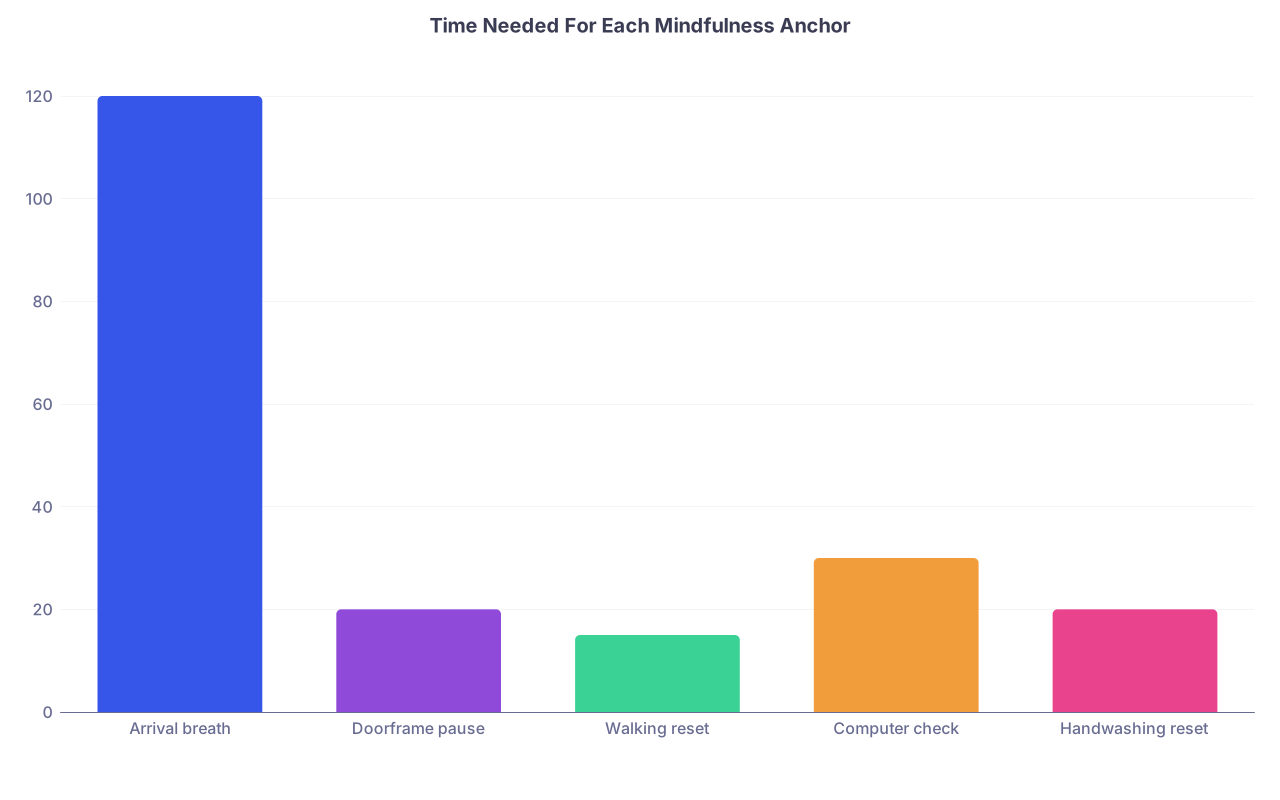
| Category | Value |
|---|---|
| Arrival breath | 120 |
| Doorframe pause | 20 |
| Walking reset | 15 |
| Computer check | 30 |
| Handwashing reset | 20 |
At the computer: Inbox or note overload (30–60 seconds)
You’re staring at 20 in‑basket messages and 6 unfinished notes. This is where burnout breeds.
Anchor: 4‑point reality check
Eyes on the monitor, then:
- Name 4 things you see (monitor, coffee mug, pen, window).
- Name 3 things you feel physically (chair under you, shirt on your shoulders, weight of your feet).
- Name 2 sounds (ventilation hum, printer, distant voices).
- Take 1 slow exhale, longer than your inhale.
Then ask: “What’s the single next action that actually matters?”
Do that. Not the five distractions.
Ethically, this is non‑maleficence applied to yourself. You are part of the system of care. Overwhelm leads to errors.
Pre‑Lunch Crunch: Late Morning When You’re Behind
Everyone’s hungry. You’re 20 minutes behind. This is where you think you have no time for mindfulness. Wrong.
At this point you should be protecting two anchors: before difficult patients and before the “one more thing” moment.
Before a known challenging encounter (10–20 seconds)
Seeing the schedule: “Oh no, it’s Mr. X again.” Chronic pain, boundary tester, or the patient who always complains.
Anchor: Bias spotlight
Outside the door, silently fill in three blanks:
- “The story I’m already telling myself about this patient is ______.”
- “The risk if I believe that story is ______.”
- “Instead I will choose to focus on ______.”
Example:
- “The story: He’s drug‑seeking and ungrateful.”
- “Risk: I’ll miss real pathology or betray my own professionalism.”
- “Focus: Clear boundaries and genuine curiosity.”
This is ethics: justice (fair treatment) and respect for autonomy, despite your annoyance.
At minute 18 of a 20‑minute visit: “One more thing” defense (10–20 seconds)
Patient: “Oh, and one other thing…”
You feel the spike of irritation.
Anchor: Micro‑body scan
Notice: jaw, throat, chest, belly.
Wherever you feel tightest, exhale toward that area.
Then say, aloud and kindly:
- “I really want to hear that. We’re short on time, so let’s decide together: is this more important than everything else we’ve covered, or should we schedule a dedicated visit?”
Mindfulness is not saying yes to everything. It’s noticing reactivity and then choosing an honest, ethical boundary.
Lunch: The Temptation To Chart Through It
At this point you should be protecting at least 5–10 minutes for an actual reset. Yes, even in residency. Especially in residency.
First 3 minutes of lunch: Don’t touch the EHR
You sit down. Everyone else opens their laptops like a reflex.
Anchor: Chair + bite + breath
For the first 3 minutes:
- Feel the chair under you. Really feel it.
- Take one bite or one sip.
- Put the food or cup down.
- Take one slow breath.
Repeat until 3 minutes are up. You can talk with colleagues, but keep that slow‑down rhythm: bite, put down, breath.
This is when people tell me, “I noticed I hadn’t actually tasted my lunch in months.”
Last 2 minutes of lunch: Values reminder
Pull your badge out or look at your ID photo.
Ask yourself:
- “Why did I start this profession in the first place?”
- “Is there one small behavior this afternoon that would be more aligned with that?”
Answer in one sentence. Example:
- “I wanted to be the doctor who really listens.”
- “This afternoon, I’ll let each patient finish their first sentence without interrupting.”
Small, concrete, doable. That’s how you tie mindfulness to ethics instead of vague wellness slogans.
Early Afternoon: Post‑Lunch Slump (Hours 5–6)
Afternoon starts, energy drops, and the waiting room is full again.
At this point you should be using sensory anchors to stay awake and humane.
First patient after lunch: Sensory reboot (20–30 seconds)
Outside the door:
Anchor: Five‑sense sweep
- Look: notice one color in the room or hallway.
- Hear: pick out one distant sound.
- Touch: feel your hand on the doorknob.
- Smell: notice any scent (even “hospital neutral”).
- Taste: whatever is in your mouth (even if it’s “nothing”).
This snaps you out of autopilot. Patients know when they’re getting the “post‑lunch robot” version of you. Do not be that.
In a complex visit: Shared silence (10–20 seconds)
Bad news. Grief. Diagnostic uncertainty.
Anchor: Ethical silence
- After delivering difficult information, do not immediately fill the space with more words.
- Count a slow “one‑one‑thousand, two‑one‑thousand, three‑one‑thousand” in your head.
Let the patient react. Cry. Stare. Ask the question they’re afraid to ask.
This is respect for autonomy in practice. You’re giving them space to actually process and choose, not railroading them with your agenda.

Late Afternoon: Fatigue, Irritability, and Cutting Corners (Hours 7–8)
This is danger time. Errors go up. Patience goes down. Your “professionalism mask” starts to crack.
At this point you should be guarding two junctions: when you’re tempted to shortcut, and when you feel resentment.
When tempted to shortcut (10–30 seconds)
Example shortcuts you know too well:
- Skipping a physical exam you know you should do.
- Ignoring an abnormal vital because “they’re always like that.”
- Brushing off a vague complaint because “it’s probably nothing.”
Anchor: Future‑you check
Ask yourself:
- “If this patient comes back sicker in 3 days, what will I wish I had done right now?”
- “Can I do that in the next 60 seconds?”
Often it’s as simple as:
- Glancing back at the med list.
- Palpating that abdomen.
- Actually looking at the rash instead of assuming.
You’re aligning behavior with beneficence and non‑maleficence — not your mood.
When resentment spikes (10–20 seconds)
The “difficult” patient. The rude family-member. The admin email about metrics. You feel the internal “Are you kidding me?”
Anchor: 3‑part compassion for everyone
Silently, toward the person in front of you:
- “This person wants to suffer less.”
- “I also want to suffer less.”
- “We’re both stuck in this system right now.”
You’re not excusing behavior. You’re dropping the story that you’re the only victim in the room, which changes how you respond.
End of Day: Last Patient to Last Note
You’re tired, done, and still have charts. This is where you decide whether tomorrow will feel slightly more bearable or slightly worse.
At this point you should be closing your clinical day on purpose, not just stumbling out.
Before the last patient: Commitment reset (15–30 seconds)
Even if you’re 45 minutes behind.
Anchor: “Last patient first”
Ask:
- “If this person were first on my schedule, how would I show up?”
- “Can I offer them 80% of that, even now?”
Then choose one specific behavior:
- Sit down instead of hovering at the door.
- Make eye contact for two extra seconds.
- Ask, “Anything else on your mind before we wrap up?”
You are protecting justice — the last patient deserves the same moral seriousness as the first.
After the last patient: Micro‑debrief (2–3 minutes)
You’re back at the workstation, exhausted.
Anchor: Two columns, three lines
On a scrap paper or notes app, draw two columns:
- Left: “Proud of”
- Right: “Wish different”
Write 3 bullets total, not more:
- 2 under “Proud of”
- 1 under “Wish different”
Example:
- Proud of: “Stayed calm with angry family.”
- Proud of: “Caught subtle sign of sepsis early.”
- Wish different: “Interrupted Ms. L three times.”
Then, for the Wish different, write one sentence:
“Tomorrow I will try ______ instead.”
You’re doing continuous ethical quality improvement on yourself, in under 3 minutes.
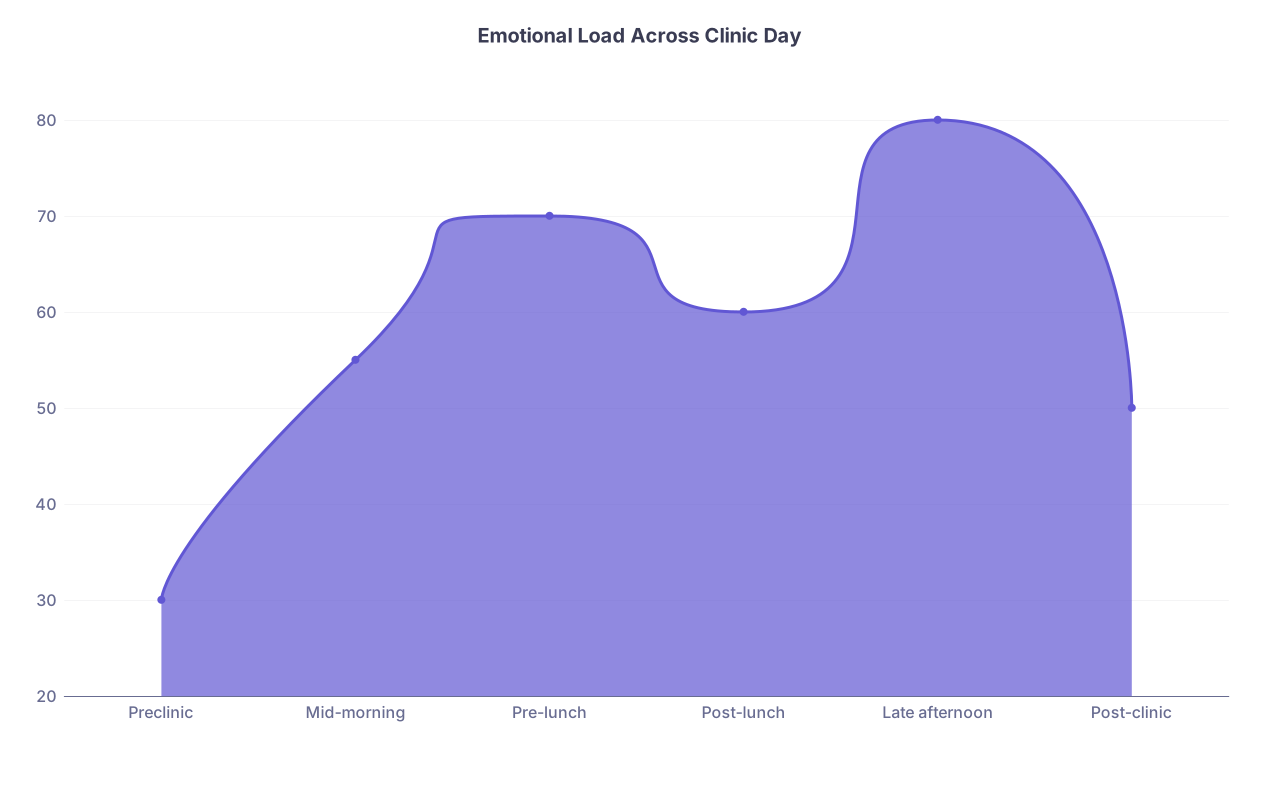
| Category | Value |
|---|---|
| Preclinic | 30 |
| Mid-morning | 55 |
| Pre-lunch | 70 |
| Post-lunch | 60 |
| Late afternoon | 80 |
| Post-clinic | 50 |
Before leaving the building: Decoupling (30–60 seconds)
At your locker, the parking lot, or just before the elevator.
Anchor: Threshold ritual
Pick a physical threshold: door to stairwell, badge‑out sensor, or parking garage entrance.
At that spot:
Stop.
Place one hand on your chest, one on your belly.
Take three slow breaths.
Silently say:
- “Clinic day is ending.”
- “I am more than my productivity.”
- “Home version of me starts now.”
You will still think about patients at home. Fine. But this ritual gives your nervous system a clear cue that the clinical role has shifted.

Quick Reference Timeline: Anchors Across the Day
| Phase | Key Anchor | Time Required |
|---|---|---|
| Pre‑clinic | 10‑breath arrival | 2–3 minutes |
| First patients | Doorframe pause | 10–20 seconds |
| Mid‑morning | Walking reset | 5–15 seconds |
| Pre‑lunch | Bias spotlight | 10–20 seconds |
| Post‑lunch | Five‑sense sweep | 20–30 seconds |
| Late afternoon | Future‑you check | 10–30 seconds |
| End of day | Two‑column debrief | 2–3 minutes |
How To Start Tomorrow Without Overhauling Everything
Do not try to use every anchor on day one. That’s how people fail and decide “mindfulness doesn’t work.”
Tomorrow, pick:
- 1 anchor before patients (10‑breath arrival or doorframe pause)
- 1 anchor between patients (walking reset)
- 1 anchor at the end of the day (two‑column debrief or threshold ritual)
Run just those three for a week. Then layer in one more.

| Step | Description |
|---|---|
| Step 1 | Arrive at clinic |
| Step 2 | 10 breath arrival |
| Step 3 | Review schedule with compass |
| Step 4 | Doorframe pause |
| Step 5 | In room presence check |
| Step 6 | Hallway walking reset |
| Step 7 | Lunch reset |
| Step 8 | Afternoon sensory reboot |
| Step 9 | Future you shortcut check |
| Step 10 | Last patient commitment |
| Step 11 | Two column debrief |
| Step 12 | Threshold ritual exit |
FAQ (Exactly 4 Questions)
1. What if I literally have no time between patients — not even 10 seconds?
You do. You just are not using it yet. The walk from your chair to the exam room is 5–15 seconds. The hand on the doorknob is 3–5 seconds. Washing your hands is 10–20 seconds. Start by turning handwashing into an anchor: feel the water, take one slow breath, and think, “Reset.” That’s it. No extra time required.
2. Is this just performance — pretending to care more by looking calm?
No. If you’re just putting on a calm face while raging inside, patients and staff feel the mismatch. These anchors aim at your actual physiology — breath, muscle tension, attention — so your outside and inside gradually line up. Better for ethics too: it’s easier to be honest, kind, and fair when your nervous system is not in full fight‑or‑flight.
3. How do I keep from blaming myself when I still snap or rush sometimes?
You will still snap. You will still rush. The point is not perfection; the point is catching it faster. When you notice you were reactive, use the end‑of‑day two‑column debrief. Log “Wish different: Snapped at nurse when behind.” Then commit to one specific tweak tomorrow. That’s an ethical practice of accountability, not self‑attack.
4. Can I teach this to residents, students, or staff without sounding “woo‑woo”?
Yes. Drop the word “mindfulness” if you need to. Call them “reset habits” or “safety checks.” Tie each one to something concrete: fewer errors, better listening, less exhaustion at 5 p.m. Then demonstrate a single anchor on rounds — for example, a 10‑second doorframe pause — and explain, “This helps me not carry the last patient into the next room.” That’s professionalism, not mysticism.
Open tomorrow’s clinic schedule right now. Next to three specific patients — first of the day, first after lunch, and last of the day — type a tiny note to yourself: “Pause.” That’s where you’ll run your anchors.