
The physicians who almost never burn out are not tougher than you. They’re running a different mental operating system—and nobody teaches it in medical school.
You’ve been sold the wrong model. The hidden curriculum says: push harder, care more, sacrifice yourself, and maybe someday you’ll “get used to it.” The attendings who actually last 20–30 years without becoming bitter or broken? They’re doing something very different, quietly, almost invisibly. To trainees, it can look like they “just don’t care as much.”
They do care. They’ve just learned where to stop.
Let’s pull back the curtain on what they’re actually doing, inside their own heads, on a normal Tuesday at 3:17 a.m. when the ED is full, the system is failing, and somebody’s crashing in bed 12.
The First Secret: They Don’t Identify With Every Outcome
Here’s the dirty little secret: most young physicians are unconsciously trained to fuse their self-worth with patient outcomes. The ones who rarely burn out reject that contract.
I watched this dynamic play out on an ICU rotation. Two attendings. Same census, same nightmare nights.
Attending A would say at sign-out: “Bad outcome. I failed her.”
Attending B, after just as horrible a night: “This was a bad outcome. The team did what was possible in a broken system. Now we figure out what we can learn and move on.”
Same facts. Completely different mental move.
The low-burnout physicians make a sharp, constant distinction in their minds:
- What I can control: my preparation, my presence, my judgment in the moment, how I communicate, whether I own my mistakes.
- What I cannot control: the biology, the timing, the patient’s life before they met me, the hospital constraints, the fact that some people die no matter what you do.
And here’s the part nobody says aloud: they enforce this distinction ruthlessly. Almost like a boundary around the psyche.
They still feel grief. They still feel responsibility. But they refuse to translate “The patient died” into “I am bad” or “I’m a fraud” every single time. They run a short internal debrief, pull out one or two learning points, acknowledge the emotional hit, and then shut the mental file.
Not because they’re cold. Because they want to be able to show up again tomorrow with their brain intact.
You want an example? Think about the cardiologist who’s been running STEMI call for 25 years. If every unsuccessful resuscitation became a personal indictment, they’d be done. Instead, you’ll hear things like:
“We caught it late. Could we have been faster? Maybe by 2–3 minutes, tops. Would that have changed the outcome? Probably not. We update the protocol; then we let this one go.”
That phrase—let this one go—is not just something they say. It’s a deliberate mental habit.
The Micro-Mindfulness You Never See
Most people hear “mindfulness” and think of meditation apps and 10-minute body scans. That’s not what keeps a trauma surgeon sane at 2 a.m.
The physicians who rarely burn out practice micro-mindfulness. Tiny, 10–30 second practices embedded directly into the clinical flow. Done so often they become reflexive.
I’ve watched this during rounds more times than I can count. Here’s what actually happens.
The Breath Before the Door
On a heme-onc service, there was an attending who almost never snapped, no matter how bad the day got. One day I watched him more closely.
Outside every door—every single one—he’d pause just half a second. Tiny inhale. Tiny exhale. Shoulders dropped a fraction of an inch. Then he went in.
Not performative. Not dramatic. Just a micro-reset. That’s mindfulness, stripped of all the branding.
He told me later, over coffee: “I started doing that after I caught myself bringing anger from room 4 into room 5. They don’t deserve that. It takes me two breaths to remember where I am and who this room is about.”
The habit: one conscious breath, with one conscious intention, at each threshold. Reset. Refocus. Leave the last room behind.
You’ll see a variation in the OR: surgeon steps away from the field while they’re waiting, puts both hands on the counter, slow exhale, eyes soft-focus for a moment. Looks like they’re just zoning out. They’re not. They’re discharging the last five minutes of adrenaline so they can think again.

Naming the Surge
Another tiny habit you almost never see taught: they name their internal state, silently, without judgment.
Over and over I’ve heard some version of this from resilient attendings:
“I feel the spike—anger, fear, whatever. In my head I just tag it. ‘That’s anger.’ Once I name it, it stops driving the bus.”
The “mindfulness” is not them trying to be calm. It’s them noticing: “I’m flooded right now. That will make my judgment worse.” Tag. Acknowledge. That’s all.
In high-acuity settings, this can happen in under two seconds. I’ve seen an EM attending get screamed at by a family member, turn away, and I could see his face change: jaw unclench, eyes soften, tiny head shake. Later he said:
“Yeah. I just said in my head, ‘OK, that hurt.’ Then I asked, ‘What’s actually needed here?’ If I skip that step I start talking to defend myself instead of helping them.”
Is that “mindfulness”? By textbook definition, yes. In reality, it’s battlefield emotional awareness.
How They Talk to Themselves (When No One’s Listening)
You know what burns people out more than hours? The soundtrack in their own head.
Most residents run constant internal abuse:
“You’re behind. You’re stupid. You’re slow. They’re all judging you.”
The physicians who last? They do not tolerate that kind of internal monologue forever. Many started there, then changed it deliberately.
Here’s the trick almost no one admits to out loud: they use intentional, practiced self-talk. Not fake positivity. Just accurate, kinder language.
I remember a senior ICU attending dictating his own chart note out loud and then muttering, half to himself:
“OK, that was rough, but you made the right call based on the info. You can live with that.”
He wasn’t talking to me. He was talking to himself. Out loud. This was a guy who trained in the era when you never showed weakness. Yet he’d built a reflex: review, judge fairly, then close the case.
The underlying habit looks like this:
- After a hard case: “What did I actually know at the time? Would a reasonable, competent physician have done the same? If yes, I let it go. If no, I fix the process, not annihilate myself.”
- When they screw up: “I made an error. That doesn’t make me garbage. It means I figure out why it happened and change something upstream.”
That internal language matters more than you think. It’s one of the clearest differences between the attendings who are quietly content at 55 and the ones who are cynical, checked out, or drunk.
Strategic Detachment vs. “Not Caring”
Let me be blunt: the physicians who don’t burn out are selectively attached. They do not throw their whole emotional body into every single case. That romantic ideal of “every patient is like family” is how you get wrecked.
On a palliative care consult service, I once heard an attending say to a resident after a brutal family meeting:
“You were drowning with them. They don’t need you to drown. They need you to be the lifeguard.”
That line stuck with me. Lifeguards care whether you live or die. But they stay on the shore. They do not jump in headfirst every time without a rope.
Low-burnout physicians walk this line all day:
Deep presence in the room. Real empathy. Real honesty.
Then, when they step out, they consciously zoom back out. Back to role, back to system, back to next task.
They use mental phrases like:
- “That was heavy. Now back to the list.”
- “That’s their story. I’m just one person passing through it.”
- “I’m not the cause of all their suffering, and I’m not the cure for all of it either.”
To a naïve observer, that can look cold. Detached. “They’ve lost their compassion.” No. They’ve learned that unlimited emotional bleeding isn’t compassion—it’s martyrdom.
And I’ll tell you something you do not hear in wellness lectures: the most ethical physicians I know, the ones who fight like hell for their patients, are the ones who’ve mastered this kind of selective detachment. Because they can still think clearly on day 28.
Time Boundaries That Are Actually Mental Boundaries
Everyone loves to talk about “work-life balance.” The attending who never opens Epic at home is held up as a unicorn. The reality is more nuanced.
Lots of low-burnout physicians still chart at home. Still answer calls. Still think about patients. The difference is how and when—and the mental rules they run.
Here’s what they hide behind their calm smiles.
Hard Stop Rituals
You’ll notice that some attendings have a little ritual when they leave the hospital. Not just grabbing their bag. I mean tiny, repeatable acts that signal to their nervous system: “Shift is over.”
I’ve seen:
- The ID attending who always, and I mean always, takes the stairs down from the 4th floor, phone in pocket, no email. Says it’s his “decompression descent.”
- The hospitalist who sits in her car for three minutes, phone off, hands on the wheel, before starting the engine. She told me, “That’s when I decide what, if anything, I’m bringing home in my head.”
Those are mindfulness practices. They’re just not branded as such.

| Step | Description |
|---|---|
| Step 1 | End of Shift |
| Step 2 | Micro Debrief |
| Step 3 | Capture on list |
| Step 4 | Release mentally |
| Step 5 | Transition Ritual in Car or Stairs |
| Step 6 | Enter Home Role |
| Step 7 | Unfinished tasks? |
Pre-Decided Rules About After-Hours Mental Space
The physicians who last rarely make these decisions on the fly, exhausted. They’ve already chosen their rules.
I’ve heard rules like:
- “I will not think about a non-critical patient while I’m in my kid’s room reading bedtime stories. If my mind wanders there, I will gently bring it back. That’s non-negotiable.”
- “If something about a case is haunting me at home, I either (1) add a task for tomorrow to address it, or (2) call a colleague to debrief. I don’t just ruminate alone for three hours.”
Notice the pattern: they intervene on rumination. They don’t let mental loops run wild unpaid.
That’s mindfulness too. Not Zen. Just strategic attention management in self-defense.
Quiet Ethical Lines That Protect Their Minds
You asked about mindfulness, but here’s the unspoken link: the veterans who rarely burn out have fierce ethical boundaries that support their mental habits.
They have decided, very clearly, what they will and will not do. Because nothing erodes your inner peace faster than living in conflict with your own ethics.
Let me give you a few real lines I’ve heard:
From an internist: “I do not lie to patients about prognosis. I soften it, I pace it, but I do not lie. The minute I started shading the truth to make families ‘feel better,’ I couldn’t sleep.”
From a surgeon: “I don’t operate to appease family guilt. If I believe the knife won’t help, I say so. I’ll sit in that discomfort for as long as it takes. But I won’t cross that line.”
From a young hospitalist who figured it out early: “I decided I will never chart something I don’t believe is medically accurate just because admin wants a metric. If that gets me fired someday, so be it.”
Why does this matter for burnout? Because when your actions and your values are aligned, you don’t have to burn energy justifying yourself to yourself at 1 a.m.
That internal congruence is a form of mindfulness. A felt sense of “I am doing my job in a way I can live with.” It’s astonishing how protective that is.

The Unsexy Physical Habits They Guard Like Lions
I’m going to say something unfashionable: the physicians who last are not juggling five side hustles while training for an Ironman and writing a book.
They’re boring. On purpose.
They treat their sleep, food, and body like non-negotiable clinical equipment. And they use quiet, mindful awareness to keep themselves from drifting too far from baseline.
Not “gratitude journaling” every night. I mean noticing:
“I’ve been snapping at people all day. That’s usually my 2-night sleep debt signal. I fix the sleep before I decide I ‘hate my job.’”
They have internal dashboards. Body, mood, concentration, patience. And they actually check them.
I’ve seen attendings pause mid-morning and say, half-joking:
“OK, my brain is sludge. I need 5 minutes and a coffee before I staff your next admission or I’m going to miss something.”
They’re not being cute. They’re respecting the instrument. Quietly. Consistently.
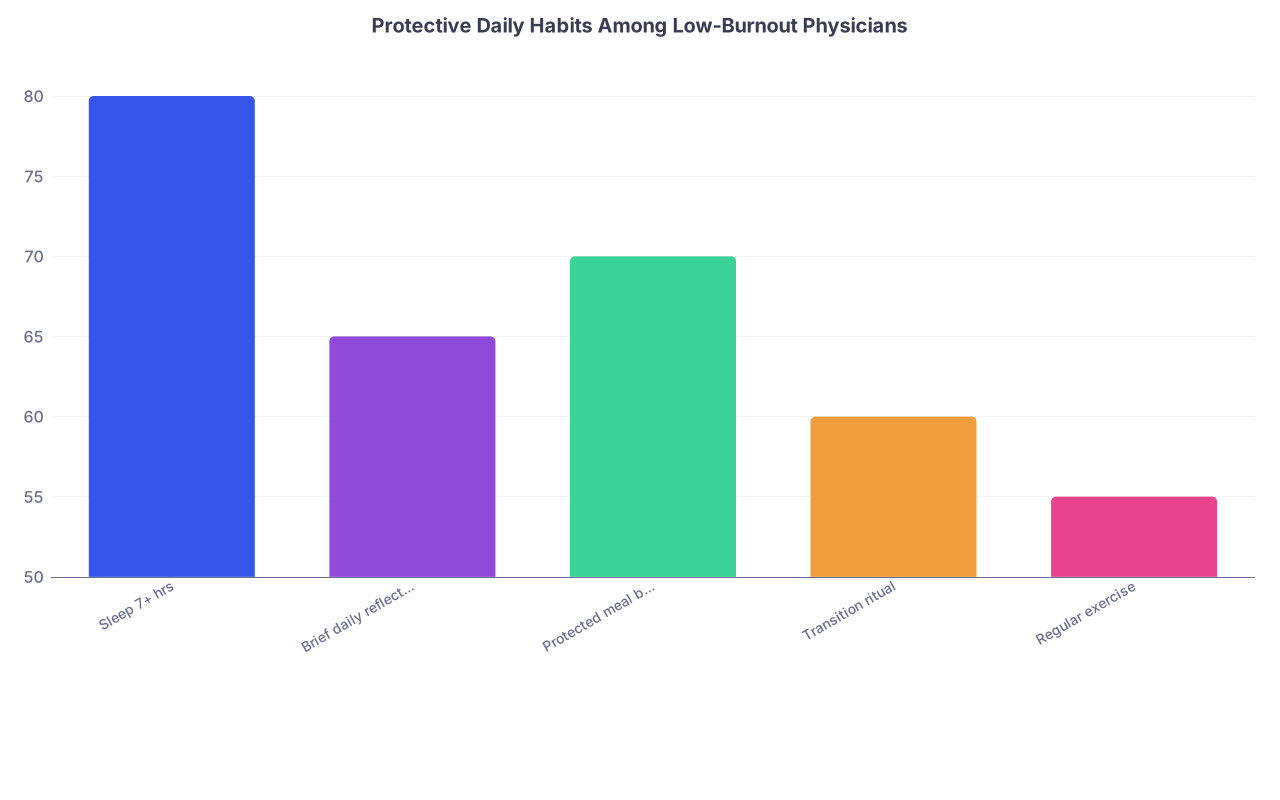
| Category | Value |
|---|---|
| Sleep 7+ hrs | 80 |
| Brief daily reflection | 65 |
| Protected meal break | 70 |
| Transition ritual | 60 |
| Regular exercise | 55 |
How They Handle the Worst Cases (Without Shattering)
You want to know where mindfulness really shows up? Not in five-minute breathing exercises between patients. In what happens after the horrific case. The pediatric code. The missed diagnosis that mattered.
Most trainees do one of two things: wall it off completely, or spiral in guilt and self-loathing.
The physicians who rarely burn out run a different sequence.
I’ve seen it play out like this:
- They allow themselves to feel it. Not forever. But they don’t slam the door shut immediately. Maybe they sit in the call room for 90 seconds and just feel sick, or sad, or furious. They don’t override their physiology.
- They create a specific container for reflection. That might be M&M, or a 10-minute walk with a colleague, or a deliberate solitary debrief: “What happened? What would I tell a resident who did what I did?”
- They separate preventable from tragic. If it was preventable, they act: change a process, make a checklist, apologize, learn a new skill. If it was tragic but not preventable, they very consciously tell themselves: “This hurts because I care, not because I failed.”
- Then—this is key—they grant themselves permission to move forward. They do not make “I will suffer forever over this” into some kind of twisted loyalty to the patient.
You can almost hear the internal monologue: “I will remember this case. It will change how I practice. But I will not let it destroy me. That doesn’t honor anyone.”
That last step is ethical self-compassion. Nobody will give you a CME talk on it. You’re supposed to do it alone, in the dark, and just hope you guess right.

The Social Shield: Who They Let Into Their Mental World
Let’s talk about something most wellness committees are too polite to touch: some colleagues are poison. Spend enough time around them and you’ll start to believe that medicine is only suffering, that all patients are ungrateful, and that nothing you do matters.
The physicians who endure are ruthless about who they absorb energy from.
Look closely and you’ll notice:
- They have one or two people they can be brutally honest with about cases, fear, shame. Not ten. Not none. One or two.
- They limit time around the perpetually bitter attendings. Professional when required, but they don’t linger at that workstation for another 20 minutes of “this place is hell” talk.
- They pick mentors whose lives they’d actually want. Not just whose CVs are shiny.
There’s a kind of social mindfulness here: a constant quiet question running in the background—“How do I feel after I talk to this person, day after day? More grounded, or more hollow?”—and then they adjust their proximity accordingly.
You won’t see that on any professionalism evaluation. But it will make or break your career.
| Dimension | Low-Burnout Physicians | High-Burnout Physicians |
|---|---|---|
| Self-talk after errors | Specific, process-focused, fair | Global, self-attacking, catastrophic |
| Emotional boundaries | Selective attachment, conscious detachment | Over-immersion or total emotional shutdown |
| Transitions | Deliberate rituals, brief decompression | Abrupt shift, rumination on commute/home |
| Ethics & values | Clear red lines, aligned actions | Frequent compromises, lingering resentment |
| Social environment | A few trusted peers, limit toxic exposure | No real confidants or constant venting circle |
Training Yourself Into These Habits (Without Becoming “That Wellness Person”)
You don’t have to become a caricature of mindfulness to use this. No one needs to see you with a meditation cushion in the call room.
Here’s how people I’ve worked with actually build this in silently:
- Pick one micro-habit and tie it to a trigger already in your day. Breath before door. Name-the-feeling once per hour. Three-minute car ritual before you drive home. Do it every day for a month until it’s automatic.
- Start policing your internal voice the way you police your documentation. If you wouldn’t write that sentence about a colleague—“He’s an idiot who always screws up”—don’t say it about yourself either. Replace it with: “He made a mistake on a hard day; here’s what he’s doing about it.” Apply that standard to you.
- Decide one ethical line in advance. Just one. Something like, “I won’t lie to patients about test results,” or “I won’t yell at nurses.” Lock it in. When you hit that boundary and protect it, notice how your body feels afterward. That bodily sense of integrity is fuel.
This is all mindfulness. Just with the jargon ripped off and the timeline compressed to something that survives on a 28-hour call.
The physicians who rarely burn out aren’t superhuman. They are just quietly, stubbornly intentional about what they pay attention to, what story they tell themselves, and which parts of the suffering they agree to carry.
You will not learn this from the online modules, or the pizza-and-resilience noon lecture. You learn it the same way they did: by paying attention to the attendings whose eyes are still alive, asking them what they actually do on the bad days, and having the courage to experiment on your own inner life.
With these unspoken habits on your radar, you’re not just trying to “survive residency” anymore. You’re starting to sketch the kind of physician you want to be at 50, with your integrity intact and your empathy still accessible.
The next step is translating these inner shifts into how you lead teams and teach trainees—because the culture will not change itself. But that’s a conversation for another call night.