
The Real Reason Mindful Physicians Get Picked for Leadership Roles
It’s 7:55 a.m. You’re in a cramped conference room for the monthly department meeting. Coffee’s burnt, projector’s flickering, everyone’s half-charting on laptops.
A case blows up: delayed consult, angry family, near-miss.
Half the room goes on defense. Someone starts weaponizing “patient safety.” Voices rise. A senior surgeon starts that tight-jawed, passive-aggressive speech you’ve heard a hundred times.
And then there’s one attending. Calm. Makes space. Actually listens. Reframes the issue without shaming anyone. By 8:20, people are no longer on edge. There’s a plan. Folks walk out feeling heard instead of humiliated.
Fast-forward six months. Guess who just got named associate medical director? Not the loudest. Not the most published. The one who kept their head while everyone else spun out.
You think that’s an accident?
It isn’t. Let me tell you what really happens in those rooms where leadership decisions get made—and why the “mindful” physicians, the ones who’ve done the inner work, keep ending up with the titles and the influence.
What Administrators Actually Look For (But Never Put in the Job Posting)
On paper, leadership positions talk about “strategic vision,” “scholarly activity,” “quality improvement experience,” and all the usual fluff. Committees still scan your CV and H-index. But that’s the first pass, not the decision point.
Behind closed doors, the conversation sounds very different.
I’ve sat in those meetings. You’ll hear things like:
- “She doesn’t lose it when the ED is on fire.”
- “He can give hard feedback without making people quit.”
- “Nurses actually like working with her.”
- “If I put him in charge of this, my inbox will get quieter, not louder.”
That’s mindfulness, translated into admin language.
They’re not saying, “We must select someone with advanced nonjudgmental awareness of the present moment.” They’re saying, “I can trust this person with conflict, chaos, and politics without making my life harder.”
Here’s the ugly truth: hospital leadership is terrified of volatile physicians in power.
The last thing they want is a brilliant, reactive hothead with a title. Liability. HR nightmares. Turnover.
So they quietly filter for three traits that mindfulness training builds better than anything else:
- Emotional self-regulation under pressure
- Non-defensive listening when criticized
- The ability to separate ego from decision-making
You show up with those? Half the battle is already won.
Why Mindfulness Beats Raw Intelligence in Leadership Settings
Let’s be blunt: the average mid-level administrator doesn’t fully understand the clinical nuances of your specialty. They can’t judge you on the finesse of your surgical technique or your interpretation of a rare CT finding. They can judge something else very quickly:
Are you a problem multiplier or a problem container?
That’s the game. And mindful physicians are containers. They absorb heat, metabolize anxiety, and return something calmer, more organized, and less dangerous.
Imagine two hospitalists.
- Both are clinically sharp.
- Both publish a bit.
- Both show up on time, get their notes in, and are generally reliable.
Here’s how they behave differently when things go sideways.
Code event with a bad outcome. Family distraught. Nursing team shaken. Afterwards, there’s blowback: an email chain accusing, finger-pointing, venting. The CMO hears vague complaints and starts quietly asking around.
The non-mindful doc replies to emails like a landmine: defensive phrasing, subtle blame-shifting, one or two sentences that make HR’s antenna go up.
The mindful doc? Pauses. Checks their own emotional reactivity. Writes something like:
“Yesterday was very tough for all involved. I’m open to reviewing what happened and how we can support the team and look at our process. Let’s talk together instead of over email.”
Administration notices that difference. They may not call it mindfulness. They call it “professionalism,” “maturity,” “leadership potential.”
Same thing in real life: at 2 a.m., when the team is drowning, the mindful doc slows their speech, clarifies tasks, acknowledges fear without getting swallowed by it. That’s present-moment awareness, applied. Residents feel it. Nurses feel it. Word spreads.
Leadership roles go to the people others are willing to follow at 2 a.m., not the ones with the prettiest CV.
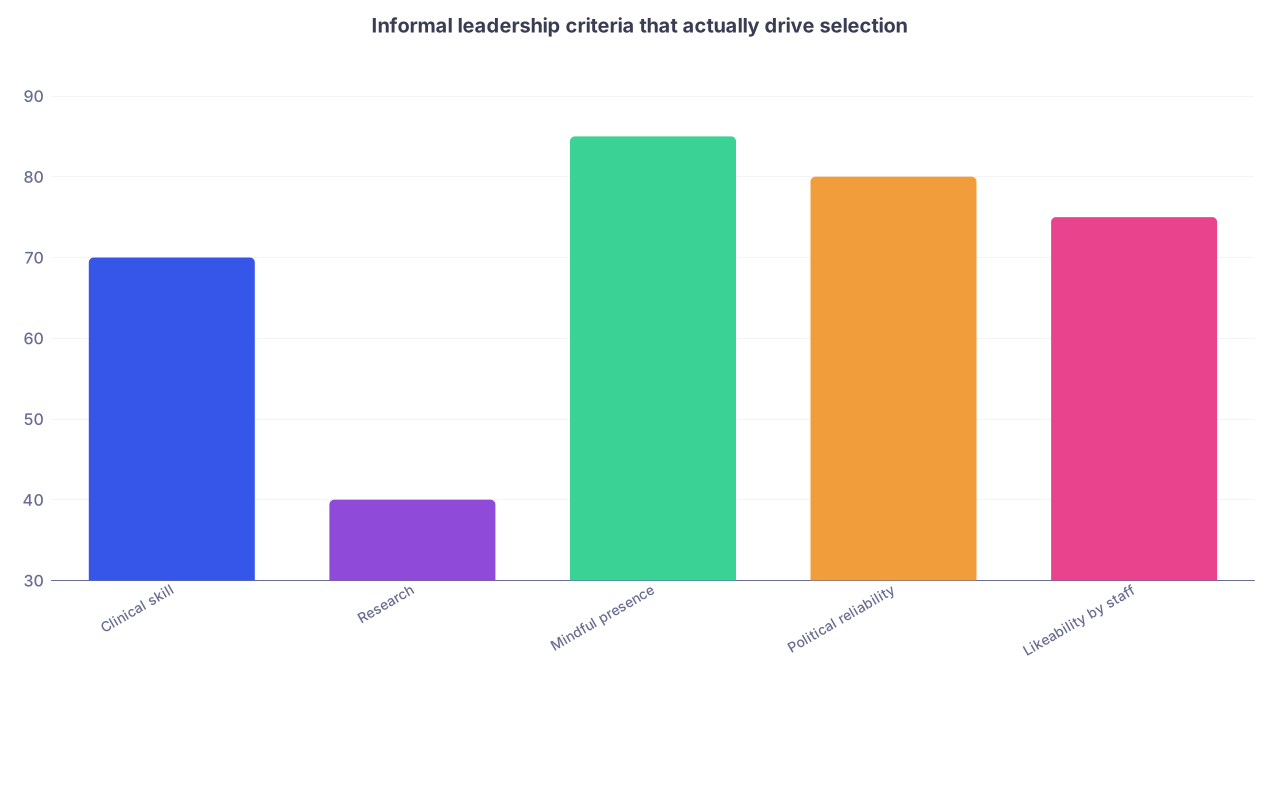
| Category | Value |
|---|---|
| Clinical skill | 70 |
| Research | 40 |
| Mindful presence | 85 |
| Political reliability | 80 |
| Likeability by staff | 75 |
The Quiet Politics: Why Mindfulness Is a Political Asset
Let’s talk politics. Because if you think leadership selection is purely merit-based, you’re still in med school mentally.
At the senior table, people are sorting you into one of three buckets:
- Useful and low-drama
- Useful but high-drama
- Not useful
They don’t say that out loud, but that’s the calculus.
Mindful physicians almost always land in bucket one. Here’s why.
They don’t take every slight personally
If you’re easily offended in committee meetings, people will walk around you like unexploded ordnance. They won’t entrust you with sensitive roles. Leadership requires being criticized, second-guessed, and sometimes undermined—without turning the place into a soap opera.
Mindfulness gives you space between stimulus and response. You can hear “I don’t agree” without hearing “You’re worthless.” That difference is gold in political environments.
They de-escalate, not escalate
I remember a search committee where two final candidates were compared. Both cardiologists. Both well-liked by fellows. Both academically solid, nothing spectacular. The deciding comment?
“Look, when there’s a turf war with CT surgery, he pours gasoline. She cools it down.”
They picked the cooler. Without hesitation.
They don’t contribute to the whisper network
A lot of senior leadership decisions are shaped by the informal network: what nursing leadership quietly says, what unit managers mention over coffee, what the long-serving admin assistant has noticed.
Mindful physicians are usually the ones who listen more than they gossip. They’re careful with other people’s reputations. That gets back to the CMO.
So mindfulness isn’t some soft, spiritual add-on. It’s a political shield and a political asset. It stops you from torching your own future every time your ego gets bruised.
What Mindful Physicians Actually Do Differently Day to Day
Let’s get concrete. What does a “mindful” physician look like on the ground, when nobody is preaching about burnout wellness initiatives?
I’ll tell you what shows up on 360 reviews and in back-channel comments.
They notice their own reactivity in real time
Residents screw something up. Intern is late with a note. Lab lost a sample. The non-mindful doc reacts automatically—eye roll, sharp tone, snarky comment. The message: “You are the problem.”
The mindful doc feels the spike of irritation—and catches it. There’s a micro-second of space. They might still give firm feedback, but the delivery is surgical, not blunt-force trauma.
This matters because nurses and residents remember how they felt with you more than what you said. When stakeholders later weigh in about “Who should lead X?” those emotional memories surface.
They create psychological safety without being “soft”
Psychological safety isn’t about never raising your voice or never being demanding. It’s about your team knowing that mistakes will be discussed, not weaponized.
Mindful physicians ask, “What happened?” before “Who screwed up?”
That single shift changes how teams function—and it’s exactly what quality and safety leaders are desperate to promote.
They handle uncertainty without spinning stories
Things go wrong constantly. Tests are delayed. Consultants disagree. Administration makes yet another opaque decision.
Non-mindful docs immediately build catastrophic narratives: “They don’t care about us,” “This place is falling apart,” “Nothing ever changes.” They then infect the entire team with that story.
Mindful docs see the same mess, feel the same frustration, but notice the story-building process. They don’t believe every thought. So they communicate with less hysteria and more clarity. Leadership notices who destabilizes the room and who stabilizes it.
The Unspoken Link: Mindfulness, Ethics, and Trust
You listed this under “Personal Development and Medical Ethics.” Good. Because here’s something people rarely say plainly:
Ethical trust is heavily tied to whether others believe you are self-aware.
Hospitals have been burned by “charismatic leaders” who were train wrecks under the surface—boundary violations, bullying, shady billing, or just profound arrogance that eventually harms patients or staff.
So when leadership considers you for a real role—anything with power over schedules, evaluations, hiring—they’re asking themselves:
- Will this person notice their own bias before they punish someone they dislike?
- Will they hear quiet objections, or only listen to people who flatter them?
- When they’re under pressure from above, will they shove it all down on the most vulnerable people below?
Mindfulness practice, done seriously, answers those questions in your favor. Not because you become perfect—but because you become transparent to yourself.
I’ve seen promotion meetings where the deciding factor wasn’t scholarly metrics. It was someone in the room saying:
“I’ve seen him admit when he was wrong in front of residents.”
or
“She owned a bad outcome without blaming anyone else. I trust her with more responsibility.”
That’s ethical credibility. Directly built on self-awareness.

Why Mindfulness Training Programs Are Suddenly Everywhere (And Who Actually Benefits)
You’ve seen the emails. “Mindfulness for Clinician Well-Being.” “Resilience Rounds.” Half the staff rolls their eyes. Some of that skepticism is justified; administrators love low-cost interventions that don’t require fixing systemic problems.
But behind the PR, something real is happening: these programs are fishing grounds for future leaders.
Who shows up?
The burnt-out and desperate. And also the curious, the self-reflective, the ones willing to change their own patterns rather than just complain about everyone else’s.
Guess who stands out in the latter group.
I’ve watched CMOs sit quietly at the back of these sessions. Not to meditate. To see faces. To notice who engages, who thinks deeply, who displays emotional intelligence without theatrics.
Later, when a committee needs a new chair or a “physician champion” for some QI initiative, those same names bubble up:
“Oh, she did that mindfulness series and ended up facilitating one of the small groups. People loved her.”
“He’s been working with the wellness committee and somehow gets even the cynical surgeons to participate.”
You think that doesn’t matter? It absolutely does.
These programs are unofficial auditions. If you take them seriously—not as corporate fluff, but as real training in attention, emotion regulation, and presence—you quietly distinguish yourself from your peers. Not by being louder. By being more grounded.
How This Connects to Your Own Development (If You Want Those Roles)
If you have zero interest in leadership, you can stop here. Mindfulness will still make your life on the wards less miserable, but you don’t need to weaponize it for career advancement.
If you do want a seat at the table, you need to stop thinking of mindfulness as “self-care” and start treating it as core leadership training.
Here’s the playbook I’ve seen work:
You build a private practice first
Five minutes before shift. Two minutes between cases. A few intentional breaths before you enter a room with an angry family. It doesn’t have to be some 45-minute candlelit session. You’re training your brain to insert a pause.
That pause is what people later experience as “calm,” “measured,” and “thoughtful.”
You apply it in public situations that matter
Committee meeting gets heated? You notice your body tightening, your urge to interrupt. You consciously slow your speech, ask clarifying questions, name what’s happening in the room without attacking anyone.
Suddenly people see you as the adult in the room. Even if you’re an early-career attending.
You link mindfulness to ethical clarity
When there’s a gray area—disposition pressure, throughput vs. patient preference, documentation that feels “creative”—you use that same inner awareness to notice your rationalizations. You ask yourself what you’ll be proud of five years from now, not what’s easiest this minute.
Then you say that out loud in small ways. “I know we’re getting pressure to move this patient, but clinically I don’t think it’s safe, and I need to stand on that.”
Over time, this is how you become “the person we trust when things are messy.” Exactly the type who gets pulled into ethics committees, policy groups, and eventually leadership.
| Situation | Non‑Mindful Physician | Mindful Physician |
|---|---|---|
| Angry family complaint | Defensiveness, blames staff | Listens fully, acknowledges, responds |
| Committee disagreement | Interrupts, personalizes conflict | Waits, clarifies, separates issue from ego |
| Team error discovered | Shaming, public criticism | Private, specific feedback, root‑cause focus |
| New hospital policy | Immediate outrage and venting | Questions, seeks understanding, then responds |
The Ethical Edge: Patients Feel It Too
Leadership isn’t just about admin meetings. Patients can tell when you’re half-present, rushing through, mentally already onto the next five tasks.
Mindful physicians aren’t slower; they’re cleaner with their attention. For thirty seconds in a room, they’re actually there. Eye contact. Full presence. No hand on the doorknob.
What does that translate into?
- Fewer complaints about “rude” or “uncaring” doctors
- More compliance, because patients feel heard and thus trust recommendations
- Less risk, because you catch subtle “by the way, doc…” comments that might otherwise be missed
Hospital leaders pay attention to complaint patterns. They know which names keep showing up in negative surveys and which never do. The ones who can move metrics on patient experience without faking it? Those are leadership material.
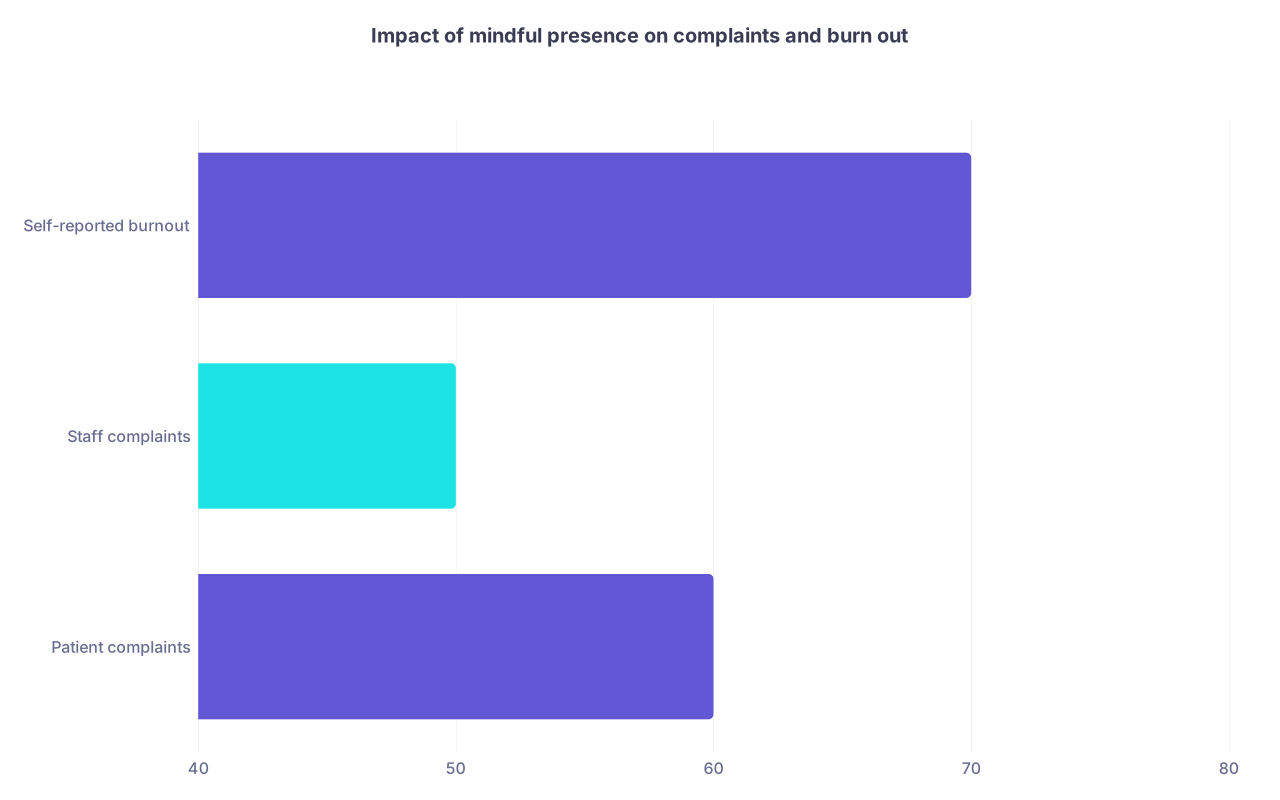
| Category | Value |
|---|---|
| Patient complaints | 60 |
| Staff complaints | 50 |
| Self-reported burnout | 70 |
(Think of those numbers as relative decreases in physicians who routinely practice versus those who don’t. Exact percentages vary, but the pattern is consistent in internal reports I’ve seen.)
If You’re Skeptical About All This
You might be thinking: “So I have to meditate to get promoted now?” No. But if you want to be effective long-term, you can’t just brute-force your way through medicine with raw intellect and anger. That era is dying.
Here’s what I’ve actually seen kill careers:
- Brilliant surgeons who couldn’t control their temper
- Star researchers who melted down whenever challenged
- Charismatic clinicians who refused to examine their own biases
They all got passed over for roles they assumed were theirs. Nobody sends them an email saying, “You weren’t chosen because we don’t trust your self-awareness.” They get boilerplate rejection language instead.
Mindfulness is simply the most efficient way I know to build self-awareness that shows up in how you treat other people. Others experience that, even if they can’t name the cause. And they vote—with their feedback, with their willingness to work with you, and yes, with their leadership choices.

| Step | Description |
|---|---|
| Step 1 | Private mindfulness practice |
| Step 2 | Better emotional regulation |
| Step 3 | Calmer behavior under stress |
| Step 4 | Team trust and psychological safety |
| Step 5 | Positive informal feedback |
| Step 6 | Invited to committees and projects |
| Step 7 | Proven track record in conflict and ethics |
| Step 8 | Selected for leadership roles |
FAQ (Exactly 3 Questions)
1. Do I have to explicitly talk about “mindfulness” to be seen as a mindful leader?
No. In fact, constantly advertising your “mindfulness journey” can come off as performative. What matters is behavior: how you respond when challenged, how you handle mistakes, how present you are with people. You can call it mindfulness, emotional intelligence, or nothing at all. The senior people making decisions will care about the effects, not the label.
2. How much formal practice do I actually need for this to matter?
You don’t need to disappear to a monastery. Ten focused minutes a day, consistently, plus using micro-pauses at work (three breaths before responding to an email, grounding yourself before a hard conversation) will change how you show up. I’ve watched physicians transform their reputations in under a year by being deliberate about this, without ever bragging about meditating.
3. What if my institution doesn’t value mindfulness or wellness at all?
They may not use the language. They may even mock it. But they still value low-drama, high-stability physicians who keep teams functioning under pressure. You can cultivate mindfulness quietly and let the results speak for themselves. Toxic cultures will still recognize and use people who can manage conflict, think clearly under stress, and maintain ethical clarity. Those are mindfulness outputs, whatever label your hospital prefers.
Key points, and then you can get back to your notes:
Mindful physicians get picked for leadership because they make other people’s jobs easier—especially in conflict, crisis, and ambiguity.
Self-awareness and emotional regulation are not “nice extras”; they are the hidden selection criteria every serious leadership table uses, whether they admit it or not.
If you want real influence in medicine, start with the only thing you fully control: how present and aware you are in each interaction. The titles tend to follow that, not the other way around.