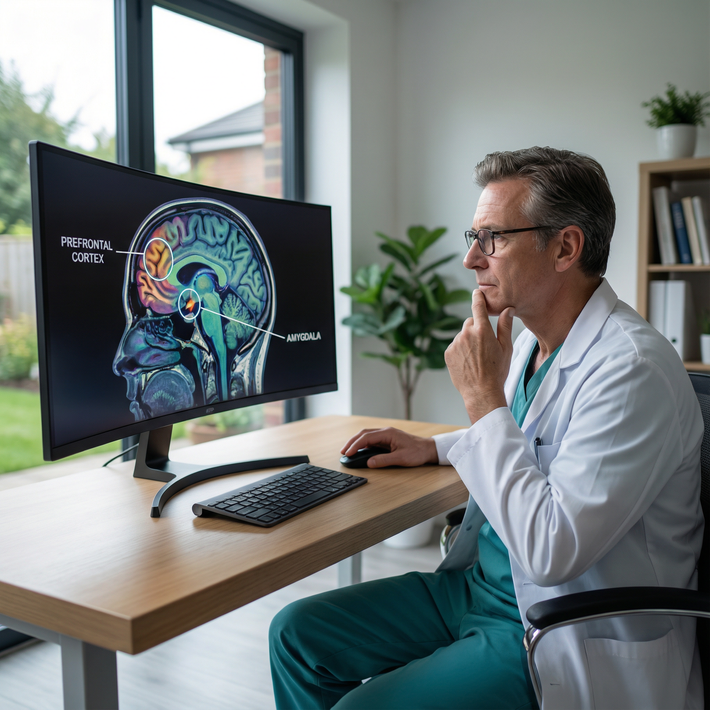
The biggest lie about telemedicine is that you “lose” presence once you move to a screen. You do not lose it. You just lose your autopilot crutches.
Most clinicians show up to video visits with the same mental habits they bring to their inbox: half-distracted, multitasking, and rushing. Then they blame the medium. That is lazy. The problem is not telemedicine. The problem is untrained attention.
Let me break this down specifically: mindfulness is not a scented candle and a breathing app. In clinical work—especially telemedicine—it is a trainable, operable skill: the ability to sustain attention on the patient with clarity, emotional steadiness, and ethical intention. You can absolutely do that through a laptop camera. But you need to build it deliberately.
This is about personal development and ethics at the same time. Because “presence” is not just nice-to-have bedside manner; it is part of respect for patient autonomy, beneficence, and nonmaleficence. A rushed, fragmented mind makes more errors and misses more subtext. Through a screen, those misses compound.
Let’s get concrete.
What “Presence” Actually Means in a Telemedicine Visit
Presence is one of those buzzwords that everyone nods at and almost no one operationalizes. So let us be precise.
In a telemedicine context, “presence” has at least four components:
- Cognitive presence – where your attention is.
- Emotional presence – what emotional tone you bring and communicate.
- Somatic presence – how your body shows up on screen (posture, micro-movements, eye contact).
- Ethical presence – the intention and values you are actually embodying.
If you want a mental checklist for each visit, use a quick internal question:
- What am I attending to?
- What am I feeling and radiating?
- What is my body communicating?
- What is my ethical intention right now?
Telemedicine strips away shared physical space, lighting, and a lot of non-verbal cues. That makes your internal stance more important, not less. Patients can still feel whether you are rushing, bored, or actually with them, even with a 2‑inch video tile.
I have seen this play out in clinic: two clinicians, same platform, same time pressure. One looks intermittently at a second monitor (chart, email, Slack), monotone voice: “Uh huh, any other questions?” The other leans slightly forward, steady gaze toward the camera, pauses after the patient speaks, and reflects back: “So your main worry is that the shortness of breath means your heart is getting worse, yes?” Same fifteen minutes. Completely different experience of being “seen.”
You cannot fake that with a script. You need a trained mind.
Why Telemedicine Exposes Your Attention Habits
Telemedicine is like turning on harsh overhead lighting in a messy room. It exposes what was already there.
The cognitive traps
These are the most common attention failures I see in tele-visits:
- Chart surfing while the patient is talking.
- Checking messages, responding to staff pings, or glancing at your phone.
- Pre-writing your note in real time instead of listening.
- Mentally jumping to disposition (“This is GERD, PPI, next patient…”) by minute two.
- Getting hijacked by technical issues and staying flustered for the rest of the visit.
You can get away with some of this in person because physical presence camouflages a lot. You look at the computer, but you are still sharing the same space. On video, every micro-shift in your eyes and face gets amplified. Patients are staring at your head, not your whole body. When your gaze flickers to a second monitor every few seconds, they notice. And they interpret it.
The ethical piece: divided attention is not just “bad manners.” It is a risk factor for:
- Missed red flags.
- Poor shared decision making.
- Truncated explanations.
- Erosion of trust, especially in already marginalized patients who enter the visit wondering if the system cares.
So the question is not whether presence matters; it is whether you are willing to treat attention as a clinical tool, not a background condition.
Core Mindfulness Skills That Actually Transfer to Telemedicine
Mindfulness gets packaged as “relaxation” in a lot of wellness programs. That does not help much when you are on your fifth complex tele-visit of the morning, behind schedule, with three MyChart messages flashing.
The skills that matter clinically are these:
- Intentional attention – choosing where your mind rests, and keeping it there.
- Non-reactivity – noticing irritation, anxiety, or boredom without immediately acting it out (e.g., cutting the patient off, rushing).
- Meta-awareness – seeing “I am distracted / triggered” in real time and adjusting.
- Compassionate stance – holding both the patient’s suffering and your own limits without shutting down.
These can be trained in short, practical ways that fit into a clinic workflow. You do not need 45-minute sits on a cushion. You need 30–90 seconds at specific points.
Let me give you concrete scripts and micro-practices.
A 3-Part Mindfulness Framework for Each Telemedicine Visit
Think in three phases: before, during, after. You can treat each tele-visit as a rep for your attentional muscle. This is not theoretical—I have seen clinicians implement this and feel different within a week.
1. Before the visit: 30–60 seconds of deliberate arrival
Your default: you click “Join visit” with your mind still jammed from the previous patient, the call you just took, or the lab result that annoyed you. You carry that residue forward.
You need a reset.
Here is a simple pre-visit protocol you can run between patients. Thirty seconds is enough if you commit.
- Sit back in your chair; both feet on the floor.
- Feel your sit bones in the chair. Let your shoulders drop 5%.
- Take one slow in-breath through the nose, count 4.
- Long slow exhale through the mouth, count 6–8.
On the exhale, say internally: “Arriving for this patient.”
Not “clearing your mind.” Just shifting from the last encounter to this one.
b. Name your intention in one clean sentence
Something like:
- “For the next 15 minutes, I will prioritize understanding this patient’s main concern.”
- “I will listen fully before deciding.”
- “I will treat this person as if they were my own family member on the screen.”
Pick one and keep it the same all day if that is easier. Intention shapes attention. If your intention is “finish on time,” you will cut corners unconsciously. If your intention is “understand and respect,” that will quietly filter how you show up.
c. Quick awareness scan (10 seconds)
Ask yourself:
- What am I bringing into this visit? (Fatigue, annoyance, rushing?)
- Where do I feel that in my body? (Tight jaw, chest, gut.)
Just notice. No fixing required. Awareness itself dials down reactivity.
Then click “Join.”
2. During the visit: staying present on a screen
Most presence is lost after minute three. Once the chief complaint is out, your mind starts planning.
You are not going to stop planning; you are not supposed to. The goal is to stay anchored in the live interaction while your clinical reasoning runs in the background.
Here are specific practices that work well on video.
a. Single-tasking rule: one cognitive task at a time
Use a simple internal rule:
- Either I am listening, or I am documenting.
- Either I am reviewing data, or I am talking with the patient.
You can switch quickly between them, but do not do them simultaneously.
This sounds trivial. It is not. Most of the “flattened” feeling patients describe from telemedicine comes from being spoken to by someone who is really reading and typing.
Operationalize it like this:
- Listening mode: eyes near the camera, hands off the keyboard, body turned toward the screen.
- Documentation/data mode: explicitly tell the patient what you are doing, and when you are about to switch back.
For example:
“I am going to look at your last lab results for about twenty seconds, so you might see me looking off to the side. Then I will come right back to you.”
You can even say:
“Give me fifteen seconds to jot down what you just told me so I do not lose it. Then I want to come back to a couple of details.”
This is transparent, ethical, and prevents you from half-typing while pretending to listen. Patients notice the honesty and tend to relax.
b. Camera-eye vs. screen-eye: intentional gaze
Eye contact on video is odd. Looking at the patient’s face on the screen feels natural to you, but to them it looks like you are slightly looking down. Looking into the camera feels unnatural to you but looks like direct eye contact to them.
Use an explicit strategy:
- During crucial moments—introductions, sharing serious news, asking about fears—look at the camera, not the screen.
- During detailed history, you can alternate camera and screen view: 5–10 seconds on their face, 5–10 seconds on your notes or EMR.
If you find it hard, put a small sticky dot or discreet marker near the camera. Train your eyes to return there periodically. This is not cosmetic. Direct gaze conveys attention and care, even when virtual.
c. Micro-pauses as mindfulness interventions
Tele-visits tend to become compressed because silence feels more awkward online. That is a mistake. Controlled silence is one of your best tools for presence.
Use micro-pauses deliberately:
- After the patient finishes a sentence, wait one full breath before jumping in.
- If they describe something emotional (“I have been terrified I might die from this”), pause for 2–3 seconds, then reflect back: “That sounds very frightening for you.”
This does three things:
- It gives your own nervous system a moment to settle instead of reacting.
- It signals to the patient that their words matter.
- It reduces talking over each other, which on video can be chaotic.
You can also use a pause plus naming when you notice reactivity:
“Let me pause a second. I want to make sure I understood what you just said before I respond.”
That is a mindfulness move in plain language.
d. Noticing and managing internal reactivity
You will get irritated. With connection glitches. With patients who talk in circles. With family members shouting off-camera. Mindfulness is not about not feeling that. It is about catching it at the half-second mark instead of acting it out.
Train a simple recognition script:
- Label it mentally: “Irritation is here.” Or “Anxiety is here.”
- Feel where it lands in the body: “Jaw tight, chest hot.”
- Reconnect to intention: “OK, I am here to help this person understand and decide.”
This takes 3–5 seconds in real time. Do not narrate it aloud. But you may say something like, “Let me organize my thoughts for a moment,” to buy those seconds if needed.
The key is the label. As soon as you move from “I am angry” to “Anger is here,” you create a bit of space. That space is what stops you from snapping back, rushing, or subtly withdrawing.
e. Mindful language: fewer words, more precision
On telemedicine, audio quality, lag, and lack of full-body cues mean your words carry extra weight. Mindfulness shows up in how you choose them.
Some concrete, mindful habits:
- Ask one question at a time. Not: “So is the pain sharp or dull and does it go anywhere and is it worse with exertion?” Break it up.
- Periodically summarize: “Let me see if I have this right…” Then mirror the main points.
- Name the emotional undercurrent: “It sounds not just frustrating, but also scary that this has not improved yet.”
That last one is not “therapy.” It is basic human acknowledgment. Mindfulness allows you to notice the emotional tone instead of bulldozing over it to get to your checklist.
3. After the visit: 20–60 seconds to close and reset
Most clinicians slam “End visit,” immediately jump into note-writing and reviewing labs, then wonder why they feel progressively more scattered and drained.
You need a tiny closing ritual. Not for mysticism. For your prefrontal cortex.
a. One-breath debrief
Right after you click out:
- Exhale fully (longer than your inhale).
- Ask one question: “What stands out from that visit?”
Do not analyze for minutes. Just let one key point surface: “She is more afraid than she is letting on.” Or “I felt rushed and cut him off.” Or “We actually connected well.”
This is informal mindfulness-based reflective practice. It teaches your mind to pay attention to the relational quality of care, not just the throughput.
b. Release + reset
Say internally: “That visit is complete.”
Then do one small physical reset:
- Stand up and stretch your arms overhead, or
- Roll your shoulders slowly, or
- Look away from screens—out a window—for three deep breaths.
This is how you prevent the residue of one emotionally charged encounter from flooding into the next. It is also how you avoid the “blur of 30 faces” feeling at the end of a teleclinic day.
Ethics: Mindfulness as a Professional Obligation, Not a Wellness Perk
Let us get blunt. Distraction in telemedicine is not ethically neutral. When your attention is fragmented, several core principles of medical ethics take a hit.
Respect for autonomy
In tele-visits, patients often have less contextual grounding. No waiting room, no white coat, no vital signs station. They are entering your “virtual office” with fewer signals that you are taking this seriously.
If you spend half the visit looking away, interrupting, and hurrying, you send a clear (even if unintentional) message: “This is not real care, this is triage-lite.” That undermines the conditions under which they make informed decisions.
Mindful presence—looking at the camera when discussing choices, summarizing what you heard, checking their understanding—directly supports true informed consent.
Beneficence and nonmaleficence
You cannot benefit patients or avoid harming them if you are not fully taking in their story. On telemedicine, subtle red flags are easy to miss: the delayed responses that hint at cognitive decline, the shortness of breath while they talk, the way they wince when they shift in their chair.
A mindful clinician is actively watching and listening for these, not just waiting for keywords that match an order set.
Mindfulness here is not airy philosophy. It is pattern recognition sharpened by attention.
Justice
Telemedicine has been a double-edged sword for health equity. It can improve access or exacerbate disparities, depending on how you show up.
Patients who are older, less tech literate, non-native speakers, or from marginalized communities often approach tele-visits with apprehension. If they sense you are distracted or impatient, they will share less, ask fewer questions, and accept recommendations they do not fully understand. That is an equity problem.
Mindful listening, culturally humble curiosity, and patience with tech hiccups are not “extras.” They are how you avoid turning telemedicine into a second-tier product for those with fewer resources.
Designing Your Environment to Support Mindfulness
You cannot meditate your way out of a chaotic, poorly designed set-up. Your environment either supports presence or constantly fractures it.
Here are specific, non-fluffy design moves:
- One screen if possible. If you must have two, put the camera between them and move the primary focus window near the camera.
- Turn off all non-essential notifications during clinic blocks. Email, messaging apps, pop-ups. Yes, really.
- Physical background: simple, uncluttered, neutral. Your patient should not be trying to figure out your bookshelf titles or the diploma behind you.
- Audio: use a decent headset or directional mic; poor audio multiplies miscommunication and frustration.
Set this once, then you are not fighting your set-up every day. That is upstream mindfulness.
A Simple Telemedicine Mindfulness Flow You Can Actually Use
You probably do not need more theory. You need one concrete flow you can plug into your next clinic.
Here is a practical script you can tape to your monitor:

| Step | Description |
|---|---|
| Step 1 | Before visit 30 sec |
| Step 2 | Posture reset and one breath |
| Step 3 | Name intention |
| Step 4 | Join video |
| Step 5 | Welcome and orient patient |
| Step 6 | Listen mode - no typing |
| Step 7 | Summarize and clarify |
| Step 8 | Documentation mode - explain shift |
| Step 9 | Discuss plan with mindful language |
| Step 10 | Check understanding and emotions |
| Step 11 | End visit |
| Step 12 | One breath debrief |
| Step 13 | Physical reset before next patient |
You can refine the details, but if you actually follow this skeleton, your sense of presence will change within a week.
Training Yourself: Small, Repeated Reps
You do not need a 10-day retreat to become more mindful in telemedicine. You need hundreds of short reps, embedded in your actual workflow.
Some very practical training ideas:
- Commit to one day where before every visit you take exactly one conscious breath and name your intention.
- Pick one patient per session where you deliberately practice longer pauses and camera-eye contact.
- At the end of each day, spend three minutes asking: “In which visit did I feel most present? Least present? Why?”
If you want a slightly more formal practice:
- 5 minutes, three times a week, of simple breath-focused meditation:
- Sit, eyes soft or closed.
- Feel the sensation of breathing in the nostrils or chest.
- When (not if) the mind wanders, label it “thinking,” and come back.
- This is not about feel-good states. You are rehearsing noticing distraction and redirecting. Exactly the skill you need mid-visit.
Over a month, that adds up. Your baseline reactivity drops a bit. Your ability to notice “I am distracted” in the middle of a visit increases. And that is where presence is saved—midstream, not in abstract.
A Quick Comparison: Typical vs. Mindful Telemedicine Visit
To make this concrete, here is what shifts when you actually practice this.
| Aspect | Typical Visit Behavior | Mindful Visit Behavior |
|---|---|---|
| Pre-visit | Clicks join while still multitasking | 30-sec reset, intention set |
| Gaze | Constant flicker to other screens | Intentional camera-eye at key moments |
| Listening | Typing while patient talks | Clear listening vs typing modes, explained |
| Handling emotion | Quickly redirects to medical facts | Pauses, names and acknowledges emotion |
| Ending | Abrupt "Any questions? Bye" | Summarize, check understanding, brief debrief |
You can feel the difference just reading that. Your patients will feel it more.
Handling Common Telemedicine Stressors Mindfully
Two high-yield scenarios where mindfulness helps immediately:
1. Technical failures mid-visit
What normally happens: frustration spikes, you apologize hurriedly, both of you get tense or embarrassed, and the visit quality drops.
A mindful approach:
- Pause. One breath. Label internally: “Frustration is here.”
- Say, calmly: “Let us pause and reset the connection. These glitches are very common. I am going to reconnect, and we will pick up where we left off.”
- When back on: “You were telling me about how the pain changes when you walk. Could you start that part again? I want to be sure I heard it clearly.”
Your regulated demeanor becomes co-regulation for the patient. That is ethically significant: you are taking responsibility for the environment and emotional tone.
2. The “endless talker” or chaotic visit
Everyone has had that 20-minute monologue that never arrives at a clear complaint. On telemedicine, it is even harder to interrupt gracefully.
A non-mindful pattern: you get irritated, you either let it run and then rush the rest, or you bluntly cut them off.
A mindful intervention:
- Notice irritation. Label it. Feel it in the body.
- Reconnect to intention: “Understand and focus.”
- Then say, with kindness and structure:
“I want to make sure we focus on what matters most for you today. Could we pause for a moment? From everything you have told me, what would you say is the one or two most important things you want us to address in the next ten minutes?”
You are using mindful awareness of your own reactivity to intervene in a way that respects their autonomy but also respects time and clinical priorities.
Visualizing Cognitive Load and Presence
Mindfulness is your counterweight to cognitive overload. As you stack tasks—documentation, inbox, messages, orders—presence predictably drops if you do not deliberately anchor it.
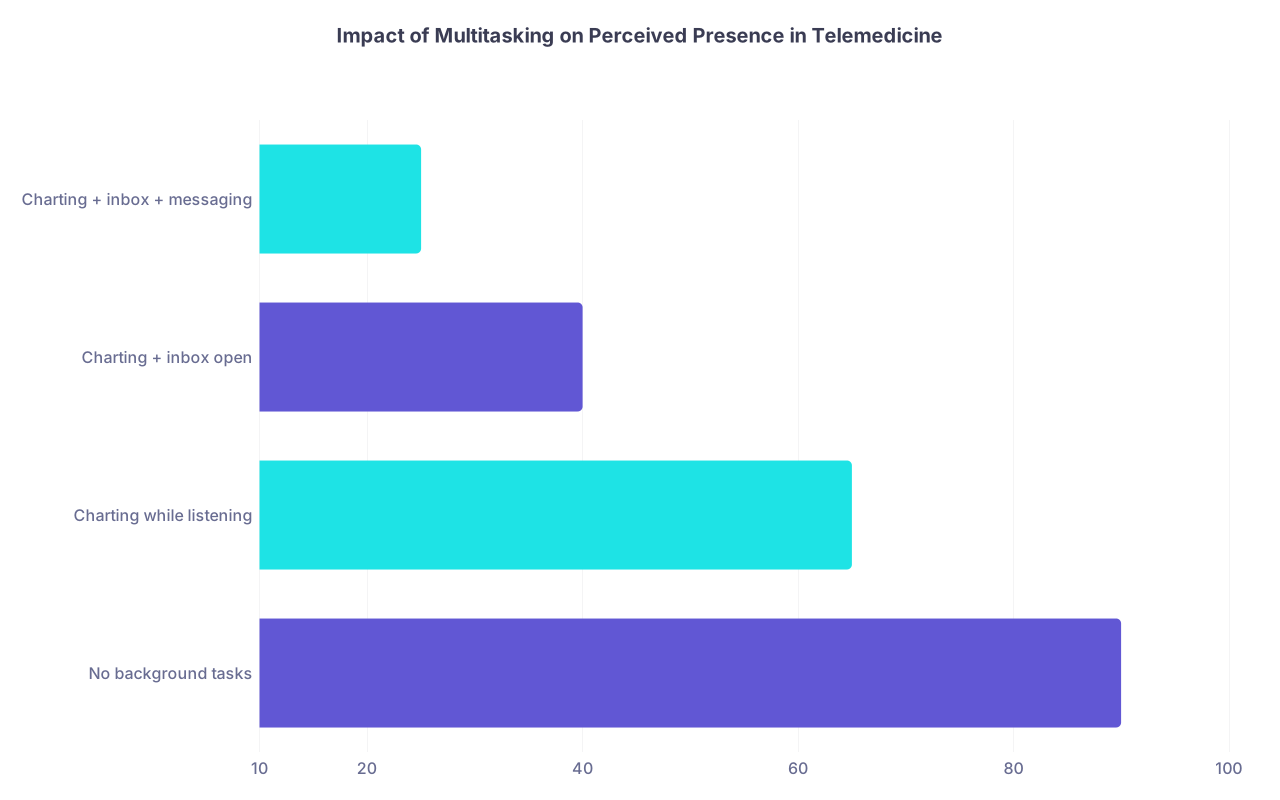
| Category | Value |
|---|---|
| No background tasks | 90 |
| Charting while listening | 65 |
| Charting + inbox open | 40 |
| Charting + inbox + messaging | 25 |
Interpretation is obvious: as multitasking increases, patients’ perceived presence plummets. The percentages here are illustrative, but they match what you hear anecdotally if you listen to patients talk about “video visits where the doctor barely looked at me.”
Mindfulness is not about never multitasking. It is about knowing when you are doing it and choosing to stop when it costs too much.
Bringing It All Together
Presence in telemedicine is a skill, not a personality trait and not a casualty of technology. You do not need to be a Zen monk. You need short, repeatable moves that keep your attention, body, and ethics aligned with the patient in front of you—even if that patient is a face on a screen.
If you remember nothing else:
- Treat each visit as a discrete unit of attention. 30–60 seconds to arrive, 20–60 seconds to reset. You have time for that.
- Separate listening from typing. Tell patients explicitly when you switch. It is the simplest, most powerful way to restore presence.
- Use micro-mindfulness: one breath before joining, one breath after ending, and a habit of naming your internal state. That alone will change how you show up.
You are not “less of a doctor” through a screen. But you do have fewer excuses. Your mind is the main instrument now. Train it.