
The way most clinicians “listen” during the H&P is broken. Not malicious. Just swallowed by time pressure, EHR demands, and habit.
Mindful listening is not a wellness buzzword you sprinkle on top of a 15‑minute visit. It is a set of deliberate micro‑skills that change what you hear, what you document, and what you decide to do next. And it is absolutely compatible with high‑volume, real‑world clinical work—if you structure it correctly.
Let me walk through a concrete, time‑bound, exam‑ready way to build mindful listening into the H&P, without tanking your productivity or your sanity.
Why Mindful Listening Actually Matters in the H&P
Mindful listening in medicine is not “being nice.” It is a core clinical competency that affects:
- Diagnostic accuracy
- Therapeutic alliance
- Ethical practice (respect for autonomy, informed consent, truth‑telling)
When I say “mindful listening,” I mean three specific things:
- Present‑moment attention to the patient’s words, body, and emotions, on purpose.
- Non‑reactive awareness of your own thoughts, judgments, and emotional responses.
- Deliberate choices in how you respond, aligned with clinical goals and ethical duties.
This is not meditation in the exam room. It is disciplined cognitive control during the H&P.
Here is the hard truth: most misses in the history are not because the patient refused to tell you. They are because:
- You asked too fast or too narrowly.
- You mentally anchored on an early hypothesis and stopped really listening.
- You were half in the chart, half in the room.
- You got emotionally triggered (annoyed, rushed, bored, defensive) and subtly shut down.
Mindful listening directly counters those.
A 3‑Phase Structure: Before, During, After the H&P
You cannot “remember to be mindful” in the middle of clinic chaos. You need a structure.
I use a simple three‑phase framework:
- Pre‑Encounter Reset (30–60 seconds) – set your attentional stance.
- Mindful Micro‑Skills During the H&P – specific behaviors in each part of the history.
- Post‑Encounter Debrief (30–90 seconds) – quick reflection and ethical check.
This is clinic‑realistic. You can do all of this in under 2 minutes of total added time once you are practiced.
Phase 1: Pre‑Encounter Reset (30–60 seconds that change everything)
You walk toward the room. You are thinking about the last admission, your inbox, and whether you will ever see lunch again. If you open the door like that, you are not listening. You are reacting on autopilot.
You need a micro‑reset.
A. One‑Breath Check‑In
Outside the door (or before clicking “Start Visit” on telehealth), do this:
- Feel your feet on the floor. Literally. Weight distribution, contact, stability.
- Take one slow breath in, one slow breath out. Not theatrical. Just deliberate.
- Mentally label: “New patient. Fresh chart.” Or “Same patient. Fresh attention.”
You are not cleansing your aura. You are signaling your brain: new file, new data. It cuts carryover bias from the last patient.
B. Name Your Bias in Advance
If you already feel something about this patient—annoyance at their frequent visits, dread about a complex social situation—call it out to yourself:
- “I am already irritated about this refill situation.”
- “I think this is going to be ‘noncompliant diabetes’ again.”
Then add: “Park it. Listen first.”
You are not erasing bias. You are labeling it so it does not silently drive the encounter.
C. Choose a Listening Intention
Pick one simple focus for this visit. Examples:
- “I am going to understand what this symptom means to them.”
- “I am going to find out what they are most worried about.”
- “I am going to make sure they feel heard about at least one thing.”
One sentence. That is your anchor when the EHR starts screaming at you.
Phase 2: Mindful Micro‑Skills During the H&P
Now the meat. How to actually embed mindful listening into each segment of the history—without blowing up your schedule.
1. The First 2 Minutes: Let Them Talk, But With Guardrails
There is strong evidence that if you do not interrupt, most patients finish their opening statement in under 2 minutes. In practice? Many clinicians interrupt within 15–20 seconds.
A mindful opening sequence looks like this:
Setup + Permission
“I am going to start by listening to what has been going on in your own words. I might take a few notes, but I want to really get your story first.”Open Invitation
“What brings you in today?” or “Tell me what has been going on.”Shut up, but actually listen
No EHR clicking for the first 45–60 seconds unless absolutely necessary. Eyes mostly on the patient, not the screen.Mindful noticing while they speak
Track three channels:- Content: symptoms, timeline, key words.
- Emotion: fear, anger, frustration, hopelessness.
- Your reaction: bored? skeptical? anxious about time?
If they go past 90 seconds and are clearly drifting, mindfully redirect:
“I want to make sure I understand the most important parts and also have time to address them. If you had to pick the top one or two concerns today, what would they be?”
That is not rude. It is structured listening.
2. Mindful “Echo” and Clarification
After the opening, do not launch straight into a symptom checklist.
First, give a brief reflective summary:
- “So you have had chest discomfort for a week, worse with exertion, and you are worried because your father had a heart attack young. Is that right?”
- “You feel like nobody has really taken your pain seriously so far. That sounds exhausting.”
Then pause. Let them correct or deepen. This 5‑second pause often surfaces the “real” agenda:
- “Yes… and I am also worried this is cancer.”
- “Also, my job is at risk if I miss more days.”
That extra line is where diagnostic clarity and ethics live.
3. Using Silence as a Clinical Tool
Silence makes a lot of clinicians nervous. They patch it immediately with the next question.
Mindful listening uses targeted silence:
- After delivering a difficult result: give 5–10 seconds before filling the space.
- After a patient’s emotional statement: “I am really scared I am dying.” Stop. Wait.
In those seconds, watch:
- Do they cry, get angry, look away?
- Do they add: “because my kids are still so young,” or “because I saw my uncle die like this”?
These details fundamentally change your ethical obligations around counseling, shared decision‑making, and documentation.
4. Managing Your Inner Commentary
While the patient talks, your mind will run wild: “This is somaticizing,” “This is drug‑seeking,” “This is nonsense,” “This is classic biliary colic.”
Mindful listening does not demand you stop thinking clinically. It asks you to:
- Notice the thought – “I am labeling this as drug‑seeking.”
- Mentally tag it – “Hypothesis, not fact.”
- Return to data – “Tell me more about when you take the medication and what happens.”
This prevents premature closure. It also prevents moral judgment from subtly leaking into your tone, which patients read instantly.
5. Mindful Listening Within a Review of Systems (Without Losing Time)
ROS can become a robotic checkbox exercise. You can inject mindful listening into it without stretching the visit.
Strategy: whenever a patient answers “yes” to a ROS item, do a micro‑pause:
- “Any shortness of breath?” – “Yes.”
Instead of just clicking “positive,” ask one focused follow‑up:
“Tell me more about what that shortness of breath is like.”
You do not do this for every item, obviously. But when something clinically relevant or surprising appears, that one extra curious question often uncovers the key detail (orthopnea vs exertional dyspnea, panic vs asthma, etc).
Integrating Mindful Listening With EHR Reality
The main objection I hear: “This sounds great, but I have 15 minutes and 3 pop‑ups for every click.”
Fair. So you integrate, not separate.
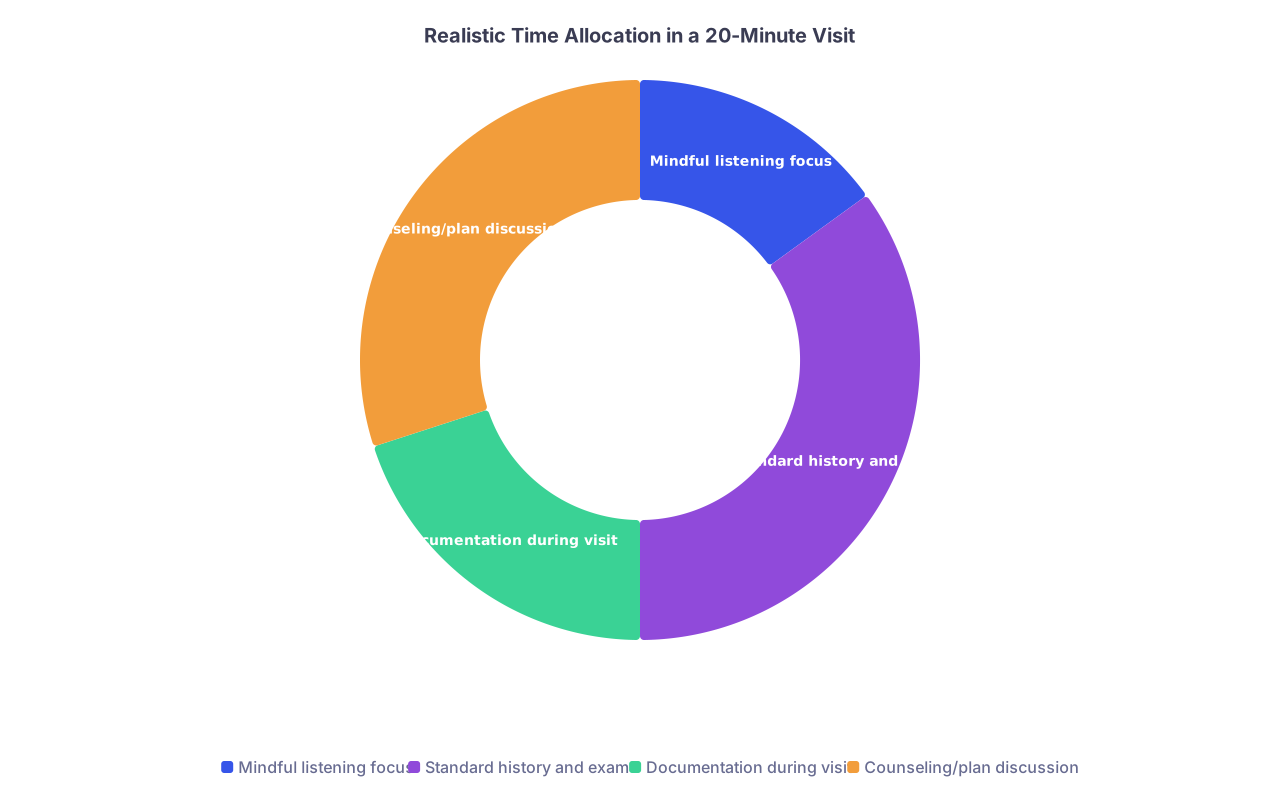
| Category | Value |
|---|---|
| Mindful listening focus | 3 |
| Standard history and exam | 7 |
| Documentation during visit | 4 |
| Counseling/plan discussion | 6 |
A 20‑minute visit might look like that. Three minutes of truly focused listening is already better than the usual split‑attention mess.
Here is how to make it work.
A. Segment the Visit Intentionally
- First 1–2 minutes: full attention, minimal typing. Let them talk.
- Next 5–7 minutes: directed history + exam, with shared screen if possible.
- Last 5–7 minutes: planning, counseling, documentation in front of them when appropriate.
This is not some idealistic fantasy; this is exactly how good outpatient attendings run high‑volume clinics.
B. Use “Narrate Your Clicks”
Patients interpret your silence + typing as disinterest. You can maintain listening even while documenting if you narrate briefly:
- “I am just going to type what you said so I do not miss it.”
- “I want to make sure your story is in the note the way you told it.”
It signals you are still attuned, not drifting.
C. Use Templates as Listening Prompts, Not Crutches
You probably use HPI templates. The worst version turns them into a script you follow mindlessly. The better version:
- Keep the template minimal.
- Use it to remind you of domains, not dictate your questions.
- Leave free‑text space labeled “Patient narrative” and actually put their words there.
That “patient narrative” chunk has disproportionate legal, ethical, and diagnostic weight. It also forces you to listen for exact phrases worth quoting.
Phase 3: Post‑Encounter Debrief (30–90 Seconds)
If you sprint from one room to the next without mental cleanup, you accumulate cognitive and emotional residue. It degrades your listening over the day.
You need a quick post‑visit reset.
A. One‑Line Summary (Clinical + Human)
After you step out (or end the telehealth visit), before opening the next chart, ask:
- “What is this patient’s story in one sentence?”
Example:
- “Middle‑aged man with new exertional chest pain and deep fear because of family history.”
- “Young woman with chronic pain who has been dismissed repeatedly and is losing trust in the system.”
This helps both memory and empathy. It anchors the chart as a human being, not just a list of ICD codes.
B. Ethical Spot‑Check
This is where the “medical ethics” piece stops being theoretical.
Ask yourself quickly:
- Did I actually understand what mattered most to them?
- Did I clearly communicate the options or next steps?
- Is there any way they might feel dismissed, blamed, or coerced?
If something feels off, you have options:
- Add one clarifying sentence in the after‑visit summary.
- Send a quick portal message (if allowed) clarifying a plan.
- Make an explicit note to revisit a sensitive topic next appointment.
This is not perfectionism. It is damage control and integrity.
C. Micro‑Compassion for Yourself
Yes, you. Because a lot of moral distress in clinicians comes from feeling like you are constantly failing ethically due to time constraints.
Take 10 seconds:
- Acknowledge: “That was hard. I did not do it perfectly, but I tried to listen.”
- Reset: “Next visit is a fresh start. New patient, new chance.”
This is not self‑indulgent. It keeps you from numbing out, which is how listening dies.
Mindful Listening With “Difficult” Patients
You cannot talk about mindful listening without addressing the people who trigger you the most: the patient you dread seeing when you open your schedule.
Common categories:
- The frequent flyer with chronic pain and complex psychosocial issues.
- The “Google expert” who questions every recommendation.
- The angry family member who dominates the room.
- The “nonadherent” patient who “never follows instructions.”
Here is where you actually test whether your mindfulness is real or performative.
1. Separate Behavior From Worth
Internally, it helps to frame:
- “This patient is not difficult. Their situation and coping are difficult.”
You do not need to say that out loud. You need to stop conflating their behaviors with their value as a person. That shift changes your tone.
2. Listen for the Hidden Demand
Under most “difficult” behaviors, there is a core unmet need:
- Validation (“You actually believe I am in pain.”)
- Control (“You respect that I read about my condition.”)
- Security (“You will not abandon me like the last doctor.”)
Your job is not to fix their entire life. It is to identify at least one of those and address it authentically:
- “I can see you have done a lot of reading; let us look at what applies to your specific situation.”
- “I do not have a perfect answer for why your pain is still this bad, but I do not think you are making it up.”
That kind of statement takes 20 seconds and can de‑escalate a 20‑minute argument.
3. Notice Your Own Escalation Early
Mindful listening includes bodily awareness of your own anger or frustration:
- Jaw tight? Shoulders up? Heart rate up?
That is your cue to slow down your speech, lower your volume slightly, and simplify your language.
If needed, you can say:
- “I want to make sure I understand you clearly. Let me repeat back what I am hearing.”
This buys time for your physiology to settle and keeps the interaction from spiraling.
Training Yourself: Concrete Practice Strategies
You do not build mindful listening by reading about it. You build it the same way you built your neuro exam: repetition with feedback.
A. One Skill Per Week
Do not overhaul everything at once. Pick one micro‑skill to focus on for a week:
- Week 1: No interruptions for the first 60 seconds.
- Week 2: One reflective summary per visit.
- Week 3: Post‑visit “one‑line story” for your last 5 patients each day.
Track how often you actually do it. Even a rough mental count is fine.
B. Use a Quick Peer Debrief
Grab a colleague or resident after a perplexing or heated encounter and ask:
- “If you were the patient in that room, where do you think you would have felt least heard?”
Not “How was my presentation?” but “Where did my listening fail?” It is a sharper question.
Over time, you will notice patterns: you might consistently shut down when patients challenge your plan or when substance use is involved. That is where your personal work is.
C. Review One Recorded Encounter (If Your System Allows)
If you work in a setting where audio or video recording is used for training (some academic clinics do this), reviewing even one visit is eye‑opening.
Watch for:
- How often you interrupt.
- How often you respond to emotion vs just content.
- How often you look at the screen, and for how long.
Then set one concrete target: “I will cut my first interruption from 15 seconds to 40 seconds.”
Ethical Dimensions: Mindful Listening as Professional Duty
This is not just a “nice to have” layer on top of clinical skill. It intersects directly with fundamental bioethical principles.
| Ethical Principle | Role of Mindful Listening |
|---|---|
| Autonomy | Ensures you understand patient values and preferences before recommending or deciding |
| Beneficence | Improves diagnostic accuracy and tailored treatment by hearing the full story |
| Nonmaleficence | Reduces harm from misdiagnosis, bias, and coercive communication |
| Justice | Counters stereotyping and inequitable listening based on race, gender, or social status |
When you do not listen:
- You cannot truly obtain informed consent, because you do not know what matters to them.
- You risk over‑ or under‑treating based on assumptions.
- You perpetuate systemic inequities, because certain groups are more likely to be interrupted and doubted.
I have watched this play out repeatedly:
- The woman with chest pain labeled “anxiety” because nobody listened to the descriptors with a calm brain. Later found to have NSTEMI.
- The Black patient with abdominal pain who got fewer analgesics and more skepticism than the white patient with the same exam, because the team’s listening was already contaminated by bias before they walked in.
Mindful listening is one of the few immediate, personal levers you have against these structural problems. It is not sufficient, but it is necessary.
A Simple Mental Flowchart During the H&P
To tie this together, here is a compact way to visualize what you are doing mentally.

| Step | Description |
|---|---|
| Step 1 | Pre-encounter reset |
| Step 2 | Open question |
| Step 3 | Observe content and emotion |
| Step 4 | Reflective summary |
| Step 5 | Directed questions |
| Step 6 | Pause and acknowledge |
| Step 7 | Proceed with exam |
| Step 8 | Post-encounter one-line story |
| Step 9 | Patient still talking? |
| Step 10 | Strong emotion appears? |
You are not going to consciously walk through this during every visit. But if you rehearse these checkpoints, they become default behavior.
Closing: What You Should Actually Remember
If you forget everything else and you are walking into clinic tomorrow, hold on to three points:
- Take 30 seconds before each new patient to reset: one breath, name your bias, choose a listening intention. That alone changes the encounter.
- Protect the first minute of the H&P for true, uninterrupted listening, then use one reflective summary to confirm you actually heard the story that matters.
- End with a 30‑second debrief: one‑line patient story plus a quick ethical check—“Did I understand what mattered most to them, and did I make that visible?”
You do not need to become a monk. You need to become 10–20% more deliberate about how you listen during the H&P. That margin is where safer diagnoses, better relationships, and more ethical practice live.