
It is 4:25 p.m. You have been running behind all afternoon. The clinic assistant slips a chart into your hand and lowers her voice: “This is the woman with the new CT… metastases everywhere. Family’s in the room.”
You glance at the EMR. You see the report. You feel your stomach drop. And you realize you are about to walk into one of the most consequential conversations of this person’s life—while your own mind is racing, your chest is tight, and you have not taken a full breath in the last 30 minutes.
This is exactly where mindfulness scripts either exist… or they do not. If you have them, you have a scaffold: specific, practiced, ethical language that steadies you and protects the patient. If you do not, you are improvising serious news with a nervous system in fight‑or‑flight.
Let me break this down specifically: designing mindfulness scripts for breaking bad news in oncology is not about sounding “zen” or reciting platitudes. It is about building deliberate, repeatable mental and verbal sequences that:
- Calm your own autonomic storm enough so you can think clearly.
- Anchor you to ethical communication—truth, compassion, autonomy.
- Give the patient space to process without you flooding the room with your own anxiety.
We will go step by step through how to actually construct those scripts.
1. The Real Problem: You, Not Just the News
Before we talk about scripts, we have to be honest about what breaks in real clinics.
You already know the protocols: SPIKES, BREAKS, COMFORT, whatever variant your institution pushes. You can list the steps: Setting up, Perception, Invitation, Knowledge, Emotions, Summary. Fine.
Yet on a Tuesday afternoon in a cramped oncology room, what really happens?
- Your mind jumps ahead: “How will I explain progression? Molecular options? Hospice?”
- You are replaying the last time this went badly. The patient who shouted. The husband who went silent and never came back.
- You feel the clock behind your eyes. Three more patients waiting. CT that is still unread. Inbox at 72 messages.
In that state, even “perfect” phrasing comes out brittle. You talk faster. You throw jargon to get it over with. You preempt their emotions because you do not want to watch them fall apart.
That is the real use case for mindfulness scripts: not theory, but emergency brake.
A good mindfulness script in oncology has three components:
- A pre‑encounter internal script (30–90 seconds)
- A micro‑mindfulness insertion during the actual breaking of news (5–10 seconds, repeated)
- A post‑encounter reset script (60–120 seconds) to keep the last room from contaminating the next
We will design all three. But first, a quick map of what you are actually trying to regulate.
2. What Mindfulness Has To Do Here (And What It Does Not)
Mindfulness in this context is not about becoming serene or detached. If you are emotionally flat in an oncology bad‑news conversation, that is not mindful. That is dissociation.
The job of mindfulness here is more tactical:
- Slow down your limbic over‑reactivity enough to keep your prefrontal cortex online.
- Increase your capacity to tolerate the patient’s distress without rushing to fix or avoid it.
- Keep you anchored in your actual ethical commitments: honesty, respect, and non‑abandonment.
You are not trying to feel good. You are trying to stay present.
This is where scripts come in. Under stress, free‑form mindfulness practice collapses. You reach for something automatic. So we make it automatic—by designing very specific, very short scripts that you repeat before almost every serious‑news encounter.
To design them well, align them with three overlapping frameworks:
- Clinical communication structure (for example, SPIKES)
- Ethical principles (autonomy, beneficence, non‑maleficence, honesty)
- Mindfulness mechanisms (attention to breath/body, nonjudgmental awareness, intentional pauses)
You are not re‑inventing communication models. You are wrapping mindfulness around them so you can actually execute them under pressure.
3. Pre‑Encounter Script: 60–90 Seconds That Change the Room
This is the script you use before you open the door. In a hallway, workroom, even at the computer. If you skip anything else, do not skip this.
Structure of a Pre‑Encounter Mindfulness Script
Keep it under 90 seconds; you need it to be realistic on a full clinic day. The components:
- Physical anchor (breath or body)
- Naming intention (who you want to be in that room)
- Ethical commitment (what you will not compromise)
- Emotional allowance (permission for your own feelings to exist without controlling you)
Here is a concrete example—you could literally put this on a small card on your badge.
“Three breaths to arrive, then intention, then ethics, then permission.”
Now turn that into full text.
Example Pre‑Encounter Script (Oncology – Bad News)
“I am going to pause here for three slow breaths before I enter.”
On the inhale: “Here.”
On the exhale: “Now.”“This conversation is about them, not about my schedule or my discomfort. My intention is to be clear, honest, and kind.”
“I will tell the truth about what we know. I will not rush their reaction. I will not abandon them afterward.”
“I may feel nervous or sad or helpless, and that is allowed. Those feelings do not have to run this encounter. I can notice them and still speak clearly.”
You can shorten the wording once it is in your bones, but keep the structure.

| Step | Description |
|---|---|
| Step 1 | See bad scan result |
| Step 2 | Step away from door |
| Step 3 | 3 slow breaths |
| Step 4 | Name intention |
| Step 5 | Recall ethical commitments |
| Step 6 | Acknowledge own feelings |
| Step 7 | Enter room |
The point is not poetry. The point is repetition. You run this script 3–5 times a week and your nervous system starts recognizing the sequence as a cue: “Slow down; serious thing coming; prefrontal on.”
4. Designing the In‑Room Mindfulness Script: Phrases You Actually Use
Here is where many mindfulness enthusiasts get lost. They talk about “holding space” and “deep listening” but never give you words that survive a real Thursday clinic.
You need three specific in‑room script layers:
- Grounding phrases for yourself that you silently repeat
- Framing phrases that ethically structure the conversation
- Response phrases for when emotions show up
Let us go one by one.
4.1 Silent Grounding Phrases (During the Conversation)
These are phrases you repeat internally when you feel yourself speeding up or tensing. They are short, neutral, and tied to sensation.
Examples:
- “Feel feet. Slow voice.”
- “One thing at a time.”
- “Breath first, then speak.”
You use them at key points:
- Right before stating the diagnosis or progression.
- Right after you see an intense emotional reaction.
- When you notice your mind racing to the next patient.
If you want an actual micro‑script:
“As I say the key sentence, I will feel my feet on the floor. After I say it, I will take one silent breath before continuing.”
That one breath is not for you to think of the next drug. It is to let the information land for them.
4.2 Framing Script: How You Start the Conversation
The opening framing sets the entire emotional tone. You can design a script that is both mindful and ethically robust.
A bad opening sounds like this (and yes, I have heard versions of this in real clinics):
“So, the scan is not as good as we had hoped. There are some new spots. Let me show you.”
That is vague, defensive, and avoids the actual word: progression, spread, cancer.
A mindful, ethical opening script might look like:
“I want to take a moment before we look at anything and share what the scans show in a very clear way.”
“We did the CT to understand why you have been more short of breath. The scan shows that the cancer has grown and has spread to [location] compared with last time.”
Notice the sequencing:
- You signal that this is important.
- You state why the test was done.
- You name the result directly and plainly.
Here is the mindfulness layer: your commitment to clarity and honesty is part of your script. You are not just reciting “results”; you are following an intention you chose outside the room.
4.3 Scripted Responses To Emotion (NURSE With A Brain)
You already know NURSE (Name, Understand, Respect, Support, Explore). The problem is that without mindfulness, NURSE degenerates into canned empathy: “I can see this is hard.” Then you pivot back to chemotherapy options.
Let us build a mindful NURSE variant with actual language.
Patient starts crying: “So… this means it is everywhere now? Am I dying?”
You notice your own panic surge: “I do not want to say ‘yes, this is terminal’ in front of her kids.” Your internal script kicks in:
Inner: “Feel feet. One breath.”
Breath in, breath out (silent).
Then the external script:
- Name: “I can see how overwhelming this is to hear.”
- Understand: “Anyone in your position, hearing that the cancer has spread, would feel scared and shocked.”
- Respect: “You have handled so many difficult treatments already with such strength.”
- Support: “I am here with you in this, and we will talk through what this means step by step.”
- Explore: “When you ask, ‘Am I dying,’ can you tell me more about what is going through your mind right now?”
The mindfulness piece is not the words. It is the pause you insert, the way you actually let silence linger instead of stampeding over it.
Design yourself a template such as:
“Name the feeling + normalize it + recall a strength + promise not to abandon + ask an open question.”
Then, in real time, you supply the specifics. This is where practice with colleagues or in simulation matters. You want these patterns to be pre‑loaded.

5. Embedding Ethics Directly Into Your Scripts
Too many “mindfulness scripts” in medicine forget that you are not a therapist guiding a meditation. You are a physician in a highly charged ethical situation.
Breaking bad news in oncology touches at least four core ethical issues every time:
- Truth telling and disclosure
- Respect for autonomy and shared decision‑making
- Non‑maleficence (balancing psychological harm of news vs harm of deceit/avoidance)
- Non‑abandonment and continuity of care
If your mindfulness script does not protect these, it is cosmetic.
5.1 Script Lines That Operationalize Ethics
Let us make this concrete. Here are lines that explicitly anchor you to ethical principles:
Truth telling
“I will be as clear and honest as I can, even when the information is difficult.”
“I want to make sure you have the full picture so your decisions are truly your own.”
Autonomy
“Different people want different levels of detail. How much detail would feel right for you today?”
“Once we have gone over what this means medically, I want to hear what matters most to you so we can align our next steps.”
Non‑maleficence (psychological harm)
Your internal script, not spoken:
“Avoiding clarity now may feel easier but can cause deeper harm later. I will not trade their long‑term trust for my short‑term comfort.”
Non‑abandonment
“Even though this is not the news we hoped for, I want you to know that I am not going anywhere. We will keep walking through this together.”
You can—and should—borrow and adapt these into your own voice. But do not skip the ethical step. Tie it directly into your pre‑encounter script:
“My commitment is: clear and honest truth, respect for their choices, and not abandoning them regardless of the news.”
That is mindfulness with teeth.
| Script Element | Primary Ethical Focus |
|---|---|
| “I will be as clear and honest as I can…” | Truth telling |
| “How much detail would feel right for you today?” | Autonomy |
| “I will not trade their long-term trust…” (inner) | Non-maleficence |
| “I am not going anywhere…” | Non-abandonment |
| “We will decide next steps based on your values.” | Shared decision-making |
6. Building the Actual Script: Step‑By‑Step Template
Let us assemble this into something you can actually draft on paper.
6.1 Step 1 – Write Your 60–90 Second Pre‑Encounter Script
Use this skeleton and fill it with your own language:
- Body anchor:
“I pause for [X] breaths. I feel [feet/seat/hands].” - Intention:
“My intention in this conversation is to be [three adjectives: honest, calm, kind].” - Ethics:
“I will [tell the truth] and [not rush their reaction] and [not abandon them].” - Emotional allowance:
“If I feel [nervous/sad/angry], I will notice it and still choose my words carefully.”
Put it on a small card or in a phone note. Actually read it before serious conversations for a month. Then see what sticks and refine.
6.2 Step 2 – Draft 3–4 Core In‑Room Phrases
Write down:
- One opening framing line you like.
- One clarity line: “The cancer has…” (use unambiguous words).
- Two emotion response lines that feel natural in your mouth.
You are not scripting the entire conversation. You are giving yourself strong starting points.
Example set:
- Opening: “Before we talk about next steps, I want to share clearly what the scans show.”
- Clarity: “The scan shows that the cancer has grown and spread to the liver since our last visit.”
- Emotion 1: “I can see how much this lands like a shock. It is absolutely understandable to feel that way.”
- Emotion 2: “You do not have to rush to respond. We can take a minute here.”
6.3 Step 3 – Decide on 1–2 Silent Grounding Phrases
Pick ones you are willing to use repeatedly. Short; 3–4 words.
Examples:
- “Breath first, then speak.”
- “Slow voice, clear words.”
- “Here with them now.”
Commit to using them at two points: just before you state bad news, and immediately after you see a strong reaction.
6.4 Step 4 – Post‑Encounter Reset Script
This part gets ignored. Then you carry the last room into the next.
Your post‑encounter script has two jobs:
- Let the emotional residue register, so it does not leak out sideways.
- Re‑orient attention to the next patient as a new person, not “the one after the bad news.”
Example:
“That was heavy. I feel [sad/angry/drained].”
“Three breaths. In, out.”
“That patient deserved my full presence and I did what I could in that time.”
“The next patient is not a continuation of that story. They deserve fresh attention. I will restart with them.”
This is not about self‑soothing only. It is about ethical consistency: not punishing the 5:00 p.m. patient because of your 4:30 p.m. emotional hangover.
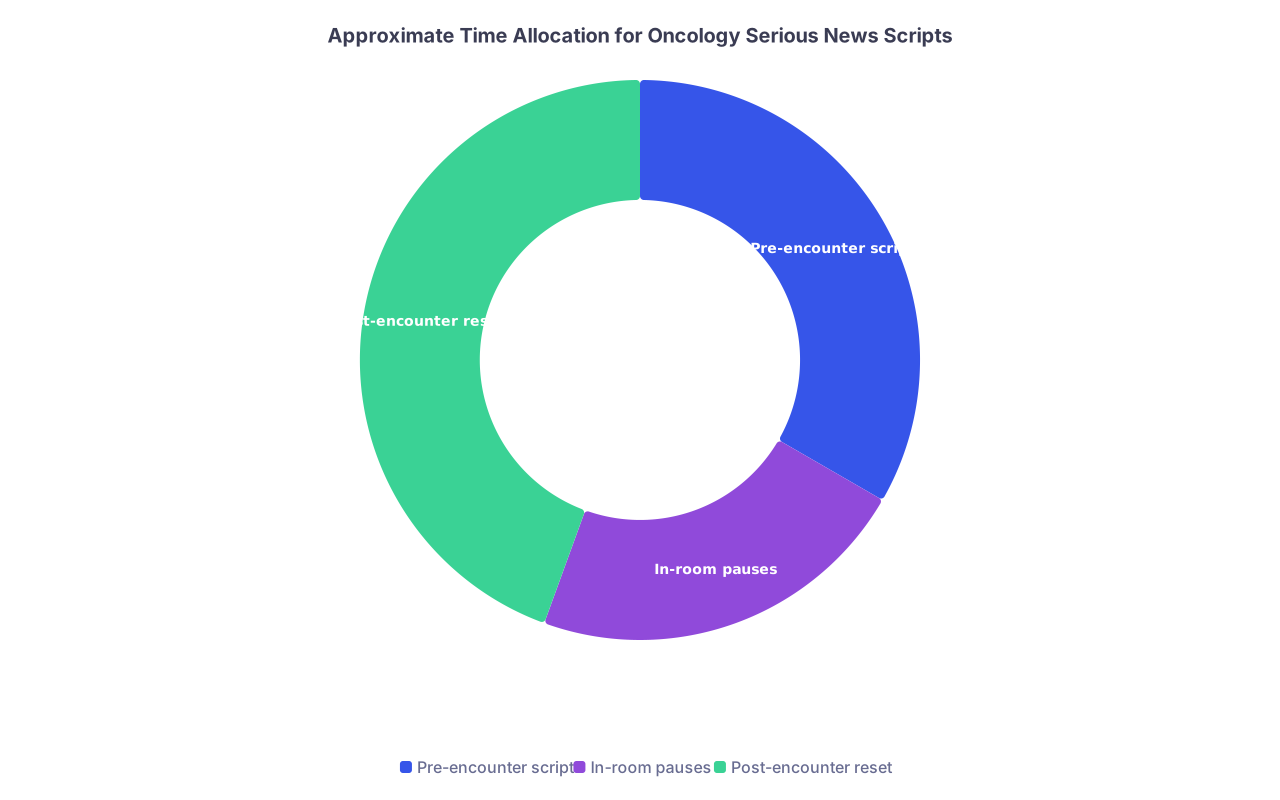
| Category | Value |
|---|---|
| Pre-encounter script | 90 |
| In-room pauses | 60 |
| Post-encounter reset | 120 |
(Times in seconds: small investments that radically change the tone of your day.)
7. Practical Real‑World Use: Cases and Adjustments
Let us run through two common oncology scenarios and see how these scripts actually play.
7.1 Case 1: Young Parent, Metastatic Progression
Forty‑two year old with metastatic colon cancer, two kids under 10, scan shows clear progression on second‑line chemotherapy.
Pre‑encounter (you, in hallway):
“Three breaths. Here, now.”
“Intention: honest, kind, unhurried.”
“I will say the word ‘progression.’ I will not hide behind vague language. I will not rush if they cry.”
You enter.
In‑room, early:
“We did this scan to see how the cancer is responding to the current chemotherapy. The scan shows that the cancer has progressed. It has grown in the liver and new spots have appeared in the lungs.”
You watch their face. Silence. Your inner script:
“Breath first, then speak.”
You wait a full 5 seconds. They start to tear up.
“This is not what we were hoping for. It is completely understandable to feel devastated hearing this.”
You stop again. Let that sit.
Eventually:
“When you think about this news in the context of your kids, what is weighing on you most right now?”
Mindfulness here is not a soft voice or incense. It is your tolerance for silence and feeling, maintained by those micro‑scripts.
7.2 Case 2: Elderly Patient, First Time Cancer Diagnosis
Seventy‑nine year old, new pancreatic mass, you have not used the word “cancer” yet.
Pre‑encounter:
“Three breaths. Intention: clear, calm, respectful.”
“I will use the word ‘cancer.’ I will check how much detail she wants. I will not minimize.”
In the room:
“The tests we did were to understand what is causing your weight loss and pain. The imaging and biopsy show that this is cancer of the pancreas.”
She stares. Long pause. You repeat your internal phrase: “Here with her now.”
She says: “So. This is serious.”
“Yes. This is serious. Most people in your situation, hearing ‘pancreatic cancer,’ know it can limit time. Would you like me to talk about what this means for prognosis and options, or would you prefer to take this in and talk more at another visit?”
You are combining: honoring autonomy, allowing pacing, and staying honest. That is the ethical‑mindful script in action.

8. Training This So It Is There When You Need It
Reading about scripts does nothing by itself. You have to rehearse them in low‑stakes contexts so they show up on the worst day.
Here is a simple training plan I have seen actually work in oncology fellowships:
- Write your scripts: Pre‑encounter, 3 in‑room phrases, post‑encounter. One page, max.
- Rehearse out loud: Once a week, in an empty room or with a colleague, read them as if you were about to walk into a real patient encounter.
- Sim sessions: During communication workshops, explicitly layer in your mindfulness steps—ask the facilitator for 30 seconds before each simulated patient to run your pre‑encounter script.
- Cue your environment: Put a small dot sticker on the exam‑room door handle. Use it as your reminder: “Stop. Scripts.”
- Reflect once a week: Pick one bad‑news conversation. Ask: Did I actually use my script? Where did I abandon it? Adjust.
You are not trying to be perfect. You are trying to be 10–20% more grounded and intentional than you would be by default. That difference is enormous to a patient hearing life‑altering news.

| Step | Description |
|---|---|
| Step 1 | Draft scripts |
| Step 2 | Rehearse weekly |
| Step 3 | Use pre-encounter in clinic |
| Step 4 | Apply in-room phrases |
| Step 5 | Post-encounter reset |
| Step 6 | Weekly reflection |
9. The Line You Do Not Cross: Mindfulness Is Not a Shield From Grief
One last point, because this is where many clinicians misuse mindfulness.
You are not designing scripts to dampen your own humanity. If you never feel your throat tighten, if you never have to sit in your car after clinic because of the sheer weight of what you have said to people—that is not resilience. That is a problem.
Mindfulness scripts here are not sedatives. They are stabilizers. They give you enough regulation to:
- Stay present and honest with this patient.
- Not spiral into guilt or avoidance.
- Actually metabolize your own grief later, instead of stuffing it behind “efficiency.”
You are still going to have patients and families who break your heart. You will still wake up at 3 a.m. thinking about whether you could have worded something better. That is part of the work.
What these scripts do is keep you from adding a layer of preventable harm—rushed, vague, defensive communication—on top of already painful news. They help you show up as the physician you intended to be when you chose this field.
With those pieces in place—a pre‑encounter anchor, in‑room grounding phrases, ethics‑infused language, and a post‑encounter reset—you will start to feel a quiet shift. The hardest conversations will still be hard, but they will feel less chaotic, less morally dissonant.
From here, the next step in your own development is not more text on a card. It is live practice: role‑plays, observed encounters, and asking for feedback that actually stings. And eventually, teaching the junior colleague standing outside that 4:25 p.m. room how to write their own scripts, so they are not improvising life‑altering news on an empty breath.