
It’s 6:47 a.m.
You’re outside OR 6 at a big academic hospital. The circs are wheeling in the case cart, anesthesia is fiddling with the machine, the resident is silently panicking over the consent note they still haven’t finished.
You notice your attending.
He’s already scrubbed, but he’s not talking. Not scrolling his phone. Not reviewing the CT for the tenth time. He’s standing at the scrub sink, water long off, hands held up, eyes fixed on some point that’s not really in the room.
Thirty seconds. Maybe a minute.
Then he walks in, all business. “Okay, team, let’s focus.”
You think he’s just “getting in the zone.”
What nobody tells you is that almost every good senior surgeon you admire has a pre‑op ritual. Mindful, deliberate, highly personal. And they almost never talk about it.
Let me show you what’s actually going on.
The Myth of the Unflappable Surgeon
The official story says surgeons are supposed to be machines.
Always decisive, never uncertain, never afraid. You’re supposed to stride into the OR like a fighter pilot—focused, sharp, emotionally bulletproof.
Reality? I’ve watched chiefs with thirty years in practice go pale when they see a certain name on the board. The ex‑lap on the septic train wreck. The redo valve on the guy with an ejection fraction of “why are we doing this.” The tumor wrapped around the SMA where the scans never fully tell the truth.
They do not show you the flicker of dread. They will show you the ritual.
Not on purpose. It just leaks out between cases in the quiet moments:
- The vascular surgeon who always closes the OR door and stands alone by the anesthesia machine for exactly one minute before incision.
- The pediatric surgeon who will not start until she’s gone through the same four silent steps at the scrub sink. Every time.
- The transplant attending who sits in the dark anesthesia pre‑op bay, alone at the foot of the bed, eyes closed, before a high‑risk liver.
Call it mindfulness. Call it superstition. They’ll call it “just my routine.”
It’s not “just routine.” It’s how they manage fear, ego, responsibility, and ethics in a room where a bad minute can ruin a whole life.
The Shape of the Ritual: What Actually Happens
Strip away the bravado and it’s always the same architecture underneath. Different flavors, same bones.
Most senior surgeons I’ve seen have three phases to their pre‑op ritual, even if they’d never label it that way:
- Contain the noise
- Rehearse the reality
- Anchor the why
Let me break those down in real terms.
1. Contain the Noise: The Quiet Before the Cut
This is where mindfulness really shows up, but nobody uses that word.
From the outside it looks like “the attending is zoning out.” From the inside, it’s a deliberate shift from scattered to singular.
Here’s what you’ll actually see if you pay attention:
- They step away. Out of the chatter. Out of the surgeon’s lounge. Sometimes just to a corner of the OR, sometimes all the way to the stairwell.
- They stop engaging. Short answers. Minimal conversation. Not rude, just… elsewhere.
- There’s usually a physical cue. Hands on hips. Arms crossed. Elbows on the knees, eyes on the floor. Or that frozen posture at the scrub sink.
What they’re doing is brutally simple: shrinking their world down to one case, one patient, one responsibility.
And here’s the part no one will admit openly: most of them are using some form of breath control and attention focusing. They don’t call it meditation. But it is.
I’ve watched an older cardiac surgeon do the same thing for years:
- He finishes scrubbing.
- He steps back from the sink, still hands up.
- He stares at the corner of the ceiling.
- He takes five slow, identical breaths.
Not random breaths. Paced, deep, controlled. In for four, out for six. Every time.
He once told a fellow, “If my heart rate isn’t slower than the monitor by the time I walk in, I’m not ready.”
That’s mindfulness, whether he’s read a single word of Kabat‑Zinn or not.
This phase is about shutting out everything that isn’t this case:
- The fight with their teenager that morning
- The billing issue from yesterday
- The disastrous morbidity and mortality from last week that they still replay at 3 a.m.
- The other five cases on the board
If you’re a trainee, you usually do the opposite. You ramp up the noise. You check labs again, scroll the CT again, shuffle papers, ask last‑minute questions.
The senior surgeon? They’re stripping it all away. On purpose.
2. Rehearse the Reality: The Mental Walkthrough Nobody Sees
The second part is where the real mental work lives.
You’ll hear people talk about “visualization” in sports. Same idea here, but with higher stakes and worse lighting.
Most attendings are doing a silent, ruthless pre‑op run‑through right before they walk in. Not the happy‑path fantasy. The real version.
I’ve seen this play out in a few consistent ways:
- They replay the critical steps: incision, exposure, the first clamp, the dangerous dissection plane, the reconstruction. Not everything. Just the pressure points.
- They name the failure points to themselves: “If this bleeds here, I go straight to… If the view is terrible, I’ll convert to… If I find X, I abort and call the family.”
- They pre‑decide the ethical hard stops: “If I see metastases where I didn’t expect them, I am not pushing this for the sake of the operation.”
Here’s one colorectal surgeon’s internal script before a big pelvic exenteration (yes, he essentially said this out loud once when he forgot I was behind him):
“Okay. Midline down, hand in, feel the planes. If the sidewall is concrete, we stop. I am not brutalizing this pelvis for a non‑resectable tumor. If I can get around it, ureters up, vessels clean. If I hit a bleeder I can’t see, pack, calm down, call vascular if needed. Stoma plan is end colostomy unless I’m 100% convinced I can protect an anastomosis. I’d rather the patient hate the bag than die septic.”
That’s not bravado. That’s a rehearsal.
They’re recomputing risk in real time and aligning the team in their head before a scalpel ever hits skin.
Notice something: this is profoundly mindful. It’s grounded in what’s actually in front of them, not the story they want to tell at grand rounds later.
The worst surgeons—technically gifted but dangerous—skip this step. They rely on muscle memory and swagger. They walk in, “We’ve done this a thousand times,” and then act surprised when variant anatomy or an ugly field blows up the plan.
The good ones respect their own fallibility. They run the tape in their head. Every time.
3. Anchor the Why: The Quiet Ethical Check
This part almost nobody discusses openly. Because it sounds soft. Or religious. Or like you’re not sure of yourself.
But I have seen too many attendings do some version of this to pretend it’s rare.
There is, in almost every senior surgeon with a conscience, a pre‑op ethical check‑in. Often in the last 30–60 seconds before they step through the doors.
Sometimes they literally look at the patient’s face one last time. Not the CT image. Not the problem list. The human.
For some, it’s a brief internal line:
- “Do no harm first.”
- “This is not my surgery; it’s their body.”
- “Be kind if you can’t be perfect.”
One trauma surgeon I know sits at the bedside, hand resting on the bed rail, eyes closed for a few seconds. He’s not praying in the religious sense. He calls it “remembering that this is someone’s kid.”
Another older surgeon, Catholic, does explicitly pray: “Use my hands. Protect this patient.” You’ll never see it unless you catch him just before he masks up.
Why does this matter?
Because this is where ego either steps back or takes over.
In that moment, they’re making a choice—conscious or not:
- Is this about doing the biggest, flashiest operation because they can?
- Or is it about doing the right operation for this specific person, even if that means doing less, backing out, or accepting limitations?
That quiet “why” filter is often the difference between an ethical surgeon and a talented technician.
And yes, that’s mindfulness. Mindfulness is not sitting on a cushion with incense. It’s seeing what’s actually happening in your own mind before you act. Especially when your actions involve a scalpel.
Why They Don’t Talk About It (And Why You Should)
You’re probably wondering: if this is so common, why isn’t it taught? Why isn’t there a “pre‑op mindfulness module” in your curriculum?
Because surgery, culturally, is about control and certainty. Exposure therapy against doubt.
To admit you need a ritual—to center yourself, to calm down, to reconnect with ethics—sounds, to some older surgeons, like weakness. Or at least like something you don’t say in front of the juniors who already look terrified.
So they hide it in plain sight. As “habit.” As “my way of focusing.”
You’ll hear things like:
- “I like to look at the images one more time alone.”
- “I just need a minute before we start.”
- “Don’t talk to me at the scrub sink.”
Those are not quirks. Those are defensive walls around a very human truth: they feel the weight of what they’re about to do. They’ve just learned not to show it directly.
The irony? As a trainee, you actually need this more than they do.
They have pattern recognition, scar tissue, and muscle memory. You have caffeine and anxiety. If you skip building your own version of this ritual, you’ll default to the worst possible substitute: disorganized panic.
How to Build Your Own Mindful Pre‑Op Ritual (Without Being Weird)
You do not need to chant. You do not need a three‑page script. You certainly do not need to announce, “I am now entering my mindfulness practice.”
What you need is something repeatable that does three things:
- Clears the noise
- Rehearses the reality
- Anchors your ethics
Here’s a simple, non‑cringey version I’ve seen residents quietly adopt and refine.
Step 1: 60 Seconds of Silence
Find a place: stairwell, empty bathroom, corner by the lockers. Set a mental rule: one minute, no phone, no notes, no talking.
You stand still. Notice your own physical state—heart rate, tension in shoulders, jaw. You’re not trying to be a monk. You’re just checking your instrument.
Then take five slow breaths. In for four, hold for one, out for six. Count in your head. That’s it.
You’ll feel stupid the first few times. Then one day before a big case, you’ll feel your heart drop from 110 to 80 and realize why so many attendings do some version of this.
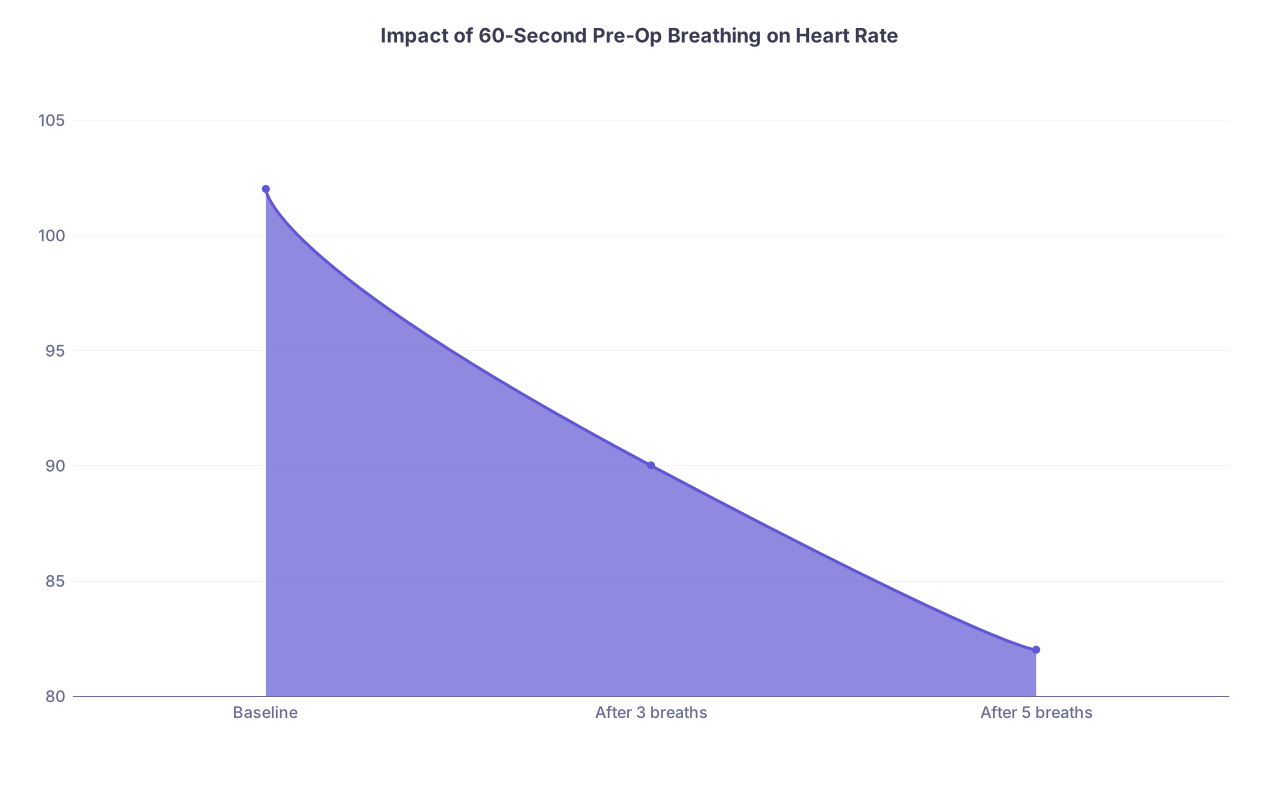
| Category | Value |
|---|---|
| Baseline | 102 |
| After 3 breaths | 90 |
| After 5 breaths | 82 |
Step 2: 90 Seconds of Mental Walkthrough
Once the static is down a bit, run the tape of the case. Not the whole operation. Just:
- Entry
- Key danger point
- Decision point
- Exit plan
Internally, in plain language:
- “Induction, position, timeout. Incision here. First real risk is dissecting near X—if it bleeds, I call attending immediately, no heroics. If exposure is bad, I speak up. If findings don’t match the plan, I don’t fake it.”
If you’re the med student with zero control over the case, fine. Your script is more modest:
- “I know the indication. I know the key structures. I know the one thing that can kill the patient fast. I know the post‑op complication they fear most.”
That’s still rehearsal. It’s still bringing your mind into alignment with what’s actually about to happen, not the vague idea of “hernia repair.”
Step 3: 30 Seconds of Ethical Check
Last piece, and yes, you have to actually do it, not just nod along.
Ask yourself one question, silently:
“What does doing right by this patient look like today?”
Not “What makes me look smart.” Not “What fulfills the textbook.”
Maybe doing right means:
- Speaking up when you see the attending about to miss something.
- Admitting you do not understand a step instead of nodding along.
- Advocating for pain control post‑op.
- Being the one who goes to update the family clearly and kindly.
You tie your presence in that OR to something beyond your evaluation.
That’s your version of the silent “why” senior surgeons do before they walk in.
You stack those three pieces together and you’ve got a three‑minute ritual that will do more for your performance and ethics than another five frantic minutes of re‑reading UpToDate.
The Uncomfortable Ethical Edge: When the Ritual Changes the Plan
There’s a darker, more honest layer to this that rarely gets said out loud.
A genuine mindful pre‑op ritual sometimes leads to uncomfortable decisions.
I’ve seen attendings:
- Cancel a case at the door because something felt off. Vitals a bit unstable. Lab just posted. Or they realized, in the quiet moment, that the indication had drifted—this was now more about “doing something” than helping.
- Decide to stage an operation instead of pushing for the whole heroic plan they’d initially sold to themselves (and maybe to the patient).
- Walk into the OR and tell the team, “We are prepared to abort this if we see X. We’re not committing to completion at all costs.”
That’s what happens when you actually let reality and ethics into the room before the knife goes in.
The flip side is ugly: I’ve sat in morbidity and mortality where everyone in the room knew the surgeon’s ego had overridden that internal check. The plan was too big, too aggressive, too self‑serving. No one had the courage—or the ritual—to say, “Wait. Why are we really doing this?”
Your pre‑op ritual is not just about your anxiety. It’s a guardrail against your future arrogance.
Because if you’re good, you will get powerful. People will stop questioning you. That’s when you’re most dangerous.
Build the habit now of questioning yourself before the incision, not after the complication.
This Is Mindfulness in Medicine, Whether We Admit It or Not
Hospitals love to throw around “resilience” and “wellness” now. Yoga in the conference room at 5 p.m. Mindfulness apps you’ll never open. All fine.
But the real, gritty, high‑impact mindfulness in medicine is not on a wellness poster. It’s standing at a scrub sink with wet hands and a quiet decision:
“I will be fully here. I will see what’s in front of me. I will remember this is not about me.”
Senior surgeons have been doing some version of this for decades, long before it had a name.
You can roll your eyes and call it superstition. Or you can recognize it for what it actually is:
A private, disciplined way of aligning mind, skill, and ethics in the exact moment they matter most.
You will forget most of the pimp questions, the textbook diagrams, the petty OR politics. What will stick in your bones is how you showed up in those few minutes before the cut. That’s where you quietly decide what kind of surgeon—or physician—you’re going to be.
Years from now, you will not remember the exact vitals or lab values before every big case. You’ll remember the patients who trusted you, and you’ll remember whether you honored that trust in the seconds before you picked up the knife.
| Phase | Time Needed | Core Action |
|---|---|---|
| Contain Noise | 1 minute | 5 slow, paced breaths |
| Rehearse Reality | 1–2 minutes | Mental walkthrough steps |
| Anchor Ethics | 30 seconds | Ask why and define "right" |

| Step | Description |
|---|---|
| Step 1 | Step away for 1 minute |
| Step 2 | Slow breathing |
| Step 3 | Mental walkthrough |
| Step 4 | Ethical question |
| Step 5 | Enter OR focused |