
Most “safeguards” around high‑risk prescribing are mechanical; the real failure is that the clinician’s mind never truly stops to think.
Let me be blunt: alert pop‑ups, forcing functions, and order‑set warnings have not solved unsafe prescribing. You click through them on autopilot. I have watched residents blow past a bright red QTc warning while saying, “Yeah, yeah, accept,” because the ED board was full and admission orders “had to be done.”
The missing piece is not another checkbox. It is a reliable, trainable, two‑minute mindful pause algorithm built into your own cognitive workflow. Especially for high‑risk prescribing.
Let’s build that, properly.
Why You Need a Mindful Pause Specifically for Prescribing
High‑risk prescribing decisions are exactly what they sound like: single clicks that can seriously harm someone. Think:
- Starting opioids in a patient with untreated sleep apnea and benzos on board.
- Pushing more insulin in the already‑hypotensive, NPO septic patient on pressors.
- Adding amiodarone to someone with a QTc of 505 and multiple psych meds.
- Ordering IV contrast in the CKD patient whose creatinine you “thought was fine yesterday.”
The problem is not only knowledge. You probably know the risks. The problem is state of mind at the moment of ordering: rushed, fragmented, ego‑defensive, sometimes emotionally flooded.
You are tired, behind, half‑listening, trying not to look stupid in front of the attending or the nurse. That state generates predictable cognitive errors:
- Premature closure (“It is probably fine, I just saw a similar case.”)
- Framing bias (trusting the prior team’s narrative too much).
- Authority bias (“Pharmacy already verified it, so it must be safe.”)
- Availability bias (overweighting that one time it went fine).
A mindful pause algorithm is not a “nice” wellness trick. It is a structured, repeatable series of micro‑steps that force a state shift: from reactive → reflective; from defended → curious; from hurried → precise.
And crucially, it must be fast enough that you will actually use it at 3 a.m.
What a “Mindful Pause Algorithm” Actually Is
Let me define this in operational terms.
A mindful pause algorithm for prescribing is:
A short, scripted sequence (15–90 seconds) that:
- Interrupts automaticity at predefined “high‑risk” decision points
- Uses one or two embodied mindfulness anchors (breath, posture, touch)
- Poses a fixed set of safety, values, and responsibility questions
- Ends with a deliberate, conscious commit or revise decision
This is not general meditation. It is situation‑specific. You will not sit on a cushion in the ICU.
You are going to:
- Notice you are entering a high‑risk prescribing scenario.
- Pause using a brief embodied anchor.
- Run through a micro‑checklist of clinical + ethical questions.
- Decide consciously, with a bias toward safety and transparency.
- Own the decision (including documentation and communication).
Let’s make this concrete.
Where to Apply Mindful Pause: High‑Risk Triggers
You cannot pause before every acetaminophen order. You would last one day.
You need clear triggers. These should be simple, easily recognized patterns where the downside of a bad decision is high and time usually feels tight.
| Trigger Type | Examples |
|---|---|
| Narrow TI / complex meds | Warfarin, DOACs in CKD, digoxin, lithium, amiodarone |
| Sedation / respiratory risk | Opioid + benzo, new opioid in OSA/COPD, PCA initiation |
| QTc / arrhythmia risk | QTc > 470–500 with antipsychotics, macrolides, methadone |
| Hemodynamic instability | Insulin in septic shock, antihypertensives in borderline BP |
| Renal/hepatic impairment | Nephrotoxins in CKD, DOAC dosing in cirrhosis |
Minimalist version: decide that your mindful pause algorithm must trigger when:
- You are about to prescribe a medication that:
- Can stop breathing (sedatives, opioids, benzos, combinations).
- Can cause a life‑threatening arrhythmia.
- Has a narrow therapeutic window with known toxicity.
- Is being given to someone unstable or with organ failure.
You can refine triggers by specialty. For example:
- Psychiatry resident: antipsychotics in elderly with dementia, clozapine, lithium.
- Cardiology fellow: amiodarone, sotalol, dofetilide, anticoagulation in frailty.
- Hospitalist: opioids in frail elderly, insulin drips, nephrotoxic antibiotics.
The key is: once a trigger fires, the algorithm is not optional.
The Core Mindful Pause Algorithm: 5‑Step MAP‑Rx
Here is a structured algorithm I teach. Call it MAP‑Rx.
Step 1 – Mark the moment: “This is a high‑risk order.”
You cannot pause if your brain never labels the situation.
Right when you open the order entry for a flagged medication (opioid, high‑alert drug, etc.), silently say to yourself:
“High‑risk order. I am in MAP‑Rx.”
This sounds trivial. It is not. That verbal tag is a pattern interrupt. You are naming a distinct state: I am no longer just clicking boxes; I am entering a risk‑dense decision zone.
Some clinicians like a physical micro‑gesture to mark it:
- Taking one hand off the keyboard and resting it lightly on the desk.
- Removing your hand from the mouse for three breaths.
- Sitting back in the chair briefly.
Do not skip the mark. It is the entry gate.
Step 2 – Anchor the mind: 3 breaths, 10 seconds
You need a quick state reset. Not calm for its own sake, but to drop out of fight‑or‑flight autopilot.
Script it:
- Exhale fully through the mouth (quietly).
- Inhale slowly through the nose to a count of 4.
- Exhale to a count of 6.
- Repeat twice.
During these 3 breaths, focus attention on:
- The sensation of the air at the nostrils, or
- The feeling of your feet in contact with the floor, or
- The contact of your hand with the desk or your own forearm.
You are telling your nervous system: We have 10 seconds. No one dies in 10 seconds. We can think.
In chaotic environments, you can compress this to a single slow breath. I have watched ICU attendings do one deliberate inhale‑exhale before ordering a paralytic in a difficult airway. That single breath changed the quality of the decision.
Step 3 – Perspective check: Mental “Zoom Out” in 15–20 seconds
Now, very quickly, you expand the frame. This is where most clinicians either shine or fail.
I use a 3‑question mental zoom‑out:
Patient – “If this goes badly, what does it look like for this specific person?”
- Visualize: oversedation, fall, bleed, arrhythmia, dialysis.
- Put a concrete image in mind, not an abstract risk percentage.
Context – “What about this clinical situation makes it more fragile?”
- Age, frailty, comorbidities, polypharmacy, organ dysfunction, unreliable follow‑up.
- Ask: “Would I feel different prescribing this to a healthy 30‑year‑old?” If yes, why?
Options – “Do I actually have a safer viable option?”
- Non‑pharmacologic, lower dose, different drug, delayed prescribing, shared decision with patient.
This is not a prolonged ethics committee. It is 15–20 seconds of aimed curiosity.
Let me give you a real pattern I have seen:
- Resident wants to start IV hydromorphone in an 82‑year‑old with creatinine 2.1, on lorazepam at home, mild delirium in the ED.
- No pause: they order what they are used to (0.5–1 mg IV q3h PRN).
- With MAP‑Rx: they mentally picture this man oversedated, hypotensive, falling on the ward, or aspirating. They notice the delirium, CKD, benzo. They realize oral or subcutaneous low‑dose morphine with tight nursing parameters may be better. They might even decide to start with non‑opioid modalities first.
That entire reconsideration can fit inside 30 seconds when you are practiced.
Step 4 – Risk‑reality check: The “3‑S” Questions
Now we get pointed. I use three S‑questions: Safety, Support, Story.
Ask them explicitly:
Safety – “What is the most likely serious thing that can go wrong with this order?”
- Respiratory depression, hypoglycemia, AKI, torsades, bleed.
Support – “Do we have the monitoring and backup to detect and rescue early?”
- Nursing ratios, telemetry, pulse oximetry, level of care, on‑call coverage, patient literacy at home.
Story – “Am I prescribing this because of the patient’s story or because of my story?”
- Patient story: their pain, their values, their prior experiences, their risks.
- My story: my discomfort with their distress, my fear of complaints, my desire to look decisive, my avoidance of a hard conversation.
That last question is where the ethics sits.
Prescribing a sedating medication at night because you are uncomfortable with the patient calling the nurse repeatedly is not ethically equivalent to prescribing it because the patient, fully informed, prioritizes sleep despite some risk.
Mindful pause means you at least know which story is driving you.
Step 5 – Decide and declare: Commit, adjust, or abort
Now you choose. But you choose consciously.
Three options:
Commit – Proceed with the order as planned, but:
- Adjust monitoring and documentation to fit the acknowledged risk.
- Communicate clearly with nursing and, where possible, the patient/family.
Adjust – Modify:
- Lower dose, different route, different agent, changed frequency.
- Add explicit nursing parameters: “Hold if RR < 12 or SBP < 100,” “Notify provider if sedation scale > X.”
Abort (for now) – Decide this is not safe or acceptable right now:
- Delay until more data (labs, ECG, consult).
- Reframe with patient: explain that risk profile is too high for this option.
Crucially: declare the decision in language, even silently.
“I am choosing to proceed with 0.2 mg IV hydromorphone, with explicit hold parameters and frequent reassessment, because the patient’s pain is severe and other options are inadequate, and this seems like a balanced risk.”
Or:
“I am not starting that QT‑prolonging antipsychotic tonight. I will explain to the team and the patient why.”
That internal sentence cements ownership. It moves you from “The system ordered this” to “I, as a moral agent, chose this knowing the stakes.”
The Ethical Spine: From Mechanic to Moral Agent
Mindful pause algorithms are not just about safety metrics. They are about reclaiming your role as a moral decision‑maker in medicine.
Autonomy and informed risk
Too often, “consent” in prescribing is a mumbled, “This might cause side effects, but you should be fine.” That is not meaningful autonomy.
A mindful pause forces you to ask: If I were this patient, would I feel adequately informed about the real downside?
That might mean saying:
- “This opioid will probably help your pain, but here is the trade‑off: there is a real risk of slowed breathing, confusion, and falls. We will monitor closely. Here is how we try to keep you safe. If that balance does not feel right to you, we can consider other options, even if they work less well for pain.”
This conversation takes 60–90 seconds. I have seen it de‑escalate family anger later when complications occur, because they recall that you treated them as partners, not passive recipients.
Beneficence vs. nonmaleficence in the real world
Everyone pays lip service to “do good and do no harm.” In practice, clinicians skew toward avoiding complaints and visible suffering in front of them, and they discount future or less visible harm.
Mindful pause brings future harm into the present moment of attention. You make the GI bleed or the respiratory arrest “real” for 10 seconds in your mind. That shifts the calculus.
Justice and “who pays the price”
High‑risk prescribing mistakes disproportionately harm:
- Elderly, frail, cognitively impaired patients.
- Those with poor health literacy who cannot self‑advocate.
- Patients without strong family or social support.
Mindful pause includes a simple justice question: Is this person especially vulnerable to being harmed by my default choice? If yes, maybe the threshold for pushing ahead should be higher, not lower.
Integrating Mindful Pause into Real‑World Workflow
Here is the brutal truth: if your algorithm takes more than 60–90 seconds most of the time, you will abandon it by Wednesday.
So you need two versions:
- A full MAP‑Rx (45–90 seconds) for non‑code situations.
- A micro‑MAP (5–15 seconds) for time‑pressured cases.
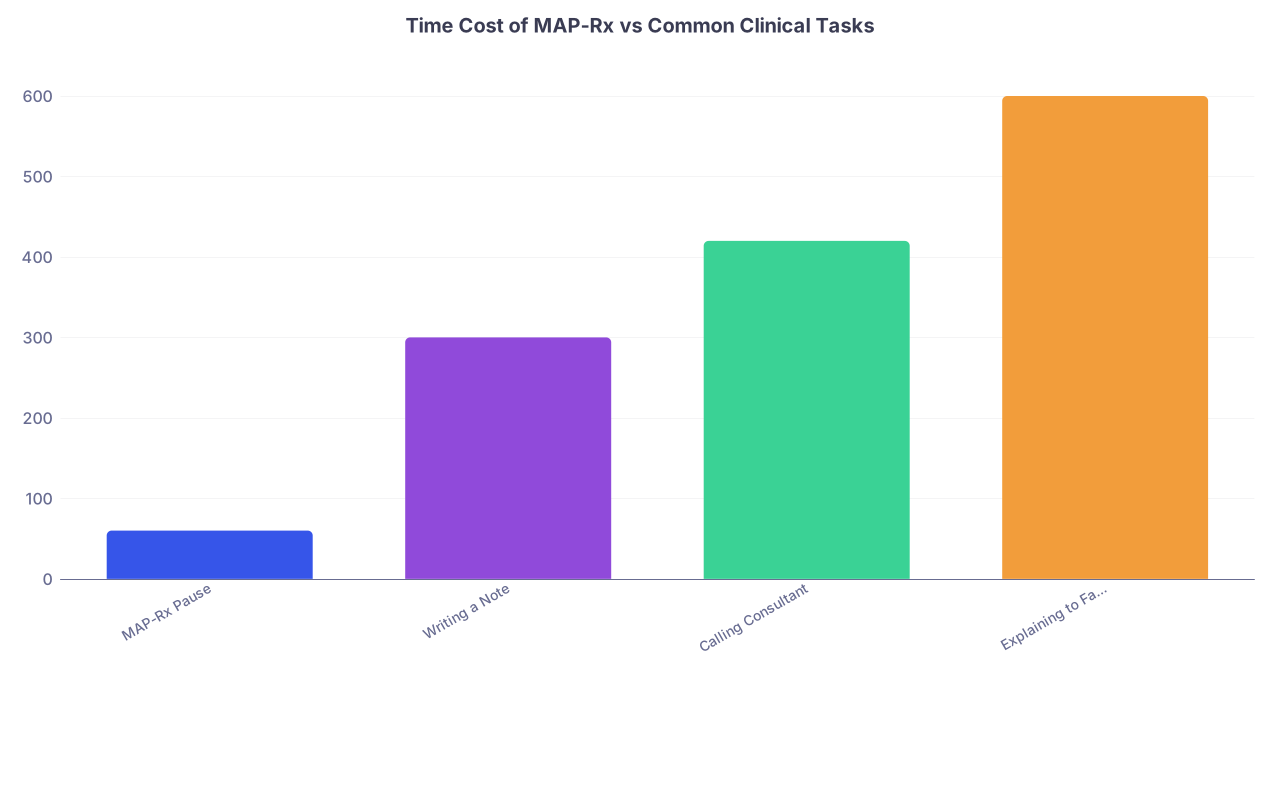
| Category | Value |
|---|---|
| MAP-Rx Pause | 60 |
| Writing a Note | 300 |
| Calling Consultant | 420 |
| Explaining to Family | 600 |
Full MAP‑Rx (when you have a minute)
This is what I outlined above. Breath, zoom‑out, 3‑S questions, decision.
Use it:
- During day shifts.
- For new chronic med starts.
- On admission and discharge med reconciliation.
- In clinic visits for long‑term high‑risk regimens.
Micro‑MAP (for the chaotic moments)
When the room is on fire, you do not give a TED talk to yourself. You compress:
- One slow exhale.
- One question: “What is the worst thing this order can do in the next 30 minutes, and can we rescue it?”
- One adjustment if needed (dose, route, backup).
For instance, in a crashing patient:
- You know you need to push a sedative for intubation.
- Micro‑MAP: one breath, “Worst thing is profound hypotension and loss of airway before tube is in; do I have pressors ready, airway backup, skilled help in the room?”
- If something crucial is missing, you shout for it before injecting.
Making it a habit: attach to existing cues
Humans are terrible at “remembering” new steps in a complex workflow. You must piggyback your pause on an existing cue:
- The moment you click on a known high‑risk drug in the EHR.
- The moment you see a red or yellow alert you usually ignore.
- The moment a nurse says, “Are you sure about this dose?” (this is gold).
Decide: Whenever I see X, I will do one breath and ask Y question.
For example:
- Cue: Opioid order in someone over 70.
Routine: One breath + “Safety/Support/Story”.
Reward: Reduced anxiety about oversedation; fewer night‑time calls.
Team‑level embedding
This becomes much more powerful when the team shares the language.
- “This is an MAP‑Rx moment for the amiodarone start.”
- “Let us do a 30‑second zoom‑out before we load this.”
- “Pause: whose story is driving this antipsychotic order—ours or the patient’s?”
Nurses and pharmacists love this phrasing because it legitimizes their own unease. It becomes invited, not oppositional, to say, “Can we do a mindful pause here?”
Training Yourself: Mental Reps and Debriefs
You cannot build a new cognitive reflex in the middle of your busiest month. You need practice.
Simulation and deliberate practice
Use 5–10 minutes after a shift (or during a quieter call night) to:
- Pick a real high‑risk prescribing decision from that day.
- Rewind mentally to just before you ordered.
- Walk through the full MAP‑Rx as if you were there again.
- Ask: Would I have changed anything?
Do this 2–3 times per week for a month. You are installing the algorithm into your “muscle memory.” Next time, it will come up faster.
You can also script 3–4 archetypal cases:

| Step | Description |
|---|---|
| Step 1 | Recall High Risk Case |
| Step 2 | Identify Trigger |
| Step 3 | Mark as MAP-Rx |
| Step 4 | 3 Breaths |
| Step 5 | Ask 3-S Questions |
| Step 6 | Decide Commit Adjust Abort |
| Step 7 | Reflect on Outcome |
Debrief the near‑misses
The most powerful training ground: cases that went almost wrong.
After an oversedation, hypoglycemia, near‑bleed, or QTc scare, do not just file an incident report and move on. Sit down (even for 3 minutes) and ask yourself or the team:
- “Where would a 30‑second pause have fit?”
- “Which question, if we had asked it, would have changed the decision?”
Write down that one question. Add it to your MAP‑Rx script.
Over a few years, this is how good clinicians quietly accumulate their internal safety heuristics. Mindful pause just makes that process explicit and shareable.
The Psychological Payoff: Less Moral Injury, More Integrity
Let me address something few people say out loud.
Many clinicians carry quiet guilt about harms they suspect they contributed to. The sedated fall, the unexpected ICU transfer after a “routine” med tweak. The EHR says “complication.” Your mind says, “I did this.”
You can not prevent every bad outcome. That is fantasy. What you can do is clean up your side of the street. You can know, honestly, “I gave that decision my best judgment, with eyes open, not on autopilot.”
Mindful pause algorithms reduce:
- Moral injury – because your actions are better aligned with your values.
- Defensiveness – you do not have to hide behind “the protocol” when you own your choice.
- Burnout from regret – you will still feel pain when things go badly, but it will not be compounded by “I did not even think.”
Patients and families feel the difference. They may not know you did MAP‑Rx in your head, but they sense when a clinician is deliberate and transparent versus hasty and avoidant.
FAQ – Mindful Pause Algorithms for High‑Risk Prescribing
1. Isn’t this just “being careful”? Why do I need a formal algorithm?
No. “Be careful” is content‑free advice, like “be nice.” Under fatigue and pressure, generic intentions collapse. A formal algorithm gives you specific, actionable micro‑steps—a breath, three questions, a decision frame—that can still function when you are tired, annoyed, or rushed. It converts vague caution into a reproducible behavior.
2. What if I truly do not have time—like during a code or crashing patient?
In genuine seconds‑matter emergencies, you use micro‑MAP: one deliberate exhale plus one focused question about immediate catastrophic risk and rescue capacity. That takes 3–5 seconds and can still prevent the most egregious mistakes (wrong dose, wrong route, giving something with no backup ready). For non‑code situations—which is where most high‑risk prescribing happens—you almost always have 30–60 seconds, even if your mind insists you do not.
3. Won’t this make me even slower and feed into the feeling that I am never getting my work done?
Initially, yes, you will feel slower for specific orders. But two things happen over time: first, MAP‑Rx decisions become faster with practice; second, you save time on the back end—fewer crisis calls, fewer panicked chart reviews, fewer extended family meetings caused by preventable complications. Clinically, a minute of mindful prescribing can easily save you twenty minutes of damage control later.
4. How do I introduce this without sounding “woo‑woo” or getting eye‑rolls from colleagues?
Drop the word “mindfulness” if it triggers cynicism. Call it a “high‑risk prescribing pause check” or “MAP‑Rx protocol.” Emphasize that it is about patient safety and cognitive error reduction, not spiritual enlightenment. On rounds, model it quietly: “This is a high‑risk med; give me 30 seconds to do a quick pause check.” When others see that it is fast, structured, and clinically sharp, resistance usually fades.
5. What if my attending or supervisor pressures me to proceed quickly despite my concerns?
This is where the “Story” part of MAP‑Rx matters ethically. You can respond with concise, structured language: “I am concerned about X concrete risk in this patient—age, comorbidities, monitoring limits. Can we take 20 seconds to double‑check dose and monitoring?” You are not being oppositional; you are invoking a shared safety practice. If they still override you, you have at least articulated the risk and honored your own ethical standard.
6. Can I document any of this, or is it purely mental?
You can absolutely reflect MAP‑Rx in your documentation and orders. Examples: adding hold parameters (“Hold opioid if RR < 12”), noting rationale (“Lowered dose due to age, CKD, concurrent benzo”), or stating that you discussed specific risks with the patient. This not only improves patient care; it also creates a transparent record that your decision was considered and ethically grounded, not reflexive.
Key points, distilled:
- High‑risk prescribing failures are usually failures of state, not knowledge; a 30–90 second mindful pause algorithm (MAP‑Rx) changes that state reliably.
- Attach the pause to clear triggers and run a tight script—mark the moment, anchor with a breath, zoom out, ask Safety/Support/Story, then consciously commit, adjust, or abort.
- Done consistently, this shifts you from mechanical prescriber to moral agent, reducing preventable harm and the quiet moral injury that comes from decisions made on autopilot.