
What happens when “being present” with your patient slowly turns into “being personally responsible” for their pain?
If you’re using mindfulness in your clinical life—and you should be—there are a few specific mistakes that can quietly wreck your boundaries without you noticing. I’ve watched good clinicians slide from grounded and compassionate to exhausted, over‑involved, and ethically exposed, all while congratulating themselves for being “so mindful.”
Let me walk you through the traps before you step in them.
1. Turning Mindfulness Into Emotional Merging
Mindfulness is not “feeling everything the patient feels.” That’s emotional fusion, and it’s one of the fastest ways to destroy your boundaries.
Here’s the mistake I see all the time:
You’re taught “be fully present, open-hearted, non‑judgmental.” So you start doing deep listening, soft eye contact, long pauses. The patient cries. You feel it in your chest. And instead of noticing your reaction, you start thinking it’s your job to carry their pain.
That’s not mindfulness. That’s self‑sacrifice disguised as virtue.
Classic warning signs you’ve slipped from mindful presence into emotional merging:
- You leave certain patients’ rooms feeling drained for hours.
- You find yourself thinking about a patient obsessively off‑shift.
- You feel guilty setting any limits: visit length, messages, requests.
- You start saying “we” when you really mean “you,” as in, “We’re going to beat this.”
Mindfulness done well is observant, not engulfed.
You notice the emotional storm. You don’t jump into the middle of it without a life jacket.
The fix: consciously practice “compassion with edges.”
When you feel pulled into emotional merging:
- Name it internally: “I’m feeling pulled to absorb this.”
- Anchor to your body: feel your feet, your breath, your back against the chair.
- Reframe your role: “My job is to witness and help, not to drown with them.”
If your “mindful” sessions regularly leave you wrecked, you’re not being mindful. You’re being porous.
2. Using Mindfulness to Avoid Saying “No”
Mindfulness is often sold as endlessly accepting, endlessly open. That’s cute in a yoga studio. It’s dangerous in a clinic.
I’ve seen residents say things like, “I wanted to respond to every MyChart message tonight so patients feel heard,” then call it “a mindful commitment to care.” No. That’s boundary collapse with a spiritual sticker on it.
Mindfulness is awareness + wise response, not awareness + automatic yes.
Red flags you’re using “mindfulness” as a way to justify never setting limits:
- You tell yourself, “It feels more compassionate to keep this patient on even though they need a higher level of care.”
- You extend sessions “just this once” three times a week.
- You answer non‑urgent messages at 10:30 pm because “I want to be present for them.”
- You let patients text your personal phone “because it helps them feel safe.”
Let me be blunt:
If your mindfulness practice makes it harder—not easier—to say no, you’re doing it wrong.
A healthy, boundary‑protective version looks like this:
- You mindfully feel the pull to please.
- You recognize the urge to cave.
- You respond with a clear boundary anyway, and you tolerate the discomfort.
A mindful “no” might sound like:
- “I hear how urgent this feels. Clinically, it’s safe to address this at your next appointment.”
- “Our visit is 20 minutes today. We can talk about one more concern and schedule another appointment for the rest.”
- “For safety and documentation, I only communicate with patients through the clinic messaging system, not personal text.”
You can be present and kind without being permanently available. If your presence comes at the cost of your own wellbeing and the quality of care for all your other patients, you’ve crossed the line from ethical to reckless.
3. Confusing Self‑Disclosure With “Authentic Presence”
Another big one: using mindfulness as an excuse to overshare.
You learn in mindfulness training to “show up as your authentic self” and “drop the mask.” That can easily mutate into: you start telling patients about your own medical history, your burnout, your divorce, your spiritual practices, because “it felt authentic in the moment.”
I hear this sentence a lot: “It just felt right to share, and I wanted to be real.” That sentence usually precedes a boundary breach.
The danger is simple:
Self‑disclosure shifts the focus from patient to clinician. Once that happens, you’re using the encounter to meet your own emotional needs under the cover of “connection.”
Watch for these mistakes:
- Telling a depressed patient about your own depression “to normalize it,” but really because you feel lonely in your own struggle.
- Sharing details of your infertility with a patient going through IVF because “I know how she feels.”
- Talking about your mindfulness retreat to a grieving patient because “it might help,” but mostly because you’re proud of your practice.
A clean test:
If you feel relieved after disclosing, ask yourself honestly—was that for them or for you?
Mindful presence doesn’t require self‑disclosure. Most of the time, it doesn’t even benefit from it. You can be warm, attuned, supportive, and real without explaining your entire life story.
Guideline I’d use:
- If the disclosure is immediately, clearly, and specifically therapeutic for the patient—and brief—maybe.
- If you’re not sure, do not share in the moment. Sit with the urge. Reflect later. Or run it by a colleague or supervisor.
- If you “need” to share to feel less alone, bring it to your own therapist, supervisor, or peer group. Not to your patient.
Mindfulness should increase your ability to pause and choose, not justify impulsive blurting.
4. Mistaking Over‑Identification for Compassion
Compassion isn’t “I’m basically you.” That’s identification. When mindfulness practice leaks into sloppy identification, your clinical judgment goes with it.
I saw a trainee who’d done a lot of mindfulness work with trauma. She was good—attuned, present, calm. Then she got a patient whose background mirrored her own: same culture, similar trauma, similar family script.
Within three months:
- She was routinely going over time with that patient.
- She downplayed the need for higher level care because “I know what it’s like, she hates hospitals.”
- She took missed appointments personally.
- Her documentation became vague and protective: “patient understandably upset…”
All of that felt to her like compassion. It wasn’t. It was blurred boundaries fueled by unprocessed personal material dressed up as mindful sensitivity.
Here’s the line you can’t afford to cross:
Recognizing your reactions to a familiar story is mindful.
Letting those reactions quietly direct care is not.
Signs over‑identification is hijacking your practice:
- You think “I’m the only one who really gets this patient.”
- You feel more defensive about this patient than others when staff raise concerns.
- You subtly loosen your usual standards—safety plans, follow‑ups, referrals.
- You feel pride in being their “safe person,” coupled with fear they’ll see someone else.
Use mindfulness where it actually belongs here: on yourself.
- Notice: “This story is hitting me harder than usual.”
- Label it: “That’s my stuff, not theirs.”
- Protect the patient: consult early, not late. Document restrictions and safety concerns clearly. Consider transferring care if needed.
Compassion doesn’t mean you’re the hero of their story. It means you don’t twist their care to resolve your own.
5. “Mindful Exceptions” That Become Your New Normal
You know this one. You “mindfully” decide to make a one‑time exception. Then again. Then again. Soon it’s your default.
“I consciously chose to let her session run 15 minutes over because she was in crisis, and I wanted to be fully present.” Fine. Once. Maybe twice.
Where it becomes a boundary error is when every emotionally intense patient magically turns into an “exception.”
The pattern usually looks like this:
- You mindfully notice: “This feels important; I don’t want to cut them off.”
- You rationalize: “The schedule is just a structure, not a prison.”
- You repeat. The scheduler is now constantly behind. Other patients wait longer. Documentation gets rushed.
You tell yourself you’re practicing flexible, present‑moment awareness. You’re really just avoiding the discomfort of ending.
Mindful, boundary‑intact version:
- You still end on time most of the time.
- If you deviate, you document clearly and honestly: “Session extended by 10 minutes for acute safety planning.”
- You adjust elsewhere: shorten non‑urgent content, improve time management, or advocate for more realistic scheduling.
If you find yourself saying “just this once” more than once a week, it’s not “just this once.” It’s your new policy—you’re just not admitting it yet.
6. Making Yourself the Intervention
Another quiet mistake: using your own inner state as the primary treatment tool.
You read that being deeply mindful, calm, and present can regulate the patient. True enough. Then you slide into this belief: “If I just stay more open, more attuned, more spacious, that’s the real intervention.”
The danger? You start under‑using actual clinical tools:
- You delay adjusting meds because you want to “give presence more time.”
- You skip difficult topics—substance use, suicidality, non‑adherence—because they “disrupt the connection.”
- You over‑value “how it feels in the room” and under‑value objective data: labs, collateral, history.
Now you’re not just at risk of burnout. You’re edging into substandard care.
Presence supports clinical work. It does not replace it.
Check yourself with questions like:
- If another clinician reviewed my documentation, would the treatment plan stand on its own without “but I felt really connected” as the justification?
- Am I delaying necessary, uncomfortable conversations because I don’t want to disturb the mindful vibe?
- Have I ever thought “if they get transferred to someone else, I worry they won’t be as ‘present’ with them” and used that to justify avoiding consultation or referral?
That’s your ego talking, not your ethics.
Use your mindfulness to stay grounded while you do the harder, technical, less “spiritual” parts of medicine. Not instead of them.
7. Neglecting Your Own Containment Practices
This one’s simple. And deadly over time.
You use mindfulness with patients but not for yourself. So your “presence” becomes a one‑way leak.
Here’s how that plays out:
- You center and breathe before entering the room.
- You open yourself fully to heavy content.
- You walk out, chart, then walk into the next room without closing, processing, or re‑grounding.
- Repeat x 20–30 encounters a day.
You’ve turned yourself into emotional flypaper.
Over weeks to months, you’ll see:
- Intrusive imagery from cases during off hours.
- Cynicism or numbness in unrelated areas of life.
- Increased irritability with minor inconveniences at work.
- Temptation to “fix” or “save” patients quicker to get relief from their distress.
All while you tell yourself you’re “being mindful.”
True mindfulness in medicine requires containment:
- Micro‑rituals between patients: a single slow exhale, feeling your feet, naming what you’re leaving in that room.
- Clear “off duty” practices: phone down, no charting in bed, a physical or mental boundary ritual when you leave the hospital or close your office.
- Regular spaces where you are the one held: supervision, therapy, peer groups, not just meditation alone in your apartment.
Without those, mindfulness becomes an unfiltered intake valve with no outlet. It will eventually corrode your boundaries whether you like it or not.
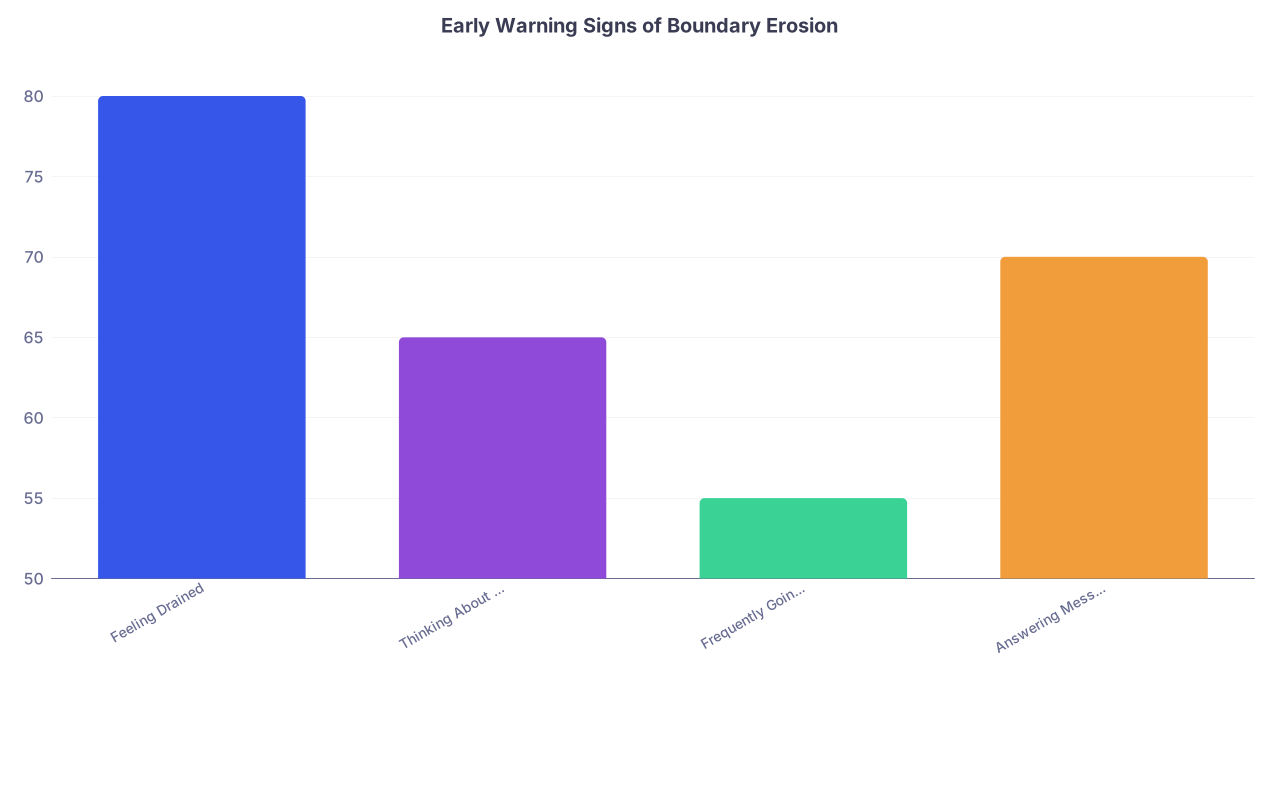
| Category | Value |
|---|---|
| Feeling Drained | 80 |
| Thinking About Patients Off-Shift | 65 |
| Frequently Going Over Time | 55 |
| Answering Messages Off-Hours | 70 |
8. Pretending Mindfulness Solves Power Dynamics
One of the most naive mistakes: believing that your mindful, egalitarian attitude erases the power differential between you and your patient.
It does not. It never will.
What happens if you forget that?
- You assume “we’re just two humans in the room,” so you share more than is appropriate.
- You trust that because you feel “connected,” they’ll be honest about disagreements or discomfort. They won’t.
- You think your soft tone and reflective listening automatically guarantee informed consent. They don’t.
I’ve heard clinicians say, “I could tell she was truly comfortable with this plan; we were really aligned today.” Then you read the note: complex decision, minimal exploration of alternatives, patient nodded quietly.
Mindfulness can actually mask power if you’re not bluntly honest with yourself:
- Your calm voice and grounded body make it easier for patients to go along, not harder.
- Your appearance of thoughtfulness can make them less likely to challenge you.
- Your reputation as the “present, kind doctor” can make it harder for staff to raise concerns when you cross a line.
Ethical mindfulness means you stay hyper‑aware:
You are always the more powerful person in the room. No amount of presence changes that.
So you:
- Explicitly invite disagreement: “If anything in this plan does not feel right, I want you to tell me, even if it feels awkward.”
- Check understanding and consent in concrete terms, not vibes.
- Stay alert to when “connection” is really compliance.

9. Over‑Spiritualizing Clinical Work
Final trap: turning medicine into a spiritual practice so thoroughly that clinical boundaries start to look like obstacles to your personal growth.
You hear things like:
- “Every patient is my teacher.”
- “Every encounter is sacred.”
- “I’m learning so much about myself from really opening to their suffering.”
Those statements are not inherently wrong. But if they become the central story, here’s what I see go wrong:
- You keep complex or high‑risk patients longer than is safe because “this work feels deeply meaningful.”
- You under‑document or avoid mandated reporting because it feels “harsh” or “unspiritual.”
- You feel personally wounded when patients are angry, litigious, or non‑compliant—as if they’ve broken the sacred contract.
Your spiritual growth is not the purpose of the clinical encounter. If that sounds harsh, good. It should.
You’re allowed to find meaning in your work. You’re not allowed to put your search for meaning ahead of safety, clarity, or standards of care.
Mindfulness used ethically in medicine is very boring from the outside:
- You chart accurately even when it feels cold.
- You call security or CPS or psychiatric emergency services when indicated, even if your ego hates being “the bad guy.”
- You say, “I’m no longer the best person to treat you; I recommend transfer” even if you’ve built a deep “spiritual” rapport.
If your mindfulness practice makes you feel too “above” policies, protocols, or documentation, you’ve turned it into a self‑serving fantasy.
| Area | Healthy Use | Boundary-Eroding Use |
|---|---|---|
| Emotional attunement | Noticing and regulating your reactions | Absorbing and carrying patient emotions |
| Session length | Mostly on-time, rare clear exceptions | Chronic over-time “just this once” |
| Self-disclosure | Rare, brief, clearly therapeutic | Frequent, relieving your own distress |
| Availability | Clear limits, scheduled contact | Off-hours responses, personal channels |
| Decision-making | Presence supports clinical judgment | Presence replaces clinical judgment |
FAQs
1. How do I know if my mindfulness practice is actually harming my boundaries?
Look at behavior, not intention. If you’re frequently going over time, answering messages off‑hours, feeling responsible for patient emotions, or struggling to say no, that’s boundary erosion—even if you call it “presence” or “compassion.”
2. Can self‑disclosure ever be appropriate if I’m trying to stay mindful and boundaried?
Yes, but keep it rare, brief, and clearly for the patient’s benefit, not yours. If you feel emotional relief or gratification from sharing, or you’re unsure who it helped more, you’ve probably crossed into self‑serving disclosure.
3. What concrete practices help maintain boundaries while staying mindful?
Use short grounding resets between patients, explicit time limits in visits, clear communication policies (no personal numbers, no off‑hours non‑urgent replies), routine supervision or peer consultation, and honest documentation of any “exceptions.” Mindfulness should make those practices easier, not harder.
Key points:
Mindfulness is supposed to sharpen your boundaries, not dissolve them. And any “presence” that consistently costs your time, clarity, or clinical standards is not ethical mindfulness—it’s a slow leak you need to seal.