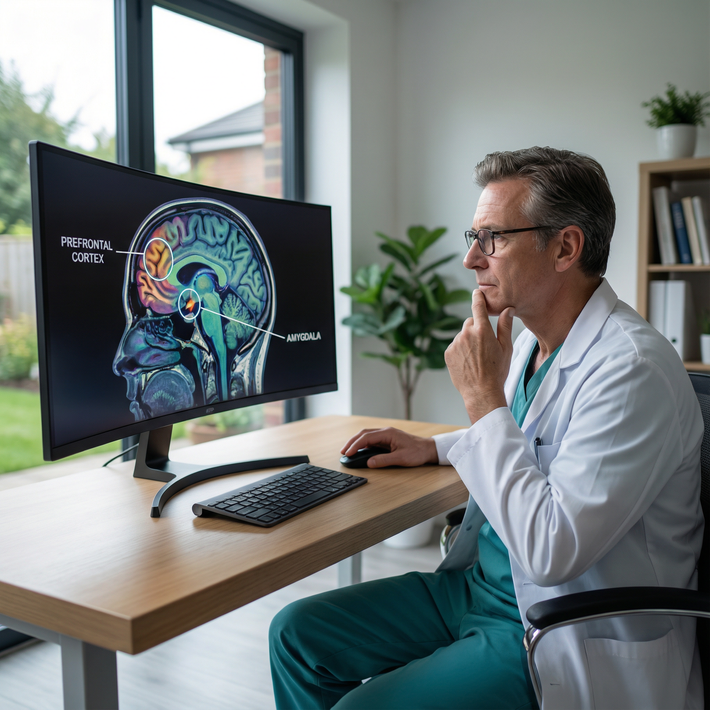
The data shows that most GME programs are guessing about mindfulness. They like the idea, but cannot quantify the return. That is a problem, because you are talking about diverting faculty time, resident hours, and hard dollars away from clinical care and toward a curriculum that may or may not move any measurable needle.
Let’s treat this like what it is: an investment decision under resource constraints.
1. The Baseline: What Problem Are You Actually Paying to Solve?
Before pricing mindfulness, you have to quantify the status quo. For most residency programs, three cost drivers dominate the wellness and professionalism problem set:
- Burnout and turnover
- Medical errors and near-misses
- Decreased productivity and teaching efficiency
You do not need exotic models here. A few conservative assumptions already tell a clear story.
Burnout and turnover
Published estimates vary, but across internal medicine, surgery, emergency medicine, and OB/GYN, resident burnout rates typically range from 45–70%. Let’s work with round numbers.
Take a mid-size residency:
- 60 residents (any specialty)
- Annual resident replacement cost (recruitment, onboarding, lost productivity) = $50,000–$100,000 per vacancy
I have seen CFOs use $80,000 as a working figure when you fully load HR, credentialing, orientation, and early inefficiency.
If 10% of your residents leave early or need prolonged leave driven by burnout or related factors, that is 6 residents per year.
At $80,000 per vacancy:
6 × $80,000 = $480,000 per year in turnover-related cost.
Even if you argue that only half of those exits are meaningfully preventable, you are still looking at roughly $240,000 in preventable cost per year for a 60-resident program.
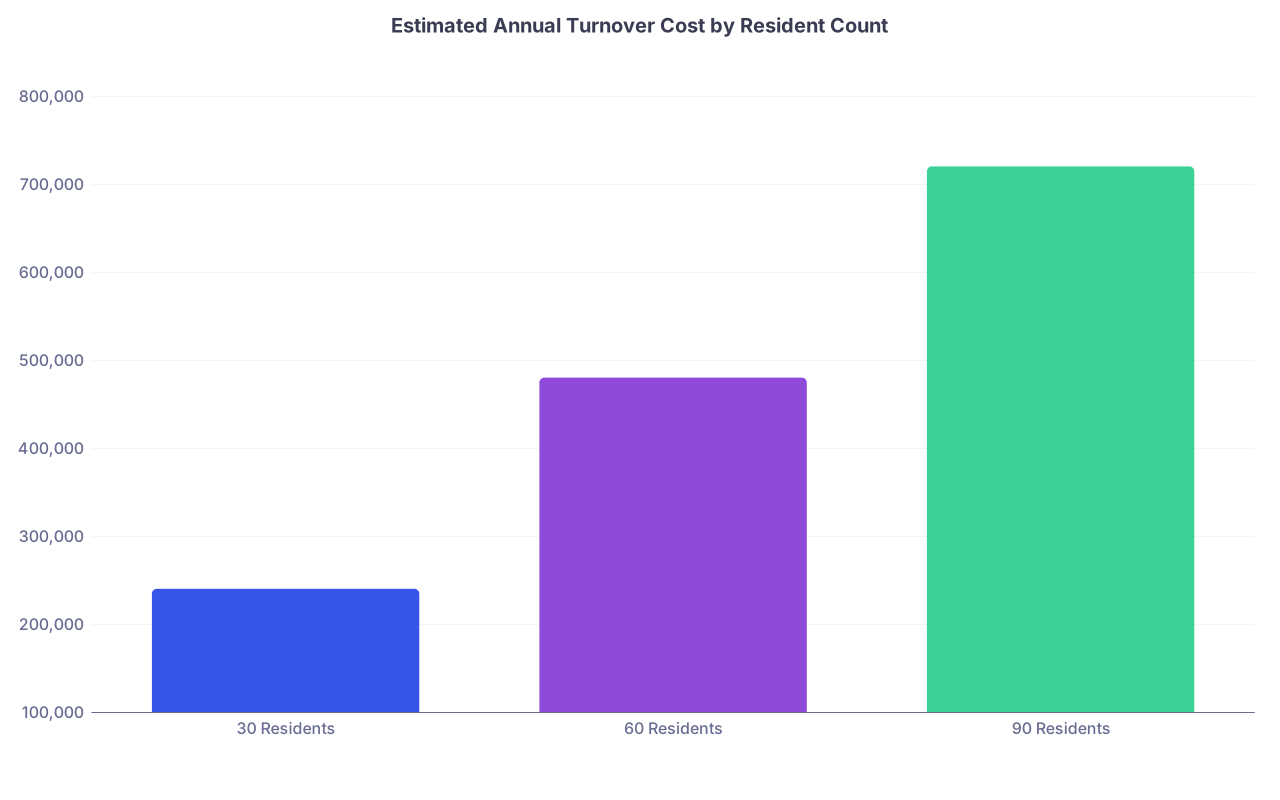
| Category | Value |
|---|---|
| 30 Residents | 240000 |
| 60 Residents | 480000 |
| 90 Residents | 720000 |
That is your first benchmark. If mindfulness cannot plausibly chip away at that, it probably does not deserve serious consideration as an institutional investment.
Medical errors and adverse events
Second driver: errors and quality events. The literature is clear that burnout is associated with higher self-reported medical error rates (odds ratios often in the 1.5–2.0 range), but programs rarely translate that into actual dollars.
Use another simple frame.
Assume:
- Your residents generate or contribute to ~30 reportable adverse events per year (modest for a typical teaching hospital).
- Average direct plus indirect cost per significant event (extra days, interventions, risk management time, potential legal exposure) is conservatively $10,000.
30 × $10,000 = $300,000 per year.
If burnout-driven inattention, poor communication, and cognitive overload drive even 20–30% of these events, there is another $60,000–$90,000 per year sitting on the table from error reduction alone.
Lost productivity
Third bucket: productivity. Burned-out residents are measurably less efficient. They write slower notes, need more supervision, and are more frequently absent or “present but disengaged.”
If the average resident clinical effort is valued at $150,000–$200,000 per year to the institution (RVUs and unbilled work combined), a 5–10% drop in effective productivity from burnout equates to $7,500–$20,000 per resident per year. Multiply that by 60 residents and you arrive in the mid-six-figure range of soft but very real institutional cost.
You do not need all of it back to justify a mindfulness intervention. You just need to be able to credibly capture a slice.
2. What Does a Mindfulness Curriculum Actually Cost?
Now we price the intervention. There are three main cost components if you build a serious, not-token, curriculum: development, delivery, and opportunity cost of resident time.
Direct program costs
I will outline a realistic model for a 60-resident program that wants a standardized annual curriculum, not a one-off “wellness day.”
Assume:
- 8 sessions per year per resident
- 60 minutes per session
- Professionally trained facilitator (internal or external)
- Basic evaluation and some light QI metrics
| Cost Component | Annual Estimate |
|---|---|
| External facilitator fees | \$20,000 |
| Curriculum design/update | \$5,000 |
| Admin & coordination | \$5,000 |
| Materials / digital tools | \$2,000 |
| Evaluation / surveys | \$3,000 |
Total direct cash outlay: $35,000 per year (round to $40,000 for contingency and occasional guest faculty).
Programs that use internal faculty or chief residents to deliver content can drop the cash outlay but will incur hidden faculty time costs. In raw budget-speak, though, $30,000–$50,000 per year is the right order of magnitude for something credible, not performative.
Opportunity cost of resident time
This is usually where program directors push back. “You want me to pull my residents off the wards for eight hours a year?”
Let’s put numbers on that.
Assume:
- 60 residents
- 8 hours per year in scheduled mindfulness curriculum
- Value of resident hour to the institution: $50–$75 equivalent (a blend of RVU contribution and service coverage value)
Resident time cost:
60 × 8 × $60 (midpoint) ≈ $28,800 per year
Add this to the $40,000 direct costs and your all-in annual cost is around $70,000.
That is your denominator. Any talk about “benefit” has to be grounded against ~$70,000 per year and some political friction from faculty who think an extra hour of didactics is already too much.
3. What Does the Evidence Say Mindfulness Buys You?
Now the more uncomfortable part: the benefit estimates. The data here is not perfect. But you are not flying blind.
Meta-analyses of mindfulness-based interventions (MBIs) for physicians and trainees consistently report:
- Moderate reductions in burnout (effect sizes ~0.3–0.5 in emotional exhaustion and stress scores)
- Improvements in mindfulness, self-compassion, and sometimes empathy
- Variable but generally positive impact on depression, anxiety, and sleep quality
What is usually missing is the translation to hard operational outcomes. So you model it.
Scenario modeling: conservative effect sizes
Let’s assume a moderate program effect for a well-designed, longitudinal mindfulness curriculum embedded in GME:
Burnout prevalence drops by 10–15% relative (not absolute).
If 60% of residents report high burnout at baseline, a 15% relative drop yields a new rate of 51%. That is 5–6 fewer highly burned-out residents in a 60-person program.Burnout-related turnover/leave drops from 10% to 7–8%.
That is 1–2 residents per year “saved” from early exit or prolonged leave.Self-reported major errors fall by 10–20%.
Not revolutionary, but directionally consistent with lower cognitive overload and better attention.
Run that through the cost framework.
Burnout / turnover savings
Use the earlier $80,000 per resident turnover cost.
If burnout-related exits/extended leaves drop by even 1 resident per year:
- Savings = 1 × $80,000 = $80,000 per year
If the effect is 2 residents:
- Savings = $160,000 per year
Even allowing that not every case is purely burnout-driven, if mindfulness prevents only half of those 1–2 at-risk residents, you still land in the $40,000–$80,000 savings band.
Error and adverse event savings
We priced adverse events at $300,000 per year total cost. A 10–20% reduction linked to better attention, emotional regulation, and communication yields:
- 10% reduction: $30,000 per year
- 20% reduction: $60,000 per year
Let’s be conservative and use $30,000.
Productivity and engagement
This is harder to monetize but important. If burnout drives a 5–10% effective productivity loss, and mindfulness can claw back even 2–3%, you are looking at real value.
Rough estimate:
- Effective annual productivity value per resident: $175,000
- 2% improvement due to lower burnout and better focus: $3,500 per resident
- Across 60 residents: 60 × $3,500 = $210,000 per year
Now, you should discount this heavily for modeling conservatism. Even using a 0.25 weighting (assuming only a quarter of that modeled effect is real and attributable), you still get $52,500 in effective value.
Put all of this together in a simple range.
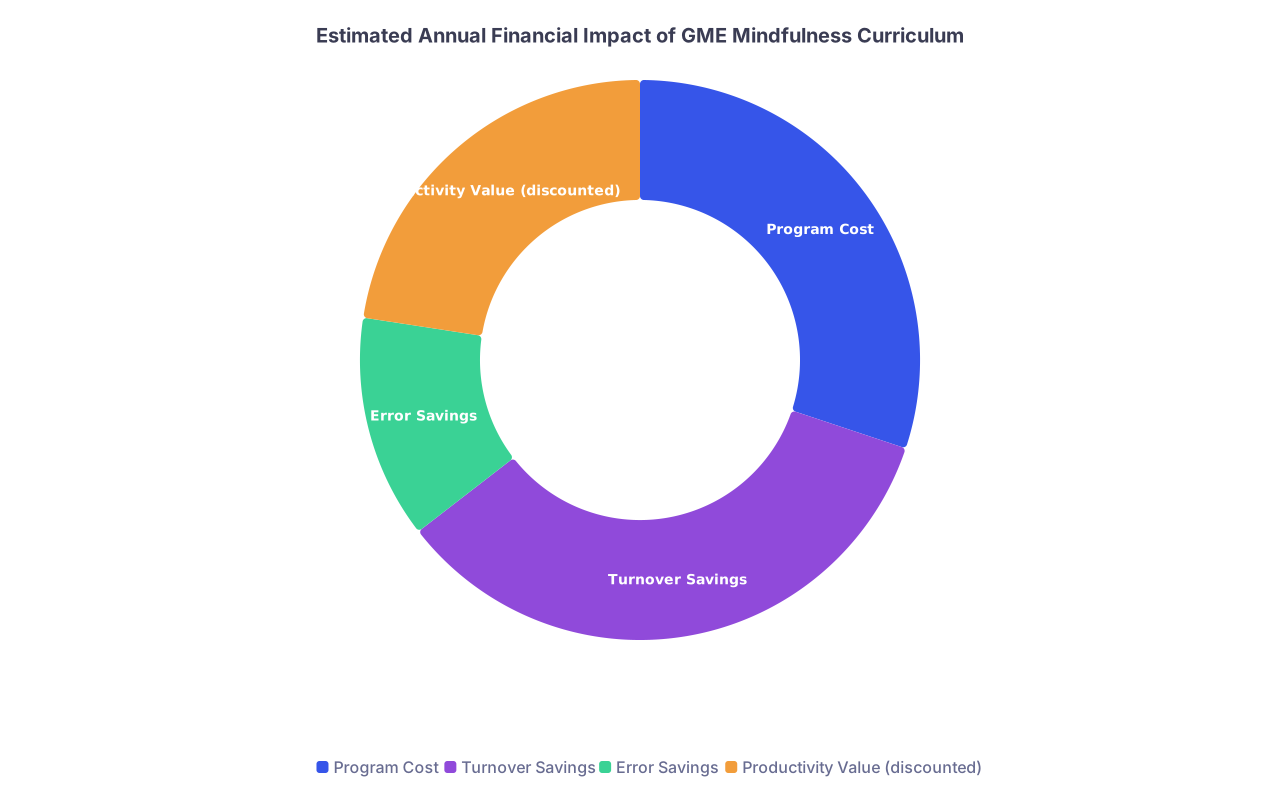
| Category | Value |
|---|---|
| Program Cost | 70000 |
| Turnover Savings | 80000 |
| Error Savings | 30000 |
| Productivity Value (discounted) | 52500 |
The picture is straightforward: even under conservative assumptions, your expected benefit range overshoots your cost.
- Low end: $70,000 program cost vs $40,000 (partial turnover) + $30,000 (errors) + $20,000 (heavily discounted productivity) ≈ $90,000 benefit
- High end: $70,000 cost vs $160,000 + $60,000 + $50,000+ ≈ $270,000+ benefit
On a pure cost-benefit basis, if you trust even half the modeled effect, this is not a vanity spend.
4. Cost-Benefit by Specialty: Not All Programs Look the Same
This is where things get interesting. The return on mindfulness is not uniform across specialties, because baseline burnout and turnover rates are not uniform.
Consider a simplified comparison.
| Residency Type | Burnout Rate | Turnover Risk | Mindfulness ROI Potential |
|---|---|---|---|
| Internal Med | High | Moderate | High |
| Surgery | Very High | High | Very High |
| Emergency Med | Very High | Very High | Very High |
| Psychiatry | Moderate | Moderate | Moderate |
| Pathology | Lower | Lower | Modest |
Programs with already extreme stressors and high attrition (EM, surgery) stand to gain more absolute dollars from even modest improvements in burnout metrics. The same $70,000 curriculum cost lands very differently in a high-burnout domain than in a relatively stable one.
You can visualize that quickly.
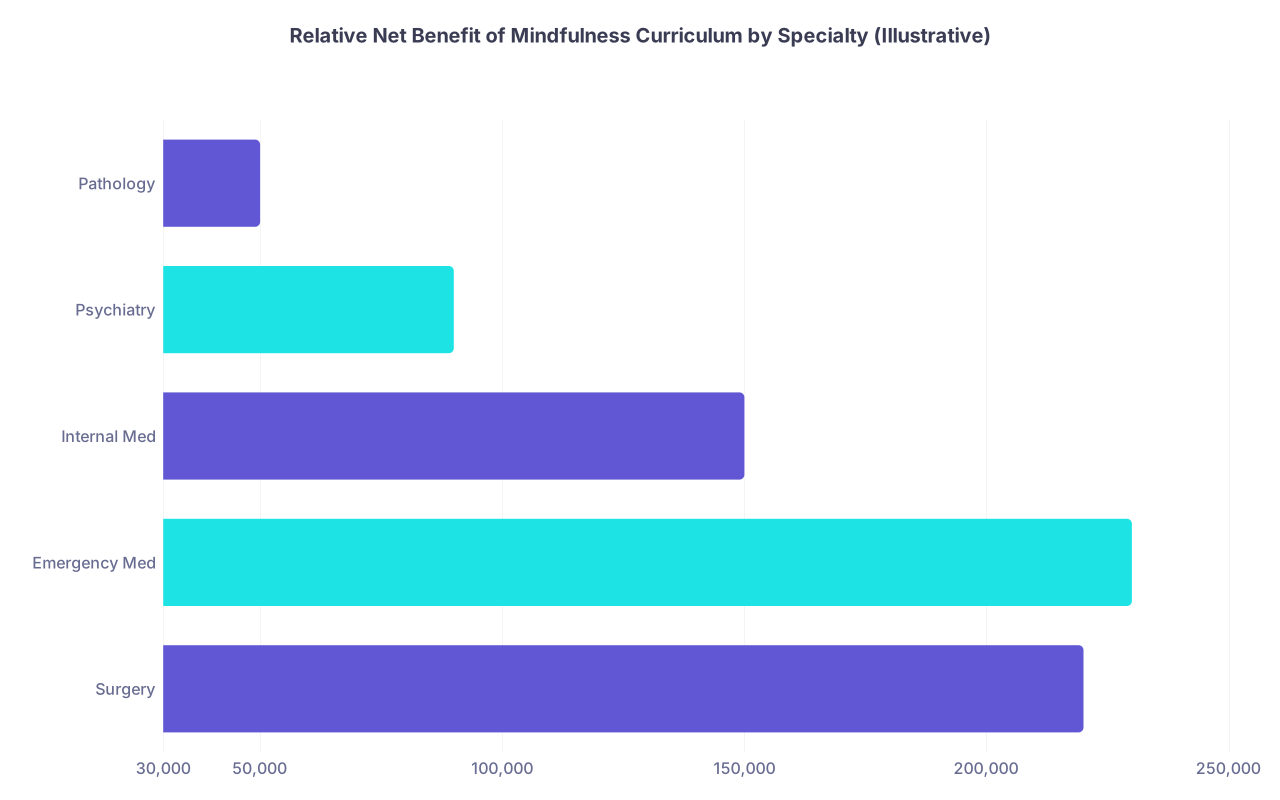
| Category | Value |
|---|---|
| Surgery | 220000 |
| Emergency Med | 230000 |
| Internal Med | 150000 |
| Psychiatry | 90000 |
| Pathology | 50000 |
If you are a DIO or GME leadership group deciding where to pilot, the data points you toward the high-burnout, high-turnover specialties first. You do not sprinkle mindfulness evenly across the house like fairy dust. You prioritize where the marginal dollar returns more.
5. Ethical and Professional Development Returns (Harder to Price, Not Optional)
Because this article sits at the intersection of personal development and medical ethics, you cannot pretend the only axis is dollars. That said, you can still be analytical about the ethical upside.
Patient autonomy and safety
Mindfulness training improves:
- Attention and presence in patient encounters
- Emotional regulation in high-stress, time-limited decisions
- Empathic listening (which supports informed consent quality)
These are not soft virtues. They influence:
- How accurately residents elicit patient values and preferences
- Whether family meetings derail or proceed constructively
- How often rushed, half-explained decisions are made at 3 a.m. in the ICU
It is difficult (and frankly distasteful) to assign a dollar figure to avoiding a catastrophic communication failure in end-of-life care. But if mindfulness decreases even a handful of critical misunderstandings, the ethical payoff is obvious.
Professional identity formation
Residents are not just workers; they are people in the middle of forming a professional identity that will shape 30+ years of practice.
A mindfulness curriculum that is:
- Longitudinal (not one-off)
- Explicitly tied to professional values (compassion, integrity, responsibility)
- Embedded in real clinical narratives (reflecting on “near miss” cases, ethical stress, moral injury)
…contributes directly to how these physicians understand their own obligations to patients, colleagues, and themselves.
There is data that higher mindfulness correlates with lower implicit bias and better patient-centered communication. It is early but directionally consistent. If you care about equity and respectful care, it is hard to argue that training clinicians to be more aware of their own automatic reactions is ethically optional.
Is that “cost-effective” in a spreadsheet sense? Possibly, through downstream improvements in patient satisfaction, complaints, and litigation risk. But even if you cannot pin an exact ROI on those metrics, there is a strong ethical argument:
- You are already investing enormous amounts in technical competence.
- You are legally and ethically obligated to support a safe, humane training environment.
- You are seeing measurable, preventable harm tied to unaddressed burnout and moral distress.
At some point, not investing in proven tools to mitigate those harms looks less like cost-saving and more like neglect.
6. Implementation Design: How to Maximize Return and Avoid Waste
Mindfulness is not magic. Done poorly, it becomes what residents dismiss as “mindfulness theater”: a couple of forced sessions that signal institutional hypocrisy. That kind of implementation has a negative ROI, both financially and ethically.
From a data and design standpoint, three elements separate high-yield from performative programs.
1. Integration with schedules and clinical reality
I have watched programs sabotage good curricula by scheduling them at the worst possible times.
High-ROI pattern:
- Protected time during lower-acuity parts of the day
- Integrated into existing didactics blocks
- Mandatory attendance with genuine backing from program leadership
Low-ROI pattern:
- Voluntary lunchtime sessions competing with documentation and pages
- Scheduling during peak clinical chaos
- Mixed messages from attendings who quietly resent time away from service
Every time a resident gets paged out of a “mindfulness session” to fix a missing order, you are burning credibility and value.
2. Measurement and iteration
You cannot call this a cost-benefit analysis if you do not measure anything.
At minimum, track:
- Baseline and annual burnout scores (e.g., Maslach or abbreviated scales)
- Turnover and leave-of-absence rates
- Rate of reported resident-related adverse events or near-misses (even if only trends)
- Resident satisfaction with the curriculum (not as the primary outcome, but as a process metric)

| Step | Description |
|---|---|
| Step 1 | Baseline Metrics |
| Step 2 | Design Curriculum |
| Step 3 | Deliver Sessions |
| Step 4 | Collect Data |
| Step 5 | Analyze Outcomes |
| Step 6 | Maintain and Scale |
| Step 7 | Refine Content |
| Step 8 | Meets Targets |
Target explicit thresholds. For example:
- 10% reduction in high-burnout scores over 2 years
- 25% reduction in burnout-attributed leaves/exits
- Stable or improved error trends despite rising clinical volume
If you see nothing move after 2–3 years, you should not blindly keep funding the same design. You adjust frequency, facilitation quality, integration with other wellness supports, or you reallocate resources.
3. Culture and ethics alignment
Residents are sophisticated. They spot the disconnect when a hospital pushes mindfulness while simultaneously expanding duty hours at the margins and under-staffing night coverage.
To maintain ethical integrity and effectiveness:
- Pair mindfulness with structural changes: reasonable scheduling, adequate staffing, psychological safety to report concerns.
- Explicitly present mindfulness as a tool, not a bandage for systemic problems.
- Create channels where residents can safely say, “The problem is the system, not my mindset,” and actually see responses.
This alignment matters practically: if residents see mindfulness as a way to help them care for patients and themselves more sustainably, they engage. If they see it as a way for leadership to avoid making harder structural decisions, they disengage, and your ROI collapses.
7. Decision Point: Should You Fund Mindfulness in Your GME Program?
Let me be blunt: for most mid- to large-sized residency programs, a well-designed mindfulness curriculum passes a cost-benefit test.
When you line up:
- All-in costs around $70,000 per year
- Plausible, evidence-consistent benefits in the $90,000–$250,000 range
- Additional ethical and professional formation gains that are difficult but not impossible to link to institutional risk and quality metrics
…the rational position is not “Is this worth anything?” but “How do we design and measure this carefully enough to realize the upside?”
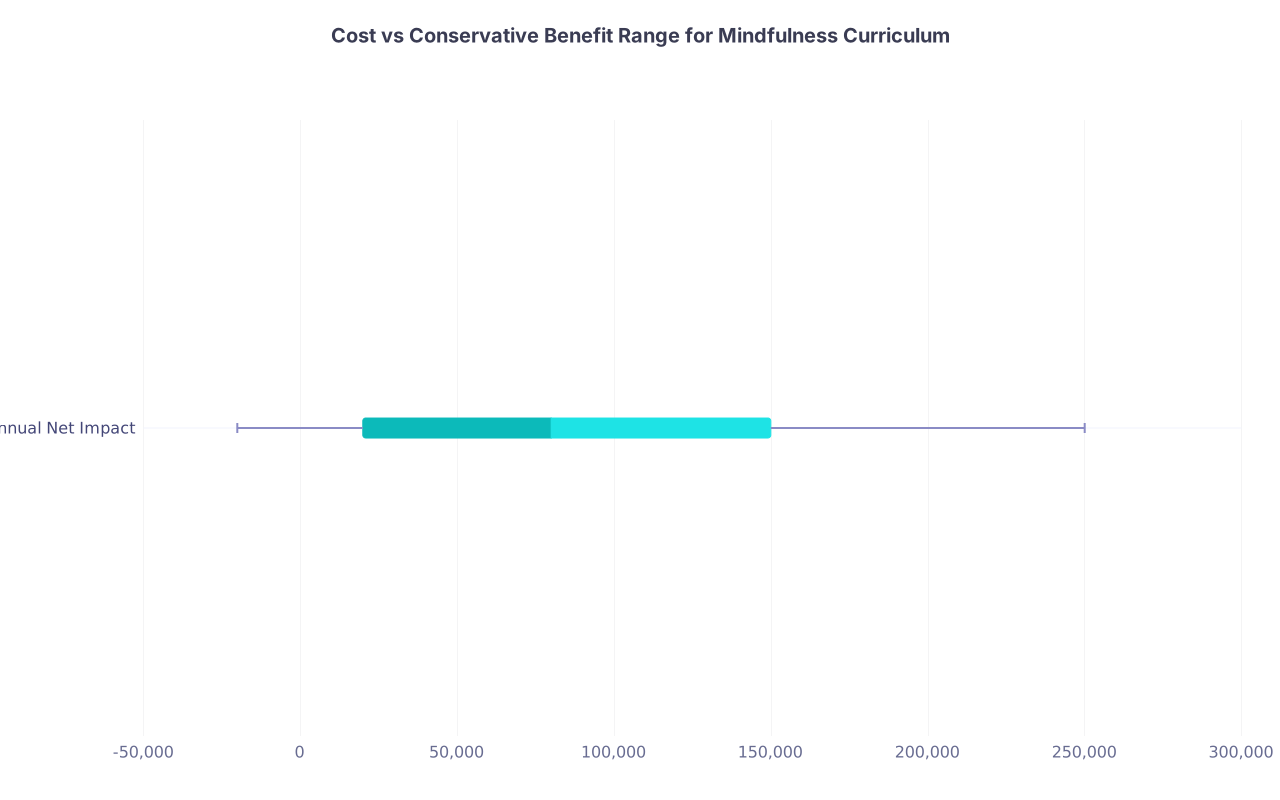
| Category | Min | Q1 | Median | Q3 | Max |
|---|---|---|---|---|---|
| Annual Net Impact | -20000 | 20000 | 80000 | 150000 | 250000 |
That boxplot-style framing is deliberate. Yes, there is a tail risk that you design and implement so poorly that you waste $20,000–$50,000 in net terms. But the median and upper quartile outcomes are strongly positive.
For a GME program that routinely writes six- and seven-figure checks for simulation centers, recruitment, and faculty development, refusing to allocate tens of thousands to a measured, evidence-aligned intervention against burnout and ethical erosion is hard to justify.
Key Takeaways
The financial upside is real. With credible assumptions, a robust mindfulness curriculum in GME returns more in reduced turnover, fewer errors, and recovered productivity than it costs to run.
Design and measurement determine ROI. Programs that integrate mindfulness into protected time, pair it with structural reforms, and track burnout and operational outcomes generate value. Token, poorly scheduled efforts do not.
The ethical case aligns with the financial one. Supporting residents’ capacity for attention, empathy, and moral resilience is not only a wellness perk; it is part of your obligation to patients and trainees—and the data shows it can pay for itself.