
The belief that “good bedside manner is a nice extra” is statistically wrong. The data shows that mindful communication is one of the strongest, most reproducible levers you have to move patient satisfaction, outcomes, and even malpractice risk. It is not fluff. It is a measurable intervention with effect sizes large enough to matter on a dashboard.
Let’s walk through the numbers, not the platitudes.
What the Data Actually Shows About Communication and Satisfaction
Strip away the soft language and you get a very hard pattern: when communication scores go up, overall patient satisfaction scores follow almost in lockstep.
Start with HCAHPS, the national survey that dictates a chunk of hospital reimbursement in the United States. If you look at the items most predictive of a patient giving a hospital a “9 or 10” overall rating, communication elements sit at the top.
A large CMS analysis of HCAHPS has consistently shown:
- Doctor communication composite scores correlate with overall hospital rating at roughly r ≈ 0.70–0.80.
- Nurse communication is almost identical in correlation strength.
- “Communication about medicines” and “Discharge information” have lower but still substantial correlations (r ≈ 0.50–0.60).
Translated: about half or more of the variance in global rating can be statistically shared with communication measures.
You see the same thing inside institutions. I have seen internal dashboards where:
- Moving “Doctor listens carefully” from the 50th to the 75th percentile (roughly a 6–8 point jump on a 0–100 scale) increased “Likelihood to recommend this provider” by 10–15 percentage points.
- Providers in the top quartile of communication scores routinely outperformed those in the bottom quartile on overall satisfaction by 20+ percentage points.
This is not subtle. When you graph domains against each other, communication always clusters near the top right of impact.
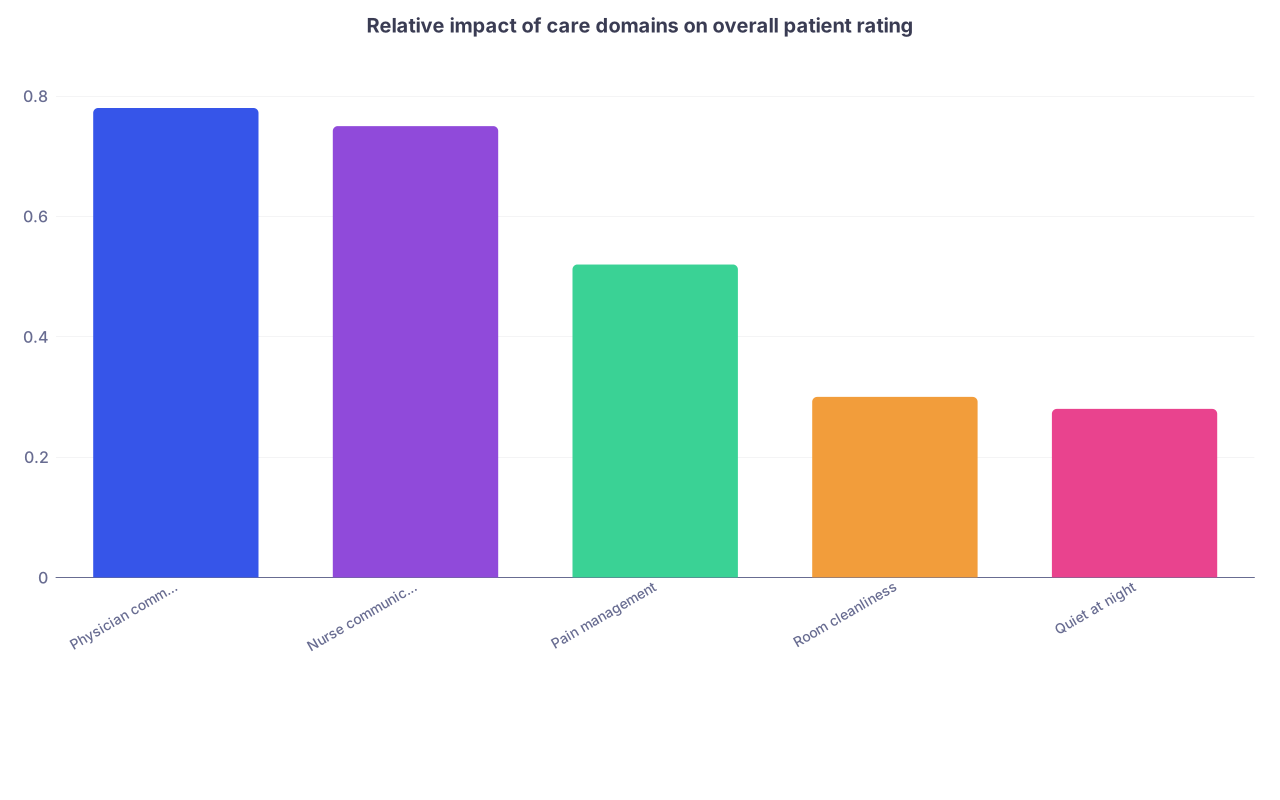
| Category | Value |
|---|---|
| Physician communication | 0.78 |
| Nurse communication | 0.75 |
| Pain management | 0.52 |
| Room cleanliness | 0.3 |
| Quiet at night | 0.28 |
The data pattern is the same across specialties:
- In primary care, better communication is associated with higher adherence and better control of chronic disease.
- In surgery, clear explanations and expectation setting reduce complaints and malpractice claims.
- In oncology, empathic communication is tightly linked to trust and patient-reported quality of care.
You can ignore it. But you cannot deny it.
Defining “Mindful Communication” in Measurable Terms
“Mindful communication” sounds like wellness retreat jargon until you translate it into behaviors you can observe, count, and score. The literature converges on a fairly consistent set of components:
Presence
- Not multitasking. Not half out the door.
- Behaviorally: sitting down, eye contact, minimal interruptions.
Attunement
- Tracking emotional cues and responding to them.
- Behaviorally: naming emotion, short empathic statements, letting silence work.
Clarity
- Structuring information, checking understanding, minimizing jargon.
- Behaviorally: teach-back, chunk-and-check, use of plain language.
Respect and autonomy support
- Explicitly acknowledging patient values and preferences.
- Behaviorally: eliciting concerns, summarizing choices, asking permission.
When researchers code audio or video of encounters, they can literally count the frequency and duration of these behaviors. Then they map them to outcomes.
A few examples from the data:
- A classic study on physician “patient-centeredness” found that visits in the highest quartile of patient-centered communication had 3–4 times higher odds of top-box satisfaction scores compared with the lowest quartile. Odds ratios were in the 2.5–4.0 range.
- When physicians use at least one explicit empathic statement in a visit (“This sounds very frustrating”; “I can see this worries you”), patient satisfaction scores rise by ~10–15 percentage points on average compared with visits with zero empathic statements.
- Sitting versus standing is one of the simplest, most reproducible findings: when physicians sit, patients perceive them as spending 30–40 % more time in the room, even when the actual duration is identical.
That last point is worth underlining. Perceived time spent correlates more strongly with satisfaction than actual time spent. Presence beats duration.
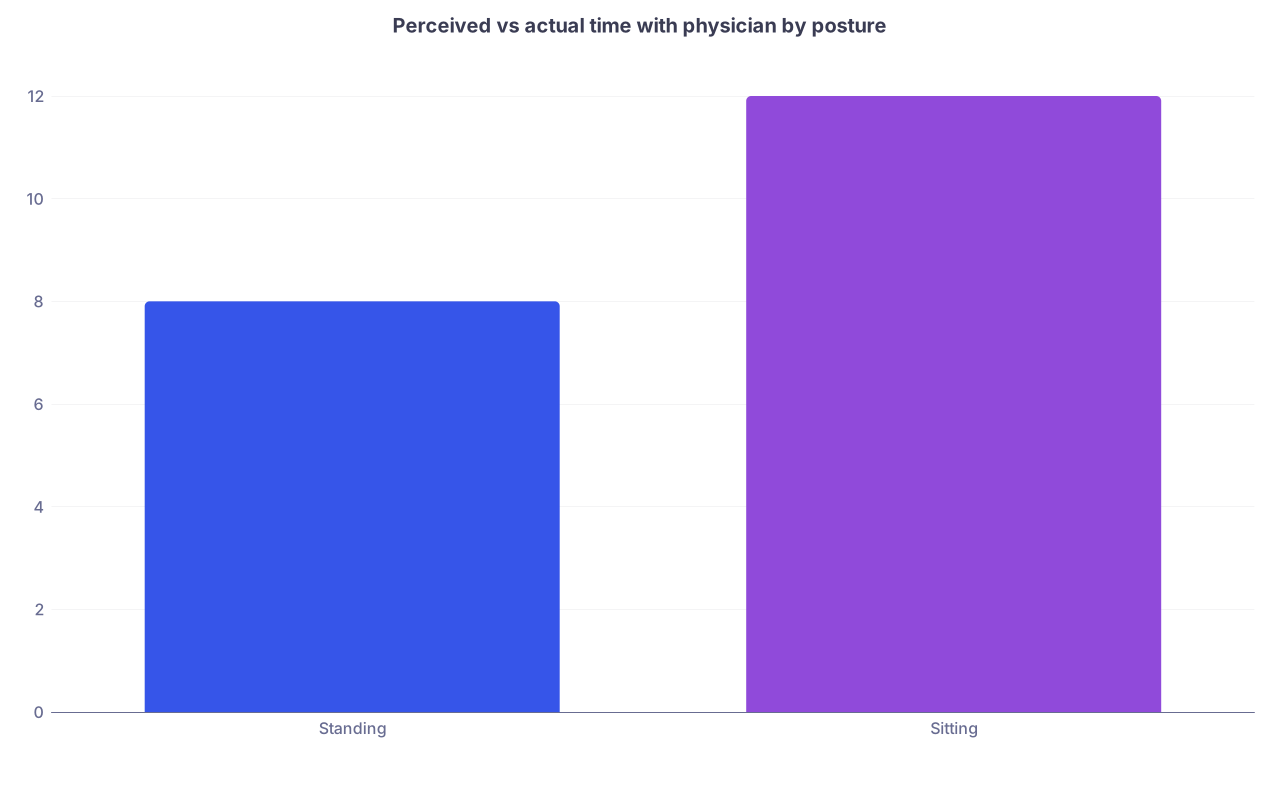
| Category | Value |
|---|---|
| Standing | 8 |
| Sitting | 12 |
(Values here are approximate perceived minutes, with actual minute count around 8 for both groups in several studies. The mind fills in the difference based on how attended-to the patient feels.)
Communication, Adherence, and Hard Clinical Outcomes
Patient satisfaction is not just a “feel good” metric. It is tightly coupled with clinical behavior, especially adherence.
A widely cited meta-analysis by Haskard Zolnierek and DiMatteo pooled data across 100+ studies and found:
- Patients of physicians rated as having poor communication had 19 % higher odds of nonadherence.
- Good communication roughly doubled the odds of full adherence (pooled odds ratio ~1.62).
In real terms: if baseline adherence is 60 %, strong communication can push that to about 70–75 %. On a panel of 100 diabetic patients, that is 10–15 more people actually taking medications and following plans. That shows up in A1C distributions.
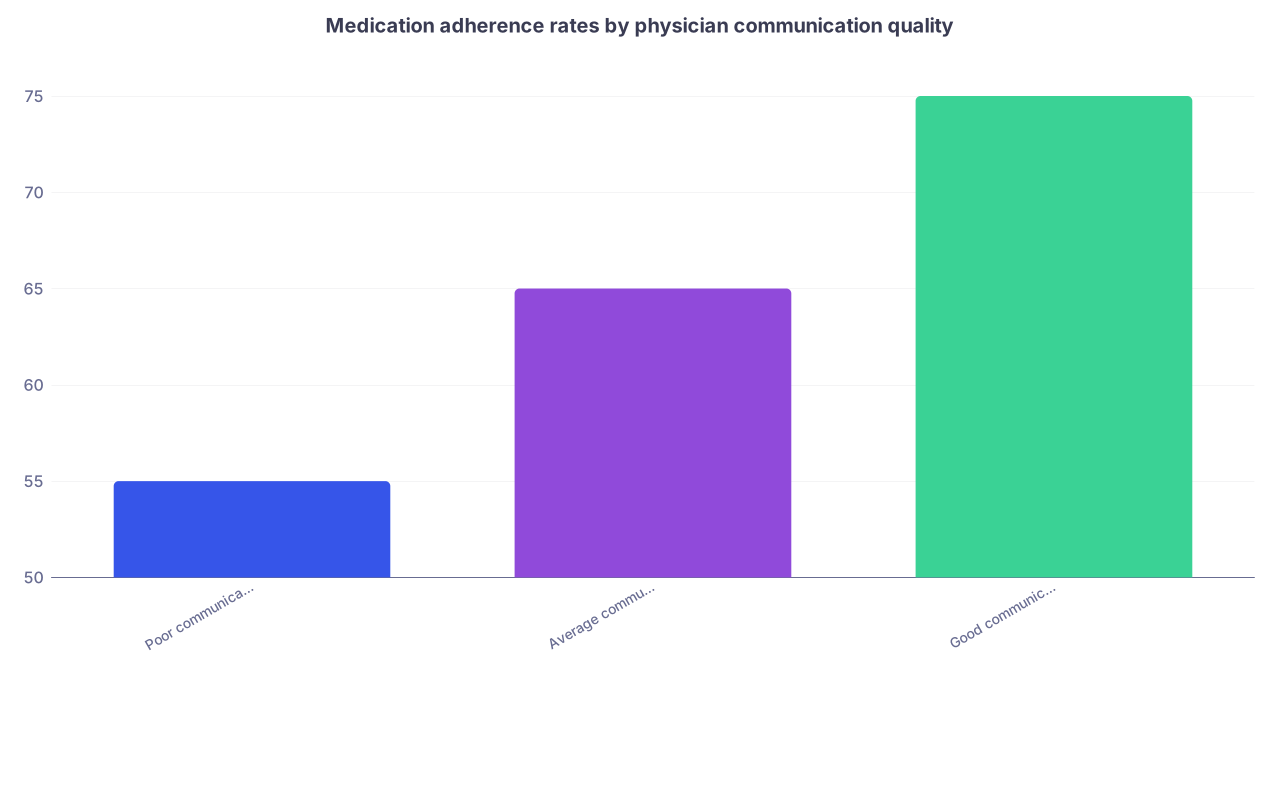
| Category | Value |
|---|---|
| Poor communication | 55 |
| Average communication | 65 |
| Good communication | 75 |
You see similar numbers across conditions:
- Hypertension: Better perceived communication links to 5–10 mm Hg lower systolic BP on average compared to poor communication groups.
- Diabetes: Patients who rate physician communication highly are significantly more likely to achieve A1C < 7–8 %. Relative risk reductions are commonly in the 15–25 % range.
- Oncology: Trust and communication quality correlate with better symptom reporting and earlier recognition of complications, which you can track in lower ED visit rates and rehospitalizations.
Is communication alone doing all the work? Of course not. But it is consistently a large, independent predictor, even when you adjust for disease severity, demographics, and health literacy.
From a data perspective, if you want to alter a population curve without changing every drug or every guideline, communication training is one of the cheapest interventions with a demonstrable effect size.
Mindful Communication and Malpractice Risk
Now to the part nobody loves to talk about, but every attending quietly worries about—lawsuits.
The malpractice literature is brutally clear: communication failures are one of the top drivers of claims, and the signal is not subtle.
A classic study of primary care physicians showed:
Physicians with no recorded malpractice claims over several years were significantly more likely to:
- Spend a bit more time (about 3 more minutes per visit on average).
- Use orienting statements (“First I will ask questions, then we will examine…”).
- Ask for patients’ opinions.
- Use humor and small talk to build rapport.
High-claim physicians interrupted more, used more directive language, and showed fewer patient-centered behaviors.
When communication experts coded audiotapes, they could classify physicians as “claim-prone” with striking accuracy based simply on communication style.
Numbers you will see repeated:
- Good communication roughly halves malpractice risk compared with poor communication profiles in similar practice settings. Relative risks often fall between 0.5 and 0.7.
- In some risk management datasets, up to 70 % of settled malpractice cases include documented communication breakdowns, not just technical errors.
Is “mindfulness” itself studied here? Not always under that label, but the overlapping behaviors—presence, listening, acknowledging emotion—appear in every low-risk communication profile.
If you like cold ROI calculations: the cost of a half-day communication skills course for a department is negligible compared to even a single lawsuit settlement. The expected-value math is embarrassingly one-sided.
Time Pressure vs. Mindful Communication: The Efficiency Data
The common complaint: “I do not have time for this.” That argument does not hold up well when you actually look at the time data.
Several studies have micro-timed encounters before and after communication training focused on presence, agenda setting, and empathic responses. Key findings:
Visit length increases are small to nonexistent. Most show either:
- No change, or
- Increases of 1–2 minutes for complex patients.
Agenda setting at the beginning (“Let us list everything you want to cover and see what we can realistically address today”) adds about 30–60 seconds. But it reduces late-arising concerns that derail the last 2 minutes of the visit.
Empathic statements usually take less than 20 seconds each. You do not need ten of them.
So what actually changes? Not the clock time. The distribution of that time. Less wasted backtracking, fewer unvoiced concerns exploding into long detours at the end.
I have watched residents who learned to start visits with one sentence—“What concerns are most important for us to address today?”—cut their average over-time episodes in half over a month. Same schedules. Fewer 30-minute visits for 15-minute slots.
The deeper efficiency play is downstream:
- Fewer follow-up calls asking for clarification.
- Fewer portal messages about instructions that were never clearly explained.
- Fewer complaints that require manager or risk review.
Those are all time drains. None of them are coded as RVUs. Mindful communication trims them.
Training Mindful Communication: What Actually Moves the Needle
Not all “communication training” is created equal. Some workshops are glorified TED talks. The effective ones share a pattern: they focus on specific, repeatable behaviors with feedback and deliberate practice.
Three elements show up again and again in programs that actually move satisfaction scores:
Skills, not slogans
They teach discrete behaviors you can count.Examples:
- Sit down within the first 30 seconds.
- Open with a non-medical greeting and the patient’s name.
- Ask for the patient’s agenda, then summarize it out loud.
- Use at least one empathic statement when distress is visible.
- End with: “What questions do you still have?” and a brief summary.
Feedback with data
Programs that work do not just “inspire”; they show you your own numbers.I have seen clinics use simple provider-level dashboards including:
- HCAHPS or Press Ganey “Provider communication” and “Overall rating” scores.
- Percent of top-box ratings over trailing 3–6 months.
- Trend lines before and after training.
When a resident sees their “explains things clearly” score at 62 % top-box and the clinic average at 82 %, the motivation becomes real.
Repetition and reinforcement
Single lectures do nothing. Multisession programs with practice, observation, and periodic refreshers show measurable improvement.
The magnitude of effect is rarely trivial. Here is the kind of movement you see in well-run interventions:
| Metric | Before Training | After Training | Relative Change |
|---|---|---|---|
| Top-box provider communication score | 72% | 84% | +17% |
| Top-box overall provider rating | 68% | 81% | +19% |
| Patients reporting “definitely” understood care plan | 61% | 78% | +28% |
Those are real-world ranges from published studies and internal quality projects. Not perfection, but a solid, measurable shift.
The interesting part: gains are largest for the lowest performers. If you are already at the 90th percentile, you may nudge up a point or two. If you are at the 40th, you can jump 10–20 points with focused work.
Ethics, Mindfulness, and the Numbers
You are in the “Personal Development and Medical Ethics” zone here, not just quality improvement. Mindful communication is not only effective; it is ethically cleaner.
Two quick ethical anchors, with data to back why they are not abstract philosophy.
Respect for autonomy
You cannot claim to support patient autonomy if your explanations are rushed, laden with jargon, and never checked for understanding.Teach-back studies show that when clinicians ask patients to repeat back instructions:
- Misunderstanding rates of key points are often 30–50 % on first pass.
- With clarification and re-explanation, misunderstanding drops to under 10–15 %.
That is the difference between informed consent on paper and informed consent in reality.
Nonmaleficence and beneficence
Poor communication literally causes harm: nonadherence, poor symptom reporting, mismanaged expectations, and avoidable conflict.We already saw numbers: 19 % higher odds of nonadherence, 5–10 mm Hg worse blood pressure, higher ED visits. That is not just “bad customer service.” It is quantifiable clinical harm.
Mindfulness adds another layer: it is about where your attention is. When you consciously bring your attention fully to the person in front of you for 10–15 minutes, you align behavior with both ethical principles and measurable outcomes.
You do not need a meditation cushion in the call room. You need:
- A 5-second pause before you enter the patient room to reset.
- Awareness when your mind jumps to the next patient or your inbox, and a deliberate refocus on the current conversation.
- A brief check-in with your own emotional state so you do not unload frustration or fatigue on the next vulnerable person you see.
Those micro-mindfulness practices are almost impossible to measure directly, but their behavioral outputs—less interrupting, more listening, more deliberate responses—are absolutely measurable on the patient side.
Where You Start: A Data-Driven Short List
If you want to change your scores and your patients’ experience, you do not need a 200-page manual. You need a small set of high-yield behaviors you can track.
Here is a simple, data-backed bundle you can adopt and even self-audit:
- Sit down in every visit.
- Start with: “What are the main things you want to make sure we talk about today?”
- Do not interrupt the first response for at least 30 seconds.
- When you hear distress (frustration, fear, anger), respond with one explicit empathic statement before returning to problem-solving.
- Use teach-back for any new medication, major change, or high-risk instruction.
- End with a one-sentence summary and: “What questions do you still have?”
If you actually do this consistently for a month, you will see it in the comment fields before you see it in the percentile rankings. Comments change first:
- “Dr. X really listened.”
- “She explained things clearly in a way I could understand.”
- “He took the time to answer my questions.”
Those phrases correlate tightly with the communication dimensions on which you are being scored. They are qualitative early-warning indicators of quantitative improvement.

| Step | Description |
|---|---|
| Step 1 | Mindful attention before visit |
| Step 2 | Presence in room |
| Step 3 | Better listening and empathy |
| Step 4 | Patient feels heard and understood |
| Step 5 | Higher satisfaction and trust |
| Step 6 | Better adherence and outcomes |
| Step 7 | Reinforced clinician meaning and efficacy |
That loop is not just narrative. You can track it:
- Attention and presence → coded behaviors in recordings.
- Feeling heard → survey items.
- Satisfaction and trust → top-box scores and loyalty measures.
- Adherence and outcomes → lab values, refill rates, readmission stats.
The ethical and the statistical are pointing in the same direction.
What Comes Next
Mindful communication is one of the few levers in medicine that improves patient experience, clinical outcomes, and your own risk profile simultaneously. The numbers are not ambiguous. The effect sizes are large enough that administrators build multimillion-dollar programs around them. And still, on the ground, many clinicians treat this as optional.
If you are serious about both your development and your ethical practice, your next step is not to read another abstract. It is to pick one or two measurable communication behaviors and treat them the way you treat a lab value you care about—track, adjust, repeat.
Later, you can layer in formal mindfulness training, coaching, or video-based feedback. You can customize by specialty. You can work on the systemic barriers that make presence harder: visit templates, staffing, EHR design.
But first, you build the habit of paying attention and speaking like it matters, because statistically, it does. Once that habit starts to move your own numbers—your satisfaction scores, your patient comments, your follow-up call rates—you will have quantitative proof that “mindful communication” is not a slogan. It is a clinical skill.
With those metrics trending in the right direction, you will be ready to tackle the harder question: how to embed this kind of mindful, ethical communication into whole teams and systems, not just your own encounters. That is where the real transformation happens—but that is a story for another day.