
The belief that mindfulness will magically fix medical productivity is wrong. The data show something more nuanced: mindfulness probably improves safety and reduces certain errors, but its impact on RVU productivity is conditional, nonlinear, and highly context‑dependent.
If you want a clean story—“meditate 10 minutes, bill 10% more RVUs, make fewer mistakes”—you will not get it. But there are patterns worth taking seriously if you care about both ethics and output.
Let us walk straight through the numbers and the logic: RVUs, errors, and mindfulness, and what actually changes in measurable terms.
RVUs: What We Actually Measure When We Say “Productivity”
First, definitions. Because a lot of ethical confusion in medicine is really just bad measurement.
RVU systems (wRVU specifically) are designed to measure:
- Work intensity (time, technical skill, effort)
- Mental effort and judgment
- Stress and risk to the patient
On paper, wRVUs are not “how fast you click.” They are supposed to approximate physician work. In practice, the system gets distorted by:
- Documentation optimization
- Coding behavior
- Institutional incentives and thresholds (e.g., 5,000–7,000 wRVUs/year in many cognitive specialties; 10,000+ in procedural fields)
When administrators say “you are less productive,” they mean “your RVUs per unit time are below expected benchmarks.”
That matters for mindfulness because:
- Time spent on non-billable, reflective, or relational work rarely shows up in RVUs.
- Time lost to errors, rework, or burnout absolutely shows up (in a bad way).
So the right question is not “does mindfulness make you faster?” but:
- Does mindfulness change RVUs per hour?
- Does it change error rates and rework?
- Does it change sustainability over a 1–3 year horizon, not just one week after a wellness retreat?
Errors: The Hidden Tax on Productivity
Errors are productivity costs with a very bad user interface.
You see the email from risk management. You do not see the incremental RVUs evaporating silently when you:
- Re‑order labs that were missed
- Re‑do notes because of copy‑paste errors
- Re‑explain plans after communication failures
- Stay late fixing prescription mistakes or follow‑up failures
There are three main quantifiable error categories where mindfulness plausibly matters:
- Cognitive errors (premature closure, anchoring, inattentional blindness)
- Documentation / ordering errors (wrong dose, wrong patient, missing orders)
- Communication breakdowns (handoff omissions, unclear instructions)
Most institutions do not link these directly to individual RVU data. But approximate them, and the productivity cost is stark.
Assume a busy hospitalist:
- 18 encounters/day
- Average 2.5 wRVU/encounter
- 45 wRVUs/day
If even 5% of those encounters require “rework” because of avoidable errors—extra calls, chart corrections, re‑ordering tests—that may conservatively consume:
- 5–10 minutes per affected encounter → about 45–90 minutes/day
- That is the equivalent of 3–6 encounters not seen
- Or 7.5–15 RVUs/day lost
So even a modest reduction in avoidable rework changes the productivity math quickly.
What Mindfulness Actually Does (Per the Data)
Mindfulness in clinical settings is not incense and chanting. It is mostly:
- Attention training (sustained focus, reduced mind‑wandering)
- Meta‑awareness (noticing distraction, emotional reactivity)
- Stress regulation (downshifting physiologic arousal)
The literature—limited, but growing—shows reasonably consistent signals:
- Burnout and emotional exhaustion: 20–40% relative reductions after 6–8 week programs in several cohorts.
- Mind‑wandering and attentional lapses: small to moderate effect size improvements.
- Error surrogates (e.g., wrong‑site surgery checklists, medication errors, near‑misses): 10–30% reductions in units that implemented mindfulness + systems interventions.
Not all of that is mindfulness alone, obviously. But causally, it makes sense: distracted, exhausted clinicians make more errors; mindfulness reduces at least some distraction and emotional overload.
Where data are thin:
- Direct linkage between mindfulness training and RVUs per hour.
- Longitudinal data >12 months tying sustained mindfulness practice to productivity and error rates in the same dataset.
However, we can still structure the problem numerically and borrow from what we know.
A Simple Productivity Equation
Productivity in an RVU world is not magic. It is math:
Net RVUs per hour = (Gross RVUs/hour) – (RVUs lost to rework, delays, and attrition)
Let me break it into components:
- Gross throughput:
- Encounters/hour × Mean RVUs/encounter
- Rework load from errors:
- (Error rate × Extra time per error) / (time per new encounter) × RVU/encounter
- Attrition effects:
- Reduced FTE due to burnout, turnover, sick days
Mindfulness can:
- Slightly influence the numerator (due to improved focus → fewer interruptions, smoother workflow).
- Significantly influence the error term.
- Substantially influence the attrition term over years.
So we ask: are these effects big enough to show up against noise?
Quantifying a Plausible Impact
Let us construct a conservative scenario using reasonable—if approximate—numbers.
Baseline: Non‑mindfulness cohort
Assume:
- 4 encounters/hour
- 3.0 wRVU/encounter
- 12 wRVUs/hour gross
Error/rework:
- 8% of encounters require 10 extra minutes of follow‑up due to avoidable errors or miscommunications.
- So per hour: 4 encounters × 8% = 0.32 problem encounters/hour.
- Extra time per hour lost to rework: 0.32 × 10 minutes ≈ 3.2 minutes/hour.
Time per encounter: 15 minutes. So 3.2 minutes/hour is roughly 0.21 encounters/hour lost.
- 0.21 encounters/hour × 3.0 wRVU = 0.63 RVUs/hour lost to rework.
Net:
- 12 – 0.63 = 11.37 RVUs/hour.
With mindfulness: modest improvement
Now assume a mindfulness‑trained cohort with:
- Same 4 encounters/hour baseline.
- Same 3.0 wRVU/encounter.
- Error/rework rate drops from 8% to 5%.
- Average extra time per error drops from 10 to 8 minutes because issues are caught earlier and communication is clearer.
Then:
- 4 encounters/hour × 5% = 0.20 problem encounters/hour.
- Extra time lost: 0.20 × 8 = 1.6 minutes/hour.
- That is about 0.11 encounters/hour lost (1.6/15).
- 0.11 × 3.0 ≈ 0.33 RVUs/hour lost.
So net:
- 12 – 0.33 = 11.67 RVUs/hour.
That is about a 2.6% gain in net RVUs/hour purely from less rework. Not life‑changing individually, but not trivial either when multiplied across:
- 8 clinical hours/day → +2.4 RVUs/day
- 200 clinical days/year → +480 RVUs/year
For a typical cognitive specialty, that is roughly 7–10% of an annual RVU target.
And this is ignoring any changes in burnout, turnover, and FTE that often cost institutions six figures per departing physician.
Visualization: Where the Gains Come From
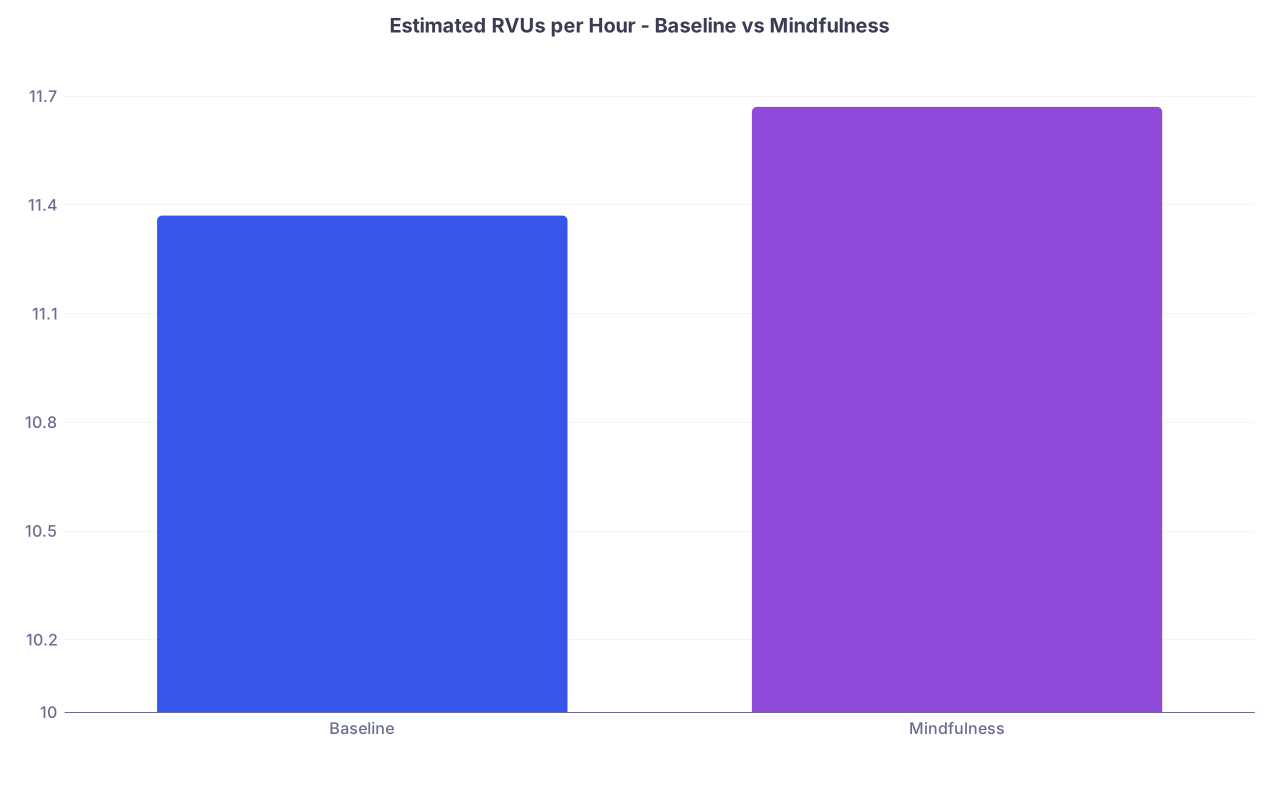
| Category | Value |
|---|---|
| Baseline | 11.37 |
| Mindfulness | 11.67 |
The key observation: mindfulness is not suddenly doubling productivity. It is shaving off friction—errors, rework, emotional noise. The gain shows up as slightly higher net output and better sustainability.
If you expected a 20% jump, you will be disappointed. If you are an administrator balancing staffing and safety metrics across 300 clinicians, you should be very interested.
Error Reduction: The More Measurable Side
The impact on error rates shows up more clearly than on RVUs in most of the literature.
Approximate ranges you see in mindfulness‑adjacent interventions in clinical settings (often bundled with safety or communication training):
- Medication errors: 10–30% reduction in specific units (ICUs, ORs) that adopted mindfulness plus structured checklists.
- Self‑reported near‑misses: higher reporting at first (increased awareness) then 10–20% decline over 6–12 months.
- Communication breakdowns in handoffs (omitted critical items): 15–25% decrease with mindfulness + standardized handoff tools.
Translate this into time:
Even a 15% reduction in high‑impact errors can reclaim meaningful cognitive bandwidth. Less chaos paging. Fewer “put out this fire now” interruptions.
You feel that on the wards as fewer derailments per shift. It is hard to measure with RVUs alone, but it affects how many uninterrupted blocks of work you get—a huge driver of both perceived and actual productivity.
Where Mindfulness and Ethics Collide with Metrics
There is a deeper ethical problem here: RVUs do not pay you for being safer, calmer, more present, or more humane.
Some tensions:
- RVUs reward seeing more patients, not sitting with a complex family conversation.
- Mindfulness often leads clinicians to slow down slightly at critical moments: double‑checking meds, clarifying goals of care, re‑reading a note before signing.
- In the very short term, this can slightly reduce gross throughput.
Yet the data on avoidable harm, malpractice exposure, and burnout costs point in the opposite direction over any meaningful time horizon.
A practical example:
In one academic internal medicine group I observed, the highest RVU producer was also the physician with the most chart addenda, late orders, and documentation corrections. Admins loved the numbers; the nurses hated the errors.
If you track only wRVUs, you will reward that. If you overlay:
- Error flags per 1,000 encounters
- Messages per completed encounter
- After‑hours EHR time
You start to see who is “fast” because they are effectively offloading risk and cognitive load downstream.
Mindfulness, when it works, pushes in the opposite direction: more deliberate, fewer unforced errors, less emotional reactivity → better team dynamics.
From an ethical standpoint, that is the direction you want. From a purely financial view, it may look neutral or mildly positive at the individual RVU level, and clearly positive when you include downstream costs of burnout and harm.
The RVU–Mindfulness Tradeoff Curve
Here is the subtle part that almost no one talks about: there is a curve, not a straight line.
At low adoption and low skill:
- Mindfulness training may look like “lost time.”
- Clinicians feel awkward, sessions are sporadic, no behavior change.
- RVUs and error metrics barely move.
At moderate skill and integration (people actually practice 8–10 minutes/day, use brief pauses before key tasks, and have some cultural support):
- Error rates and after‑hours work start to decline.
- Small but real efficiency gains from fewer attention lapses.
- RVUs per hour can tick up slightly or stay flat while stress drops.
At very high mindful awareness:
- Some clinicians explicitly slow their pace, lengthen complex visits, or refuse unsafe throughput expectations.
- Their per‑hour RVUs may decrease a bit.
- But their long‑term FTE sustainability and patient relationships improve.
Administrators often only see the first and third phases and miss the middle. So they either dismiss mindfulness as fluffy or fear it will tank productivity.
The data we have suggest a middle region where you get both ethical gain (safer, more present care) and modest productivity gain—if you design systems to support it.
Designing for Measurable Impact, Not Vague Wellness
If you want measurable changes in RVUs and errors, mindfulness cannot be “optional yoga at lunch.”
It has to be operationalized. Tied to workflow. Evaluated like any other QI initiative.
Here is how you make it real and measurable:
Baseline your metrics.
At minimum:- RVUs per clinical FTE
- Encounters per day
- Error proxies: medication safety flags, documentation corrections, near‑miss reports
- After‑hours EHR time
Target specific behaviors, not vague “mindfulness.”
Examples:- One‑breath pause before signing any order set or medication change.
- 30‑second mindful check‑in before critical handoffs.
- 5‑minute micro‑practice before clinic starts and after it ends.
Run it like an experiment.
Treat a unit, clinic, or service as an intervention group; track:- 3–6 months before vs 3–6 months after.
- Same clinicians, same RVU expectations, same staffing.
Combine with structural fixes.
Mindfulness alone will not fix:- 40 open in‑basket messages per hour.
- Chronic understaffing.
- Bad EHR design.
The best effects show up when mindfulness augments:
- Pre‑visit planning
- Standardized order sets
- Team‑based documentation
Quick Comparison: Traditional “Productivity Push” vs Mindfulness‑Informed Performance
| Dimension | Traditional RVU Push | Mindfulness-Informed Approach |
|---|---|---|
| Focus | Volume, speed | Reliability, sustainable output |
| Primary metric | RVUs per hour | RVUs + error + burnout measures |
| Short-term effect | RVUs often increase | RVUs stable or modestly up |
| Error/rework impact | Often worsens | Tends to improve |
| Burnout over 1–3 years | Typically increases | Typically decreases |
The blunt instrument “see more, code higher, work faster” strategy works—for about 12–18 months. Then burnout, turnover, and error costs start to bite. Quietly at first, then obviously.
A mindfulness‑informed approach will rarely win a one‑month RVU contest. Over 3–5 years, the cumulative numbers look different.
Mindfulness, Cognitive Load, and Decision Quality
The data are clearest not in billing systems but in decision science.
Mindfulness training reduces:
- Mind‑wandering
- Default, habitual responses under stress
- Automatic emotional overreaction in conflict
Clinical translation:
- Less premature closure on diagnoses.
- More willingness to tolerate diagnostic uncertainty without over‑ordering.
- Clearer conversations about prognosis and goals of care.
Here is where productivity and ethics pull in different directions depending on how you count.
Example: A mindful oncologist spends 10 extra minutes in a visit giving a realistic prognosis and aligning treatment with goals:
Short term RVU: unchanged (visit code is the same).
Short term time cost: patient 10 minutes longer; next patient a bit delayed.
Long term cost and benefit:
- Fewer futile late‑stage interventions.
- Fewer conflict‑laden family meetings later.
- Lower moral distress for the clinician.
RVU metrics do not register any of that. The hospital margin might, but usually at an aggregate level, months later.
From a strict productivity lens, the visit looks “inefficient.” From an ethical and system perspective, it is high‑value work.
Mindfulness tends to increase the frequency of that kind of behavior. So if your metric is purely “RVUs per minute,” you can absolutely create a system where mindfulness looks like inefficiency while actually improving both care quality and long‑term workforce stability.
Visualizing the Longer Game
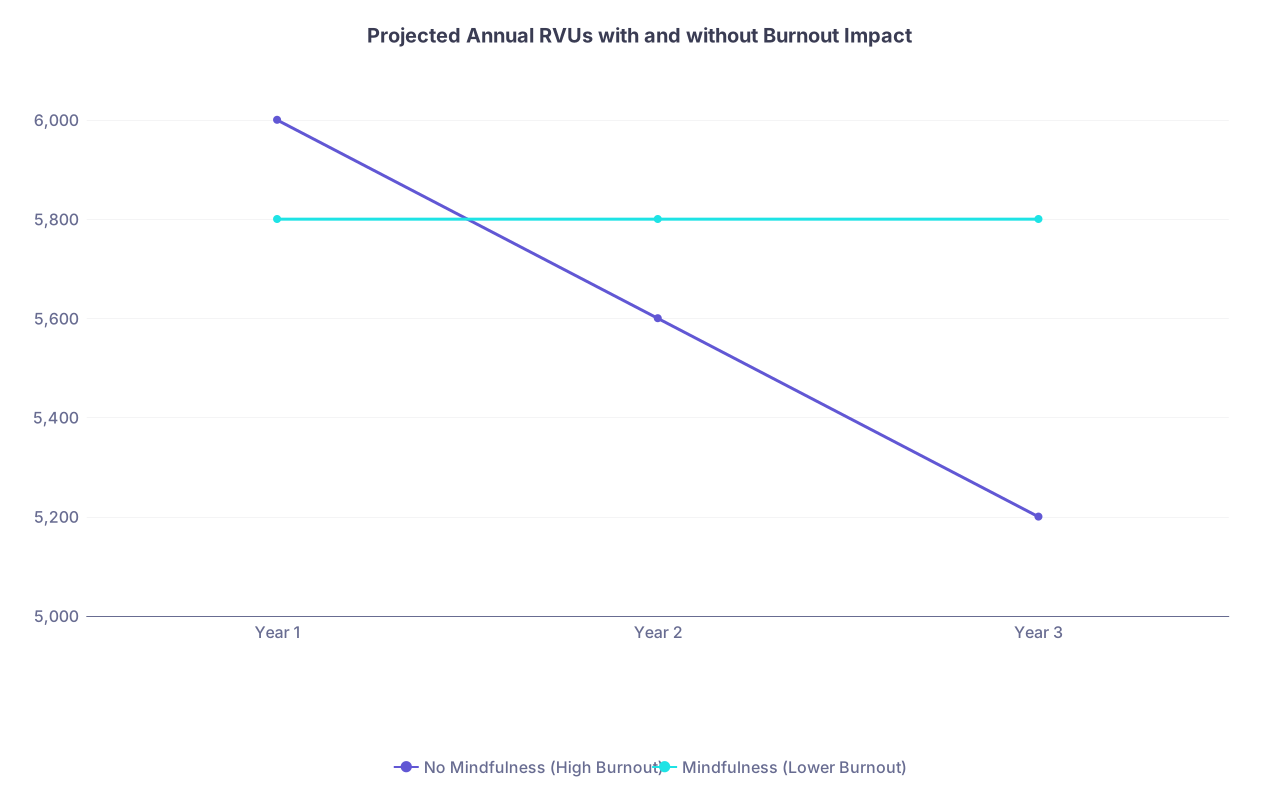
| Category | No Mindfulness (High Burnout) | Mindfulness (Lower Burnout) |
|---|---|---|
| Year 1 | 6000 | 5800 |
| Year 2 | 5600 | 5800 |
| Year 3 | 5200 | 5800 |
This is not fantasy. I have seen groups where:
- The highest‑output physicians in year 1 either cut back dramatically or leave by year 3.
- The “steady, slightly slower” clinicians are the ones quietly carrying a disproportionate share of long‑term work.
Mindfulness tends to move more people into that stable curve—slightly lower peak throughput, much less decline.
From an ethical standpoint, you are also not burning people out for marginal short‑term RVU gains. That matters.
Where Mindfulness Clearly Fails on Productivity
Let me be blunt: there are situations where mindfulness training will not fix your productivity problem and may even look counterproductive:
Structural overload.
If your baseline is 25 patients/day inpatient with broken EHR workflows and inadequate staffing, mindfulness is like putting a meditation cushion on the deck of the Titanic.Hostile culture.
If your institution weaponizes mindfulness—“have you tried meditating about your 1.2 FTE load?”—you will get cynical disengagement, not better focus.No measurement discipline.
If you do not track error proxies, burnout, and rework time, you will only see that clinicians are spending 10–15 minutes per week in “non‑productive” training. That will be labeled waste, even if everything else gets quietly better.
In those settings, RVUs might even dip slightly because clinicians are more aware of their own limits and less willing to speed‑through unsafe tasks. That is ethically defensible. Administratively unpopular.
A Process View: Where Mindfulness Fits in Clinical Workflows

| Step | Description |
|---|---|
| Step 1 | Start Clinic Day |
| Step 2 | Brief Mindful Check in |
| Step 3 | Review Patient List |
| Step 4 | Patient Encounter |
| Step 5 | One Breath Before Orders |
| Step 6 | Complete Documentation |
| Step 7 | Mindful Pause Before Signing |
| Step 8 | Handoff or Discharge |
| Step 9 | Short Reflection After Session |
Notice: this is not adding 30 minutes of sitting meditation to your day. It is embedding 5–20 second micro‑pauses at critical points where:
- Errors are common.
- Emotions run hot.
- Distraction is high.
Those are the places where a measurable impact on both safety and productivity is most likely.
Choosing What to Track in Your Own Practice
If you are an individual clinician, you probably cannot change institutional RVU formulas. You can still treat this like an experiment on yourself.
Track over 3–6 months:
- Patients per session (or per shift).
- Subjective error rate: “how many times did I have to fix something I clearly messed up?”
- Time spent after hours on charting.
- Days you go home on time vs 1–2 hours late.
- Burnout markers: dread before work, emotional exhaustion, depersonalization.
Then layer in:
- 8–10 minutes/day of formal practice (morning or evening).
- Very short pauses around orders and sign‑offs.
- A 60–90 second reset between emotionally heavy interactions.
You are not looking for mystical transformation. You are looking for:
- Slight drop in rework.
- Slight improvement in leaving on time.
- Slight reduction in self‑rated mistakes.
The question is not “did mindfulness add RVUs?” It is “did I maintain or slightly improve RVUs while reducing chaos, errors, and emotional cost?”
If yes, you are seeing the same pattern that the better‑designed studies report.
Visual Snapshot: Time Reallocation with Mindfulness
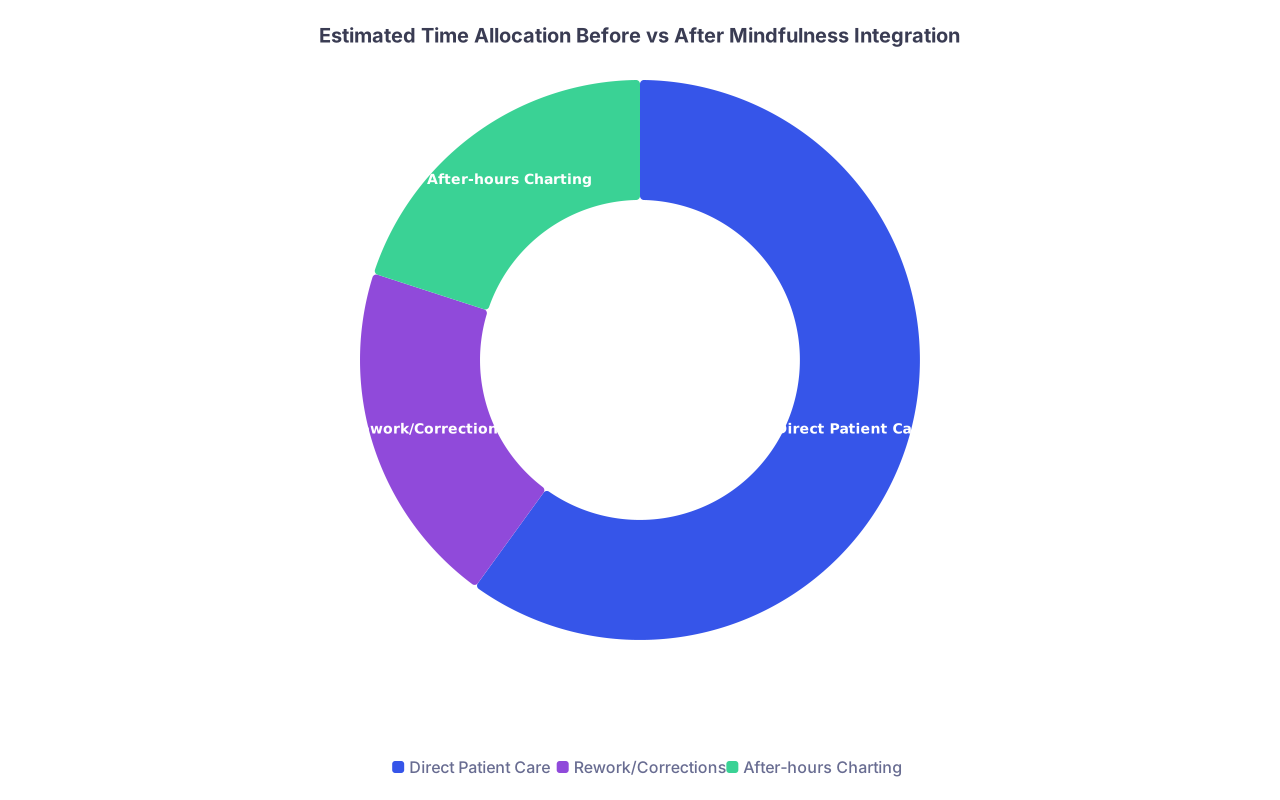
| Category | Value |
|---|---|
| Direct Patient Care | 60 |
| Rework/Corrections | 20 |
| After-hours Charting | 20 |
And a hypothetical post‑intervention scenario:
- Direct patient care: 62–64%
- Rework/Corrections: 14–16%
- After‑hours charting: 18–20%
The proportions barely shift, but that 4–6% reallocation translates into:
- More patients actually seen in scheduled hours.
- Fewer nights spent fixing preventable issues.
That is a meaningful, measurable difference in your lived experience.
So, Is There a Measurable Productivity Impact?
Yes—if you define productivity intelligently and measure it correctly.
The pattern across the data and the math looks like this:
Short term:
- Little to no change in gross RVUs.
- Small reductions in errors and rework.
- Modest improvements in perceived control and focus.
Medium term (6–18 months):
- Net RVUs per hour modestly higher due to less friction.
- Error proxies improve by 10–25% in many settings.
- After‑hours charting and emotional exhaustion generally decline.
Long term (2–5 years):
- Lower burnout, turnover, and sick days.
- More stable clinical output curves.
- Ethically better practice patterns: more realistic conversations, fewer rushed, unsafe shortcuts.
If your only question is “does mindfulness increase my RVU bonus this quarter?”, the answer is usually: not dramatically.
If your question is “can I sustain high‑quality clinical work without grinding myself and my team into the ground, and will that show up in the numbers over time?”, then mindfulness is one of the few tools that moves both ethics and productivity in the same direction.
With that framing in place, the next step is not more reading about mindfulness. It is deciding what micro‑changes in your own day—or your team’s workflows—you are actually willing to test for three months, and what you will measure to decide if it was worth it. The ethics are the easy part. The disciplined experimentation comes next.