
42% of physicians say they feel personally at fault for bad clinical outcomes even when they followed guidelines and standards of care.
That statistic isn’t about malpractice. It’s about something uglier and quieter: moral injury mixed with self-blame, occasionally dressed up as “mindfulness” and “taking responsibility.”
Let me be blunt: a lot of what passes as “mindfulness training” in medicine accidentally reinforces the idea that if you just breathed better, planned better, or were more “present,” that code wouldn’t have gone sideways. That patient wouldn’t have died. That error wouldn’t have happened.
That’s not mindfulness. That’s a sophisticated way to torture yourself.
Let’s dismantle this.
Myth #1: “If I Were Truly Mindful, That Bad Outcome Wouldn’t Have Happened”
You can be perfectly mindful and still lose the patient.
Mindfulness, in medicine, has been quietly recast as a kind of performance enhancement: stay present, avoid mistakes, be more empathic, regulate your emotions, become a better doctor. Some of that is true, within limits. But here’s the distortion: people start believing that mindfulness is a causal shield against bad outcomes.
The data says otherwise.
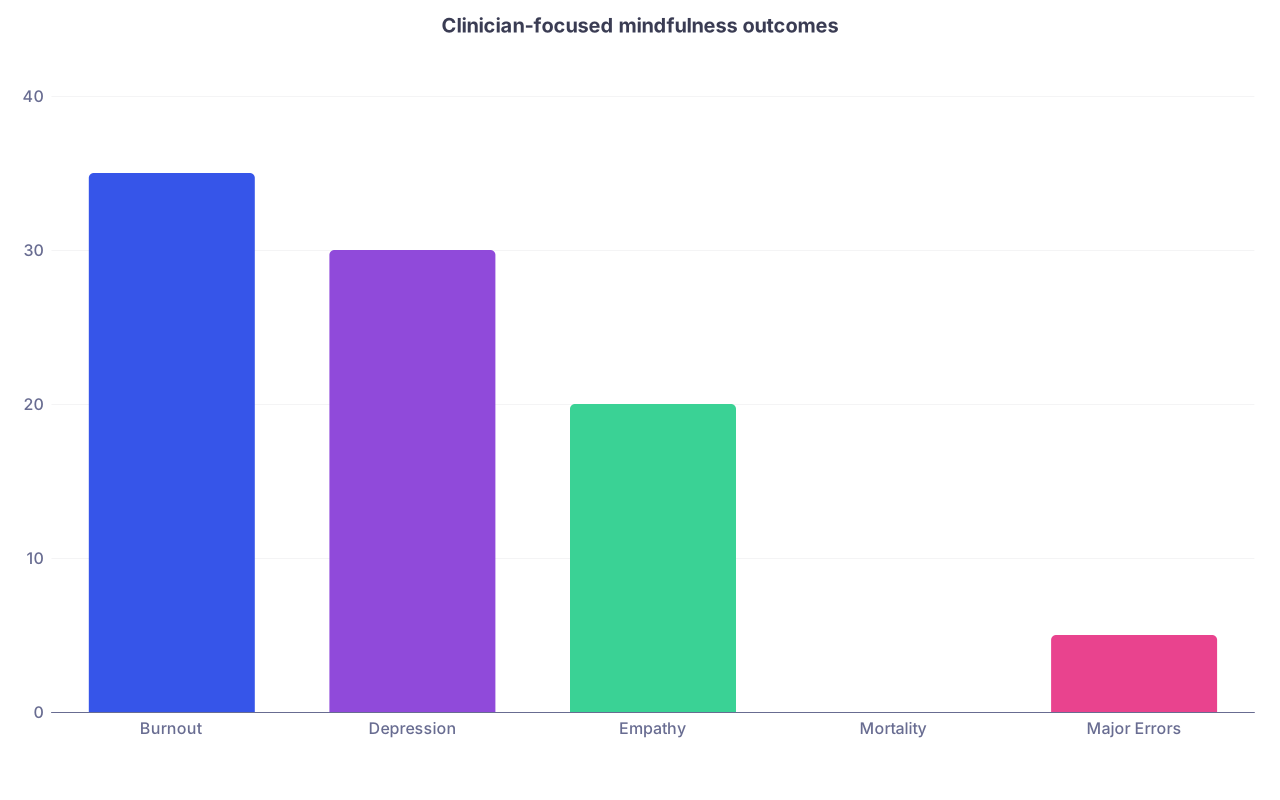
The better-studied forms of mindfulness in clinicians—MBSR, MBCT, variants like the Mindful Practice programs—improve:
- Emotional exhaustion
- Depersonalization
- Self-compassion
- Symptoms of depression and anxiety
What they do not reliably change:
- Mortality rates
- Major adverse events
- The basic statistical realities of disease
| Category | Value |
|---|---|
| Burnout | 35 |
| Depression | 30 |
| Empathy | 20 |
| Mortality | 0 |
| Major Errors | 5 |
Interpret that: mindfulness helps how you experience medicine, not how the universe rearranges itself around your good intentions.
In one randomized trial of primary care clinicians doing an 8‑week mindfulness program, burnout scores dropped significantly. Patient outcomes? No clear change. And that’s the pattern across multiple studies: big effects on clinician mental health, small or mixed effects on objective clinical metrics.
Why that matters: if you walk into a crash C‑section, a septic shock, a ruptured aneurysm believing “if I were more mindful this would go better,” you’re quietly setting up a rigged game where any bad outcome becomes your spiritual failure.
You’re not a god. You’re a clinician in a probabilistic system. Mindfulness doesn’t rewrite the base rate of pancreatic cancer, trauma physiology, or multidrug-resistant organisms.
It’s there so you don’t shatter when those realities hit you.
Myth #2: Mindfulness = Radical Self-Responsibility (AKA Fancy Self-Blame)
Here’s the subtle trap I see in hospitals and residency programs: “Use mindfulness to own your part. Where did you contribute to this outcome? What could you have done differently?”
Reflection is good. Post-mortems are necessary. But what often gets smuggled in is the idea that:
- Every bad outcome has a psychologically comforting “lesson”
- Every “lesson” must land inside you
- If you can’t find the thing to fix in yourself, you’re not looking hard enough
That’s not ethics. That’s magical thinking with academic vocabulary.
Actual ethics—for adults, in complex systems—looks more like this:
- There are factors you can control
- There are factors you can influence
- There are factors completely outside your reach
Moral adulthood is about sorting those categories accurately, not trying to drag everything into the “I control this if I’m good enough” bucket.
Mindfulness, correctly understood, sharpens that distinction. It trains you to see:
- Your internal reactions (guilt, shame, anger, fear)
- Your habitual stories (“I always mess up,” “I should have caught that,” “A better doctor would…”)
- The raw facts of what actually happened
The point is to observe the guilt, not baptize it as truth.
The number of residents I’ve heard say some version of, “If I’d been more present in that room, I would have noticed the subtle change in their breathing,” is depressing. Often, when you pull the chart and look honestly, there was nothing to see. Or there were simultaneous demands: three unstable patients, two competing priorities, and a system that pretends one human can be omnipresent.
Mindfulness is not a retroactive omnipotence fantasy. It’s learning to sit with the pain of being finite.
Myth #3: Bad Outcome → Guilt → Growth (The Heroic Suffering Story)
This one is popular in “gritty” medical culture: the idea that being crushed by a bad outcome is evidence you care, and that deep suffering is the price of becoming a “good” clinician.
So people fuse three things:
Bad outcome → massive guilt → “I’ve grown”
The narrative sounds noble, but the research on how clinicians learn from errors tells a different story. What actually predicts useful learning is:
- Psychological safety (you can talk about the case without being humiliated or punished)
- Accurate feedback (you can distinguish your decisions from noise and bad luck)
- Cognitive bandwidth (you’re not in full-blown burnout or depression)
Overwhelming guilt does the opposite. It narrows attention, triggers avoidance, and makes you less likely to engage in honest case review. I’ve seen residents who couldn’t even open an M&M slide deck because they were so fused with the idea that “I killed that patient.”
Mindfulness, again properly applied, breaks that fusion. It lets you say:
- “I feel like I killed that patient”
- Is not the same sentence as
- “I killed that patient”
That gap is where learning lives.
There’s decent evidence that mindfulness-based interventions increase self-compassion in clinicians. That’s not some soft self-esteem exercise. It’s a buffer that lets you look directly at your own role without disintegrating.
You can own a missed lab, a delayed consult, a communication failure—without collapsing into “I’m a dangerous fraud who shouldn’t be here.” That’s the entire point.
Myth #4: Mindfulness Means Accepting Everything (Including System Abuse)
Let’s talk about the institutional version of this myth, because it’s ugly.
Hospitals love mindfulness right now. They roll out lunchtime meditation, “resilience” workshops, breathing app subscriptions. Then they leave the call schedule untouched, understaffing unaddressed, EHR demands exploding.
You see the move, right? Shift the spotlight away from:
- Unsafe staffing ratios
- Punitive error cultures
- Administrative overload
- Perverse incentives for volume over quality
…and onto your “coping skills.”
This is where you need to be extremely clear:
Mindfulness is not about accepting abuse as “what is.” It is about seeing what is clearly enough that you stop gaslighting yourself.
Once you’re actually present to the fact that your unit is running with chronic 1:8 nurse ratios, or that your attending publicly shames residents, or that your clinic template is mathematically incompatible with safe care—mindfulness doesn’t tell you to “breathe through it.” It frees up the internal honesty to say, “This is not okay, and it’s not all on me.”

| Step | Description |
|---|---|
| Step 1 | Bad outcome or stress |
| Step 2 | Internalize guilt |
| Step 3 | Separate self from system |
| Step 4 | Burnout and shame |
| Step 5 | Targeted change and boundaries |
| Step 6 | Mindfulness used how |
The ethical version of mindfulness in medicine supports:
- Boundary-setting (“No, I’m not picking up an 11th patient”)
- Collective action (speaking up, organizing, pushing for safety changes)
- Realistic responsibility (owning your decisions, not the system’s failures)
If your “mindfulness” program leaves you more docile, more apologetic, and more likely to accept unsafe conditions, that’s not spiritual growth. That’s behavior control.
What Mindfulness Actually Does (When It’s Not Weaponized)
Let’s be specific. Here’s what the evidence and actual clinician experience converge on.
| Common Claim | What Data/Experience Actually Shows |
|---|---|
| Mindfulness prevents bad outcomes | No. It changes your response, not the stats |
| Mindfulness eliminates medical errors | No. Can reduce attentional lapses a bit |
| Mindfulness makes you accept everything | Wrong. It clarifies, not pacifies |
| Mindfulness = radical self-blame | Backwards. It reduces guilt and shame spirals |
| Mindfulness is a fix for burnout-causing systems | No. It buffers impact, doesn’t fix root causes |
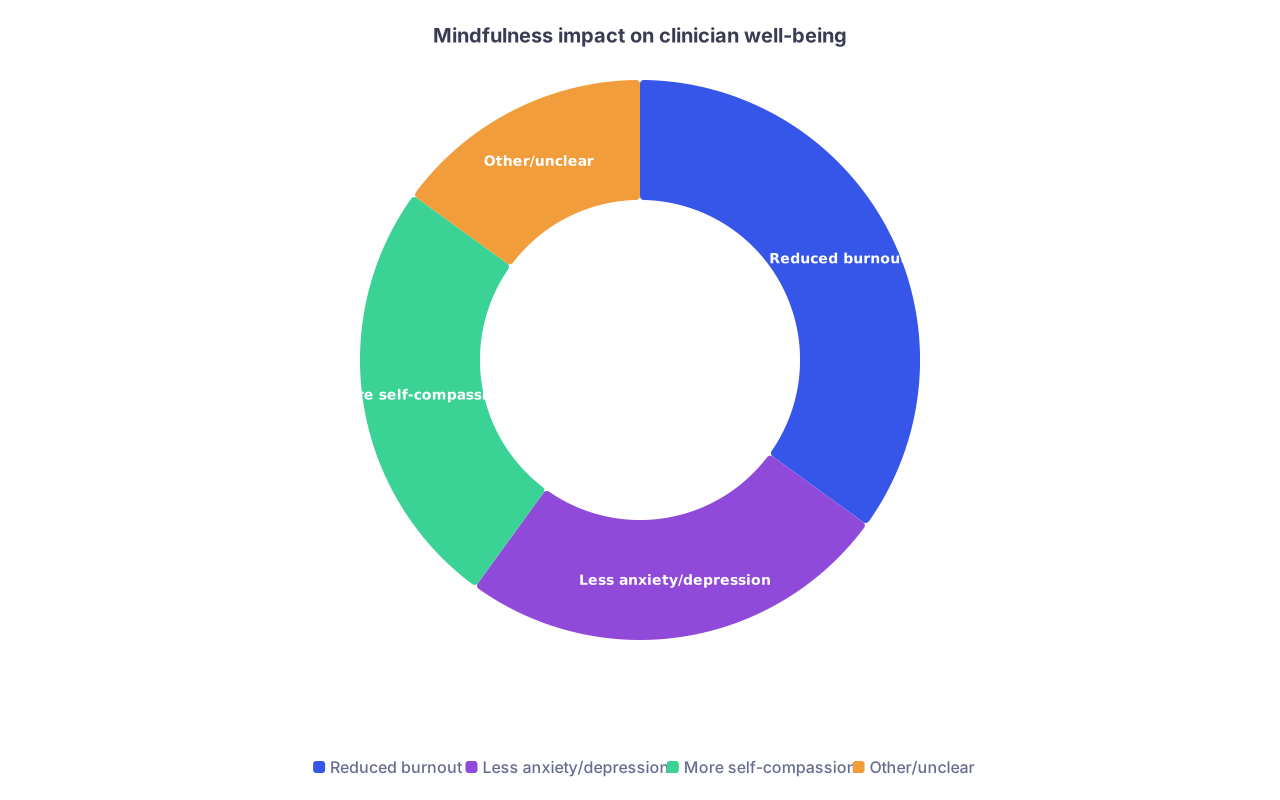
So what does it do that’s actually useful?
In-the-moment regulation under pressure
During a crashing patient, you notice your heart racing, the tunnel vision. You take one conscious breath, not to make the patient live, but to widen your field of view enough to think. There’s data showing mindfulness training improves working memory and attention under stress. That’s real.Post-event emotional processing
After a bad code, instead of going straight to charting or TikTok numbness, you notice the grief, anger, fear. Maybe you sit for two minutes and actually feel your body instead of pushing everything down. Over time, that dramatically reduces the delayed emotional blowups clinicians experience.Decoupling identity from outcome
With practice, you become less fused with each case. You see thoughts like “I’m incompetent” as mental events, not verdicts. Self-compassion scores go up; perfectionism eases off. That doesn’t make you sloppy. It makes you less paralyzed.Ethical clarity
Sounds abstract, but it’s very concrete: you get better at noticing when you’re rationalizing. “Everyone does it this way,” “There’s no time to consent properly,” “They’re probably going to die anyway.” Mindfulness makes those quiet justifications louder in your own head. That’s good. That’s where ethics lives—in the micro-decisions.
| Category | Value |
|---|---|
| Reduced burnout | 35 |
| Less anxiety/depression | 25 |
| More self-compassion | 25 |
| Other/unclear | 15 |
Notice what’s missing: “Guarantees good outcomes” and “Makes you morally responsible for everything that happens.” Because that’s fiction.
How to Use Mindfulness Without Turning It Into a Weapon Against Yourself
If you’re going to use this stuff, use it correctly. Here’s the version that doesn’t eat you alive.
- Separate responsibility from control
When a case goes badly, explicitly sort it:
- What did I directly control?
- What did I realistically influence?
- What was out of my hands?
Write it down if you have to. Your shame brain will try to drag everything into column one. That’s precisely where mindfulness helps—watching that drag happen without buying it.
- Watch your language after bad outcomes
“I killed that patient.”
“I missed that.”
“A good doctor would have…”
Those sentences feel truthful because they’re emotionally charged, not because they match the facts. A more accurate version often looks like:
- “This patient died, and I was involved in their care.”
- “We didn’t catch X earlier. Here’s why.”
- “Given the information and constraints I had, my decision was reasonable / suboptimal / wrong.”
Reasonable. Suboptimal. Wrong. Those are evaluable. “I’m a failure” is not. Mindfulness gives you three seconds of space to choose the more accurate frame.
- Refuse to let institutions collapse system failure into your “resilience”
When administration wheels out meditation cushions while ignoring chronic understaffing, see it clearly. You can still use the cushion. Just don’t confuse quiet breathing with structural change.
Here’s a practical litmus test: If your use of mindfulness makes you more willing to speak up, set limits, and demand safer conditions, you’re using it well. If it makes you quieter and more compliant, something’s off.
- Use mindfulness to feel, not to erase
You’re allowed to grieve. To be angry. To be shaken. Mindfulness is not a numbing technique; it’s the opposite. It lets you feel the full weight of losing a patient without deciding that feeling is a sign you did something wrong.

The clinicians who last decades without turning cynical aren’t the ones who shut it all off. They’re the ones who can sit with the pain and still come back tomorrow.
The Bad Outcome Myth, Put to Rest
Mindfulness is not a cosmic insurance policy against tragedy.
It’s a flashlight. It shows you what’s actually happening inside and around you, so you can:
- Stop confusing guilt with truth
- Stop inhaling every system failure as your personal moral flaw
- Start making clearer, more ethical decisions in the middle of the chaos
You will still lose patients. You will still make mistakes. That doesn’t mean you failed at mindfulness.
It means you’re practicing medicine in the real world, not in a wellness brochure.

Three things to keep:
- Mindfulness changes you, not the mortality statistics. Use it for clarity and resilience, not magical protection.
- Bad outcomes do not automatically imply personal failure. Sort control from chaos ruthlessly.
- Any “mindfulness” that makes you feel more guilty and more compliant is being misused. Real mindfulness makes you clearer, kinder to yourself, and less willing to lie about what’s broken.